
The Special Air Service, known around the world simply as the SAS, is the British Army’s most famous special forces regiment — and its rank system surprises many readers. There is no separate set of SAS ranks: every SAS soldier, from a new Trooper to the commanding officer, holds an ordinary British Army rank, from OR-1 to OR-9 for other ranks and OF-1 to OF-9 for officers. This guide covers the full SAS ranks ladder with its insignia, plus the regiment’s history, selection, beret and qualification badges.
A Sergeant in the SAS is a Sergeant in the British Army, wearing the same three chevrons as a Sergeant in any other regiment. The difference is the path: every SAS soldier has first served elsewhere in the Army, passed one of the hardest selection courses in the world, and given up their old rank to start again as a Trooper.
Key facts
- Country: United Kingdom
- Branch: British Army, part of United Kingdom Special Forces (UKSF)
- Rank system: British Army ranks — no separate SAS rank system
- Other ranks: OR-1 to OR-9 (Trooper to Warrant Officer Class 1)
- Officers: OF-1 to OF-9 (Second Lieutenant to General)
- Highest rank in the regiment: Lieutenant Colonel commands 22 SAS; the Director Special Forces is a Major General
- Motto: “Who Dares Wins”
- Beret: Sand-coloured (beige) beret
What Is the SAS?
The Special Air Service is the British Army’s principal special forces unit. It was founded in the deserts of North Africa in July 1941, during the Second World War, by Lieutenant David Stirling of the Scots Guards. His idea was radical: a tiny force of volunteers, dropped by parachute or driven across the desert, could do more damage behind enemy lines than a much larger conventional unit. His first unit was deliberately given a grand, misleading name — “L” Detachment, Special Air Service Brigade — even though no such brigade existed.
The first operation, on the night of 16–17 November 1941, was a failure: a fierce storm scattered the parachutists over Libya, and only a fraction made it back. But the idea survived — within months the SAS was raiding Axis airfields across North Africa, and by September 1942 it had grown to regimental size. Its founder’s motto, “Who Dares Wins”, has stayed with the regiment ever since.
At the end of the war the SAS was disbanded, in October 1945, but the decision did not last: it was revived as a Territorial Army unit, 21 SAS, in 1947, and a regular regiment, 22 SAS, was rebuilt in the early 1950s from the Malayan Scouts. Today the SAS consists of the regular 22 SAS Regiment, based at Stirling Lines near Hereford, and the reserve 21 SAS and 23 SAS regiments, all under United Kingdom Special Forces (UKSF), alongside the Royal Navy’s Special Boat Service.
Did you know? The SAS became a household name overnight on 5 May 1980, when it ended the Iranian Embassy siege in London — Operation Nimrod — live on television. Six gunmen had seized the embassy on 30 April and taken 26 hostages; after six days of negotiation, SAS troopers abseiled down the building and stormed it in about 17 minutes. Before that day, most of the British public had never heard of the regiment.
The Role of the SAS
The SAS specialises in the missions conventional forces cannot do: counter-terrorism, hostage rescue, direct action raids, and special reconnaissance deep behind enemy lines. In peacetime its most visible task is counter-terrorism at home; in wartime its troopers operate in small patrols, far from support, gathering intelligence and striking targets larger units cannot reach.
The regular regiment is organised into four Sabre squadrons — A, B, D and G — whose troops rotate through air, boat, mobility and mountain specialisms. The reserve regiments, 21 and 23 SAS, provide additional capacity.
Much of what the SAS does is not publicly disclosed: the government and the Ministry of Defence do not comment on its operations, strength or deployments. This article therefore sticks to what is publicly confirmed. Figures for the regiment’s size and the selection pass rate are widely quoted but not officially published, so treat any precise number with caution.
SAS Selection: How a Soldier Earns the Beret
Nobody joins the SAS straight from civilian life: every candidate must already be a serving soldier, and most come from the Army. SAS selection, in its modern form, dates to 1952, when Major John Woodhouse built the course that still shapes it today. It is widely described as the most demanding military training course in the British Army, held twice a year, in summer and winter, regardless of the weather.
Selection begins with an aptitude phase in the Brecon Beacons of Wales: weeks of loaded marches over steep hills, carrying a heavy pack and a rifle. The best-known test is the Fan Dance, a march over Pen y Fan, the highest peak in South Wales. Survivors move on to jungle training overseas, and the final test is resistance to interrogation, a 36-hour exercise.
The course is famous for its low pass rate, often quoted at 2–10 per cent, though the Ministry of Defence publishes no official figure. Those who finish earn the sand-coloured beret and the cap badge, then complete further training — parachuting, signals and medical skills — before they are fully operational. Reserve candidates in 21 and 23 SAS follow a part-time selection course, and on completion are badged as SAS (R).
Key point: Passing selection costs a soldier their old rank. A Sergeant or Corporal who joins the SAS from another regiment is reduced to Trooper and must earn promotion again from the bottom — in the SAS, what you can do matters more than the rank you arrived with.
The SAS Beret, Cap Badge and Wings
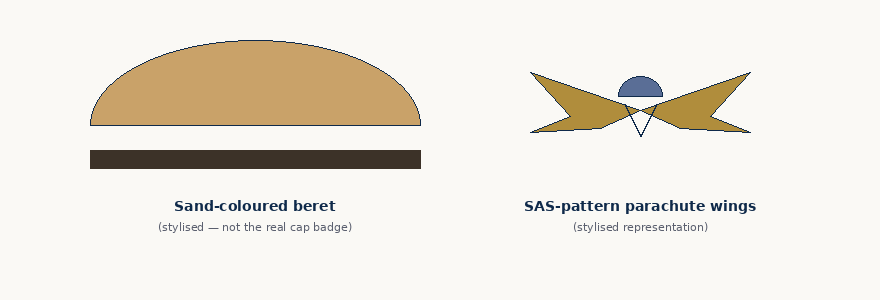
The SAS has three items of insignia that mark its soldiers out from the rest of the Army, and none of them is a rank. The first is the sand-coloured beret, often called the beige beret, worn since the regiment’s desert origins in the Second World War. Earning it is the visible sign that a soldier has passed selection. It was briefly replaced by the maroon beret of the airborne forces in 1944, but the sand colour returned.
The second is the cap badge, worn on the beret. It is popularly known as the “winged dagger”, but the designer intended a flaming sword — the sword of Damocles, or Excalibur — wreathed in flames, on a Crusader-style shield bearing the motto “Who Dares Wins”. The “winged dagger” reading is now so universal that it has effectively become the badge’s real name. The diagrams here are stylised original drawings, not copies of the real badge, which is a protected regimental emblem.
The third is the SAS parachute wings, worn on the right shoulder — not the left, where most British Army parachute wings are worn. They were designed by Lieutenant Jock Lewes, one of the regiment’s co-founders, based on the stylised wings of the sacred ibis of the Egyptian goddess Isis, as seen in the decoration of Shepheard’s Hotel in Cairo. They are sometimes nicknamed the “Egyptian wings”.
SAS Other Ranks (OR-1 to OR-9)
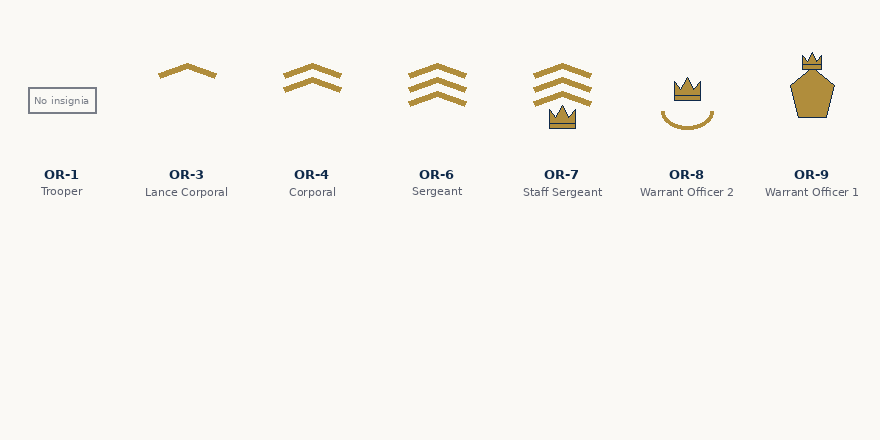
Other ranks — everyone below commissioned officer — form the fighting strength of the SAS. The regiment uses the standard British Army ladder, but with one difference of name: the lowest rank is not Private, but Trooper, the title used by regiments with a cavalry tradition. A Trooper wears no rank insignia at all, exactly like a Private in the infantry.
Above Trooper the ladder runs through Lance Corporal and Corporal, then Sergeant and Staff Sergeant, and finally Warrant Officer Class 2 and Warrant Officer Class 1. Insignia are chevrons on the upper arm, with crowns and the Royal Arms marking the senior grades. There is no separate OR-5 rank in the British Army, and OR-1 is the untrained recruit stage, so the working ladder has seven named ranks.
| Rank | NATO Code | Insignia | Typical Role in the SAS |
|---|---|---|---|
| Trooper (Tpr) | OR-2 | No insignia | Patrol member; every SAS soldier starts here |
| Lance Corporal (LCpl) | OR-3 | One chevron | Junior NCO; second-in-command of a team |
| Corporal (Cpl) | OR-4 | Two chevrons | Patrol commander; leads a four-man SAS patrol |
| Sergeant (Sgt) | OR-6 | Three chevrons | Senior NCO; troop sergeant |
| Staff Sergeant (SSgt) | OR-7 | Three chevrons above a crown | Senior troop sergeant |
| Warrant Officer Class 2 (WO2) | OR-8 | Crown in a wreath | Squadron sergeant major |
| Warrant Officer Class 1 (WO1) | OR-9 | Royal Arms | Regimental sergeant major |
The Corporal deserves a special mention: a Corporal commands an SAS patrol — normally four men — and that patrol is the basic fighting unit of the regiment. Unlike an infantry Corporal leading a section under close supervision, an SAS Corporal’s patrol may operate alone, deep behind enemy lines, for days at a time.
SAS Officer Ranks (OF-1 to OF-9)
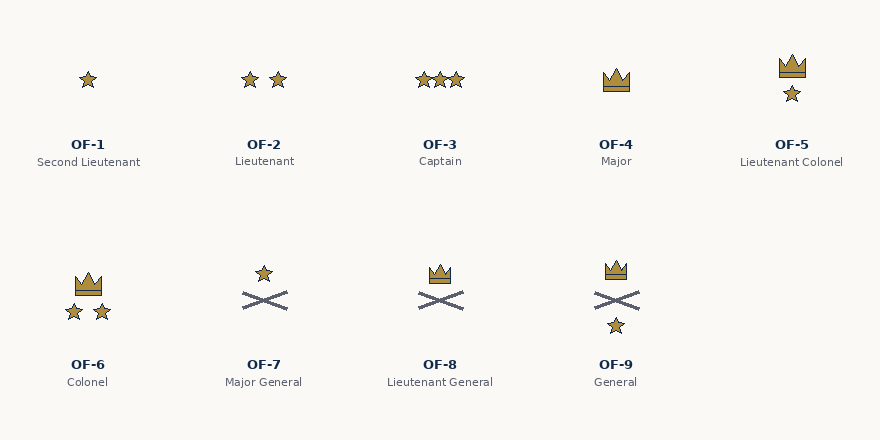
SAS officers hold the same commissioned ranks as officers across the British Army, from Second Lieutenant (OF-1) to General (OF-9). Their insignia are worn on the shoulder: pips (the Bath star), crowns (the St Edward’s Crown), and, for generals, a crossed sword and baton. Second Lieutenants, Lieutenants and Captains are company officers; Majors, Lieutenant Colonels, Colonels and Brigadiers are field officers.
Most SAS officers are already experienced when they arrive: they come from another regiment, pass the same selection course as the soldiers, and then serve as a Troop Commander, usually a Captain leading a troop of around 16 men. The commanding officer of 22 SAS is a Lieutenant Colonel, and the Director Special Forces, who commands all of UKSF, is a Major General. Field Marshal still exists but is now honorary — the last active officer promoted to it was in 1994 — so it does not appear below.
| Rank | NATO Code | Insignia | Typical Role |
|---|---|---|---|
| Second Lieutenant (2Lt) | OF-1 | One pip | Junior officer |
| Lieutenant (Lt) | OF-1 | Two pips | Troop commander or staff officer |
| Captain (Capt) | OF-2 | Three pips | Troop commander (around 16 troopers) |
| Major (Maj) | OF-3 | One crown | Squadron second-in-command |
| Lieutenant Colonel (Lt Col) | OF-4 | Crown and one pip | Commanding officer of 22 SAS |
| Colonel (Col) | OF-5 | Crown and two pips | Senior staff appointment |
| Brigadier (Brig) | OF-6 | Crown and three pips | Brigade-level command |
| Major General (Maj Gen) | OF-7 | Pip over crossed sword and baton | Director Special Forces |
| Lieutenant General (Lt Gen) | OF-8 | Crown over crossed sword and baton | Senior tri-service command |
| General (Gen) | OF-9 | Crown and pip over crossed sword and baton | Highest active rank |
The Trooper-to-Officer Path
One of the most unusual features of the SAS is that its officers and its soldiers come from the same starting point. A Trooper who shows leadership can be promoted to Sergeant, Staff Sergeant and Warrant Officer, then commissioned as an officer — late entry commissioning — and serve as a Captain or Major. A Troop Commander who was once a Trooper himself has marched the same hills and passed the same tests as the men he now leads.
SAS Badges and Qualifications
Rank insignia shows a soldier’s grade. Badges show what a soldier is qualified to do:
- SAS parachute wings — worn on the right shoulder after SAS parachute training. They are distinct from the standard Army wings worn on the left shoulder.
- The cap badge — the flaming sword (“winged dagger”) on the sand-coloured beret, bearing the motto “Who Dares Wins”. It is earned on passing selection.
- Specialist qualifications — signals, demolitions, medicine, languages and free-fall parachuting, with squadrons specialising by environment: air, boat, mobility and mountain. The details are not publicly listed.
How Promotion Works in the SAS
Promotion in the SAS follows British Army rules, but the regiment’s small size makes it unusually competitive: there are far fewer senior posts than in a conventional regiment, and every promotion is decided on merit by a board that looks at the whole record. The first step is from Trooper to Lance Corporal, then to Corporal and command of a patrol; Sergeant and Staff Sergeant bring troop-level responsibility, and the warrant officer grades bring regimental responsibility. Because every SAS soldier has already served elsewhere before selection, promotion is slower than in other regiments. An SAS officer’s career is shaped by command: of a troop, then of a squadron, and for a very few, of the regiment itself.
What the SAS Does Not Publish
The SAS is one of the least transparent units in the world. The British government follows a policy of neither confirming nor denying details of SAS operations, and the regiment’s strength, deployments, equipment and internal organisation are not published. That secrecy is why this article avoids precise numbers for the regiment’s size and the selection pass rate. Treat any website claiming to know the exact strength of the SAS, the names of its current commanding officers, or the details of recent operations with scepticism — unless the information comes from the Ministry of Defence or the National Army Museum, it is almost certainly speculation.
Read next
British Military Ranks · US Navy Ranks · US Military Branches
FAQs
What are SAS ranks?
SAS ranks are British Army ranks — the SAS has no separate rank system. Its soldiers hold ranks from Trooper (OR-2) to Warrant Officer Class 1 (OR-9), and its officers from Second Lieutenant (OF-1) to General (OF-9).
What is the lowest rank in the SAS?
Trooper. Every soldier who passes SAS selection becomes a Trooper, even if they were a Sergeant or Corporal in their previous regiment.
What rank commands the SAS?
The commanding officer of 22 SAS, the regular regiment, is a Lieutenant Colonel. The Director Special Forces, who commands all of United Kingdom Special Forces, is a Major General.
What colour beret does the SAS wear?
A sand-coloured beret, often called the beige beret, reflecting the regiment’s desert origins in North Africa in 1941. It is earned by passing SAS selection. Its cap badge is the famous “winged dagger” — properly a flaming sword — with the motto “Who Dares Wins”.
How hard is SAS selection?
It is widely described as the hardest military selection course in the British Army: loaded marches in the Brecon Beacons, jungle training overseas and a 36-hour resistance-to-interrogation test. The pass rate is often quoted at 2–10 per cent, but the Ministry of Defence does not publish an official figure.
What is the difference between 22 SAS, 21 SAS and 23 SAS?
22 SAS is the regular, full-time regiment, based at Stirling Lines near Hereford. 21 SAS and 23 SAS are reserve regiments of part-time soldiers, with their own selection course. All three use the same British Army rank system under United Kingdom Special Forces.
All insignia diagrams and images in this article are original graphics created for Forces Guide. The beret and wings drawings are stylised representations, not reproductions of the real SAS cap badge.