
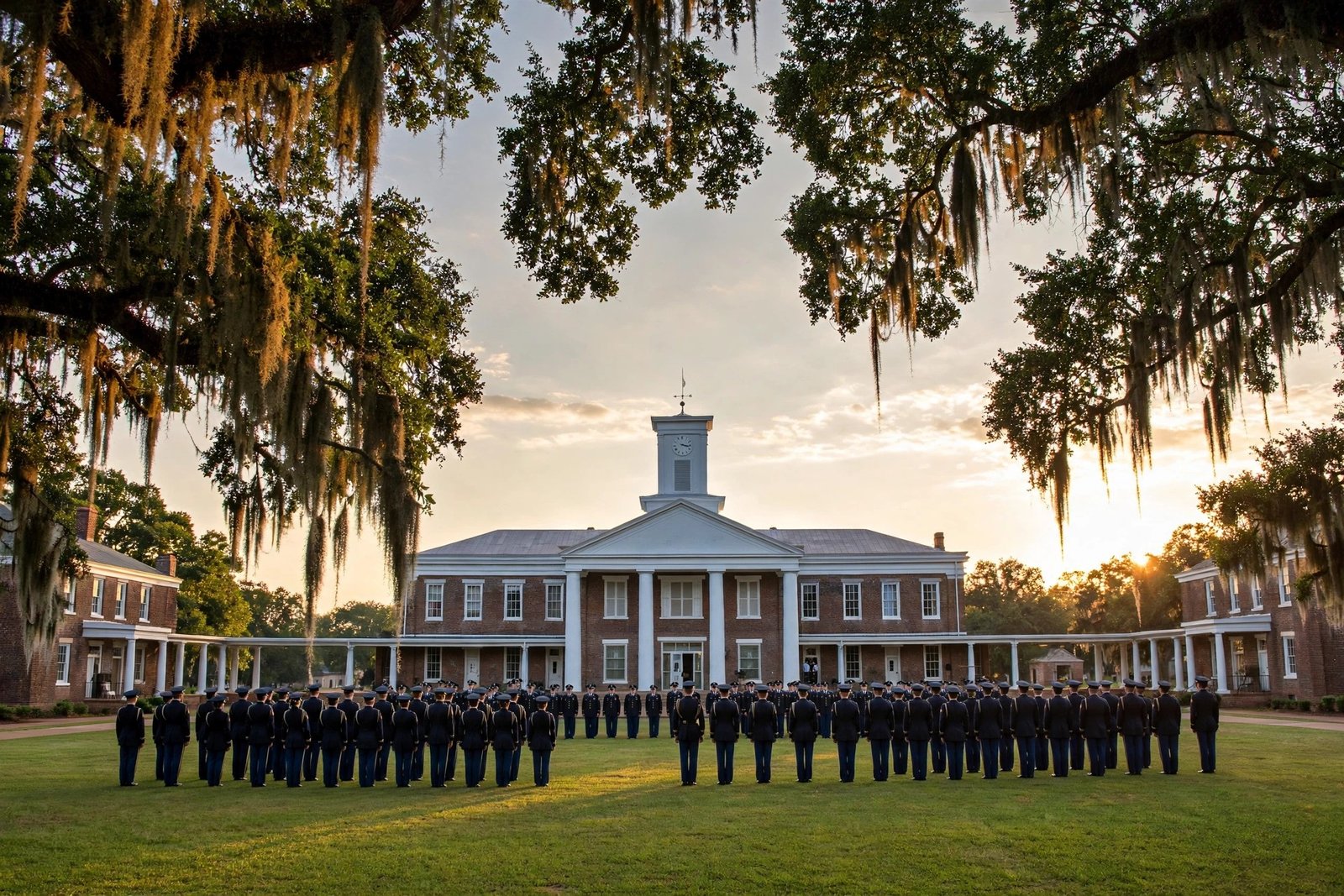
Marion Military Institute (MMI)
Tracing its origins to 1842, Marion Military Institute in Marion, Alabama, is the nation’s oldest military junior college. Its two-year, military-structured programme lets cadets earn an associate degree while pursuing one of three distinct paths: preparation for a federal service academy, an Army commission through the Early Commissioning Program, or a leadership-grounded transfer to a four-year university. This complete directory guide covers MMI’s history, programmes, admission requirements, the step-by-step application process, costs, career outcomes and the questions prospective cadets ask most.
Directory Information
| Full name | Marion Military Institute |
|---|---|
| Commonly known as | MMI — the Tigers |
| Location | Marion, Alabama, United States |
| Official address | 1101 Washington St., Marion, AL 36756 |
| Admissions phone | 800-664-1842 |
| Official website | https://marionmilitary.edu/ |
| Founded | 1842 |
| Type | Public military junior college — member of the Alabama Community College System |
| Motto | “Truth, Honor, Service” |
| Cadet strength | Approximately 300–400 cadets in recent years |
| Accreditation | Southern Association of Colleges and Schools (SACS) — awards Associate of Arts and Associate of Science degrees |
About & History
Marion Military Institute describes itself as the nation’s oldest military junior college, and the claim rests on a founding date of 1842 — when the institution opened in Marion, Alabama, as Howard College. Two of its earliest buildings, the Chapel and Lovelace Hall, were both raised in 1857 and served during the American Civil War as the Breckinridge Military Hospital, treating wounded soldiers from both armies. Howard College remained in Marion for four decades until 1887, when the Alabama State Baptist Convention voted to move the college to Birmingham, where it would eventually become Samford University.
The man who stayed behind made MMI what it is. Colonel James T. Murfee, who had led Howard College since arriving from the University of Alabama in 1871, chose to remain on the Marion campus with several of the faculty and trustees rather than join the move. They formally established Marion Military Institute there, and Murfee with the new Board of Trustees built institutional policies around three pillars that the Institute names as its hallmarks to this day: character development, academic excellence and military tradition.
MMI’s second president, Hopson O. Murfee, pushed the college’s honour culture further, championing a student-run government grounded in honour and ethics. As a result, MMI became one of the first schools in the American South to establish both a student government association and an honour system — traditions the Institute says remain central to Corps life. The school achieved national visibility under his leadership: former president William Howard Taft served as president of the Board of Directors, and in 1905 Woodrow Wilson, then president of Princeton University, delivered the convocation address in the MMI Chapel. In tribute to Wilson and Princeton, MMI changed its colours to orange and black and adopted the tiger as its mascot.
The military character deepened through the twentieth century. A Service Academy Program had its beginnings at MMI with the creation of an Army–Navy department in 1910, giving cadets a dedicated route toward the federal service academies. The Army ROTC programme was introduced in 1916 in response to the First World War, and the Army ROTC Early Commissioning Program was established at MMI in 1968 at the height of the Vietnam War — letting cadets commission as Army officers after just two years. Until the Second World War, the campus consisted essentially of the two historic buildings, the Chapel and Old South (Lovelace) Barracks. Today the MMI campus spans more than 160 acres and 38 buildings.
A final structural change came in 2006, when the Alabama legislature merged MMI into the Alabama Community College System. The high school was discontinued and MMI became a military junior college only, governed by the ACCS Board of Trustees, while the original MMI board continued as the MMI Board of Trustees and Advisors supporting the MMI Foundation. The Institute remains accredited by the Commission on Colleges of the Southern Association of Colleges and Schools to award Associate of Science and Associate of Arts degrees, and is a member of both the Association of Military Colleges and Schools of the United States and the National Junior College Athletic Association. Alumni reporting notes that more than 200 of MMI’s graduates have risen to general or flag officer rank in the US armed forces — a remarkable record for a school of a few hundred cadets.
Programmes Offered
MMI is a two-year college: cadets work toward either an Associate of Arts or an Associate of Science degree, built around a transferable general-education core of English, mathematics, natural science, humanities and the social sciences, alongside military science coursework. The academic programme is SACS-accredited, so credits transfer to four-year colleges and universities — the standard outcome for graduates. What distinguishes MMI from an ordinary community college is the military structure wrapped around the academics: every cadet lives in the Corps of Cadets, wears the uniform and follows the daily cadet regimen. Within that framework, cadets choose the track that matches their goal:
Service Academy Program (SAP)
- Preparatory route for candidates seeking appointments to the federal service academies — West Point, the Naval Academy, the Air Force Academy, the Coast Guard Academy and the Merchant Marine Academy. Its lineage reaches back to MMI’s 1910 Army–Navy department, and it is one of the longest-running academy-preparation tracks in the country.
- Candidates must be morally, physically, medically and academically sound, and as a minimum must meet all ROTC standards. Published programme minimums for SAP candidates include US citizenship, ages 17–22, unmarried with no dependents, and an ACT score of 24 or an SAT score of 1160 (580 mathematics / 580 evidence-based reading and writing) or higher.
Early Commissioning Program (ECP)
- A two-year Army ROTC route that commissions cadets as second lieutenants in the Active Army, Army Reserve or Army National Guard after just two years — an opportunity available at only a handful of military junior colleges. Cadets complete MS-level military science coursework and earn placement credit toward advanced ROTC.
- To contract in ROTC, cadets must pass the Army Physical Fitness Test and a Department of Defense medical evaluation (DODMERB), meet Army height and weight standards, and hold an approved academic plan. A cumulative GPA of 2.0 is required for non-scholarship enrolment and 2.5 for scholarship eligibility; scholarship candidates need a minimum SAT of 1000 or ACT of 19. Contracting cadets must be US citizens. Prior-service members and Basic Camp graduates may qualify for placement credit.
Leadership Education Program (LEP) & transfer track
- A non-commissioning path in which cadets complete the Corps experience and their associate degree, then transfer to a four-year university to finish a bachelor’s degree — the most common route for cadets not seeking a service appointment or commission.
Flight training
- FAA-grounded flight instruction for cadets, progressing from ground school through first solo and the private pilot licence, with follow-on instrument, multi-engine and commercial ratings available. Flight fees are charged separately by the contracted aviation provider, and aviation-specific scholarships are offered through the MMI Foundation.
Beyond academics, cadets compete in NJCAA athletics as the Tigers, and the full Corps of Cadets — a few hundred strong — functions as a single cadet battalion with its own leadership positions, guard duties and military ceremonies, including the Cresting Parade that marks a new cadet’s formal acceptance into the Corps.
Admission Requirements
MMI’s published minimum admission standards are straightforward:
- Test scores: a minimum ACT composite of 16 or SAT score of 860 (verbal and mathematics). Higher scores strengthen an application and matter for scholarships — notably the ECP scholarship threshold of 1000 SAT / 19 ACT.
- Grades: a cumulative high school GPA of at least 2.0 on a 4.0 scale; a 2.5 GPA is the published floor for ROTC scholarship eligibility.
- Credentials: high school diploma or equivalent, with official transcripts from all schools attended.
- Documents: the completed application with a non-refundable $30 application fee, plus a copy of the applicant’s birth certificate or proof of US citizenship, Social Security card, immunisation record, primary photo identification, and verification of ACT/SAT scores.
- Programme-specific extras: cadets entering the Service Academy Program or the Early Commissioning Program face the additional military standards of those tracks — physical fitness, medical qualification through DODMERB, and for contracting cadets, US citizenship and good moral character under Army regulations.
- Open campus: the Admissions Office is open Monday to Friday, 8:00 am to 5:00 pm Central Time, and welcomes visitors to observe the college’s programmes in operation.
How to Apply: Step by Step
- Choose your path. Decide which MMI track fits your goal — service academy preparation, Army commissioning through ECP, or the leadership/transfer route — since admission standards and later requirements differ between them.
- Request information and visit if you can. Contact the Admissions Office (800-664-1842) or request information online; MMI encourages campus visits so families can see the Corps routine in operation.
- Create your application account. Apply through MMI’s online application portal, creating your user account with a personal email address and the $30 application fee.
- Submit your documents. Upload or send your official high school and any college transcripts, ACT/SAT score verification, birth certificate or citizenship proof, Social Security card, immunisation record and photo identification.
- Complete financial aid paperwork. File the FAFSA and explore ROTC scholarship options early — scholarship deadlines and eligibility (GPA 2.5, SAT 1000 / ACT 19 for ECP scholarships) carry their own timelines.
- Secure your room. Upon acceptance, a $200 room deposit reserves your dormitory room; the deposit is credited to your account. Tuition and fee payment is due before the first day of class each semester.
- Arrive for new-cadet training. New cadets arrive roughly a week before the term begins for the Intensive Training Cycle — a multi-week transition covering drill, military customs, physical training, academic testing and advising — culminating in the Cresting Parade, when a recruit formally becomes a cadet.
Tuition & Costs
As a public college, MMI charges tuition — unlike the free federal service academies — but at rates well below a four-year private military college. MMI publishes yearly charges for boarding (residential) college cadets for the fall 2026 academic year; charges are assessed per credit hour, and published totals assume an average course load of 21 credit hours per semester. Figures officially listed on MMI’s tuition page include:
| Cost item | Fall 2026 published figure |
|---|---|
| Uniform pre-payment (first-year cadets, full standard issue) | $2,170 — offset for some cadets by Army uniform allowances |
| Room deposit (on acceptance, credited to account) | $200 |
| Diploma fee (graduating cadets) | $45 |
| Technology fee | $15 per credit hour |
| Facility fee | $15 per credit hour |
| ACCS enhancement fee | $20 per credit hour |
| ACS reserve fee | $1 per credit hour |
| Per-credit-hour rate for military Tuition Assistance purposes | $200 (Alabama residents) / $400 (non-residents) |
Uniform fees must be paid in full during the first semester, and payment of tuition and fees is due before the first day of class each semester. Book costs vary with course load and are estimated separately. Cadets should also budget for personal expenses and travel, and non-resident families should factor in flight costs. Because published rates are per credit hour and totals depend on each cadet’s course load, confirm the current-year total cost of attendance with MMI directly before planning. ROTC and veterans’ education benefits — including the Alabama National Guard Education Assistance Program, Army Tuition Assistance and GI Bill chapters — are available to qualifying cadets.
Service & Career Outcomes
MMI exists to launch cadets toward the next stage, and its alumni record reflects three clear outcomes. Service academy appointments: the Service Academy Program has prepared cadets for the federal academies since 1910, and MMI publishes a long record of qualified cadets earning appointments to West Point, Annapolis, the Air Force Academy and the other federal academies. Army commissions: the Early Commissioning Program lets cadets commission as second lieutenants in the Active Army, Army Reserve or Army National Guard after just two years — and MMI’s alumni include more than 200 generals and admirals of the US armed forces, a striking total for a school of a few hundred cadets. Transfer and civilian careers: graduates of the leadership track complete their associate degrees and transfer to four-year universities across the country — MMI’s accredited associate degrees and transferable general-education core are designed precisely for this — before pursuing civilian careers, graduate school or professional programmes. Notably, contracted ECP cadets continuing to a bachelor’s degree are not in a deployable status with their units while studying.
Frequently Asked Questions
Is Marion Military Institute the same as a federal service academy?
No. MMI is a public military junior college that charges tuition and awards two-year associate degrees. The federal service academies (West Point, Annapolis and the rest) are four-year institutions with free tuition. MMI instead prepares cadets to transfer into them through its Service Academy Program, or to commission into the Army after two years through the Early Commissioning Program.
What is the Early Commissioning Program?
The ECP is a two-year Army ROTC route offered at MMI that commissions cadets as second lieutenants in the Active Army, Army Reserve or Army National Guard after completing their associate degree and the required military science coursework — two years earlier than the standard four-year ROTC path. Contracting cadets must pass a DOD medical examination and the Army fitness test, meet height and weight standards, and hold a GPA of at least 2.0 (2.5 for scholarship eligibility).
What are the minimum admission requirements?
Applicants need a high school diploma or equivalent, a cumulative GPA of at least 2.0, and a minimum ACT of 16 or SAT of 860 (verbal and mathematics). The application carries a $30 non-refundable fee, and applicants submit transcripts, test-score verification, proof of citizenship, an identification document and an immunisation record.
Can civilians and international students attend MMI?
Yes — MMI is open to all students, and its Leadership Education Program is a non-commissioning route suited to cadets pursuing a leadership-grounded associate degree before transferring. US citizenship is required only for cadets who will contract in the commissioning programmes (ECP and, for appointments, SAP).
Where do graduates go after two years?
Three main routes: appointment to a federal service academy via the Service Academy Program, commissioning into the Army via the Early Commissioning Program, or transferring to a four-year university to complete a bachelor’s degree — MMI’s accredited associate degrees and transferable core curriculum are built for that last option. Alumni include more than 200 US generals and admirals.
What does it really cost, and is financial aid available?
MMI charges per credit hour; officially published fall 2026 figures include a $2,170 uniform pre-payment for first-year cadets, a $200 room deposit, a $45 diploma fee, and per-credit-hour fees ($15 technology, $15 facility, $20 ACCS enhancement, $1 ACS reserve). Full totals depend on course load, so confirm with MMI. ROTC scholarships, the Alabama National Guard Education Assistance Program, Army Tuition Assistance and GI Bill benefits are available to qualifying cadets.
Ready to become “Marion Made”?
Start your application at marionmilitary.edu or call the Admissions Office on 800-664-1842 (Monday to Friday, 8:00 am–5:00 pm Central Time).
Facts in this guide were verified against Marion Military Institute’s official website (marionmilitary.edu) in October 2026. Always confirm current deadlines and costs with MMI directly before applying.