
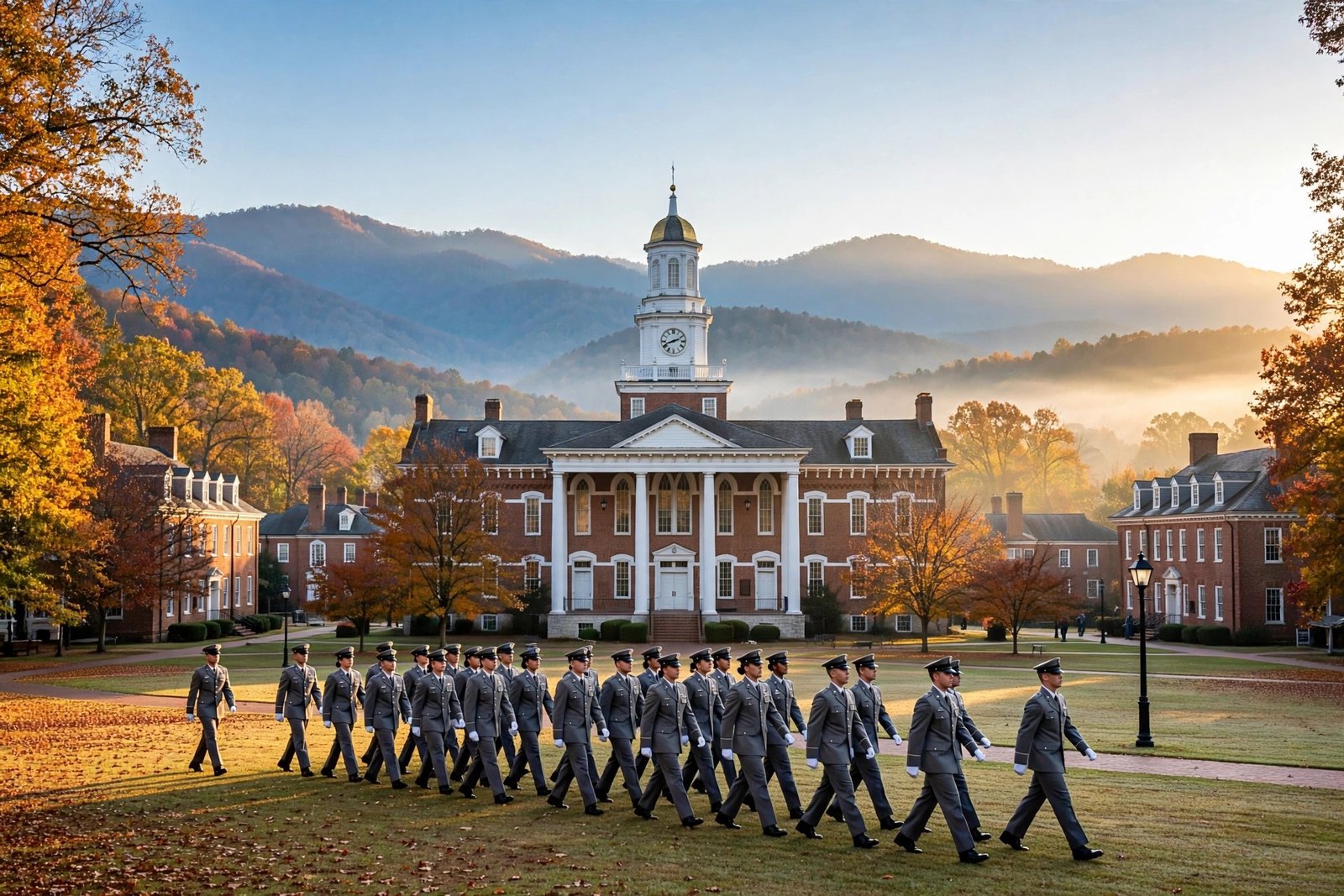
University of North Georgia — Corps of Cadets
Set in the Blue Ridge foothills of Dahlonega, Georgia, the University of North Georgia’s Corps of Cadets — the Boar’s Head Brigade — is the nation’s only Army-exclusive senior military college. This complete directory guide covers UNG’s history, academic programmes, cadet admission requirements, the step-by-step application process, costs, career outcomes and the questions prospective cadets ask most.
Directory Information
| Full name | University of North Georgia |
|---|---|
| Commonly known as | UNG — the Corps of Cadets, the Boar’s Head Brigade |
| Location | Dahlonega, Georgia, United States (the Corps is based on the Dahlonega campus) |
| Official address | 82 College Circle, Dahlonega, GA 30597 |
| Cadet Admissions phone | 888-413-9366 |
| Official website | https://ung.edu/ |
| Founded | 1873 |
| Type | Public senior military college (state-supported); the nation’s only Army-only senior military college |
| Motto | “Leaders Are Made Here” (Corps of Cadets tagline) |
| Corps of Cadets strength | More than 700 cadets, with a goal to grow to 1,000 |
About & History
Since 1873, the Boar’s Head Brigade has produced military leaders. The University of North Georgia traces its military heritage back more than 150 years, making its Corps of Cadets one of the oldest in the nation. The Corps occupies a special place among American military colleges: the state legislature designated UNG as The Military College of Georgia and as a State Leadership Institution, and it stands as one of only six federally recognised senior military colleges — alongside The Citadel, Norwich University, Texas A&M University, Virginia Tech and the Virginia Military Institute — yet it is the only one whose commissioning programme is exclusively Army.
That Army identity shapes everything about the corps experience. Cadets live the 24-hour leadership laboratory the university describes as its signature: a military residential community in which every cadet wears the uniform, follows the regulations of the Blue Book and trains under an Army ROTC programme that has repeatedly earned the General Douglas MacArthur Award as the top Army ROTC programme among the six senior military colleges. The Brigade is organised much like an Army light brigade, with more than 700 cadets formed into two battalions of three companies each, plus a headquarters company of brigade staff and special teams.
Joining the Corps is a full commitment to the cadet way of life. Every incoming cadet completes a week of cadet basic training known as FROG Week before classes begin, and the Corps participation policy requires cadets to enrol full time and live on campus in designated military residence halls for at least three years. The result is an unusually immersive environment: company life provides the structure in which cadets in leadership positions solve problems, give orders, maintain accountability and compete in athletic and tactical contests.
The university describes its cadet alumni in deliberately ambitious terms, and the record supports it. Each year, more than 100 UNG cadets are commissioned as Army officers. More than 60 alumni have gone on to become flag officers across several branches of the armed forces — most of them Army generals — including Lt. Gen. James Terry, Class of 1978, now the superintendent of the Cadet Leadership Academy, and Maj. Gen. Paul Calvert, Class of 1988. UNG’s grip on its home state’s military leadership is striking: nearly half of all officers in the Georgia Army National Guard were commissioned through UNG, and more than half of the Guard’s commanders are UNG graduates. UNG’s president, Michael Shannon, has set the strategic goal of growing the Corps of the future to 1,000 cadets and 120 commissions a year.
Programmes Offered
The Corps of Cadets is based on UNG’s Dahlonega campus, and cadets pursue the same broad range of degree programmes as their civilian classmates. Popular majors at UNG include management and marketing in the Mike Cottrell College of Business, biology, education, criminal justice, computer science and nursing, with associate and bachelor’s options alongside master’s and doctoral programmes. Cadets can also add a minor in Military Leadership or earn a Certificate of Leadership through their military science coursework.
The military programme itself is Army ROTC, and it is the only commissioning track at UNG — cadets commission into the active-duty Army, the Army Reserve or the Army National Guard. Army ROTC scholarships are a central feature: UNG awarded 65 such scholarships in the 2018–19 academic year, and cadets may also qualify for the Georgia Military Scholarship, which supports Georgia Army National Guard soldiers enrolled as cadets in the Boar’s Head Brigade. For soldiers already serving, the Green to Gold programme allows Army soldiers to earn a degree at UNG and commission as officers.
Beyond the classroom and the drill field, cadets have access to the university’s wider opportunities: study abroad, the honours programme, undergraduate research centres, internships, cadet internship opportunities and exchange programmes overseas. The Department of Modern and Classical Languages offers Summer Language Institutes and the Chinese Flagship Programme for cadets who want to add a strategic language. For cadets who choose not to commission, the National Service Leadership Track prepares graduates for careers with global companies, non-governmental organisations and federal agencies such as the NSA, FBI and CIA.
Admission Requirements
UNG admits cadets through its Cadet Admissions office rather than through general undergraduate admissions. The key eligibility conditions and documents are:
- Application: a completed application for admission as a cadet. Fall 2026 cadet applications were open until 10 July 2026.
- Transcripts: official high school transcripts, plus official college transcripts from every college attended for transfer applicants.
- Test scores: official SAT (code 5497) or ACT (code 0848) scores, submitted directly by the testing agency to the UNG Admissions Imaging Center.
- Health documents: a completed certificate of immunisation, and a completed North Georgia Medical Report (for cadets only).
- Lawful presence: all applicants must submit proof of lawful presence in the United States.
- Full-time enrolment and residency: Corps cadets must enrol full time and live on campus in designated military residence halls (at least three years of cadet residency). Exceptions are narrow — living with a parent or grandparent in Lumpkin, Hall, Dawson or White counties, marriage, age 23 or two years of active military service.
- Conduct: applicants are expected to hold a clear disciplinary, conduct and background record, and meeting minimum requirements does not guarantee acceptance.
- Application fee: a non-refundable application fee applies.
Note that admission to the university and to the Corps of Cadets does not guarantee acceptance into every specialist track — for example, Defence Language Institute language study controls its own admissions and quota, including an ASVAB requirement.
How to Apply: Step by Step
- Start your cadet application early. Apply online through UNG’s Cadet Admissions office. For the Fall 2026 cycle, cadet applications remained open until 10 July 2026 — but earlier applicants have the best shot at scholarships.
- Submit transcripts and test scores. Arrange for your official high school transcript to be sent to the UNG Admissions Imaging Center, P.O. Box 1358, Gainesville, GA 30503, and have the College Board or ACT send scores directly (SAT code 5497, ACT code 0848).
- Complete your health paperwork. Submit the certificate of immunisation and the North Georgia Medical Report required of all cadets.
- Book a visit and talk to the recruiters. Call Cadet Admissions on 888-413-9366 to set up a personalised campus tour and learn about cadet life, scholarships and the commissioning track.
- Chase ROTC and state scholarships. Apply for Army ROTC scholarships early, and if you are a Georgia Army National Guard soldier, complete the Georgia Military Scholarship application — you must be accepted as a regular, new freshman cadet before 1 February to qualify for the scholarship interview cycle.
- Pay the uniform fee and report for FROG Week. All new cadets must pay the $2,800 uniform fee no later than the first day of FROG Week — the week of cadet basic training every entering cadet completes — with fittings and issue handled through the 1873 Shop on the Dahlonega campus.
Tuition & Costs
As a public university, UNG charges tuition — but it is among the most affordable senior military colleges in America, and cadets have a financial advantage built specifically for them: every out-of-state cadet, upon acceptance, receives the Cadet Grant and pays tuition and fees at the in-state rate. Georgia residents also benefit from state aid programmes such as HOPE, the Zell Miller Scholarship and the Pell Grant. Tuition and fee rates are set each school year by the Board of Regents of the University System of Georgia and usually take effect each autumn, so always confirm current figures with UNG before budgeting.
| Cadet cost item | Verified figure |
|---|---|
| Cadet Grant (out-of-state cadets) | In-state tuition and fee rate, automatically on acceptance |
| New-cadet uniform fee | $2,800, due before the first day of FROG Week |
| Cadet housing, 2026–27 (double room, per semester) | $3,690 in Gaillard, Liberty or Patriot Hall; $3,973 in The Commons |
| Meal plans, 2026–27 (per semester) | $1,950 (10 meals) to $2,627 (All Access+) |
| Recently published annual tuition & fees (for reference) | About $5.4k in-state and $17k out-of-state (2024–25 published figures; rates update each fall) |
Service & Career Outcomes
UNG’s signature statistic is commissioning: more than 100 cadets each year are commissioned as second lieutenants in the active-duty Army, the Army Reserve and the Georgia Army National Guard, and the university’s strategic goal is to raise that to 120 a year as the Corps grows toward 1,000 members. The all-Army ROTC programme — the only one of its kind among the six senior military colleges — has won the General Douglas MacArthur Award multiple times as the top Army ROTC programme of its class.
The downstream effects on Georgia’s military leadership are remarkable. Nearly half of all officers in the Georgia Army National Guard were commissioned through UNG, more than half of the Guard’s commanders are UNG graduates, and the current adjutant general of the Georgia National Guard, Maj. Gen. Dwayne Wilson, is a UNG alumnus. Nationally, more than 60 cadet alumni have become flag officers, including three who have commanded Combined Joint Task Force – Operation Inherent Resolve.
Commissioning is not compulsory, and the Corps deliberately prepares cadets for both paths. Cadets who choose the National Service Leadership Track aim at civilian careers — global companies, non-governmental organisations and federal agencies such as the NSA, FBI and CIA — carrying either a minor in Military Leadership or a Certificate of Leadership into the job market. Either way, graduates leave with a degree from a respected public university and four years of leadership experience in a 24-hour military environment.
Frequently Asked Questions
Is UNG the same as West Point, VMI or The Citadel?
No. West Point is a federal service academy with free tuition. VMI and The Citadel are state-supported military colleges where most cadets live a purely military lifestyle. UNG is a full public university of about 20,000 students with both civilian students and a Corps of Cadets on its Dahlonega campus — and it is the only senior military college whose ROTC programme commissions exclusively into the Army.
Do all UNG cadets have to join the Army after graduation?
No. More than 100 cadets a year commission, but commissioning is optional. Cadets who do not commission can pursue the National Service Leadership Track and civilian careers with a minor in Military Leadership or a Certificate of Leadership.
How big is the Corps of Cadets?
More than 700 cadets are currently assigned to the Boar’s Head Brigade, organised as two battalions of three companies each plus a headquarters company. The university’s goal is to grow the Corps to 1,000 cadets in the coming years.
Can out-of-state and international students join the Corps?
Yes. Out-of-state cadets receive the Cadet Grant on acceptance and pay tuition and fees at the in-state rate. International applicants follow the same cadet application route and must meet the university’s English-proficiency and visa requirements.
What is FROG Week?
FROG Week is a week of cadet basic training that every incoming cadet must complete before classes begin. All new cadets must also pay a $2,800 uniform fee, arrange fittings at the 1873 Shop on the Dahlonega campus, and have all uniform items ready by the first day of FROG Week.
What scholarships can cadets apply for?
Army ROTC scholarships are the main route (65 were awarded in 2018–19), Georgia Army National Guard soldiers can apply for the Georgia Military Scholarship, and Georgia residents may qualify for HOPE, the Zell Miller Scholarship and the Pell Grant. Scholarship applicants should apply for admission well ahead of the February interview-cycle deadlines.
Ready to take the next step?
Apply through UNG’s Cadet Admissions office at ung.edu or call 888-413-9366 to set up a personalised tour of the Corps of Cadets.
Facts in this guide were verified against the University of North Georgia’s official website (ung.edu) in October 2026. Always confirm current deadlines, rates and requirements with UNG directly before applying.