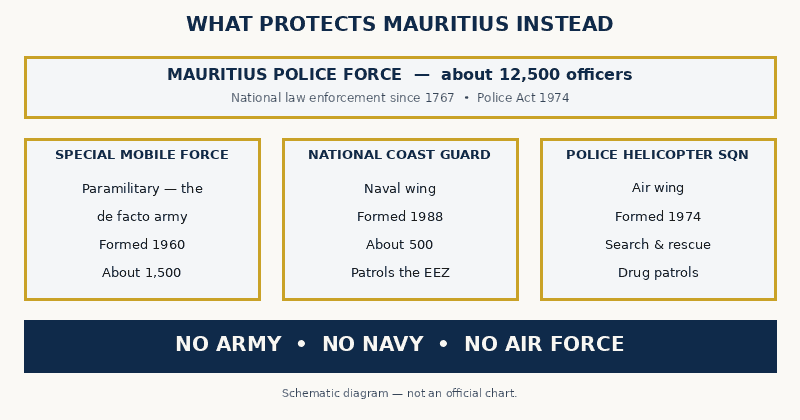
Mauritius has no army — no military of any kind. The island nation in the Indian Ocean has never had one, and there is no such thing as a Mauritius military rank. Instead, security rests on the Mauritius Police Force (MPF), a force of about 12,500 officers that also does the jobs other countries give to an army, a navy and an air force. This guide lists its 12 ranks, from Commissioner of Police down to Constable.
AT A GLANCE
Army: none · Navy: none · Air force: none
Security instead: Mauritius Police Force (about 12,500 officers)
Paramilitary arms: Special Mobile Force (about 1,500) + National Coast Guard (about 500)
Key note: the same 12 police ranks cover every branch — no military ranks exist
Why Mauritius Has No Army
Mauritius became independent from Britain on 12 March 1968, and no government since has ever raised an army. The island is small — about 2,040 square kilometres with some 1.3 million people — and its defence has always been the police force’s job. The force itself is far older than the country: it traces back to 1767, when a Commissioner of Police was first appointed under French rule, and it is governed today by the Police Act 1974.
The whole force is under civilian control. The Prime Minister holds the defence portfolio, there is no separate defence ministry, and the Commissioner of Police commands every branch, including the paramilitary units and the Coast Guard. India is the force’s closest security partner, training its officers and patrolling Mauritian waters alongside the Coast Guard.
Mauritius Police Force Ranks
The force has 12 ranks, headed by the Commissioner of Police, with the Constable at the bottom. The same ladder covers every branch — regular police, the Special Mobile Force and the Coast Guard all wear the same titles. There are no NATO codes here: these are police ranks, not military grades.
| Rank | Role | Insignia |
|---|---|---|
| Commissioner | Commands the whole force | Not described in sources |
| Deputy Commissioner | Second-in-command | Not described in sources |
| Assistant Commissioner | Commands a region or branch | Not described in sources |
| Superintendent | Commands a division | Not described in sources |
| Assistant Superintendent | Deputy divisional commander | Not described in sources |
| Deputy Assistant Superintendent | Junior command grade | Not described in sources |
| Chief Inspector | Senior inspector grade | Not described in sources |
| Inspector | Supervisory grade | Not described in sources |
| Cadet Officer | Officer in training | Not described in sources |
| Sergeant | Non-commissioned officer | Not described in sources |
| Corporal | Junior non-commissioned officer | Not described in sources |
| Constable | Police officer | Not described in sources |
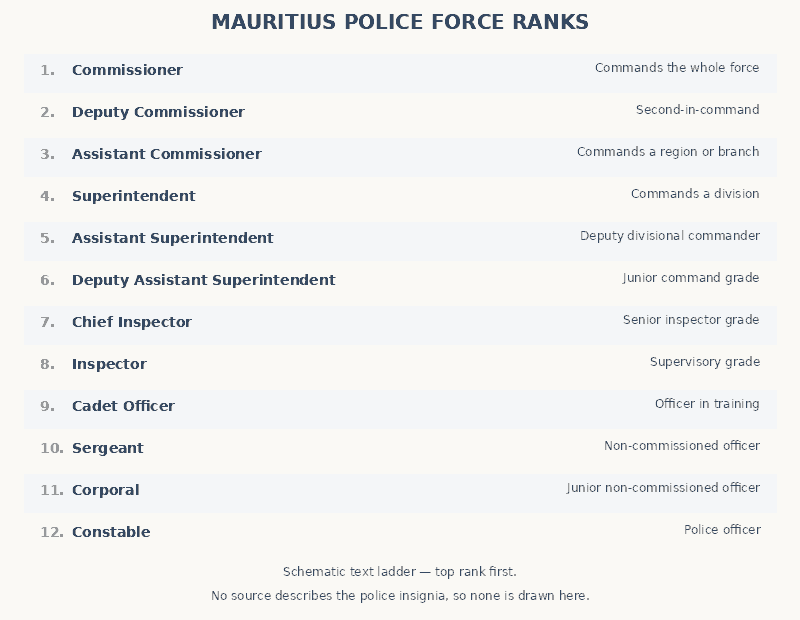
Key point: the 12 titles above are police ranks. Mauritius has no military ranks of any kind — and no branch, not even the paramilitary SMF, has a ladder of its own.
The Special Mobile Force and the Coast Guard
The Special Mobile Force is the closest thing Mauritius has to an army. Formed in 1960, when the British garrison withdrew, it is a paramilitary force of about 1,500, organised as a motorised infantry battalion — and its GIPM unit, formed in 1979, is the country’s special forces team. The National Coast Guard, formed in 1988, is the naval wing: about 500 strong, it patrols an exclusive economic zone roughly a thousand times the size of the islands.
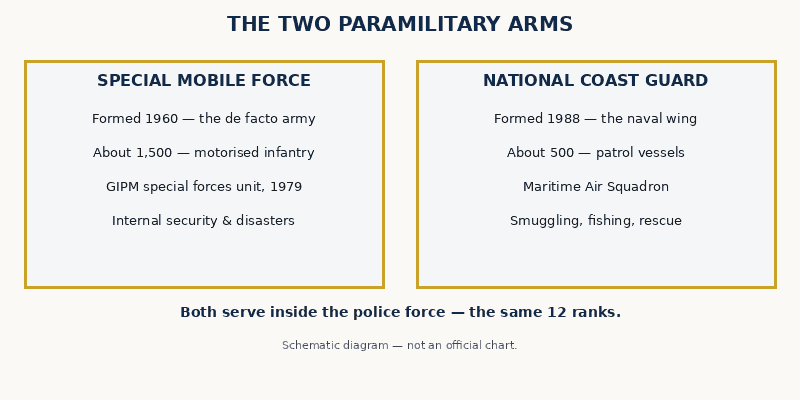
Did you know? The force has its own air wing too: the Police Helicopter Squadron, formed in 1974, flies search-and-rescue, casualty evacuation and anti-drug patrols — the closest Mauritius comes to an air force.
Read next
Nauru Military Ranks · US Army Ranks · British Military Ranks · Military Ranks and Insignia Overview
FAQs
Does Mauritius have an army?
No. Mauritius has never had a standing military — no army, no navy and no air force. The Mauritius Police Force handles all security, including the paramilitary and maritime roles.
Who commands the Mauritius Police Force?
The Commissioner of Police, who answers to the Prime Minister. The Commissioner commands the whole force, including the Special Mobile Force and the Coast Guard.
What is the Special Mobile Force?
The paramilitary branch of the police force, formed in 1960 — the closest thing Mauritius has to an army. It handles internal security, disaster relief and ceremonial duties.
All images in this article are original graphics drawn for Forces Guide. The charts are text ladders and schematic diagrams — not drawings of real insignia, which no source describes.