
Every country with a serious military has a small unit it keeps for the jobs no ordinary soldier can do: hostage rescues, raids deep behind enemy lines, and counter-terrorism operations that never make the news. These are the special forces — and the five units in this list are the names that come up again and again whenever soldiers, historians and military writers argue about the best in the world.
Before the list, one honest point. There is no official world ranking of special forces. No government, alliance or military body publishes a league table, and much of what these units do is classified. So this is an editorial pick, not an official result. We chose the five on four measures: history and combat record, how hard selection is, famous missions that changed how the world saw them, and global reputation among the people who study special operations. Another writer could order them differently — and many would — but these five would appear on almost any serious list.
The list starts with the unit that invented the modern idea of special forces, and ends with the one that fights some of the toughest mountain warfare on earth. Each section explains what the unit does, how it began, and the mission that made its name.
Key facts
- Oldest unit on the list: the British SAS, founded in 1941.
- Newest unit on the list: US Delta Force, founded in 1977.
- Most famous mission: Operation Neptune Spear, the 2011 raid that killed Osama bin Laden.
- Hardest selection: no official pass rates exist, but SAS selection and SEAL BUD/S are both widely reported to wash out most candidates.
- Pakistan’s entry: the SSG, founded in 1956 and based at Cherat, Khyber Pakhtunkhwa.
- One shared motto: the SAS and Israel’s Sayeret Matkal both use “Who Dares Wins”.
The top 5 at a glance
| Unit | Country | Founded | Motto | Famous mission |
|---|---|---|---|---|
| British SAS | United Kingdom | 1941 | “Who Dares Wins” | Iranian Embassy siege, 1980 |
| US Navy SEALs | United States | 1962 | “The only easy day was yesterday” (saying) | Operation Neptune Spear, 2011 |
| US Delta Force | United States | 1977 | No public motto | Battle of Mogadishu, 1993 |
| Russian Alpha Group | Russia | 1974 | No public motto | Moscow theatre siege, 2002 |
| Pakistan SSG | Pakistan | 1956 | “Man Janbazam” (I am valiant) | Operation Zarb-e-Azb, 2014 |
1. British SAS — The Original
The Special Air Service is the unit every other special force on this list was measured against — and in several cases, copied. It was raised in the deserts of North Africa in July 1941, during the Second World War, by Lieutenant David Stirling of the Scots Guards. Stirling’s idea was simple and, at the time, radical: a tiny team of men, dropped behind enemy lines, could do more damage to airfields and supply lines than a whole battalion attacking head-on.
The name itself was partly a trick. Calling a force of a few dozen men a “brigade” was meant to make the enemy think Britain had a full airborne regiment it did not have. The trick worked, and the raiding worked too. By the end of the war the SAS had fought across North Africa, Italy and occupied Europe — then it was disbanded in 1945, revived as a reserve unit in 1947, and rebuilt as the regular 22 SAS Regiment in 1952.
Today 22 SAS sits at the heart of United Kingdom Special Forces, alongside the SBS, the SRR and the SFSG. Its troopers wear the famous sand-coloured beret and live by the motto “Who Dares Wins”. The regiment’s work covers counter-terrorism, hostage rescue, direct action raids and special reconnaissance deep behind enemy lines. Much of it is never talked about: the British government does not comment on SAS operations, strength or deployments.
The mission that made the SAS a household name was Operation Nimrod, the ending of the Iranian Embassy siege in London on 5 May 1980. Six gunmen had seized the embassy on 30 April and taken 26 people hostage. After six days of talks, and after the gunmen killed a hostage, the SAS stormed the building live on television. The assault cleared it in about 17 minutes, five of the six gunmen were killed, and the surviving hostages were freed. An estimated 500 million people watched — and overnight, the whole world knew what “SAS” meant.
Selection is famously hard. Candidates face months of endurance marches in the Brecon Beacons, jungle training and escape-and-evasion exercises, and the Ministry of Defence publishes no pass rate. Figures of around one in ten are widely quoted, but treat any exact number with caution — the regiment keeps its own score.
Did you know? The SAS was not the first unit of its kind in Britain, but it was the first to make small-team raiding a permanent idea. Its founder, David Stirling, pitched the plan while on crutches in hospital after a parachuting accident — and talked his way past the guards at Middle East headquarters in Cairo to deliver it.
2. US Navy SEALs — The All-Rounders
The US Navy SEALs take their name from the three places they fight: sea, air and land. They were formally created on 1 January 1962, when the US Navy stood up its first two SEAL teams — one on the west coast at Coronado, one on the east coast at Little Creek — on the orders of President John F. Kennedy. Their roots go back further, to the Navy’s wartime frogmen, the underwater demolition teams who cleared beaches ahead of landing craft in the Second World War.
What sets the SEALs apart is range. The same unit that swims ashore from a submarine can parachute into a desert, storm a building, or hold a mountain ridge. Every SEAL passes BUD/S — Basic Underwater Demolition/SEAL training — a course famous for its “Hell Week” of near-constant cold, wet and sleepless work. Most candidates drop out; the course is designed that way, because the teams only want people who keep going when their body says stop. A saying attached to the SEALs sums up the attitude: “The only easy day was yesterday.”
Inside the SEALs sits an even smaller unit. After the failed Operation Eagle Claw hostage rescue in Iran in 1980, the Navy asked Commander Richard Marcinko to build a dedicated counter-terrorism team. He called it SEAL Team Six — reportedly so Soviet analysts would overestimate how many SEAL teams America had. Today it is officially the Naval Special Warfare Development Group, or DEVGRU, and it handles the missions considered too dangerous for anyone else.
DEVGRU’s most famous operation is also the most famous special forces raid in history: Operation Neptune Spear, on 2 May 2011, when its operators flew by helicopter into Abbottabad, Pakistan, and killed Osama bin Laden, ending a manhunt that had run for nearly ten years. Two years earlier, DEVGRU snipers had ended the Maersk Alabama hijacking by shooting three Somali pirates at the same moment from the deck of a warship, freeing the ship’s captain, Richard Phillips.
Key point: The SEALs and DEVGRU are not the same thing. Every DEVGRU operator is a SEAL, but only a small number of experienced SEALs are picked for DEVGRU — much like only a few SAS troopers would ever be picked for the very hardest jobs. Think of DEVGRU as the SEALs’ own elite within the elite.
3. US Delta Force — The Quiet Professionals
If the SEALs are the most famous special force in America, Delta Force is the most secretive. The US government has traditionally not even acknowledged the unit by name. Its official title is the 1st Special Forces Operational Detachment-Delta, or 1st SFOD-D, and inside the Army it is often called simply “The Unit”. It was activated on 19 November 1977 at Fort Bragg, North Carolina, by Colonel Charles Beckwith.
Beckwith had served on an exchange tour with the British SAS in the early 1960s, and he spent years arguing that America needed its own version: a small, standing unit built for counter-terrorism and hostage rescue, able to deploy anywhere in the world at a few hours’ notice. The wave of hijackings and hostage crises in the 1970s finally gave him the green light, and Delta was modelled closely on the SAS — right down to its selection course.
Delta’s first real test came fast, and it ended in disaster. In April 1980 the unit was the assault force for Operation Eagle Claw, the attempt to rescue 53 American hostages held in Tehran. The mission never reached the city: at a desert staging site called Desert One, a helicopter collided with a transport aircraft in a sandstorm, eight Americans were killed, and the mission was called off. The failure was so serious that it reshaped American special operations — it led directly to the creation of the Joint Special Operations Command and a dedicated special operations aviation regiment.
Delta’s best-known battle came in Mogadishu, Somalia, on 3–4 October 1993. As part of Task Force Ranger, Delta operators raided the city to capture lieutenants of the warlord Mohamed Farrah Aidid. When two American helicopters were shot down, the raid turned into a day-long street battle. Eighteen Americans were killed, and two Delta snipers — Master Sergeant Gary Gordon and Sergeant First Class Randall Shughart — were awarded the Medal of Honor after their deaths for defending a crashed helicopter crew alone. The battle later became famous through the book and film Black Hawk Down.
Unlike the SAS, Delta has no public motto and no published strength. Almost everything about it — how many operators it has, how it picks them, where it deploys — stays classified. That silence is part of the point: Delta is built to do the hardest counter-terrorism jobs without ever being seen.
4. Russian Alpha Group — The Counter-Terror Specialists
Alpha Group is Russia’s most famous special forces unit, and its history is the most controversial on this list. It was created by the Soviet KGB on 28 July 1974, on the orders of KGB chairman Yuri Andropov, as a direct answer to the murder of Israeli athletes by terrorists at the 1972 Munich Olympics. Its job from the start was counter-terrorism and hostage rescue at home — and that is still its core work today, now as Directorate “A” of the FSB Special Purpose Center.
Alpha’s first famous operation came before the Soviet Union fell. In December 1979, its operators stormed the presidential palace in Kabul during Operation Storm-333, killing the Afghan leader Hafizullah Amin at the start of the Soviet war in Afghanistan. It was a textbook special forces raid: fast, violent and over in minutes.
But the missions that define Alpha in the public mind are the two great hostage crises of the early 2000s, and both ended in terrible loss of life. In October 2002, Chechen gunmen seized a Moscow theatre with more than 800 people inside. After a three-day standoff, Alpha and its sister unit Vympel pumped a chemical agent through the building’s ventilation system to knock everyone out, then stormed in. All the gunmen were killed — but more than 120 hostages died too, most of them from the effects of the gas.
Two years later came Beslan. In September 2004, gunmen seized a school in North Ossetia and held more than 1,100 people hostage, including 777 children, in a gymnasium wired with explosives. On the third day, explosions inside the school set off a chaotic battle, and Alpha and Vympel stormed the building. In the end 334 hostages were killed, including 186 children, along with ten FSB special forces officers — the heaviest losses in the units’ history.
That record is why Alpha sits at number four and not higher. Its operators are unquestionably skilled, and in a straight hostage-rescue or raid role few units have more experience. But the Moscow and Beslan operations showed what happens when a counter-terrorism plan goes wrong at scale, and the human cost of those two sieges still shapes how the unit is judged. No honest list of the world’s best special forces can leave Alpha out — and no honest list can pretend its record is clean.
5. Pakistan SSG — The Mountain Warriors
The Special Services Group, or SSG, is Pakistan’s premier special forces unit — and the one on this list that fights at the highest altitude. It was raised on 23 March 1956 as a battalion under its first commanding officer, Lieutenant-Colonel A. O. Mitha, with advice from officers of the US Army’s Special Forces. Its home is Cherat, a hill station in Khyber Pakhtunkhwa about 8,000 feet above sea level, where the thin air itself is part of the training.
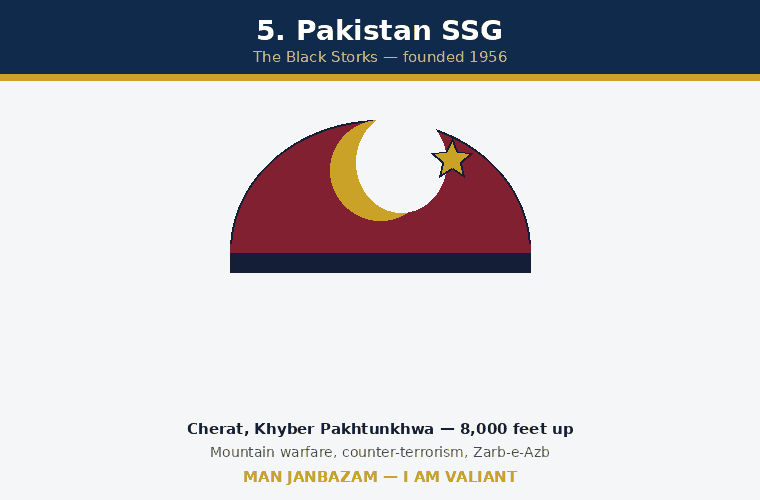
The SSG’s motto is “Man Janbazam” — Urdu for “I am valiant” — and its men wear the maroon beret. They are nicknamed the “Black Storks”, after the black stork, a bird known for flying long distances at great height. The nickname fits: the SSG specialises in mountain warfare, unconventional warfare, long-range reconnaissance and counter-terrorism, and its battalions each train for a different kind of ground — desert, mountain, long-distance raiding and deep diving among them.
The SSG’s first war came in 1965. During Operation Gibraltar, its teams slipped into Indian-administered Kashmir, and on the night of 7 September 1965 its paratroopers dropped near Indian airbases at Pathankot, Adampur and Halwara, aiming to damage aircraft on the ground. The drops went badly — most of the men were captured — but the operation forced India to divert troops to guard its airfields. In the 1971 war the SSG performed far better: 1 Commando Battalion raided an Indian artillery regiment and knocked out several of its guns.
Since then the SSG has fought in almost every conflict Pakistan has faced: the Soviet war in Afghanistan, the Siachen Glacier, the long insurgency in Khyber Pakhtunkhwa, and the counter-terrorism campaigns of the last two decades. Its dedicated counter-terrorism arm, the Zarrar Company, was built for hostage rescue and close-quarters battle, and SSG operators played a leading role in Operation Zarb-e-Azb, the 2014 campaign that cleared militant strongholds in North Waziristan.
What earns the SSG its place on this list is not one famous raid but a record of fighting in some of the hardest country on earth. Mountain warfare at 8,000 feet and above, in freezing cold and thin air, is a skill few special forces in the world practise as a daily routine. The SSG does it from a base that sits at that height — and it has been doing it since 1956.
Honourable mentions
Sayeret Matkal (Israel). Israel’s most secretive special forces unit was founded in 1957 by Major Avraham Arnan, and it was modelled directly on the British SAS — even borrowing the motto “Who Dares Wins”. Its most famous mission was Operation Entebbe on 4 July 1976, when it led the rescue of more than 100 hostages from a hijacked Air France aircraft in Uganda, flying 2,500 miles to do it. The unit’s commander, Lieutenant Colonel Yonatan Netanyahu, was killed in the raid — the only Israeli commando to die that night. Sayeret Matkal misses the top five only because so little of its record is public; what is known is extraordinary.
GIGN (France). The Groupe d’intervention de la Gendarmerie nationale is France’s elite counter-terrorism unit, formed in 1973 after the Munich massacre and operational from March 1974 under Lieutenant Christian Prouteau. Unlike the other units here it belongs to the gendarmerie — a military police force — so most of its work is at home: hostage rescues, organised crime and protecting senior officials. Its motto since 2014 is “S’engager pour la vie” — “a lifelong commitment”. Its most famous operation was the storming of hijacked Air France Flight 8969 in Marseille in December 1994, which ended with all the gunmen killed and the passengers freed.
Read next
Special Air Service Ranks and Insignia
Special Boat Service Ranks and Insignia
UK Special Forces Uniforms Explained
US Navy Ranks and Insignia
US Army Ranks and Insignia
Military Berets: Colours Explained
Frequently asked questions
Is there an official ranking of the world’s special forces?
No. No government, alliance or military body publishes a ranking of special forces, and much of what these units do is classified. Any “top 5” or “top 10” list — including this one — is an editorial judgement based on history, combat record, selection difficulty and reputation, not an official result.
Which special force is the oldest in the world?
The British SAS, founded in July 1941 during the Second World War. It is also the unit most others were modelled on: the US Delta Force, Israel’s Sayeret Matkal and several more were built by men who had served with, or studied, the SAS.
Which special force has the hardest selection?
There is no fair way to compare them, because no unit publishes its pass rate. SAS selection and the SEALs’ BUD/S course are both widely reported to wash out most candidates, and Delta Force only takes soldiers who have already served in other elite units. Any exact percentage you read online is an estimate, not an official figure.
What is the difference between the Navy SEALs and DEVGRU?
DEVGRU — the Naval Special Warfare Development Group, still widely called SEAL Team Six — is a small unit inside the SEAL organisation. It was created in 1980 for the hardest counter-terrorism and hostage rescue jobs, and only experienced SEALs are picked for it. Its most famous operation was the 2011 raid that killed Osama bin Laden.
What does SSG stand for, and what is the SSG motto?
SSG stands for Special Services Group, the special forces of the Pakistan Army, founded in 1956. Its motto is “Man Janbazam”, Urdu for “I am valiant”. Its operators wear the maroon beret and are nicknamed the “Black Storks”.
Which special force carried out the most famous hostage rescue?
Two missions share that honour. The SAS ended the Iranian Embassy siege in London in 1980 live on television, clearing the building in about 17 minutes. And Israel’s Sayeret Matkal flew 2,500 miles to rescue more than 100 hostages at Entebbe, Uganda, in 1976. Both raids are still studied by special forces around the world.
Forces Guide writes about military ranks, units and history for readers who want the facts without the jargon. Where a figure is disputed or not officially published, this article says so rather than guessing.