
Federal Service Academy Directory
United States Naval Academy (Annapolis)
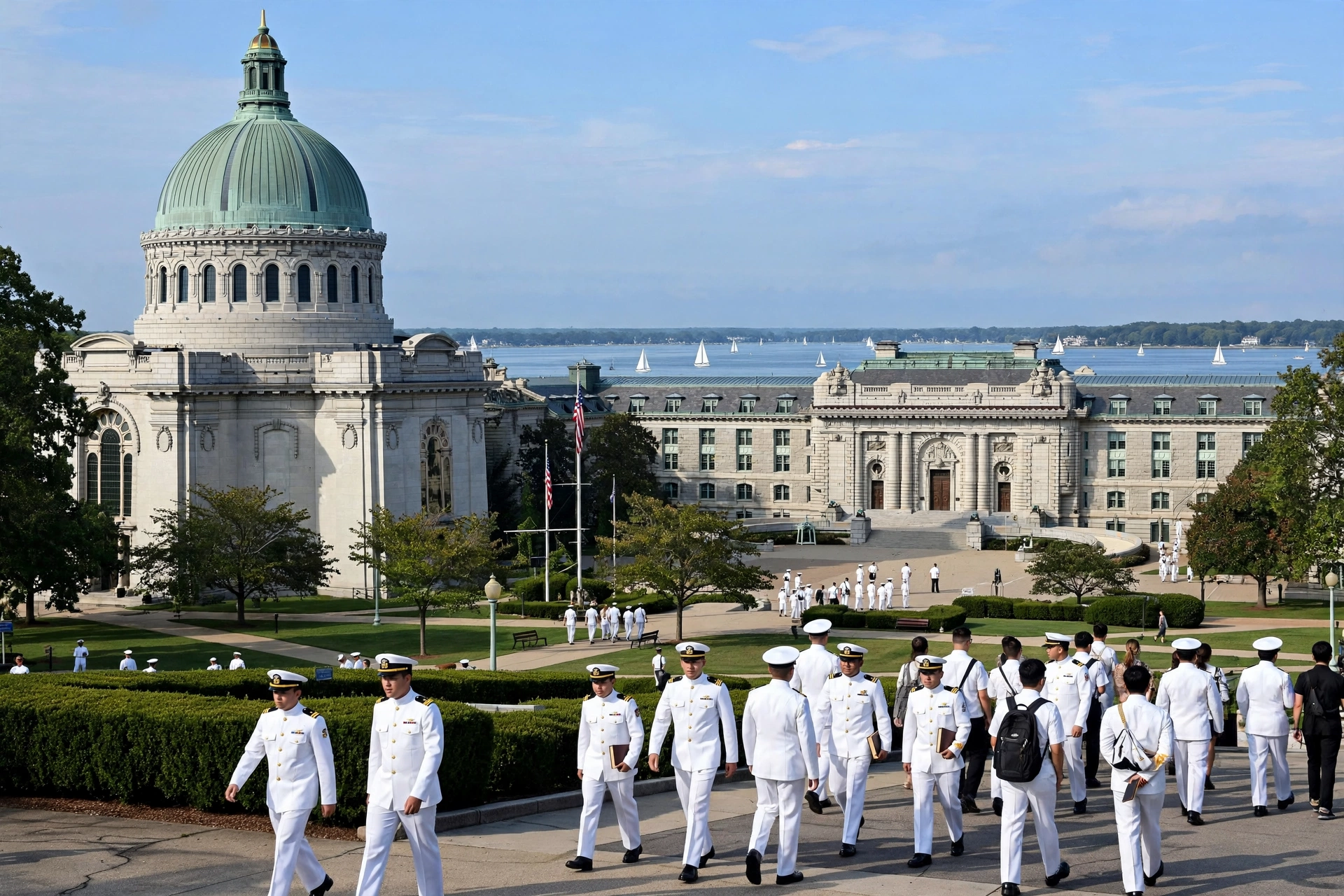
Set in Maryland’s historic state capital on the banks of the Severn River, the United States Naval Academy — known the world over simply as Annapolis — has been preparing officers for the United States Navy and Marine Corps since 1845. This complete guide covers everything a prospective candidate needs: admissions requirements, the nine-step application process, academic programmes, costs, the service commitment and answers to frequently asked questions.
Directory Information
| Full name | United States Naval Academy |
| Commonly known as | USNA — Annapolis |
| Location | Annapolis, Maryland, United States — on the Severn River |
| Official address | 121 Blake Road, Annapolis, MD 21402 |
| Admissions office | 52 King George Street, Annapolis, MD 21402 |
| Admissions enquiries | Via the Office of Admissions at usna.edu |
| Official website | usna.edu |
| Founded | 1845 |
| Branch of service | United States Navy and United States Marine Corps |
| Motto | “Ex Scientia Tridens” — “From Knowledge, Seapower” |
| Midshipman strength | Approximately 4,400 midshipmen |
| Campus size | 338 acres |
About the Academy
Founded in 1845, the United States Naval Academy is the second-oldest of America’s five federal service academies and serves as the undergraduate college of the nation’s naval service. Its campus — known as the Yard — occupies 338 acres in Annapolis, Maryland, where generations of officers have been educated amid some of the most recognisable architecture in American higher education.
Naval Academy students are midshipmen on active duty in the United States Navy. The Academy prepares young men and women to become professional officers of competence, character and compassion in the United States Navy and Marine Corps. Midshipmen attend for four years, graduating with Bachelor of Science degrees and commissions as ensigns in the Navy or second lieutenants in the Marine Corps.
Life at Annapolis is deliberately demanding. Alongside a rigorous academic programme, midshipmen train in leadership, seamanship and military skills, and take a full part in the Academy’s sporting and extracurricular life. It is an environment designed to test character as thoroughly as intellect — and to produce leaders ready to serve the nation at sea, in the air and on the ground.
What It Offers: Majors and Programmes
The Naval Academy offers 23 academic majors spanning engineering, the natural sciences, mathematics, computer and cyber science, the humanities and the social sciences. Well-known options include aerospace engineering, mechanical engineering, electrical engineering, ocean engineering, naval architecture and marine engineering, computer science, cyber science, mathematics, physics, chemistry, economics, political science, history and English — every one of them leading to a Bachelor of Science degree, whatever the field of study.
The curriculum is built around a broad core in science, technology, engineering and mathematics, balanced by studies in leadership, ethics, naval science and the liberal arts. Professional training runs in parallel: midshipmen spend summers at sea with the fleet and in Marine Corps training, so classroom theory is continually tested against real-world experience. Sport is woven into daily life too — the Academy fields NCAA Division I varsity teams, the Navy Midshipmen, alongside extensive club and intramural programmes.
Admission Requirements
Admission to the Naval Academy is highly competitive and is assessed across academics, leadership, character, medical fitness and physical fitness. The basic eligibility conditions are:
- Citizenship: you must be a United States citizen by 1 July of the year you would enter, and hold a valid Social Security number.
- Age: you must be at least 17 but not yet 23 on 1 July of your entry year.
- Family status: you must be unmarried, not pregnant, and have no dependents or legal obligation to support children.
Academics. The Academy looks for a strong school record, particularly in mathematics and science — the all-science-degree curriculum rewards candidates who have built a firm grounding in these subjects, alongside English and a foreign language. Applicants take standardised entrance examinations (the SAT or ACT) and submit their full school transcripts as part of the application.
Fitness. Every candidate must pass the Candidate Fitness Assessment (CFA), the same six-event test used across the service academies: the basketball throw, pull-ups (or the flexed-arm hang for female candidates), the shuttle run, modified sit-ups, push-ups and the one-mile run. Consistent training over months — not a last-minute effort — is what the assessment rewards.
Medical. Candidates must meet the medical standards for a commissioning programme, assessed through the Department of Defense Medical Examination Review Board (DoDMERB). The Academy also interviews candidates as part of the selection process, so your file is judged as a whole person, not on grades alone.
How to Apply: Step by Step
The Naval Academy sets out the journey to admission in nine steps. Applications for the Class of 2031 are open now, and because several steps depend on other people — nominators, examiners and medical boards — you should start early in your junior year.
- Confirm your eligibility. Check the citizenship, age and family-status conditions above before you invest time in an application.
- Submit a preliminary application. This short online form at usna.edu opens your candidate file and starts the process.
- Apply for a nomination. Almost every candidate needs a nomination, most commonly from a Member of Congress — both of your United States Senators and your Representative in the House — or from the Vice President. Service-connected nominations also exist. Each source runs its own process and deadline, so apply to every one for which you are eligible.
- Take your entrance examinations. Sit the SAT or ACT and have your scores sent to the Academy.
- Send your transcript. Arrange for your school to submit your official transcript.
- Complete the medical examination. DoDMERB will schedule your medical and vision examinations as your file progresses.
- Pass the Candidate Fitness Assessment. Arrange the six-event CFA with a qualified administrator and submit your results.
- Attend your interview. Most candidates are interviewed by a Naval Academy admissions volunteer — a Blue and Gold Officer — in their local area.
- Await admission selection. Completed files go before the Admissions Board, and offers are made to the strongest candidates overall.
Tuition and Costs
There is no tuition at the United States Naval Academy. Midshipmen attend on a full scholarship: the United States Navy pays 100% of tuition, room and board, and medical and dental care.
Midshipmen also receive monthly pay of $1,087.80, with $250 paid in cash each month, to help cover books, uniforms and everyday expenses. The education is free in financial terms — in return, graduates owe a minimum of five years of active-duty service (see below).
Service Commitment After Graduation
Every graduate is commissioned as an ensign in the United States Navy or a second lieutenant in the United States Marine Corps and owes a minimum of five years of active-duty service. That commitment is the return on the Navy’s investment in a fully funded education — and for most graduates it is the beginning of a far longer career.
New officers go on to serve across the naval service: at sea in surface ships and submarines, in naval aviation, in the Marine Corps’ ground and air arms, and in specialist fields from engineering and intelligence to cyber warfare. The choice of community is competitive and is shaped by performance across the four years at Annapolis — one more reason the Academy assesses the whole person from the very first application.
Famous Graduates
The Naval Academy’s alumni include astronauts, Medal of Honor recipients, senior commanders and business leaders. Four of the best known:
Alan B. Shepard Jr.
Class of 1945. Naval aviator and NASA astronaut who in 1961 became the first American in space.
James B. Stockdale
Class of 1947. Naval aviator awarded the Medal of Honor for his leadership as a prisoner of war in Vietnam; later a vice admiral.
H. Ross Perot
Class of 1953. Naval officer turned entrepreneur who founded Electronic Data Systems and twice ran for President of the United States.
Charles F. Bolden
Class of 1968. Marine Corps aviator and astronaut who flew four Space Shuttle missions and later served as Administrator of NASA.
Frequently Asked Questions
How much does it cost to attend the Naval Academy?
Nothing. Midshipmen attend on a full scholarship — the Navy pays 100% of tuition, room and board, and medical and dental care — and they receive monthly pay as well. In return, graduates serve a minimum of five years on active duty.
Do I need a nomination from Congress to apply?
Yes — almost every candidate needs a nomination. Most come from Members of Congress (both of your Senators and your Representative), with others available from the Vice President and service-connected sources. Apply to every source for which you are eligible.
What are the age and eligibility rules?
You must be a United States citizen by 1 July of your entry year, at least 17 but not yet 23 on that date, unmarried, not pregnant, without dependents, and hold a valid Social Security number.
What is the Candidate Fitness Assessment?
The CFA is a six-event fitness test — basketball throw, pull-ups (or the flexed-arm hang), shuttle run, modified sit-ups, push-ups and a one-mile run. Every candidate must pass it, so build a training routine well before you apply.
How many majors does the Naval Academy offer?
The Academy offers 23 majors, from aerospace engineering and cyber science to economics, history and English. Unusually, every graduate — whatever the major — earns a Bachelor of Science degree.
What happens after graduation?
Graduates are commissioned as ensigns in the US Navy or second lieutenants in the US Marine Corps and serve at least five years on active duty, in communities ranging from surface warfare and submarines to naval aviation and the Marine Corps.
Ready to take the next step?
Visit the academy’s official admissions site at usna.edu or write to the Office of Admissions, 52 King George Street, Annapolis, MD 21402. Facts in this guide were verified against the academy’s official website.