
Complete information about the Roman Military Ranks and Insignia. List of the roman military ranks from lowest to highest along with the detail explanation about the role and duty of all ranks of Roman Army. summarize overview of the Roman Military ranks and history of Roman Military.
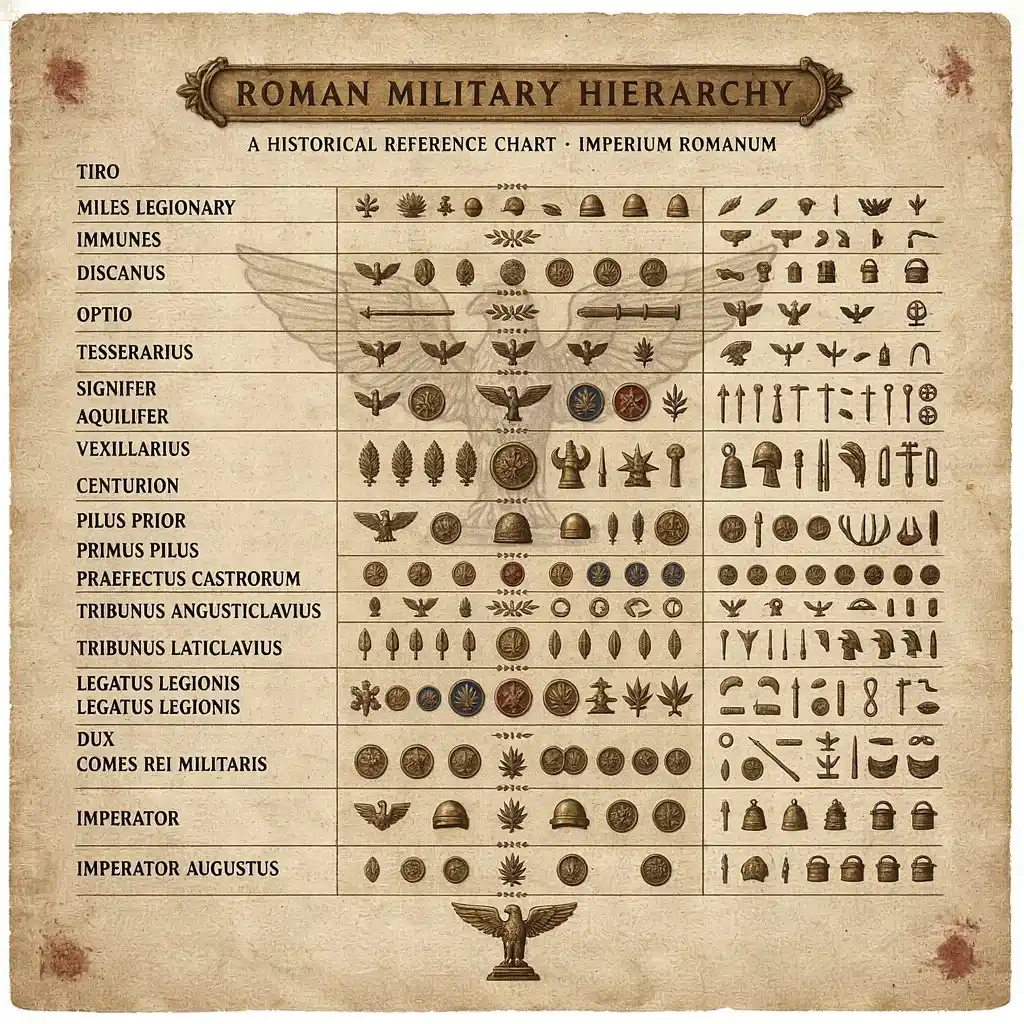
The Roman Imperial Army was a highly organized and disciplined military force with clearly defined roles ranging from raw recruits to the highest-ranking commanders and even the emperor. At the entry-level was the tiro, a recruit undergoing physical, mental, and tactical training, progressing to the miles legionary, the professional backbone of the army, who endured demanding marches and battlefield discipline. Specialized troops known as immunes were skilled specialists who supported military operations with expertise in engineering, medicine, and logistics.
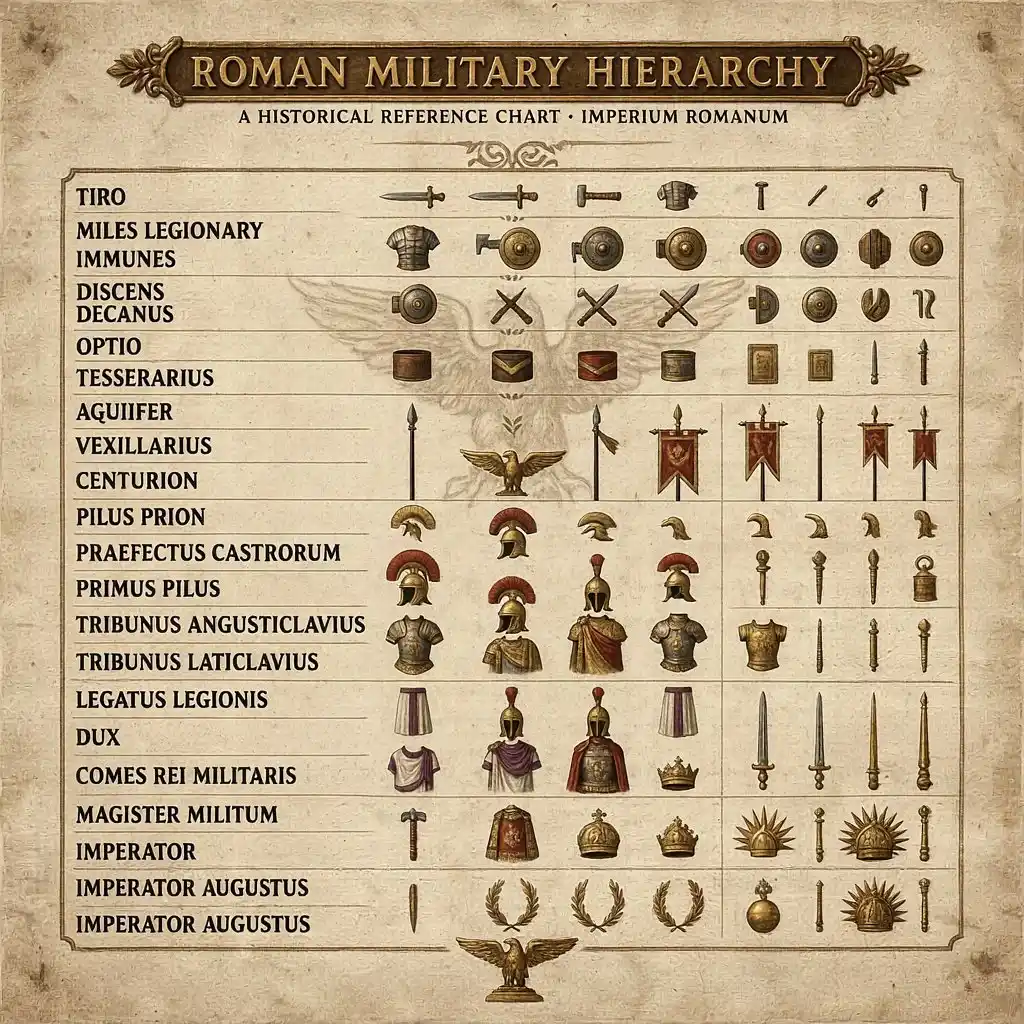
List of Roman Military Ranks In Order
Explore the ranks and roles within the Roman military hierarchy.
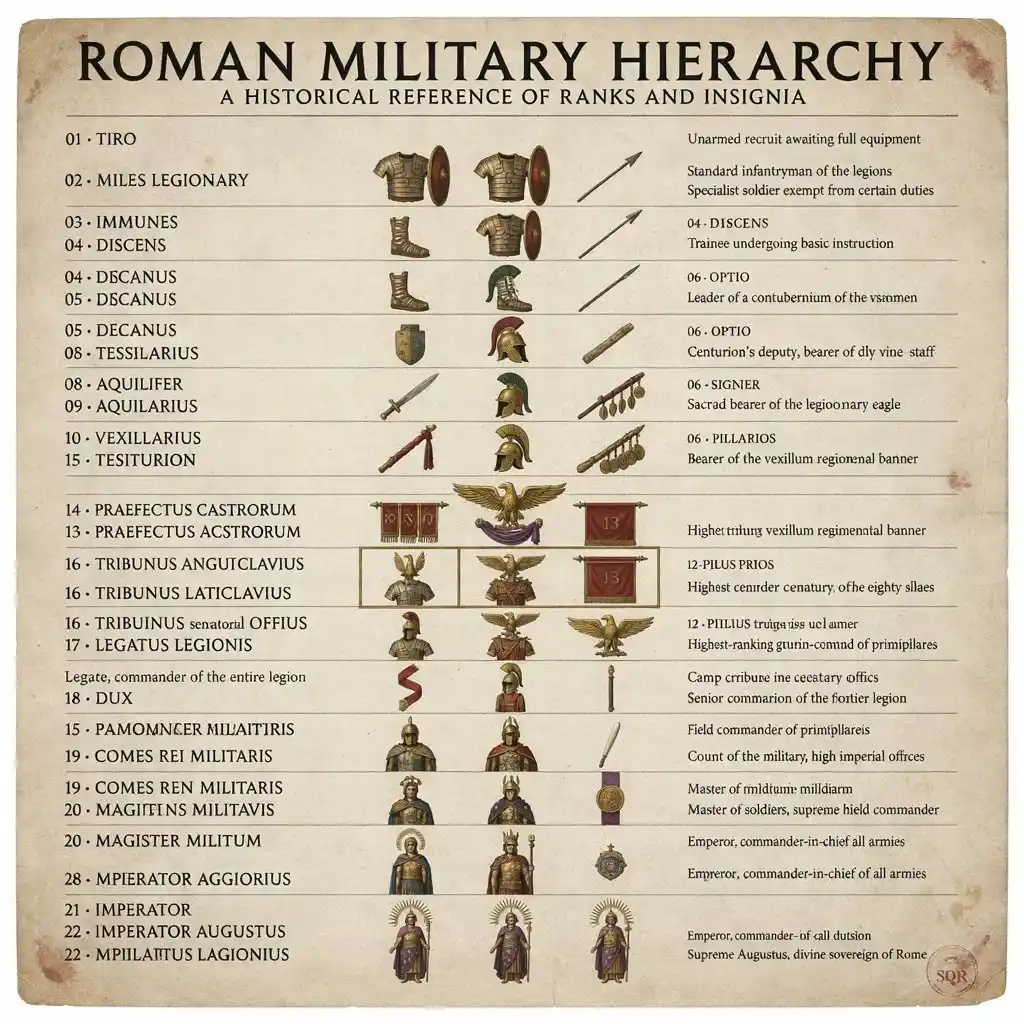
Roman Military Ranks and Roles
The Roman military hierarchy included soldiers, specialists, commanders, and senior officers with different responsibilities and positions within the Roman army.
Tiro
A tiro was the very first stage in a Roman soldier's career. A raw recruit who had just joined the ranks of the mighty Roman army. At this point, he was not yet a legionary, but a trainee undergoing intense physical and mental preparation.
Tiros were drilled daily in basic combat techniques, formation tactics, weapon handling, and Roman military discipline. Their training focused not only on strength and endurance, but also on obedience, loyalty, and cohesion within the unit.
Life as a tiro was harsh and demanding, designed to test resilience and weed out the weak. They were taught how to march for miles in full gear, construct fortified camps, and survive long campaigns.
Only after passing these grueling trials would a tiro be promoted to miles legionary, earning his place among Rome's professional warriors. Becoming a tiro was the first crucial step toward honor, status, and citizenship in the Roman Empire.
Miles Legionary
The miles gregarious was the professional backbone of the Roman Imperial Army. These legionary soldiers were the heart of every campaign, forming the front line in countless battles that shaped the Roman Empire.
Trained relentlessly, a miles could march up to 30 kilometers per day in full gear, build fortified camps from scratch, and fight with brutal efficiency using their gladius, pylum, and scutum.
Discipline was absolute. Orders were followed without question. Beyond warfare, legionaries maintained roads, secured frontiers, and imposed Roman authority in distant provinces in exchange for 20 to 25 years of loyal service.
A miles could earn land, a pension, and Roman citizenship, a life-changing reward, especially for non-citizens.
Wearing chain mail or segmented Laurica armor, a red tunic, and the iconic helmet, Gala, each legionary was both a symbol and servant of Rome's imperial ambition. Loyalty to Rome wasn't just expected. It was sacred.
Immunes
In the Roman military hierarchy, immunes were highly valued soldiers who had received specialized training for non-combat roles.
Unlike regular legionaries, they were exempt from routine manual labor duties such as ditch digging or fort construction, hence the name immunes, meaning exempt.
These soldiers served as medics, engineers, architects, carpenters, surveyors, clerks, or even weaponsmiths. Their technical skills were vital for the day-to-day operation and logistical success of the Roman legions.
Without the immunes, roads wouldn't be built, siege weapons wouldn't function, and the wounded wouldn't survive.
Most immunes began their careers as regular miles, basic legionaries, and after proving their discipline and reliability, they were selected for specialist training. Their work often happened behind the front lines, but their contributions were no less heroic.
They were the backbone of infrastructure and intelligence, silent warriors who kept the mighty Roman war machine in motion.
Discens
The desends held a crucial transitional role within the Roman military hierarchy. These soldiers were not ordinary legionaries. They were carefully selected trainees undergoing specialized instruction to become immunes, the expert class of the Roman army.
While they had completed basic combat training and could fight when needed, their primary focus was mastering a specific field such as engineering, medicine, surveying, or logistics.
A desense might train to build roads and siege engines, assist military doctors in field hospitals, or manage supplies during campaigns.
Their education took place both in the field and under the mentorship of experienced immunes. Once training was complete, the desends would be elevated to full immune status, exempt from menial duties, and positioned as indispensable support figures behind Rome's battlefield dominance.
Decanis
The Decanis was the commander of a contouium, the smallest organizational unit in the Roman army, typically consisting of 8 to 10 legionaries who shared a tent, duties, and daily routines.
While not considered an officer by modern standards, the Danis played a crucial leadership role within the group.
Usually selected from among the most disciplined and experienced legionaries, the Danis ensured order, cleanliness, and discipline within the camp, especially during marches and encampments.
Their responsibilities included supervising camp construction, managing rations and supplies, and maintaining morale among their men.
Although the Danis had limited combat authority, this role marked the first step on the ladder of military advancement and was often seen as a proving ground for future centurions.
Optio
The Opio was the second in command within a Roman centuria, serving directly under the centurion.
Handpicked for their discipline, loyalty, and battlefield experience, Opiones were often veterans who had proven themselves over years of service.
Their primary duties included enforcing order within the ranks, overseeing training drills, maintaining the line during combat, and relaying commands from the centurion to the soldiers.
In battle formations, the opio usually stood at the rear of the unit, ensuring that no man broke formation or fled.
He carried a distinctive staff called a haststyle, not just as a symbol of rank, but also as a tool to restore discipline if needed.
If the centurion was wounded or killed in action, the optoio would immediately assume command.
Tesserarius
In the Roman Imperial Army, the Tesserarius held a vital yet often overlooked role within each century, acting as a senior watch officer.
The Tesserarius was responsible for organizing guard rotations, overseeing night watches, and distributing the daily watchword known as the Tessera to ensure secure communication across the camp.
This officer reported directly to the optoio and worked closely with the centurion, ensuring that every soldier on duty was alert, positioned correctly, and aware of their responsibilities.
The Tesserarius was also tasked with enforcing discipline among the guards and could act swiftly in cases of internal breach or desertion.
Though not always seen in the heat of battle, their behind-the-scenes vigilance was essential to the security and efficiency of the Roman military machine.
Signifer, Aquilifer and Vexillarius
In the Roman army, these standard-bearers held some of the most honored and symbolically powerful roles.
The signifer carried the signum, the emblem of a century, and was responsible not only for leading the troops in formation, but also for overseeing the unit's finances and discipline.
The Aquilifer bore the Aquila, the Legion's sacred eagle, a symbol of Rome's divine authority and military pride. Losing the eagle in battle was considered a catastrophic disgrace.
The Vexillarius held the Vexylum, a flag used to represent detachments or veteran formations.
These men were elite soldiers chosen for their courage and reliability. Their presence on the battlefield boosted morale, maintained unit cohesion, and helped soldiers orient themselves amidst chaos.
More than just flagbearers, they were protectors of Rome's honor. If they fell, entire legions would risk their lives to retrieve what they carried.
Centurion
In the Roman army, the centurion was a critical figure, commanding a centuria, a unit of approximately 80 legionaries.
Far more than just a battlefield leader, the centurion embodied discipline, structure, and the Roman military ethos.
These officers typically rose from the ranks, earning their position through years of service, acts of bravery, and proven leadership.
Centurions were known for their strict fairness. They enforced discipline with a firm hand, but also earned the respect of their men through loyalty and shared hardship.
On the battlefield, they didn't just give orders from the rear. They led from the front, often fighting in the thick of battle to inspire their troops.
Their distinctive transverse crest on the helmet set them apart and they often carried a vine staff, vitis, as both a symbol of rank and a disciplinary tool.
Pilus Prior
The Pilus Prior was the highest ranking centurion within a Roman cohort, commanding authority over the other five centurions in the unit.
This prestigious position was not only earned through years of battlefield experience, but also through proven leadership, discipline, and tactical intelligence.
The pilus prior acted as a crucial link between the centurionate and the senior officers of the legion, often advising tribunes and even the legate during campaigns.
Unlike modern high-ranking officers who stay behind the lines, the pilus prior fought at the front shoulder-to-shoulder with his men, earning deep respect and loyalty.
He was responsible for coordinating multiple centuria during battle formations, ensuring discipline and executing complex maneuvers under fire.
Primus Pilus
The Primus Pilus, meaning first spear, was the highest ranking centurion in a Roman legion.
A position earned only after decades of disciplined service and battlefield excellence, he commanded the first cohort, the elite unit of the legion, and was considered the bridge between the common soldier and the high command.
Trusted by generals, the Primus Pilus had direct access to the Legatus Legionus and often advised on tactics, morale, and internal discipline.
His authority over other centurions made him a key figure in maintaining order within the ranks.
After completing service, many were granted entry into the equestrian class or transitioned into prestigious civil roles such as magistrates or governors.
This rank symbolized not just power but honor, experience, and unwavering loyalty to Rome.
Praefectus Castrorum
The prefectus castum or camp prefect was the third highest ranking officer in a Roman legion, typically a seasoned veteran who had previously served as primus pilus, the most senior centurion.
His primary responsibility was the organization and maintenance of the legion's camp infrastructure.
This included overseeing construction of forts, roads, and defenses, managing logistical support, and ensuring supplies were efficiently stored and distributed.
Unlike other officers focused solely on combat leadership, the prefectus Castrorum operated at the intersection of engineering, logistics, and strategy.
His work ensured the legion could move, rest, and fight effectively.
Whether building a temporary marching camp or maintaining a permanent fortress, his foresight often determined the survival of the legion in hostile territory.
He also played a key advisory role to the Legatus Legion, contributing to broader strategic planning.
Tribunus Angusticlavius
The Tribunis Angustic Clavius was a mid-ranking officer drawn from the equestrian class, the second highest social order in Roman society.
Each legion typically had five to six of these tribunes, each overseeing the operations of several cohorts, units of roughly 480 soldiers.
While not at the top of the command chain, they were essential to maintaining structure, discipline, and communication within the legion.
This role served as a training ground for future high-ranking commanders.
Tribunes were expected to learn the complexities of military leadership, logistics, and battlefield coordination under the guidance of more experienced officers like the Legatus Legionus and Primus Pilus.
Their tunics featured narrow purple stripes and gusticlavia, distinguishing them visually from senatorial tribunes.
Though they were not in direct control of an entire legion, their influence in shaping troop movements and morale was substantial.
Tribunus Laticlavius
The tribunous Laticlavius was a prestigious officer within the Roman legion, typically chosen from the senatorial class.
As the second in command to the Legatus Ligionis, this tribune held significant responsibility in both administrative and battlefield operations.
His title, Laticlavius, referred to the broad purple stripe on his tunic, an unmistakable symbol of his aristocratic status.
This role was often a stepping stone for young senators in training, providing firsthand exposure to the discipline, strategy, and chaos of military life.
While his authority was real, his presence was also symbolic, the embodiment of Rome's fusion of political and military power.
The tribunous Laticlavius often observed more than commanded, learning the craft of leadership under fire.
Many who served in this position would go on to become provincial governors, military generals, or even key figures in Roman politics.
Legatus Legionis
The Legatus Legionus was the highest ranking officer within a Roman legion, commanding approximately 5,000 to 6,000 soldiers.
Appointed directly by the Roman Senate or the emperor himself, the legatus was typically drawn from the senatorial class, elite, educated, and politically influential.
His responsibilities went far beyond battlefield command.
While he served as the strategic and operational leader during military campaigns, he also functioned as the top administrator, diplomat, and judge within his legion.
A legatus had to balance military discipline with morale, enforce Roman law, lead negotiations with local rulers, and report directly to Rome.
His appearance reflected his status, often clad in ornate armor with a purple cloak, paludamentum, symbolizing his authority.
Respected and sometimes feared, the legatus was the voice of Rome on foreign soil. His decisions could change the course of a campaign or an entire region's history.
Dux
The title dux in the Roman Empire referred to a high-ranking military leader responsible for commanding multiple legions during major campaigns.
Unlike the Legatus, who oversaw a single legion, the dux had authority over entire army groups, especially in strategically sensitive regions or during large-scale invasions.
Typically appointed in times of war or unrest, a dux was a seasoned general with proven tactical skill, leadership, and political loyalty.
They coordinated logistics, assigned missions to legion commanders, and directly advised the emperor or senate on military strategy.
While initially an informal designation, the role of dux evolved into a formal military office and later even a noble title, giving rise to the medieval duke.
In many ways, the modern role of a general or field marshal mirrors the scope of the Roman dux.
Comes Rei Militaris
The Comes Rei Militaris was a high-ranking military officer in the later periods of the Roman Empire, especially during the fourth and fifth centuries.
Positioned above the dux, the Comes commanded regional army groups and operated under the direct authority of the emperor.
What set this rank apart was its dual nature. The comes often held both military and administrative powers, managing troops while also overseeing civil governance in volatile frontier provinces.
This rank emerged as the empire shifted from a unified command structure to a more decentralized defense system.
The Comes Rei Militaris often led mobile field armies, comitatenses, responding to invasions and rebellions across vast territories.
Their strategic role made them key players in defending the crumbling edges of the empire.
The title comes, meaning companion, emphasized their close relationship with imperial power and strategic command.
Magister Militum
The magister militum, or master of soldiers, was one of the highest-ranking military officials in the late Roman Empire.
Appointed directly by the emperor, he held supreme command over all land forces within a designated region or sometimes across the entire empire.
His role was not limited to battlefield leadership. He was also the emperor's closest military adviser and often shaped imperial defense strategies, reforms, and logistics.
By the fourth and fifth centuries AD, the magister militum commanded multiple field armies, and his authority often surpassed that of provincial governors.
In some cases, his power rivaled, even overshadowed, that of the emperor, especially during times of weak imperial rule.
Notable holders of this title such as Stilico and Flavius Atus played pivotal roles in defending the empire from barbarian invasions.
The magister militum embodied both the sword and the shield of Rome, guardian of its borders and architect of its survival.
Imperator
In the Roman Empire, the title imperator was originally granted by soldiers to victorious generals as a mark of honor and military success.
Over time, it transformed into a formal designation for the emperor himself, symbolizing supreme command over the Roman legions.
Imperator Augustus
The term Augustus was first adopted by Octavian, Julius Caesar's adopted son and Rome's first emperor in 27 B.C.E.
It carried a sacred and elevated connotation, suggesting divine favor and absolute authority.
The Imperator Augustus was more than just a military leader. He held full political power as princeps, first among the Senate, religious authority as Pontifex Maximus, chief priest, and judicial control over the state.
This concentration of roles made the emperor the central figure in every aspect of Roman governance.
By combining military might, political leadership, and spiritual significance, the Imperator Augustus came to define the Roman Emperor as the embodiment of Roman civilization itself.
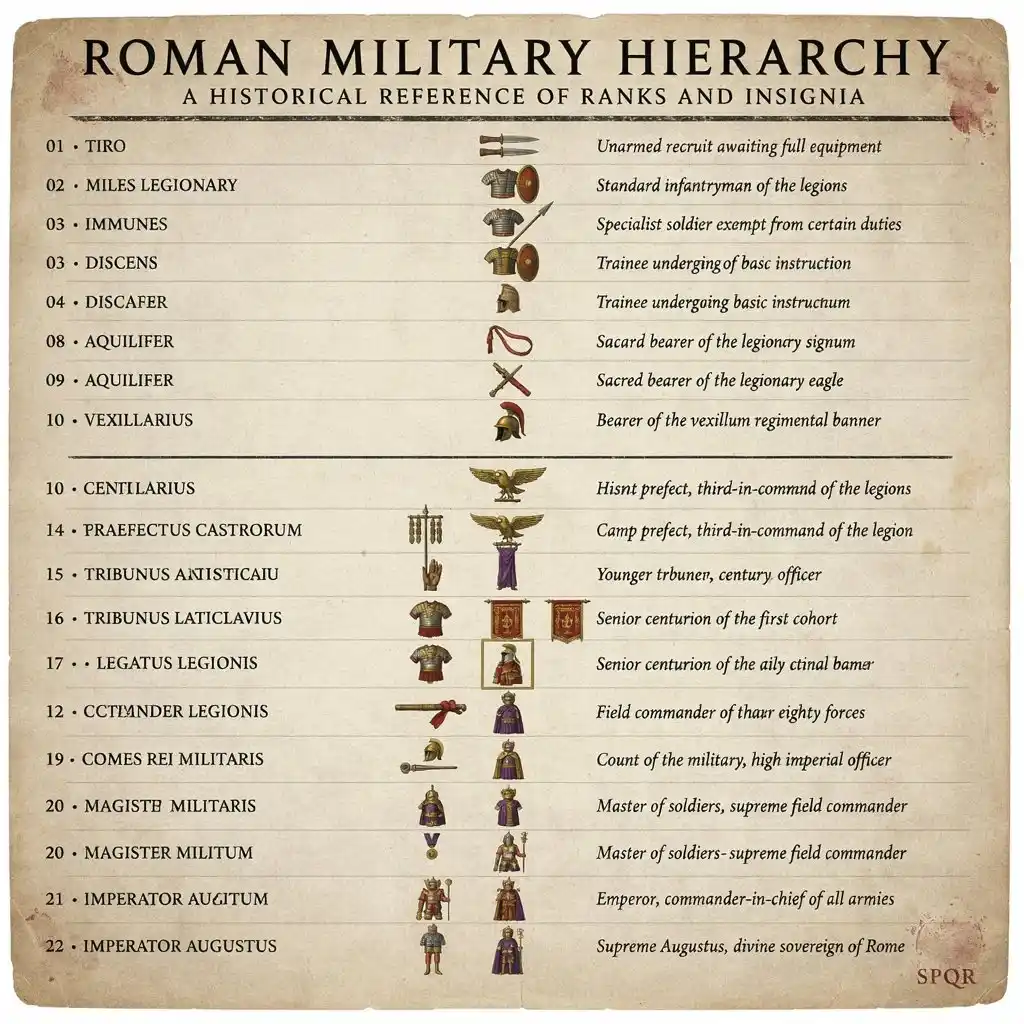
Summary Roman Military Ranks
Structured progression ensured a disciplined and skilled army: Beginning as a tiro and advancing through functional and leadership roles, Roman soldiers were systematically shaped into highly efficient warriors and specialists, blending physical endurance with technical expertise and leadership training.
Specialized roles balanced combat with logistics and administration: Immunes, desends, and camp prefects handled non-combat but crucial tasks such as engineering, medicine, and supply management, illustrating how Rome’s military success depended as much on logistical prowess as fighting ability.
Culture of Roman Military
Roman military culture balanced discipline, loyalty, and skill as the foundational pillars of its longevity: From the punishing tiro training to the responsibilities of senior commanders, each growth stage emphasized obedience, cohesion, and competence, forming a resilient war machine that lasted centuries.
1 thought on “Roman Military Ranks & Insignia”