The Indian Air Force (IAF) is the air arm of the Indian Armed Forces and one of the largest air forces in the world, with more than 170,000 personnel and a fleet of around 1,700 aircraft. Its rank structure, inherited from the Royal Air Force and adapted over decades of independent service, is one of the most distinctive in the world — built around sky-blue braids, the IAF eagle, and a clear three-tier hierarchy. Whether you are an aspirant preparing for the NDA, CDS, or AFCAT, or simply curious about military ranks, this complete guide lists every Indian Air Force rank in order, shows its insignia, and explains how promotion, pay, and the insignia system work in 2026.
IAF ranks fall into three groups: commissioned officers (from Flying Officer up to Air Chief Marshal), junior commissioned officers or JCOs (the senior leadership layer promoted from the airmen ranks), and airmen (the other ranks, including the Agniveervayu recruits inducted under the Agnipath scheme since 2022). Each group wears different insignia, and each follows a different career path — all explained below.
Commissioned Officer Ranks of the Indian Air Force
Commissioned officers hold the commission of the President of India. They command the IAF’s flying squadrons, air bases, and the seven commands — Western, Eastern, Central, Southern, South Western, Training, and Maintenance. Officer cadets train at the Air Force Academy (AFA) in Dundigal, Hyderabad, and are commissioned as Flying Officers on graduation. The table below lists every IAF officer rank from lowest to highest, with its insignia, NATO equivalent code, and approximate basic pay under the 7th Central Pay Commission.
| Insignia | Rank | NATO Code | Details |
|---|---|---|---|
 | Flying Officer | OF-1 | Entry rank on commissioning from the Air Force Academy. Approx. basic pay ₹56,100 (Pay Level 10). |
 | Flight Lieutenant | OF-2 | Reached after about 2 years of commissioned service. Approx. basic pay ₹61,300 (Pay Level 10B). |
 | Squadron Leader | OF-3 | Time-scale promotion after about 6 years. Often commands a flight or serves as a senior staff officer. Approx. basic pay ₹69,400 (Level 11). |
 | Wing Commander | OF-4 | First selection-grade rank, typically commanding a flying squadron. Approx. basic pay ₹1.21 lakh (Level 12A). |
 | Group Captain | OF-5 | Commands a major air base or large station. Approx. basic pay ₹1.31 lakh (Level 13). |
 | Air Commodore | OF-6 | Junior-most air officer rank; commands an air base or serves as a senior staff officer at command HQ. Approx. basic pay ₹1.40 lakh (Level 14). |
 | Air Vice Marshal | OF-7 | Two-star air officer, typically holding senior appointments at command or Air HQ. Approx. basic pay ₹1.44 lakh (Level 15). |
 | Air Marshal | OF-8 | Three-star rank; Air Officers Commanding-in-Chief of the operational commands are Air Marshals. Approx. basic pay ₹1.82 lakh (Level 16). |
 | Air Chief Marshal | OF-9 | Highest active rank, held by the Chief of the Air Staff (CAS), the professional head of the IAF. Pay fixed at ₹2.5 lakh (apex scale). |
 Marshal of the Indian Air Force is a ceremonial five-star rank (OF-10) above Air Chief Marshal. It has been conferred only once in history — on Arjan Singh in January 2002, honouring his leadership as Chief of the Air Staff during the 1965 Indo-Pak war. The rank is honorary and carries no command appointment; Arjan Singh remains the only officer ever to hold it.
Junior Commissioned Officers (JCOs) of the IAF
Junior Commissioned Officers form the vital middle leadership layer of the IAF. Unlike commissioned officers, JCOs are not granted the President’s commission — they are appointed (warranted) from the airmen ranks on the basis of seniority and merit, usually after 13 or more years of distinguished service. A JCO acts as the crucial link between officers and airmen: mentoring younger airmen, supervising technical trades, and upholding discipline at the unit level. The IAF has three JCO ranks, shown below with their shoulder insignia.
| Insignia | Rank | NATO Code | Details |
|---|---|---|---|
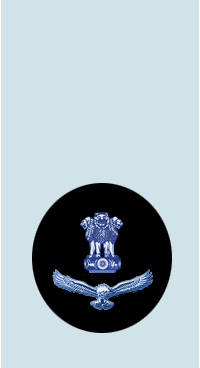 | Junior Warrant Officer (JWO) | OR-7 | First JCO rank, typically promoted from Sergeant. Supervises a section of airmen within a squadron. |
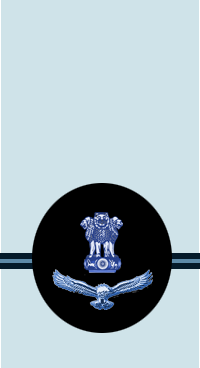 | Warrant Officer (WO) | OR-8 | Senior JCO rank with broad supervisory responsibility across a unit or trade. |
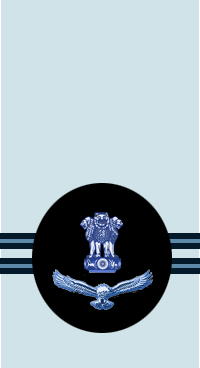 | Master Warrant Officer (MWO) | OR-9 | Highest JCO rank in the IAF; advises commanding officers on airmen’s welfare and discipline. |
Airmen Ranks of the IAF
Airmen are the other ranks of the Indian Air Force — the technicians, mechanics, administrators, and ground crew who keep aircraft flying and bases running. Recruitment to the airmen cadre is done through the Agnipath scheme (as Agniveervayu) and, earlier, through regular airman enrolment. Airmen wear their rank as chevrons on the sleeve, and the ranks run from Aircraftsman up to Sergeant, above which promotion leads into the JCO cadre.
| Insignia | Rank | NATO Code | Details |
|---|---|---|---|
| No insignia — recruits serve as Agniveervayu during the four-year Agnipath engagement | Agniveervayu | OR-1 | Entry-level recruit inducted under the Agnipath scheme (introduced 2022). After four years, up to 25% may be retained for full regular service. |
 | Aircraftsman (AC) | OR-2 | Junior-most airman rank after basic training; works under supervision in an assigned trade. |
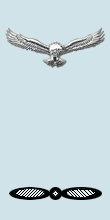 | Leading Aircraftsman (LAC) | OR-3 | Single chevron with propeller device; a trained airman competent in their trade. |
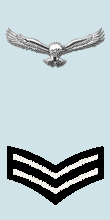 | Corporal (Cpl) | OR-4 | Two chevrons; first supervisory rank, leading small teams of junior airmen. |
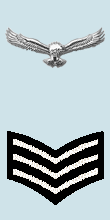 | Sergeant (Sgt) | OR-5 | Three chevrons; senior airman rank and the feeder rank for promotion to Junior Warrant Officer. |
How Promotion Works in the Indian Air Force
Promotion in the IAF follows two parallel systems: time-scale promotions for junior officers and selection-board promotions for senior ranks. A newly commissioned Flying Officer is promoted to Flight Lieutenant after about two years of service, and to Squadron Leader after about six years — these are essentially automatic, subject to satisfactory service. From Wing Commander upward, everything is by selection: promotion boards convened at Air Headquarters assess officers on performance reports, courses, and command potential, with typical service requirements of around 13 years for Wing Commander and longer for each subsequent rank.
Air officer ranks — Air Commodore and above — are filled by highly competitive selection boards, and only a small fraction of officers reach the general-officer equivalent tier. The Chief of the Air Staff is appointed by the government from among the senior-most Air Marshals. For airmen, promotion up to Corporal is largely seniority-based with trade tests, while Sergeant and the JCO ranks depend on merit, seniority, and available vacancies. Agniveervayu recruits face a separate process: at the end of the four-year engagement, up to 25 per cent are selected for enrolment as regular airmen based on merit and organisational requirements.
How to Read IAF Rank Insignia
IAF officer insignia is worn on light blue-grey shoulder boards (often called “sky blue” boards) on the service dress uniform, and as rank braids on the sleeves of the working dress. The defining symbol is the IAF eagle — a stylised eagle with outstretched wings that appears above the rank badges of senior officers and air officers. Junior officers display narrow sky-blue braids: one for Flying Officer, two for Flight Lieutenant, and three for Squadron Leader. From Wing Commander upward the braids grow wider, and air officers combine broad bands with the eagle and crossed sword-and-baton devices.
JCO insignia is worn on the shoulder straps and features chevrons with the national emblem and “IAF” titles, while airmen wear chevrons on the upper sleeve: three for Sergeant, two for Corporal, and one (with a propeller device) for Leading Aircraftsman. The overall colour scheme — sky blue on dark blue — immediately distinguishes IAF insignia from the olive green of the Army and the dark navy of the Navy.
Officers vs JCOs vs Airmen: What’s the Difference?
The three tiers differ in how members join, what authority they hold, and how far they can rise. Commissioned officers enter through the NDA (after 10+2), the CDS examination, or AFCAT, train at the Air Force Academy, and receive the President’s commission — making them gazetted officers with full command authority. They alone can command squadrons, bases, and the IAF itself.
JCOs begin as airmen and earn their warrant through years of exemplary service; they are the experienced backbone of every unit, translating officers’ orders into the technical work of the airmen, but they do not hold a commission and cannot command units. Airmen are the specialist workforce — enrolled (now largely as Agniveervayu) after 10+2, trained in one of dozens of technical and non-technical trades, from aircraft maintenance to administration. A bright airman can rise to Master Warrant Officer, and a limited number earn commissions as officers through in-service schemes.
Frequently Asked Questions
What is the highest rank in the Indian Air Force?
The highest active rank is Air Chief Marshal, held by the Chief of the Air Staff. Above it sits the honorary five-star rank of Marshal of the Indian Air Force, awarded only once — to Arjan Singh in 2002.
How long does it take to become a Squadron Leader in the IAF?
About six years of commissioned service. Promotion from Flying Officer to Flight Lieutenant takes roughly two years, and from Flight Lieutenant to Squadron Leader roughly four more years, both on a time scale.
What is an Agniveervayu?
An Agniveervayu is a recruit enrolled under the Agnipath scheme introduced in 2022. They serve a four-year engagement, after which up to 25% are retained for regular service as airmen based on merit.
What is the difference between an IAF officer and a JCO?
Officers hold the President of India’s commission, join through the NDA, CDS, or AFCAT, and can command units and formations. JCOs are appointed from the airmen ranks after long service; they supervise and mentor airmen but do not hold a commission.
How can I join the Indian Air Force as an officer?
The main entries are the NDA (after Class 12), the CDS examination (after graduation), and AFCAT (for graduates, including ground-duty and technical branches). All lead to training at the Air Force Academy, Dundigal.
Image credits: Rank insignia images via Wikimedia Commons, used under Creative Commons licences (CC BY 3.0); see file pages for attribution.