
Forces Guide · Medals Guide
On a parade ground, a soldier’s chest tells a story. Rows of small coloured ribbons — or, on the most formal occasions, gleaming metal medals — record where someone has served, what they have done, and how their country has chosen to honour them. To the untrained eye, medals and ribbons look like two names for the same thing. In reality, they are two halves of a single system, used at different times and for different reasons.
This guide explains what military medals and ribbons are, when each is worn, how the order of precedence works, and what some of the world’s most famous awards look like — so that the next time you see that coloured “fruit salad” on a uniform, you will know exactly what you are looking at.
What Is a Military Medal?
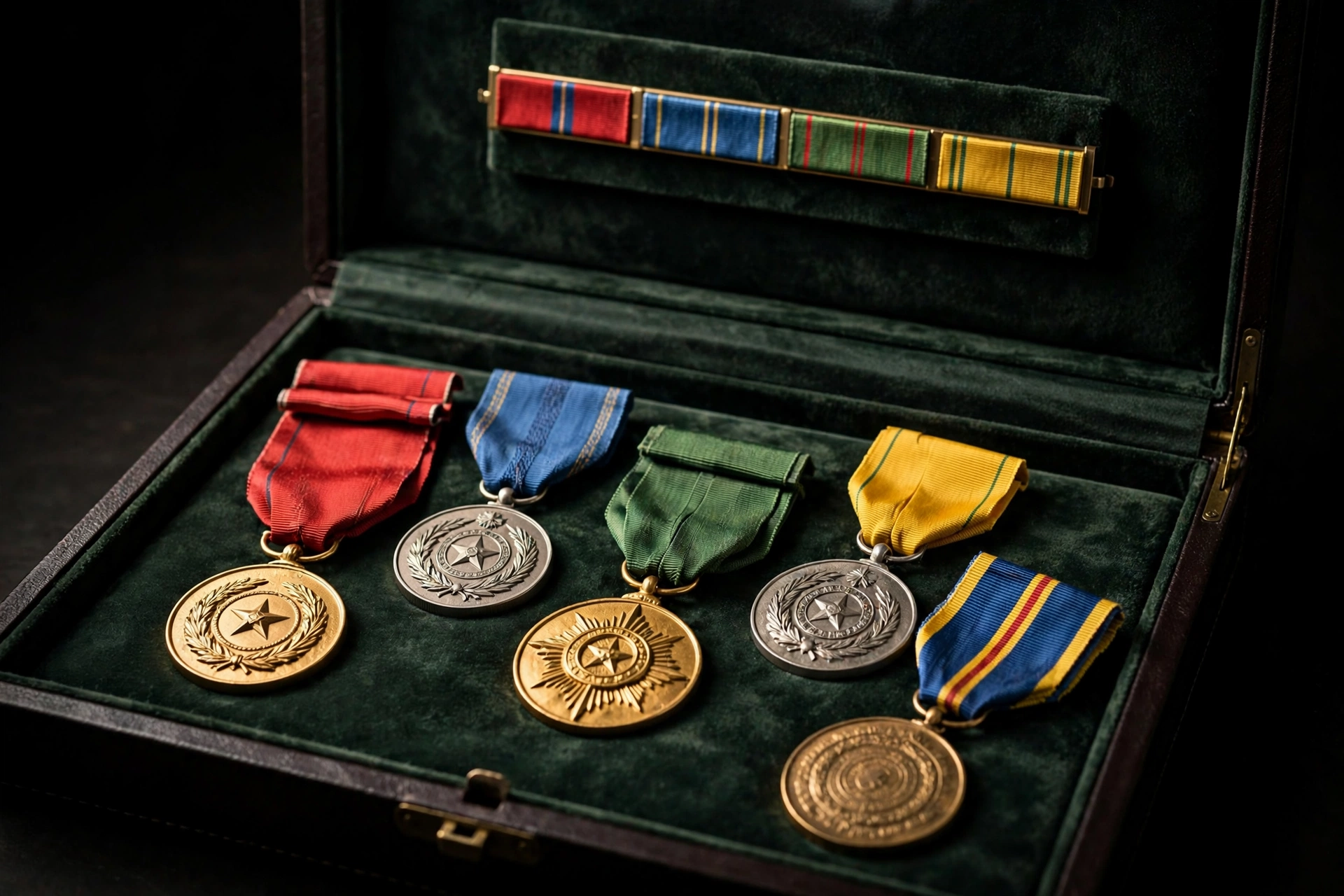
A military medal is the full-sized physical award: a piece of metal — usually a disc, star or cross — suspended from a ribbon, which is worn pinned to the left breast over the heart. Medals are struck for gallantry in battle, for distinguished or long service, and for taking part in campaigns and operations. Each medal has its own distinctive ribbon, and the metal part carries engraved or embossed designs that identify the country, the reign or the conflict it relates to.
Medals are the most formal expression of recognition a service member can wear. They are heavy, precious and often irreplaceable, presented at ceremonies by heads of state or senior commanders. Because of their value — and their fragility — full medals are reserved for the most formal occasions: state parades, remembrance ceremonies, mess functions and official photographs. A soldier who wears a full set of medals is showing the highest public form of their service record.
What Is a Military Ribbon?
A military ribbon — properly called a ribbon bar — is a small rectangular strip of the medal’s own distinctive ribbon, mounted on a bar and worn on everyday service dress. Each ribbon bar represents one medal exactly: same colours, same pattern, same honour, just without the metal. A soldier entitled to five medals will wear five ribbon bars, and they tell the identical story as the full medals.
The ribbon bar is the practical solution to a formal problem. Full medals clink, tarnish and weigh down a uniform — fine on parade, impossible in an office or on duty. Ribbon bars are light, neat and secure, which is why they are the standard form of decoration for daily service dress in most of the world’s armies, navies and air forces. When Americans slangily call a decorated chest “fruit salad”, this is what they mean: tidy rows of little coloured strips, each one standing in for a medal earned.
Medals vs Ribbons: The Key Differences
| Medal | Ribbon (ribbon bar) | |
|---|---|---|
| What it is | The full award: metal disc, star or cross hanging from a ribbon | A small rectangular strip of the medal’s own ribbon on a mounting bar |
| When worn | Ceremonial and formal occasions: parades, remembrance, state functions | Everyday service dress: daily duty, office wear, working uniforms |
| Size and weight | Large, heavy and precious — often several full sets mounted in rows | Light, compact and secure — typically rows of three or four per row |
| Cost and value | Genuine medals are valuable and irreplaceable; replicas cost money | Ribbon bars are inexpensive and easily replaced if lost |
| Who sees them | Reserved for the public’s eye on formal occasions | Seen daily by colleagues and the public on service dress |
| The rule | One award equals one medal; never worn together with its own ribbon bar | One award equals one ribbon bar; the ribbon is the medal in undress form |
When Are Full Medals Worn?
Full medals are the dress uniform of decorations. Soldiers mount them in rows on the left breast for ceremonial parades, investitures, remembrance services such as Remembrance Sunday, weddings in uniform, and formal mess events. On the most formal dress, medals are mounted “court style” — the ribbons folded neatly so the medals hang flat against the chest in a tidy grid, rather than swinging loose.
There are also the miniature medals: scaled-down versions, about half size, worn on mess dress — the smart evening uniform — where full-size medals would look out of proportion. Miniatures are a privilege of the evening, and like full medals they are worn in the exact order of precedence, on the left breast.
When Are Ribbons Worn?
Ribbon bars are the everyday face of military honours. On ordinary service dress — the uniform a soldier wears to work — the ribbon bars sit on the left breast in neat rows, each bar representing one decoration, in the same order of precedence as the medals themselves. Because they are small and light, they can be worn in barracks, offices and most working environments without fuss.
This is why ribbons are far more often seen than medals in day-to-day life. A photograph of soldiers on duty will show ribbon bars, not medals; the full medals come out only when the occasion is formal enough to demand them. The two are never mixed for the same award: if the medal is on the chest, its ribbon bar is not — and vice versa.
What Do the Colours on a Ribbon Mean?
Every medal’s ribbon is a code. The colours and stripes are chosen deliberately, and once you learn the language you can read a career at a glance. Some patterns are literal: campaign ribbons often carry the colours of the region or the nature of the operation, while long-service ribbons favour restrained, national colours.
Some of the most famous ribbons are instantly recognisable. The Victoria Cross is suspended from a deep crimson ribbon; the United States Medal of Honor hangs from a light blue ribbon scattered with white stars; Pakistan’s highest military award, the Nishan-e-Haider, hangs from its own ribbon in the national colours. Gallantry awards traditionally use bold, plain colours, while campaign medals often combine several stripes that hint at the theatre of operations. Designers choose these patterns carefully, because a ribbon must be legible across a room — the stripes are meant to be recognised, not merely admired.
Order of Precedence: Reading the Rows
Decorations are never worn in random order. Every country publishes an order of precedence — the official ranking that decides which medal sits first. The rule is universal in spirit: the most senior award goes in the position of greatest honour, and the rest follow in descending order.
In British and Commonwealth practice, medals are worn on the left breast, mounted with the most senior nearest the centre of the chest — the first row begins at the centre and works outward, and additional medals build into further rows above, each row holding the same number of medals. Gallantry awards such as the Victoria Cross always take pride of place, followed by other orders and decorations, then campaign medals, then long-service and coronation or jubilee medals. The American system works left to right from the wearer’s perspective, with the Medal of Honor first. Details vary by country, but the principle is identical worldwide: the rows are a hierarchy, and every soldier who reads them can tell in seconds which achievement their comrade’s country values most.
Did You Know?
- Medals are always worn on the left breast, over the heart — the oldest tradition in military decoration, surviving centuries of uniform change.
- The United States Medal of Honor is worn suspended from its ribbon around the neck in the Army’s version, the only American decoration displayed that way on the uniform.
- Ribbon bars became standard during the First World War, when soldiers needed a practical way to show honours without wearing fragile medals at the front.
- Family medals may be worn by relatives on the right breast on remembrance occasions — the right side distinguishes remembrance of others from honours earned yourself.
Famous Examples from Around the World
| Award | Country | Ribbon colours | Awarded for |
|---|---|---|---|
| Victoria Cross | United Kingdom & Commonwealth | Deep crimson | The highest award for gallantry in the face of the enemy |
| Medal of Honor | United States | Light blue with white stars | The highest US military decoration, for valour above and beyond |
| Nishan-e-Haider | Pakistan | National colours of green and white | Pakistan’s highest military award, for extraordinary heroism |
| Purple Heart | United States | Purple with white edges | Awarded to those wounded or killed in action |
| Campaign medals | Various | Striped theatre colours | Service in a named operation or conflict, worn after gallantry awards |
| Long Service medals | Various | Restrained national colours | Recognising years of faithful service, worn last in the order |
Frequently Asked Questions
Can you wear a medal and its ribbon bar at the same time?
No — never for the same award. The ribbon bar is simply the medal in its everyday form. You wear one or the other: full medals for ceremonial dress, ribbon bars for everyday service dress, and miniatures for mess dress.
Why don’t soldiers wear their medals every day?
Practicality. Full medals are heavy, delicate, noisy and expensive to replace. Ribbon bars show exactly the same honours in a light, secure form that survives daily duty — which is why they are the standard form of decoration for everyday wear.
Which side of the chest do medals go on?
The left, over the heart — in virtually every army in the world. The right breast is reserved, in British and Commonwealth tradition, for family medals worn by relatives on remembrance occasions, so the two are never confused.
What is a miniature medal?
A half-size replica of a full medal, worn on mess dress — the smart evening uniform. Miniatures are worn in the same order of precedence as full-size medals, and like them they replace the ribbon bars for that evening.
How can I tell what a particular ribbon is for?
Each medal has a unique ribbon pattern, so the colours and stripes identify the award. National medal registers and official lists publish every ribbon design — with a little practice you can match the most famous ones, like the Victoria Cross’s crimson, on sight.