
The Czech Republic has one of the neatest rank systems in NATO — and one of the easiest to misread. A Czech soldier’s rank is shown by small silver pips, silver rails, a single silver star, or golden stars worn on the chest of the battledress and on the epaulettes of the display uniform. There are no chevrons and no separate naval ladder to learn. This guide covers every Czech military rank, from Vojín (Private, OR-1) to Armádní generál (General of the Army, OF-9), for the Czech Land Forces and the Czech Air Force.
Czechia is landlocked and has no navy, so there is no admiral and no naval rank table here. The same twenty ranks are used across the whole Czech Armed Forces — Land Forces, Air Force, Special Forces, Information and Cyber Forces and Territorial Forces — with identical names in every branch. Only the cloth behind the insignia changes: khaki for the Land Forces, dark blue for the Air Force.
Key facts
- Country: Czech Republic (Czechia)
- Branches: Land Forces, Air Force, Special Forces, Information and Cyber Forces, Territorial Forces
- Other ranks: OR-1 to OR-9 (Vojín to Štábní praporčík)
- Commissioned officers: OF-1 to OF-9 (Poručík to Armádní generál)
- Highest rank: Armádní generál (General of the Army, OF-9) — there is no OF-10
- No navy: Czechia is landlocked, so there are no naval ranks at all
- Notable fact: junior officers’ three-pointed gold stars are nicknamed “Mercedeses”
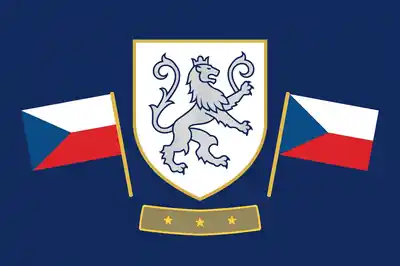
Czech ranks fall into two groups. Other ranks run OR-1 to OR-9 — soldiers, non-commissioned officers and warrant officers — and commissioned officers run OF-1 to OF-9. There is no OF-10: Armádní generál, at OF-9, is the highest rank in the country. The Czech names are the official ones; the English names here are the equivalents used by the Czech Ministry of Defence.
The force behind the ranks is the Armáda České republiky (AČR), the Army of the Czech Republic, in its current form since 1 January 1993, after the peaceful split of Czechoslovakia. It joined NATO in 1999, abolished conscription in 2004 and is now fully professional, with around 30,000 soldiers plus about 4,900 active reservists. Its ranks were brought into line with the NATO rank structure in their current form in 2011.
Czech Enlisted, NCO and Warrant Officer Ranks (OR-1 to OR-9)
The ten other ranks fall into three bands. The first is the troops, OR-1: a Vojín is a Private and a Svobodník is a Private First Class, the soldier who has finished basic training and is no longer the newest person in the unit.
The second band is the non-commissioned officers, OR-2 to OR-4: Desátník (Corporal), Četař (Sergeant) and Rotný (Staff Sergeant), the section and squad leaders who turn an officer’s orders into work done on the ground.
The third band is where the Czech system surprises English-speaking readers. From OR-5 upward the Czechs use a Warrant Corps: Rotmistr (Sergeant First Class, OR-5) and Nadrotmistr (Master Sergeant, OR-6), then the warrant officers proper — Praporčík (Warrant Officer, OR-7), Nadpraporčík (Senior Warrant Officer, OR-8) and Štábní praporčík (Chief Warrant Officer, OR-9), the most senior other rank in the force.
| Rank (Czech) | English Equivalent | NATO Code | Insignia | Typical Role |
|---|---|---|---|---|
| Vojín | Private | OR-1 | Silver pips | New soldier; entry-level rank after joining |
| Svobodník | Private First Class | OR-1 | Silver pips | Trained soldier; senior private in a section |
| Desátník | Corporal | OR-2 | Silver pips | Junior NCO; leads a small team |
| Četař | Sergeant | OR-3 | Silver pips | Section leader; trains and supervises soldiers |
| Rotný | Staff Sergeant | OR-4 | Silver pips | Senior NCO; deputy platoon leader or section leader |
| Rotmistr | Sergeant First Class | OR-5 | Silver rails | Senior NCO in the Warrant Corps; company-level specialist and leader |
| Nadrotmistr | Master Sergeant | OR-6 | Silver rails | Senior NCO; battalion-level technical and leadership role |
| Praporčík | Warrant Officer | OR-7 | Silver rails | Warrant officer; specialist leader and advisor |
| Nadpraporčík | Senior Warrant Officer | OR-8 | Silver rails | Senior warrant officer; experienced specialist advisor |
| Štábní praporčík | Chief Warrant Officer | OR-9 | Single silver star with silver bordering | Highest other rank; senior enlisted advisor to a commander |
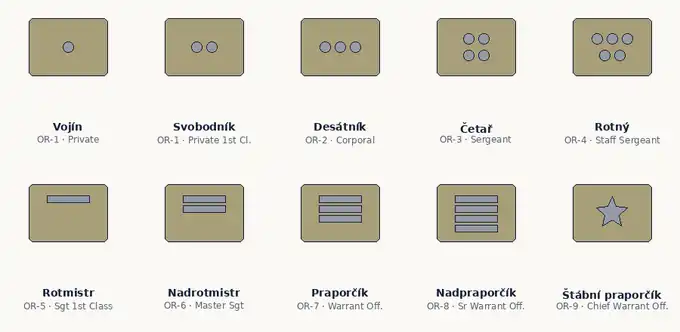
Did you know? From OR-5 upward the Czechs use a Warrant Corps — ranks that in the United States would still be senior NCOs. The most senior other rank, the Štábní praporčík (OR-9), is the only other rank to wear a star.
How to Read Czech Enlisted and Warrant Officer Insignia
Czech other-rank insignia uses only three devices:
- Silver pips — small silver discs worn by the troops and junior NCOs, from Vojín (OR-1) to Rotný (OR-4); the number rises with seniority.
- Silver rails — short silver bars worn by the Warrant Corps, from Rotmistr (OR-5) to Nadpraporčík (OR-8) — a clear step up from a pip.
- One silver star with silver bordering — the mark of the Štábní praporčík (OR-9) alone, the only other rank to wear a star.
- Khaki or dark blue backing — the cloth behind the device tells you the branch: khaki for the Land Forces, dark blue for the Air Force.
- Where it is worn — on the chest of the battledress, the beret or service hat, and the epaulettes of the display uniform — never on the sleeve.
The insignia carries no mark for corps or specialisation — that is shown by lapel badges and, to a degree, by beret colour. Two soldiers of the same rank in different corps wear the same rank insignia.
Czech Commissioned Officer Ranks (OF-1 to OF-9)
Commissioned officers are the commanders and staff officers of the Czech Armed Forces, and their ladder has ten rungs — although it starts with two ranks sharing one NATO code. Both Poručík (Second Lieutenant) and Nadporučík (First Lieutenant) are OF-1; the Nadporučík is simply the senior of the pair.
Above them, Kapitán (Captain, OF-2) commands a company, Major (OF-3) is a senior staff officer or deputy battalion commander, Podplukovník (Lieutenant Colonel, OF-4) commands a battalion, and Plukovník (Colonel, OF-5) commands a regiment or brigade or holds a senior staff post.
The four general ranks sit above the colonels: Brigádní generál (Brigadier General, OF-6), Generálmajor (Major General, OF-7), Generálporučík (Lieutenant General, OF-8) and Armádní generál (General of the Army, OF-9). The Chief of the General Staff is normally a general of this senior group.
| Rank (Czech) | English Equivalent | NATO Code | Insignia | Typical Role |
|---|---|---|---|---|
| Poručík | Second Lieutenant | OF-1 | Three-pointed golden stars (“Mercedeses”) | Platoon commander; entry-level commissioned officer |
| Nadporučík | First Lieutenant | OF-1 | Three-pointed golden stars (“Mercedeses”) | Platoon commander or company executive officer |
| Kapitán | Captain | OF-2 | Three-pointed golden stars (“Mercedeses”) | Company commander |
| Major | Major | OF-3 | Five-pointed golden stars with a single golden bar | Senior staff officer or deputy battalion commander |
| Podplukovník | Lieutenant Colonel | OF-4 | Five-pointed golden stars with a single golden bar | Battalion commander |
| Plukovník | Colonel | OF-5 | Five-pointed golden stars with a single golden bar | Regiment or brigade commander; senior staff officer |
| Brigádní generál | Brigadier General | OF-6 | Five-pointed golden stars with golden bordering | Brigade commander or senior staff appointment |
| Generálmajor | Major General | OF-7 | Five-pointed golden stars with golden bordering | Division-level commander or senior staff appointment |
| Generálporučík | Lieutenant General | OF-8 | Five-pointed golden stars with golden bordering | Senior commander or deputy chief of the General Staff |
| Armádní generál | General of the Army | OF-9 | Five-pointed golden stars with golden bordering | Highest rank in the Czech Armed Forces; Chief of the General Staff |
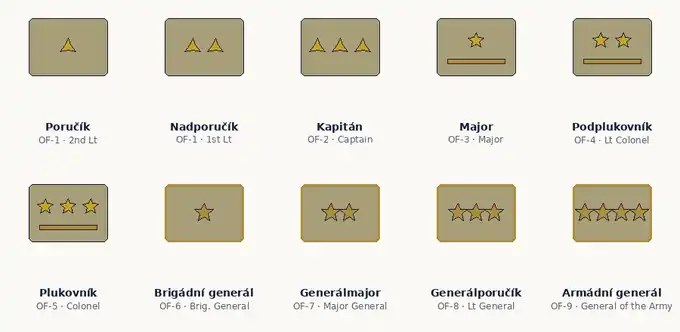
Key point: officer stars are gold, while other-rank devices are silver. That gold-versus-silver split is the fastest way to tell an officer from a warrant officer or NCO in a Czech uniform.
How to Read Czech Officer Insignia
Officer insignia follows a simple ladder of stars — and the shape of the star matters as much as the number:
- Three-pointed golden stars — worn by the junior officers, Poručík, Nadporučík and Kapitán (OF-1 and OF-2). Czech soldiers call them “Mercedeses”, after the three-pointed star of the Mercedes-Benz badge. The number rises with each step.
- Five-pointed golden stars with a single golden bar — worn by the senior officers, Major, Podplukovník and Plukovník (OF-3 to OF-5). The bar is the giveaway: a gold bar under the stars means a field-grade officer. Stars rise from one for a Major to three for a Plukovník.
- Five-pointed golden stars with golden bordering — worn by the generals, from Brigádní generál (OF-6) to Armádní generál (OF-9). The border separates a general from a colonel at a glance — one star for a Brigadier General, rising to four for the General of the Army.
- Gold, not silver — unlike the other ranks, whose devices are silver, officer stars are gold — the fastest way to tell an officer from an NCO or warrant officer.
- No OF-10 — there is no Czech equivalent of a five-star general or field marshal; OF-9 is the ceiling, held by very few officers at any one time.
Czech Army and Czech Air Force: Same Ranks, Different Cloth
The Czech Land Forces (Pozemní síly) and the Czech Air Force (Vzdušné síly) use exactly the same rank names, NATO codes and devices. A Kapitán in the Air Force is a Kapitán in the Army, and a Rotmistr in a fighter squadron holds the same rank as a Rotmistr in a mechanised battalion. The difference is presentation: the Air Force wears its insignia against a dark blue fabric, the Land Forces against khaki — on the battledress the same distinction applies to the chest badge.
The Air Force is the smaller service, built around fighter, transport and helicopter units — its best-known aircraft are the JAS 39 Gripen fighters — while the Land Forces provide the mechanised brigades, artillery, engineers and air defence. The other parts of the Armed Forces — Special Forces, Information and Cyber Forces and Territorial Forces — use the same twenty ranks, so the tables here cover the whole force.
Czech Military Badges and Emblems
Rank insignia shows a soldier’s grade. Badges show what that soldier is qualified to do, and are worn separately. The most visible is the national emblem — the Czech lion — worn as a cap badge, which marks the wearer as a soldier of the Czech Republic rather than showing any rank. Branch and corps identity is shown by lapel badges on the display uniform.
Aircrew wear pilot wings, parachute-qualified soldiers wear a parachutist badge, and other specialist qualifications are likewise marked by badges rather than by any change to the rank insignia. Read the stars, pips and rails for the rank, and the badges for the job.
How Promotion Works in the Czech Armed Forces
Promotion is not automatic with time served. Because the force has been fully professional since conscription was abolished in 2004, every promotion is a competition for a vacancy: a soldier must hold the qualifications and education for the next rank, have served well in the current one, and be selected for a post that carries the higher rank.
A soldier enters as a Vojín and is promoted through the NCO ranks as they take on leadership of larger groups, with the most experienced NCOs moving into the Warrant Corps. Officers, who normally enter through military education at the University of Defence in Brno, advance from Poručík through Kapitán and the field ranks as they take command of larger units — platoon, company, battalion, regiment — with staff appointments and further study in between. Promotion to general is by selection at the highest level, and the number of generals is small.
A Note on Czech Military Tradition
The Czech rank system is older than the Czech Republic itself. It goes back to the military of the First Czechoslovak Republic, where this form of insignia was introduced in the 1930s. The communist era broke with it in the 1950s, when the Czechoslovak People’s Army adopted insignia copied from the Soviet Army, but the original model was restored in the 1960s. The reforms that produced the present system in 2011 aligned Czech ranks with the NATO structure the country had joined in 1999.
That history explains what makes Czech ranks distinctive: the three-pointed “Mercedes” star, surviving from the 1930s with no equivalent in other NATO armies, and the Warrant Corps, which preserves a Central European idea of the senior soldier as a warrant officer. The system is fully NATO-compatible through its OF and OR codes, and unmistakably Czech in appearance.
For comparison with other NATO and world armies, see our guides to US Navy ranks, the US military branches, the US military uniform, German Army ranks and French military ranks.
Read next
German Army Ranks · French Military Ranks · US Navy Ranks · US Military Branches
FAQs
What is the highest rank in the Czech military?
Armádní generál — General of the Army — at NATO code OF-9. There is no OF-10 rank in the Czech system, so OF-9 is the ceiling. The highest other rank is Štábní praporčík (Chief Warrant Officer, OR-9).
Does the Czech Republic have a navy?
No. Czechia is a landlocked country with no coastline and no navy. Its Armed Forces consist of the Land Forces, the Air Force, the Special Forces, the Information and Cyber Forces and the Territorial Forces, and all of them use the same twenty ranks covered in this guide.
Are Czech Army and Czech Air Force ranks the same?
Yes. The rank names, NATO codes and insignia devices are identical in the Army and the Air Force. The only difference is the backing cloth on the display uniform and battledress: khaki for the Land Forces and dark blue for the Air Force.
What does “Mercedes” mean in Czech military ranks?
It is the soldiers’ nickname for the three-pointed golden stars worn by junior officers (Poručík, Nadporučík and Kapitán), because the three-pointed star resembles the Mercedes-Benz badge. Senior officers wear five-pointed stars instead, and generals wear five-pointed stars with golden bordering.
What is the difference between a Rotmistr and a Praporčík?
Both are in the Czech Warrant Corps, but they sit at different points in it. Rotmistr (Sergeant First Class, OR-5) and Nadrotmistr (Master Sergeant, OR-6) are senior NCO appointments within the corps, while Praporčík (Warrant Officer, OR-7), Nadpraporčík (OR-8) and Štábní praporčík (OR-9) are the warrant officer ranks proper. All of them wear silver rails, except the OR-9, who wears a single silver star.
How many ranks are there in the Czech military?
Twenty in total: ten commissioned officer ranks (OF-1 to OF-9, with two ranks at OF-1) and ten other ranks (OR-1 to OR-9, with two ranks at OR-1). The same twenty ranks are used across all branches of the Czech Armed Forces.
When did the Czech Republic join NATO?
In March 1999, together with Poland and Hungary. The current form of the Czech rank system was adopted in 2011 to bring it fully into line with the NATO OF/OR rank structure.
All insignia diagrams and images in this article are original graphics created for Forces Guide.