Romania’s soldiers, sailors and airmen all wear the same rank system — and you read it from their shoulders. A Romanian service member’s grade is shown by braids and stars on shoulder boards, in gold for officers, silver for senior non-commissioned officers and warrant officers, and yellow silk for junior NCOs and enlisted personnel. This guide covers every Romanian military rank with its insignia, from Soldat (OR-2) to Mareșal (OF-10), across the Land Forces, the Naval Forces and the Air Force, with the NATO code for each grade.
Romanian ranks fall into three groups: commissioned officers (OF-1 to OF-10, plus the student grade OF(D)), warrant officers called maiștri militari (OR-5 to OR-9) and other ranks — non-commissioned officers and enlisted personnel (OR-2 to OR-9). The three services share the same ladder, but the Navy and the Air Force use their own rank titles at officer level, just as navies and air forces do around the world.
Romania has been a NATO member since 2004, and its grades are mapped to the NATO OF and OR scales under STANAG 2116, so a Romanian Colonel and an American Colonel are both OF-5 even though their insignia look nothing alike.
Key facts
- Country: Romania
- Branches: Land Forces, Naval Forces and Air Force
- Commissioned officers: OF(D) to OF-10 (Sublocotenent/Aspirant to Mareșal)
- Warrant officers: OR-5 to OR-9 (Maistru militar clasa V to principal)
- Other ranks: OR-2 to OR-9 (Soldat to Plutonier adjutant principal) — there is no OR-1
- Highest rank: Mareșal (OF-10), a wartime and honorary grade; the highest rank in active service is General/Amiral (OF-9)
- NATO member: since 2004, with all grades mapped to the NATO OF and OR scales under STANAG 2116

Romanian Commissioned Officer Ranks (OF-1 to OF-10)
Romanian officers lead at every level, from a platoon of thirty soldiers to the whole of the armed forces. Junior officers (OF-1 to OF-3) command platoons and companies; senior officers (OF-4 to OF-6) command battalions, regiments and brigades; general and flag officers (OF-6 to OF-10) command divisions, fleets and the Defence Staff itself.
One quirk catches out visitors: in Romania, Căpitan is OF-2 and Locotenent is OF-1 — the whole company-grade ladder sits one NATO step lower than the familiar American pattern, and the most junior commissioned grade is Sublocotenent (or Aspirant in the Navy), which NATO classes as OF(D), an officer designate.
| NATO Code | Land Forces | Naval Forces | Air Force | Typical Role |
|---|---|---|---|---|
| OF-10 | Mareșal | Mareșal | Mareșal | Marshal; the highest rank, reserved for wartime and exceptional honour |
| OF-9 | General | Amiral | General | Chief of the Defence Staff; service chief |
| OF-8 | General-locotenent | Viceamiral | General-locotenent | Deputy chief of staff; corps or fleet commander |
| OF-7 | General-maior | Contraamiral | General-maior | Division commander; senior staff appointment |
| OF-6 | General de brigadă | Contraamiral de flotilă | General de flotilă aeriană | Brigade commander; flotilla commander |
| OF-5 | Colonel | Comandor | Comandor | Regiment or base commander; senior staff officer |
| OF-4 | Locotenent-colonel | Căpitan-comandor | Căpitan-comandor | Battalion commander; ship’s commanding officer |
| OF-3 | Maior | Locotenent-comandor | Locotenent-comandor | Battalion executive officer; department head on a warship |
| OF-2 | Căpitan | Căpitan | Căpitan | Company commander; flight commander |
| OF-1 | Locotenent | Locotenent | Locotenent | Platoon commander; junior watch officer |
| OF(D) | Sublocotenent | Aspirant | Sublocotenent | Newly commissioned officer; entry-level grade |
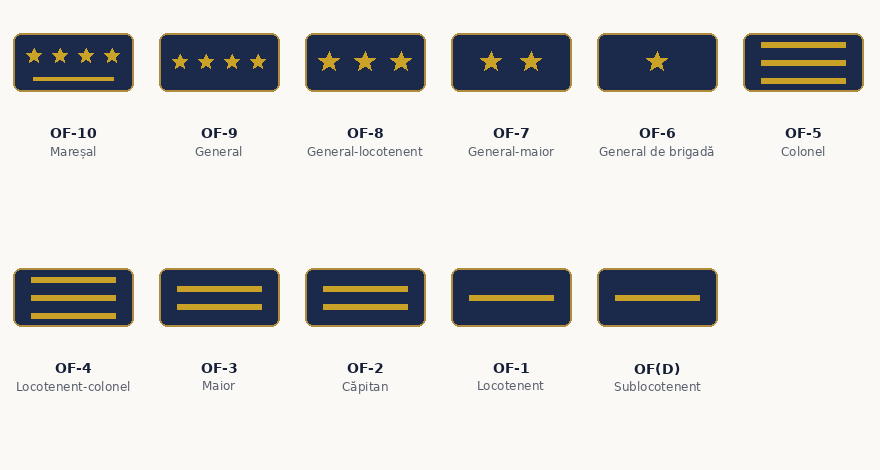
Did you know? In Romania, Căpitan is OF-2 and Locotenent is OF-1 — one NATO step lower than the familiar American Captain (O-3) and First Lieutenant (O-2).
How to Read Romanian Officer Insignia
Romanian officer rank is worn on the shoulder of the jacket, coat and shirt, as braids (galoane or trese) on a shoulder board. Once you know the code, the board tells you the grade at a glance:
- Gold braids — all commissioned officers wear gold braids. The braids grow in number and width as the grade rises, from a single narrow braid for a Sublocotenent to the broad braids of a Colonel.
- Stars for generals — general and flag officers are marked by stars rather than by braids alone. The number of stars rises with the grade, from one star for a General de brigadă up to four stars for a General or Amiral.
- Sleeve stripes — Air Force and Naval officers also wear their rank on the sleeve. Look at the topmost braid: in the Air Force it is folded into the shape of a rhombus (a diamond), in the Navy it ends in the traditional executive curl, and in parachute units it is folded into an open parachute.
- Branch colour — the shoulder board sits on a coloured backing that shows the wearer’s branch: red for infantry and for generals of the Land Forces, light blue for the Air Force and paratroopers, and black for the Naval Forces, artillery, tanks and engineers. A small branch badge (semn de armă) is worn next to the rank on the shoulder slide.
- The OF(D) grade — Sublocotenent and Aspirant are the first commissioned grades, held by officers fresh from the military academies. NATO counts them as officer designates rather than full OF-1, which is why Locotenent, not Sublocotenent, is the Romanian OF-1.
Romanian Warrant Officer Ranks (Maistru Militar, OR-5 to OR-9)
Between the officers and the NCOs sits a group with no direct American equivalent: the maiștri militari, literally “military masters”. They are highly trained technical specialists — the people who keep aircraft flying, ships’ engines running and complex weapons systems working.
A maistru militar is a warrant officer, not a commissioned officer, and the grade runs from clasa V (the most junior) up to principal. The same six titles are used in all three services.
| NATO Code | Rank | Insignia | Typical Role |
|---|---|---|---|
| OR-9 | Maistru militar principal | Star insignia, silver (yellow in the Navy) | Master technician; senior specialist advisor |
| OR-9 | Maistru militar clasa I | Star insignia, silver (yellow in the Navy) | First-class technical specialist |
| OR-8 | Maistru militar clasa II | Star insignia, silver (yellow in the Navy) | Experienced technical specialist |
| OR-7 | Maistru militar clasa III | Star insignia, silver (yellow in the Navy) | Qualified technical specialist |
| OR-6 | Maistru militar clasa IV | Star insignia, silver (yellow in the Navy) | Technical specialist building experience |
| OR-5 | Maistru militar clasa V | Star insignia, silver (yellow in the Navy) | Newly qualified technical specialist |
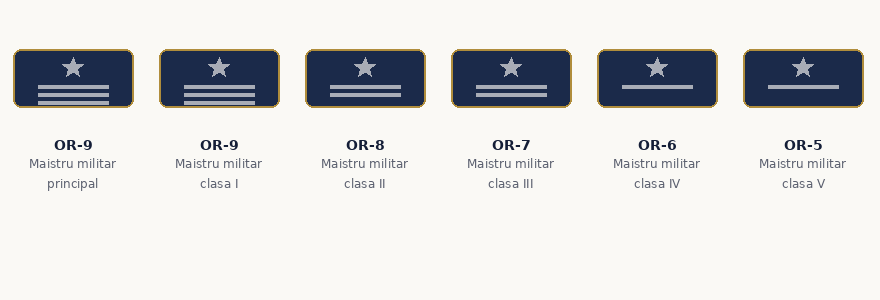
Key point: note the two ranks at OR-9: Maistru militar principal and Maistru militar clasa I share the top NATO grade, just as two of the senior NCO ranks share OR-9 below. Counting down the classes is also a small trap for outsiders — clasa I is senior to clasa V, so the numbers run in the opposite direction to what an English speaker might expect.
Romanian NCO and Enlisted Ranks (OR-2 to OR-9)
The other ranks are the backbone of the Romanian Armed Forces, and — unusually — the same eleven titles are used in the Land Forces, the Naval Forces and the Air Force. Senior NCOs hold the plutonier grades, a title that comes from the French peloton (platoon).
At the top of the ladder, Plutonier adjutant principal is the Romanian equivalent of a Sergeant Major or Command Sergeant Major, the senior enlisted advisor to a commanding officer.
| NATO Code | Rank | Insignia | Typical Role |
|---|---|---|---|
| OR-9 | Plutonier adjutant principal | Silver braids | Senior enlisted advisor at brigade level and above |
| OR-9 | Plutonier adjutant | Silver braids | Senior enlisted advisor at battalion level |
| OR-8 | Plutonier-major | Silver braids | Senior NCO; company sergeant major |
| OR-7 | Plutonier | Silver braids | Platoon sergeant; section leader |
| OR-6 | Sergent-major | Silver braids | Senior sergeant; deputy platoon leader |
| OR-5 | Sergent | Yellow silk braids | Squad leader; first NCO grade |
| OR-4 | Caporal clasa I | Yellow silk braids | Senior corporal; team leader |
| OR-4 | Caporal clasa a II-a | Yellow silk braids | Corporal; team leader |
| OR-4 | Caporal clasa a III-a | Yellow silk braids | Junior corporal |
| OR-3 | Fruntaș | Yellow silk braids | Senior private; lance corporal equivalent |
| OR-2 | Soldat | Yellow silk braids (no insignia in the Navy) | New soldier, sailor or airman; entry-level rank |
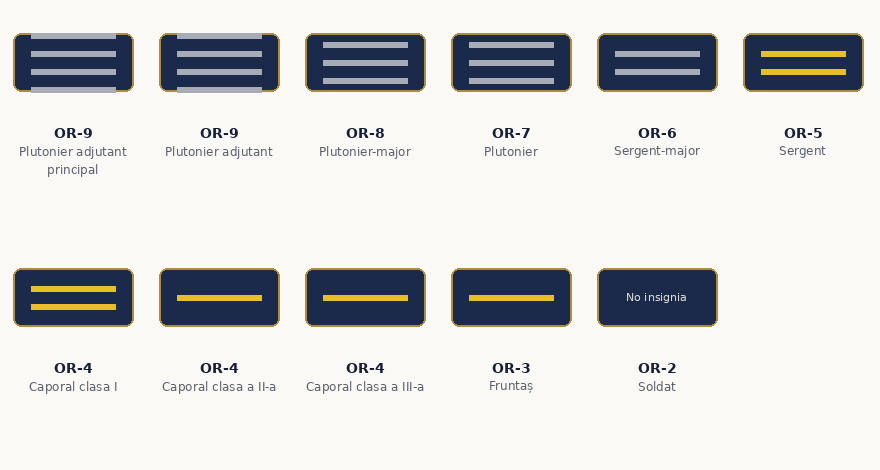
Did you know? Romania has no OR-1 grade — Soldat (OR-2) is the lowest rank, and in the Naval Forces even a Soldat wears no insignia.
How to Read Romanian Enlisted and NCO Insignia
Like the officers, NCOs and enlisted personnel wear their rank on the shoulder, and the metal — or silk — tells you which half of the ladder you are looking at:
- Silver braids — the senior NCO grades, from Sergent-major up through the plutonier ranks, wear silver braids on their shoulder boards. The broader and more numerous the braids, the more senior the grade.
- Yellow silk braids — sergeants, corporals, fruntași and soldiers wear braids of yellow silk. The colour is the giveaway: yellow means the junior half of the ladder, silver means the senior half.
- Two ranks at OR-9, three at OR-4 — Romania has eleven other ranks but only eight NATO grades from OR-2 to OR-9, so grades are shared. Plutonier adjutant principal and Plutonier adjutant are both OR-9, and all three classes of Caporal are OR-4. The same sharing happens among the warrant officers at OR-9.
- No OR-1 — Romania has no OR-1 grade at all. The lowest rank in the armed forces is Soldat at OR-2, the equivalent of a Private, and in the Naval Forces even that rank wears no insignia.
- Fruntaș — the rank between Soldat and Caporal is Fruntaș, roughly a Private First Class or Lance Corporal, a soldier with some service behind them but not yet an NCO.
Branch Colours and Shoulder Boards
Romanian rank insignia never appears on its own: the colour behind it and the small badge beside it say which branch the wearer belongs to. The branch (armă) colours are fixed by regulation and show on the shoulder slides, on the band of the combination cap and on collar insignia:
- Red — Marshals, generals of the Land Forces, infantry and military music
- Light blue — the Air Force, paratroopers and radar troops
- Black — the Naval Forces, artillery, tanks, military automobile troops, anti-aircraft artillery and missiles, communications and informatics, engineers and NBC defence
- Burgundy red — military medicine, including its generals
- Green — mountain troops (vânători de munte)
- Violet — military logistics and administration
- Dark blue / dark violet — military justice, including its generals
- Grey — military police
Because several branches share a colour — black, for example, covers the Navy, the artillery, the tanks and the engineers — each branch also has its own distinctive branch insignia (semne de armă), worn next to the rank on the shoulder slide. The same ranks and basic insignia are used beyond the armed forces proper: the Romanian Gendarmerie, a military force, uses the Land Forces system (with Jandarm in place of Soldat and a single grade of Caporal), as does the Military Firefighters Corps.
Romanian Military Badges and Emblems
Rank insignia shows a Romanian service member’s grade. Badges show what they are qualified to do and which branch they belong to. The most important are:
- Branch insignia (semne de armă) — the small metal badge worn beside the rank on the shoulder slide, identifying the wearer’s branch: crossed rifles for the infantry, crossed cannons for the artillery, wings for the Air Force, an anchor for the Navy, and so on. It is the detail that separates two soldiers whose boards are otherwise identical.
- Sleeve rank distinctions — the folded top braid on the sleeve: a rhombus for Air Force officers, the executive curl for Naval officers and an open parachute for paratroopers. These are rank markings, not decorations, but they are the quickest way to tell a sailor’s sleeve from an airman’s.
- Parachutist badge — worn by soldiers qualified in military parachuting, including the paratroopers whose sleeve braids are folded into the open-parachute shape.
- Breast badges and qualification wings — pilots wear wings, and specialists in fields such as mountain warfare, diving and military medicine wear their own qualification badges on the chest, above the medals.
- Cap insignia — the combination cap carries the branch colour on its band, so the branch is readable from the headgear as well as from the shoulder.
How Promotion Works in the Romanian Armed Forces
Promotion in Romania mixes time in grade, professional schooling and vacancies, and the path depends on which of the three groups a service member belongs to. Officers are commissioned after graduating from one of the military academies — the “Nicolae Bălcescu” Land Forces Academy in Sibiu, the “Mircea cel Bătrân” Naval Academy in Constanța or the “Henri Coandă” Air Force Academy in Brașov — and enter service as Sublocotenent or Aspirant.
From there they advance grade by grade, with command appointments and staff college courses as the gates that matter most: company command as a Căpitan, battalion command as a Locotenent-colonel, and brigade command as a General de brigadă.
Non-commissioned officers come up through the NCO schools and advance from Soldat through Fruntaș, the Caporal classes and Sergent, with the plutonier grades marking the senior NCO career. Promotion to Plutonier adjutant and Plutonier adjutant principal is selective and tied to senior enlisted appointments.
Maiștri militari follow a technical track of their own, qualifying through specialist schools and rising through the five classes to principal on the strength of technical competence rather than command. In all three tracks, a promotion needs a vacant post at the higher grade as well as the time and qualifications — the ladder is competitive, not automatic.
A Note on Romanian Military Tradition
Two things explain almost everything about Romanian ranks. The first is the French influence: Romania’s modern army was built in the nineteenth century on the French model, which is why so many titles will look familiar to anyone who knows the French system — Locotenent, Căpitan, Colonel, Plutonier and Sergent all descend from French originals, and Mareșal is the same word as Marshal. The second is the NATO alignment: since joining the Alliance in 2004, Romania has mapped every grade to the NATO OF and OR scales, so Romanian officers and NCOs slot into multinational headquarters alongside their allies without confusion.
The rank of Mareșal itself is part of that history. It is the highest grade in the Romanian system, but it is a wartime and honorary rank — it was held by the kings Carol I and Ferdinand I and by Marshal Ion Antonescu in the Second World War, and it has not been held by a serving officer in modern times.
The highest rank in active service is General (OF-9), held by the Chief of the Defence Staff. That restraint is part of the character of the system: eleven officer grades, six warrant grades and eleven other ranks, all read from a shoulder board, with nothing on display that the wearer has not earned.
For comparison with other services, see our guides to US Navy ranks, US Marine Corps ranks, French military ranks, German Army ranks, the US military uniform and the US military branches.
Read next
US Navy Ranks · US Marine Corps Ranks · French Military Ranks · German Army Ranks
FAQs
What is the highest rank in the Romanian military?
Mareșal (OF-10), the equivalent of a Marshal or a five-star general. It is a wartime and honorary rank that has not been held by a serving officer in modern times; the highest rank in active service is General (OF-9) in the Land Forces and Air Force, and Amiral (OF-9) in the Naval Forces.
What is the Romanian equivalent of a US Sergeant Major?
Plutonier adjutant principal (OR-9), the most senior NCO grade. It is the senior enlisted advisor at brigade level and above, the same role a Command Sergeant Major fills in the US Army. Plutonier adjutant (also OR-9) is the equivalent at battalion level.
Do Romanian Navy officers have different rank names?
Yes. Naval officers use Amiral, Viceamiral, Contraamiral, Contraamiral de flotilă, Comandor, Căpitan-comandor and Locotenent-comandor, while the Land Forces and Air Force use General, General-locotenent, General-maior, General de brigadă (or General de flotilă aeriană in the Air Force), Colonel, Locotenent-colonel and Maior. The lowest naval officer grade is Aspirant, where the other services use Sublocotenent.
What does “Maistru militar” mean?
It means “military master” — a warrant officer and technical specialist. Maiștri militari keep complex equipment working: aircraft, ships’ engines, radar and weapons systems. They hold six grades from clasa V up to principal, with clasa I senior to clasa V.
Why do Romanian ranks sound French?
Because Romania built its modern army in the nineteenth century on the French model. Titles such as Locotenent, Căpitan, Colonel, Plutonier and Sergent all come from French originals, and the system was later aligned to NATO grades when Romania joined the Alliance in 2004.
What is the lowest rank in the Romanian Armed Forces?
Soldat (OR-2), the equivalent of a Private. Romania has no OR-1 grade, and in the Naval Forces a Soldat wears no rank insignia at all. Above Soldat comes Fruntaș (OR-3), roughly a Private First Class, and then the three classes of Caporal (OR-4).
How can you tell a Romanian general from other officers?
By the stars on the shoulder board. General officers wear star insignia instead of braids alone, with the number of stars rising from one for a General de brigadă to four for a General or Amiral. The shoulder board also sits on a red backing for generals of the Land Forces.
All insignia diagrams and images in this article are original graphics created for Forces Guide.