
Denmark’s armed forces use one of the most distinctive rank systems in NATO. A Danish soldier’s rank is read from gold stars on a shoulder strap or gold chevrons on a sleeve — and a Danish sailor’s rank from broad and narrow gold bands around the cuff, a tradition borrowed from the Royal Navy more than 150 years ago.
This guide covers every Danish military rank with its insignia, from Konstabel (OR-1) to General and Admiral (OF-9), across the Royal Danish Army, the Royal Danish Navy and the Royal Danish Air Force.
Danish ranks follow the NATO system of OF (officer) and OR (other ranks) grades set out in STANAG 2116, but the names are Denmark’s own — drawn from German and French military terms — and the structure has two quirks that catch out newcomers: there is no OF-10 and no OR-6 in the Danish system, and the very top ranks are tied to specific appointments rather than open to promotion. In total there are 60 ranks across the three services: 11 officer ranks and 9 other ranks in the Army alone.
Key facts
- Country: Denmark
- Branches: Royal Danish Army, Royal Danish Navy and Royal Danish Air Force (the Danish Defence, Forsvaret)
- Officer ranks: OF-1 to OF-9 (Sekondløjtnant to General / Admiral)
- Other ranks: OR-1 to OR-9 (Konstabel to Chefsergent)
- Highest rank: General (Army and Air Force) and Admiral (Navy), both OF-9
- Notable quirk: Denmark has no OF-10 and no OR-6 — the ladder jumps straight from OR-7 to OR-5
- Top ranks: General and Admiral are tied to appointments — the Chief of Defence and the Monarch — not open to promotion
Danish Military Ranks at a Glance
The Danish Defence (Forsvaret) divides its people into two broad groups. Befalingsmænd — literally “commanders” — covers everyone who commands, split into officerer (commissioned officers, OF-1 to OF-9) and underofficerer (sub-officers, the senior NCOs at OR-5 to OR-9). Menige — “privates” — covers the manual level, OR-1 to OR-4.
Each rank also carries a Danish pay grade, an “M” number: M400-level for the executive ranks, M200-level for NCOs and M100-level for privates.
Officers themselves fall into two levels. The leadership level (Chefniveau, OF-9 to OF-4) holds the generals, admirals and senior field officers who command formations and staffs. The management level (Lederniveau, OF-3 to OF-1) holds the majors, captains and lieutenants who run companies, ships’ departments and flights day to day.
The table below is the key to everything that follows: the NATO code is the same in every NATO country, so an OF-5 in Denmark is the equal of a Colonel in Britain or the United States, whatever the Danish title says.
Danish Army and Air Force Officer Ranks (OF-9 to OF-1)
The Royal Danish Army and the Royal Danish Air Force use exactly the same officer titles. The highest rank, General, is reserved for the Monarch and for the Chief of Defence, and only when that post is held by an Army or Air Force officer. Below it, Generalløjtnant (Lieutenant General) is held by the Chief of the Defense Staff and the Chief of Acquisition, while Generalmajor (Major General) is now the rank of the Chief of the Royal Danish Army.
The most junior general’s rank, Brigadegeneral (Brigadier General), was only introduced in 1983, when Denmark adapted to STANAG 2116; it goes to deputy branch chiefs, the Surgeon General and brigade commanders.
| Rank | NATO Code | Pay Grade | Typical Role |
|---|---|---|---|
| General | OF-9 | M406 | Chief of Defence or the Monarch; the highest rank in the Danish military |
| Generalløjtnant | OF-8 | M405 | Chief of the Defense Staff; Chief of Acquisition; National Armaments Director |
| Generalmajor | OF-7 | M404 | Branch chief, including Chief of the Royal Danish Army |
| Brigadegeneral | OF-6 | M403 | Brigade commander; deputy branch chief; Surgeon General |
| Oberst | OF-5 | M402 | Regiment commander or senior staff officer |
| Oberstløjtnant | OF-4 | M401 | Battalion commander or senior staff officer |
| Major | OF-3 | M332 / M331 / M322 | Battalion executive officer; staff officer; company commander |
| Kaptajn | OF-2 | M321 | Company commander or staff officer |
| Premierløjtnant | OF-1 | M312 | Platoon commander; first lieutenant |
| Løjtnant | OF-1 | M311 | Platoon commander; junior lieutenant |
| Sekondløjtnant | OF-1 | M310 | Entry-level commissioned officer; second lieutenant |
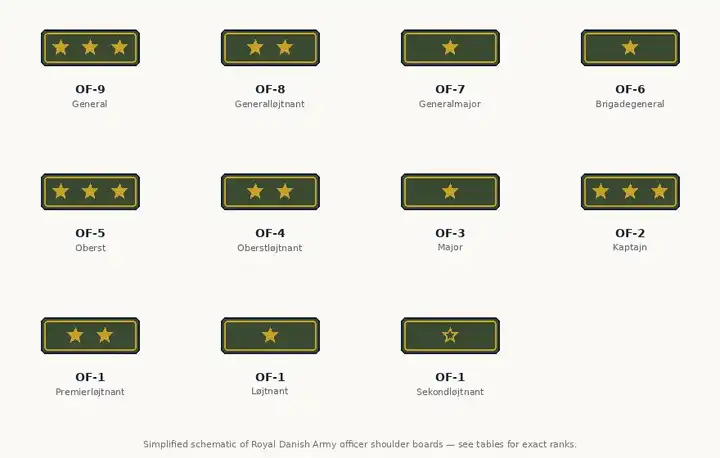
Note the three grades inside OF-1. A Danish officer does not jump straight from training to Premierløjtnant: Sekondløjtnant is the first commission, Løjtnant follows, and Premierløjtnant is the senior lieutenant grade. The same three-step ladder exists at OF-3, where Major carries three pay grades (M332, M331 and M322) — a story in itself, covered under promotion below.
Did you know? Brigadegeneral was only introduced in 1983, when Denmark adapted to STANAG 2116 — before that, Denmark had no one-star general rank at all.
Royal Danish Navy Officer Ranks (OF-9 to OF-1)
Danish naval officers wear different titles from their Army and Air Force counterparts, but the NATO grades line up exactly. Admiral (OF-9) is reserved for the Chief of Defence when a naval officer holds the post, and for the King. Viceadmiral (OF-8) is reserved for the Vice Chief of Defence.
Kontreadmiral (OF-7) is the rank of the Chief of the Royal Danish Navy, and Flotilleadmiral (OF-6) goes to the chief of the Danish Task Group and to holders of other high offices. Unlike the Army and Air Force, the Navy has no Sekondløjtnant: its most junior commissioned rank is Løjtnant.
| Rank | NATO Code | Pay Grade | Typical Role |
|---|---|---|---|
| Admiral | OF-9 | M406 | Chief of Defence (when a naval officer) or the King; highest naval rank |
| Viceadmiral | OF-8 | M405 | Vice Chief of Defence |
| Kontreadmiral | OF-7 | M404 | Chief of the Royal Danish Navy |
| Flotilleadmiral | OF-6 | M403 | Chief of the Danish Task Group; senior appointments |
| Kommandør | OF-5 | M402 | Captain of a major warship; squadron or school commander |
| Kommandørkaptajn | OF-4 | M401 | Commander; captain of a smaller vessel; squadron staff |
| Orlogskaptajn | OF-3 | M332 / M331 / M322 | Lieutenant commander; department head aboard ship |
| Kaptajnløjtnant | OF-2 | M321 | Lieutenant; watch officer or department officer |
| Premierløjtnant | OF-1 | M312 | Sub-lieutenant; junior watch officer |
| Løjtnant | OF-1 | M311 | Entry-level naval officer |
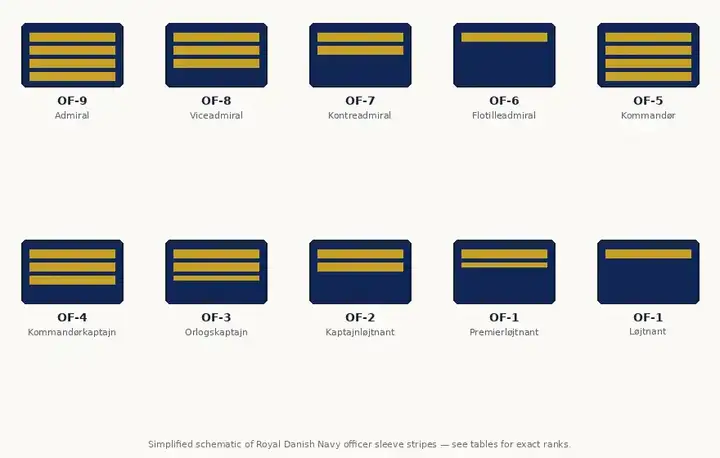
Key point: Admiral and General are tied to appointments — the Chief of Defence and the Monarch — not open to promotion. A Danish officer reaches those ranks by being appointed to the post that carries them.
Royal Danish Air Force Ranks
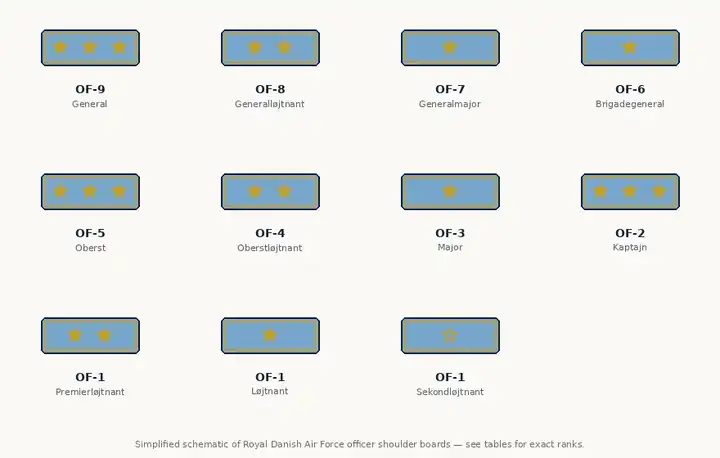
The Royal Danish Air Force shares the Army’s officer titles exactly — General down to Sekondløjtnant — so its officers are covered by the first table above. Where the Air Force differs is in the junior ranks: instead of Konstabel and Overkonstabel, its airmen are Flyverkonstabel, Flyveroverkonstabel and Flyverspecialist (OR-1 to OR-3), and its senior NCOs are the same Chefsergent, Seniorsergent and Oversergent found in the other services.
The Air Force’s officers wear their rank on the same style of shoulder strap as the Army, in Air Force blue-grey rather than Army green.
How to Read Danish Officer Insignia
Danish officer insignia are read from the shoulder in the Army and Air Force, and from the sleeve in the Navy:
- Army and Air Force shoulder straps — on the M/69 service uniform, officers wear rank on shoulder straps: gold stars on a dark strap edged with gold braid, with the number of stars rising with seniority. Generals are read by stars alone — three for a General, two for a Generalløjtnant and one for a Generalmajor — a convention that goes back to the nineteenth century, when the King wore three stars and former Generalløjtnants kept two. On combat uniform the same rank is worn as a sand-coloured slip-on, introduced with the MultiCam uniform to replace the older green slip-on. The appropriate branch-of-service badge is pinned just under the top button for all ranks except full General.
- Navy sleeve stripes — naval officers wear gold braid bands around the sleeve, in the pattern Denmark adopted from the British Royal Navy when sleeve insignia were introduced in 1871. Admirals are told apart by a broad band: Admiral wears a broad band with three narrow bands, Viceadmiral a broad band with two, Kontreadmiral a broad band with one, and Flotilleadmiral a broad band alone. Below flag rank the bands are all narrow: four for Kommandør, three for Kommandørkaptajn, two narrow with a thin band for Orlogskaptajn, two for Kaptajnløjtnant, one narrow with a thin band for Premierløjtnant and a single narrow band for Løjtnant.
- Rank flags and star plates — Danish generals and admirals also have personal rank flags, flown where they command, and vehicle star plates showing one to four stars for OF-6 to OF-9. These are ceremonial rather than uniform insignia, but they are part of the same rank language.
- Different uniforms, different insignia — the same rank looks different across orders of dress. The Army recognises several types: the sand-coloured combat slip-on (TAN499), the MTS slip-on, the M/69 service uniform (shoulder, shirt and sleeve versions), and gala and mess dress versions. A Kaptajn’s rank on a combat uniform and on a gala uniform is the same grade, but it will not look the same.
Danish NCO and Enlisted Ranks (OR-9 to OR-1)
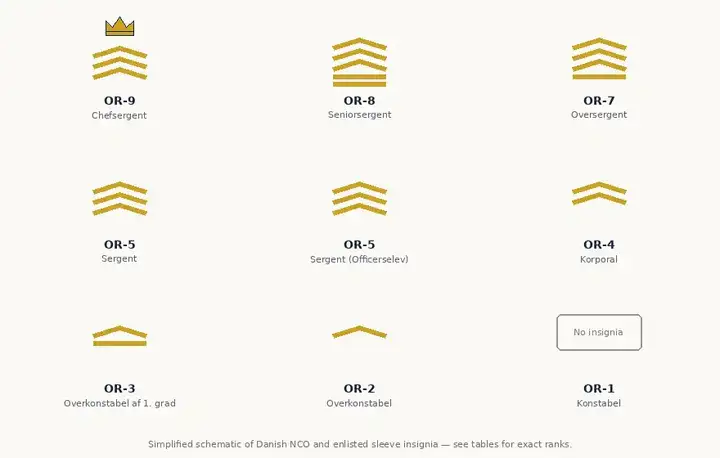
Below the officers sit the sub-officers and privates. The senior NCO ranks — Chefsergent (OR-9), Seniorsergent (OR-8) and Oversergent (OR-7) — are the middle management level of the Danish Defence: the sergeants major, first sergeants and senior sergeants who run units day to day. Sergent (OR-5) is the working sergeant rank, and an officer cadet holds the rank of Sergent (Officerselev) while training.
Korporal (OR-4) is the highest of the private-level ranks and is not itself counted as an NCO rank. There is no OR-6 anywhere in the Danish system — the ladder jumps straight from OR-7 to OR-5.
The three services share the senior ranks but give their own names to the junior ones. The Navy’s privates are Marinekonstabel, Marineoverkonstabel and Marinespecialist; the Air Force’s are Flyverkonstabel, Flyveroverkonstabel and Flyverspecialist; the Army’s are Konstabel, Overkonstabel and Overkonstabel af 1. grad.
| NATO Code | Pay Grade | Army | Navy | Air Force |
|---|---|---|---|---|
| OR-9 | M232 | Chefsergent | Chefsergent | Chefsergent |
| OR-8 | M231 | Seniorsergent | Seniorsergent | Seniorsergent |
| OR-7 | M221 | Oversergent | Oversergent | Oversergent |
| OR-5 | M212 | Sergent | Sergent | Sergent |
| OR-5 | M211 | Sergent (Officerselev) | Sergent SØ | Sergent (Officerselev) |
| OR-4 | M113 | Korporal | Korporal | Korporal |
| OR-3 | M112 | Overkonstabel af 1. grad | Marinespecialist | Flyverspecialist |
| OR-2 | — | Overkonstabel | Marineoverkonstabel | Flyveroverkonstabel |
| OR-1 | — | Konstabel | Marinekonstabel | Flyverkonstabel |
Did you know? There is no OR-6 in the Danish system — the ladder jumps straight from Oversergent (OR-7) to Sergent (OR-5). It is one of the two missing grades, the other being OF-10.
How to Read Danish NCO and Enlisted Insignia
Danish other ranks wear their rank on the sleeve, and the code is built from gold chevrons — vinkler, literally “angles” — with bars and a crown added as seniority rises:
- Chevrons — the V-shaped gold angles on the upper sleeve. Sergeants wear three chevrons; the number falls as the rank falls, and a Konstabel (OR-1) wears no rank insignia at all.
- Bars below the chevrons — the senior sergeant grades add straight gold bars under the three chevrons: one bar for Oversergent and two for Seniorsergent.
- The crown — the Chefsergent’s insignia is topped by a crown. In the Navy the rule is explicit: all NCOs and enlisted personnel wear their branch-of-service emblem, except the Chefsergent, who wears a crown instead.
- Branch emblems — below the senior ranks, the sleeve also carries the emblem of the wearer’s branch or corps, so the same chevrons can belong to an infantryman, a signaller or a naval technician. Each regiment and corps has its own distinctive insignia, cap badge, beret and formation patch as well.
- Special appointments — Denmark also has senior sergeant appointments that sit on top of the rank ladder, such as the Hærchefsergenten (Sergeant Major of the Army) and regimental, brigade and school chefsergenter in the Army, and the Søværnschefsergent (Chief Petty Officer of the Navy) and authority chefsergenter in the Navy. These are posts held by a Chefsergent, not separate ranks, but their insignia marks them out.
Danish Military Badges
Rank insignia shows a Danish service member’s grade. Badges show what they are qualified to do, and Denmark has a set of joint ranks that sit outside the normal line system altogether. The Judge Advocate Corps has its own titles — Generalauditør (Judge Advocate General), Auditør and Auditørfuldmægtig — and the military legal adviser (Militærjuridisk rådgiver) wears distinct insignia.
The medical services have their own grades for specialists, doctors and dentists, and for nurses, from Sygeplejeassistent up to Afdelingssygeplejerske. The music service has Musikdirigent (director of music) and Musiker (musician). Priests and judicial personnel wear entirely different insignia and hold no military rank at all.
On uniform, the most visible badges after rank are the branch and corps badges: every regiment and corps has its own cap badge, beret and formation patch, and on the Army’s service uniform the branch badge is pinned just under the top button. Parachute wings, pilot wings and marksmanship badges are worn in the same way as in other NATO forces, as qualification badges rather than rank.
How Promotion Works in the Danish Military
Promotion in the Danish Defence is by appointment to a post, not by time served alone — and the system has a deliberate safety valve at the middle of the officer ladder. The M332 scheme, created in 2005, gives senior Majors (M331) who cannot advance to Oberstløjtnant (M401) because there are no vacant posts a higher pay grade and a way forward without a promotion that does not exist.
Alongside it, the M322 grade is awarded to Majors with highly specialised knowledge, or with 18 to 20 years’ experience as an officer, who have not yet completed a Master of Military Studies (MMS) — the staff-college qualification that gates the senior ranks. In other words, Denmark promotes its specialists as well as its commanders, and it does so on paper even when the next command chair is occupied.
The top of the ladder is different again: the general and admiral ranks are tied to jobs, not to people. General and Admiral exist for the Chief of Defence and the Monarch; Generalløjtnant and Viceadmiral exist for the Chief and Vice Chief of the Defense Staff and the Chief of Acquisition; Generalmajor and Kontreadmiral exist for the branch chiefs. A Danish officer reaches those ranks by being appointed to the post that carries them, and leaves the rank behind when the appointment ends.
For NCOs the path runs through sergeant training — Sergentelev (sergeant trainee) to Sergent — and then through the senior sergeant grades, with the Chefsergent appointments at regimental, brigade and service level as the summit of the NCO career.
A Note on Danish Military Tradition
Three traditions explain almost everything about Danish ranks. The first is the monarchy: Denmark is a kingdom, and the highest ranks in each service are reserved for the Monarch and the Chief of Defence, a reminder that the armed forces serve the Crown.
The second is seniority of the services: the Army’s epaulette ranks date to 1801, and epaulettes were extended to all ranks in 1822; the Navy’s sleeve insignia followed in 1871, modelled on the British Royal Navy, and its admiral ranks were standardised in 1951.
The third is small-country pragmatism: with a small professional force and conscription, Denmark runs one joint rank system across three services, keeps the ladder short — no OF-10, no OR-6 — and lets the same rank names do different jobs in different services, from Marinespecialist in the Navy to Flyverspecialist in the Air Force. It is a system built to be read at a glance by allies, which is exactly what a NATO rank system is for.
Read next
US Navy Ranks · British Military Ranks · German Army Ranks · US Military Uniform · US Military Branches
FAQs
What is the highest rank in the Danish military?
General in the Army and Air Force, and Admiral in the Navy — both OF-9. The rank is reserved for the Chief of Defence and the Monarch, so it is held by very few people at any one time. The highest other rank is Chefsergent (OR-9).
What is the Danish equivalent of a US Colonel?
Oberst in the Army and Air Force, and Kommandør in the Navy — all OF-5, the NATO equivalent of a US Colonel or a US Navy Captain. The Danish equivalent of a US Sergeant Major is Chefsergent (OR-9).
Why is there no OR-6 in the Danish rank system?
Denmark simply never created one. The ladder jumps from Oversergent (OR-7) to Sergent (OR-5), and the same gap exists in all three services. It is one of the two missing grades in the Danish system, the other being OF-10.
What is the difference between a Sergent and a Sergent (Officerselev)?
Both are OR-5, but a Sergent (Officerselev) is an officer cadet: a trainee officer who holds sergeant rank while completing officer training. A Sergent is a fully qualified sergeant serving in the ranks.
How can you tell a Danish naval officer’s rank?
From the gold bands on the sleeve. Admirals have a broad band plus narrow bands (three for Admiral, two for Viceadmiral, one for Kontreadmiral, none for Flotilleadmiral); senior officers have four, three or two narrow bands, with thin bands marking Orlogskaptajn and Premierløjtnant.
Do Danish officers and NCOs wear the same insignia on every uniform?
No. The same rank is shown differently across orders of dress — sand-coloured slip-ons on combat uniform, shoulder straps on the M/69 service uniform, sleeve insignia on shirts, and separate gala and mess dress versions. The NATO code and the rank title stay the same; only the embroidery changes.
All insignia diagrams and images in this article are original graphics created for Forces Guide. The rank charts are simplified schematics; see the tables for exact rank names and NATO codes.