
Finland has one of the most unusual rank systems in Europe — and one of the easiest to misread. There are no stars anywhere in Finnish insignia: officers wear heraldic roses, generals wear lions, and non-commissioned officers wear chevrons. Once you know that rule, the whole system opens up.
This guide covers every Finnish military rank, from Recruit (OR-1) to General and Admiral (OF-9), across the Army, Navy and Air Force — plus the conscript ranks, the reserve system and how promotion works.
Key facts
- Country: Finland
- Branches: Army, Navy and Air Force, together the Finnish Defence Forces (Puolustusvoimat)
- Enlisted and NCO ranks: OR-1 to OR-9 (Recruit to Sergeant Major)
- Commissioned officers: OF-1 to OF-9 (Second Lieutenant to General / Admiral)
- Highest rank: General (Kenraali) or Admiral (Amiraali), NATO OF-9
- NATO member: since 4 April 2023
- Notable: no stars — officers wear roses, generals wear the Lion of Finland
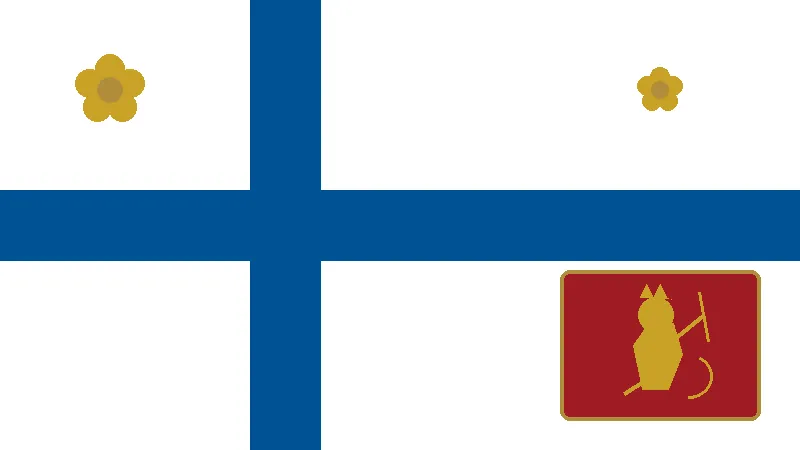
Finnish Army and Air Force Officer Ranks (OF-1 to OF-9)
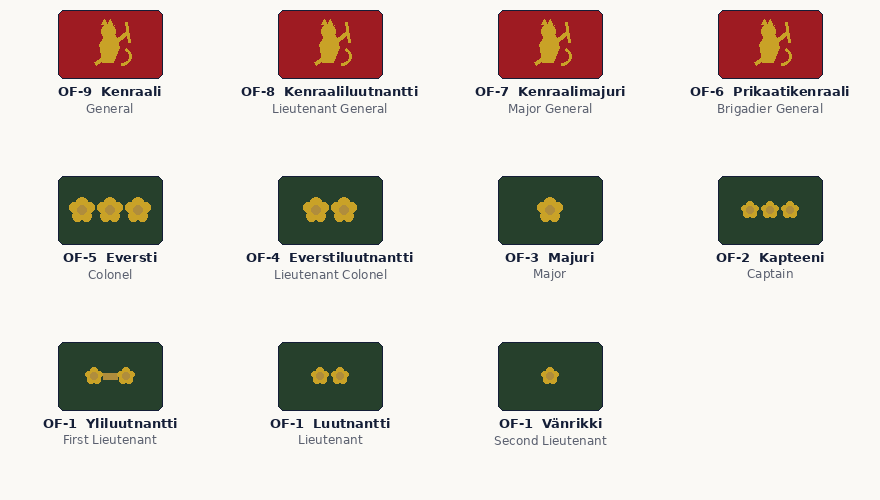
The Army and the Air Force share exactly the same officer ranks — the same Finnish names, NATO grades and collar insignia — from Second Lieutenant (OF-1) to General (OF-9). The top NATO grade, OF-10, is vacant: Finland has no serving five-star rank.
Colonels command brigades and regiments, majors and captains run battalions and companies, and lieutenants lead platoons. Every rank has an official name in Finnish and Swedish, and an official English translation.
| Rank (Finnish — English) | NATO Code | Insignia | Typical Role |
|---|---|---|---|
| Kenraali — General | OF-9 | Lions (Lion of Finland) on the collar | Chief of Defence |
| Kenraaliluutnantti — Lieutenant General | OF-8 | Lions on the collar | Service commander |
| Kenraalimajuri — Major General | OF-7 | Lions on the collar | Division commander |
| Prikaatikenraali — Brigadier General | OF-6 | Lion on the collar | Brigade commander |
| Eversti — Colonel | OF-5 | Three large heraldic roses on the collar | Brigade or regiment commander |
| Everstiluutnantti — Lieutenant Colonel | OF-4 | Two large heraldic roses on the collar | Battalion commander |
| Majuri — Major | OF-3 | One large heraldic rose on the collar | Battalion staff officer |
| Kapteeni — Captain | OF-2 | Three small heraldic roses on the collar | Company commander |
| Yliluutnantti — First Lieutenant | OF-1 | Two small heraldic roses with a bar between them | Platoon commander |
| Luutnantti — Lieutenant | OF-1 | Two small heraldic roses on the collar | Platoon commander |
| Vänrikki — Second Lieutenant | OF-1 | One small heraldic rose on the collar | Platoon commander |
Did you know? The heraldic rose in Finnish insignia was designed by the artist Akseli Gallen-Kallela for the military uniform confirmed in July 1918.
How to Read Finnish Officer Insignia
Finnish officer insignia follow one simple idea — roses below, lions above:
- No stars at all. Where most armies mark generals with stars, Finland uses the Lion of Finland, the lion from the national coat of arms. A lion on the collar means a general officer (OF-6 to OF-9).
- Heraldic roses mark every other officer. Small roses denote junior officers from Second Lieutenant to Captain, and large roses senior officers from Major to Colonel. The number of roses rises with seniority.
- Watch for the bar. A Lieutenant and a First Lieutenant both wear two small roses — but the First Lieutenant’s roses are split by a bar. That small bar is the only thing separating the two ranks at a glance.
- The collar is where you look. In the Army, rank insignia sit on the collar patches of the parade and service uniforms, and on the chest of the modern M05 field uniform. The patch’s background and lining show the wearer’s branch colour, except on field uniforms, where branch colours are dropped. Generals’ patches are most often gold on red, the colour of Defence Command.
- Swedish names sit alongside the Finnish ones. A colonel is Eversti in Finnish and Överste in Swedish; a captain is Kapteeni and Kapten.
Specialist officers — doctors, engineers and other professionals who hold a commission alongside a civilian degree — wear their specialist insignia as well as their rank insignia. Military chaplains have their own ladder: a chaplain (sotilaspastori) ranks with a captain, a senior chaplain (kenttärovasti) with a lieutenant colonel, and the field bishop (kenttäpiispa) with a brigadier general.
Finnish Navy Officer Ranks (OF-1 to OF-9)
The Navy keeps the same grades but uses seagoing titles. Its admirals mirror the Army’s generals grade for grade: Admiral (OF-9) matches General, Vice Admiral matches Lieutenant General, Rear Admiral matches Major General, and Commodore (Lippueamiraali, literally “flotilla admiral”) matches Brigadier General. Below them, a naval Captain (Kommodori) is OF-5, a Commander (Komentaja) is OF-4, and a Lieutenant Commander (Komentajakapteeni) is OF-3. At the bottom, three titles share OF-1: Lieutenant Senior Grade, Lieutenant and Ensign (Aliluutnantti), the rank a newly trained naval reserve officer leaves service with.
| Rank (Finnish — English) | NATO Code | Insignia | Typical Role |
|---|---|---|---|
| Amiraali — Admiral | OF-9 | Gold sleeve bars topped by the Lion of Finland | Most senior naval commander |
| Vara-amiraali — Vice Admiral | OF-8 | Gold sleeve bars topped by the Lion of Finland | Senior naval commander |
| Kontra-amiraali — Rear Admiral | OF-7 | Gold sleeve bars topped by the Lion of Finland | Flotilla commander |
| Lippueamiraali — Commodore | OF-6 | Gold sleeve bars topped by the Lion of Finland | Flotilla commander |
| Kommodori — Captain | OF-5 | Gold sleeve bars topped by the Lion of Finland | Senior ship or shore commander |
| Komentaja — Commander | OF-4 | Gold sleeve bars topped by the Lion of Finland | Ship or squadron commander |
| Komentajakapteeni — Lieutenant Commander | OF-3 | Gold sleeve bars topped by the Lion of Finland | Ship commander |
| Kapteeniluutnantti — Lieutenant, Senior Grade | OF-2 | Gold sleeve bars topped by the Lion of Finland | Department head aboard ship |
| Yliluutnantti — Lieutenant | OF-1 | Gold sleeve bars topped by the Lion of Finland | Watch or division officer |
| Luutnantti — Lieutenant, Junior Grade | OF-1 | Gold sleeve bars topped by the Lion of Finland | Junior ship’s officer |
| Aliluutnantti — Ensign | OF-1 | Gold sleeve bar topped by the Lion of Finland | Junior officer |
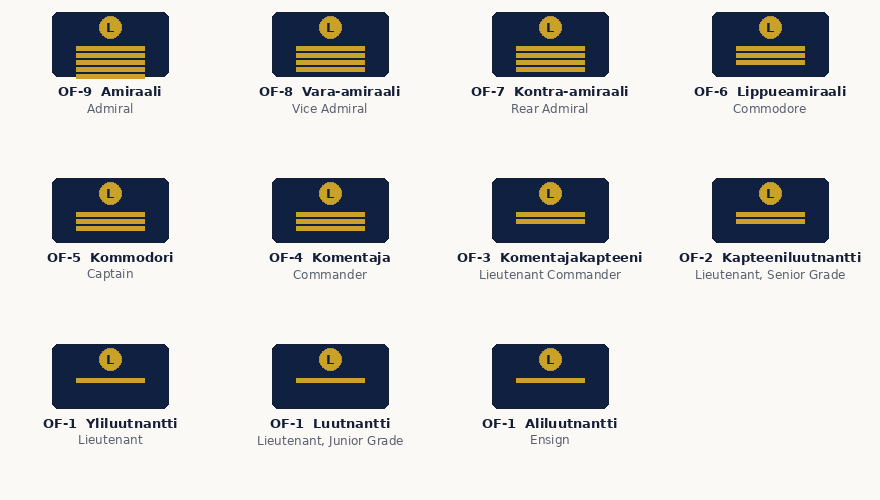
Naval rank is read from the sleeve: parallel gold bars in thick and thin combinations on the parade dress, with the Lion of Finland above them for officers. On shoulder boards the same bars appear, and on the M05 field uniform the insignia move to the chest and the lion emblem is dropped.
Key point: a naval Captain (Kommodori) is OF-5 — the same grade as an Army Colonel — so always check the NATO code. Finnish sailors joke that a Captain’s sleeve insignia, two wide stripes with a narrow one between them, looks like a hamburger.
Finnish Enlisted and NCO Ranks — Army and Air Force (OR-1 to OR-9)
Below the officers sit the non-commissioned officers and the rank and file. The Army and Air Force share this ladder, with one difference at the bottom: an Air Force private is an Lentosotamies (Airman) rather than a Sotamies. The ladder runs from Recruit (OR-1) to Sergeant Major (OR-9). Two Finnish words do a lot of work here: yli means “senior” and ali means “junior”, so alikersantti is literally “junior sergeant”.
| Rank (Finnish — English) | NATO Code | Insignia | Typical Role |
|---|---|---|---|
| Sotilasmestari — Sergeant Major | OR-9 | Chevrons on the collar | Most senior NCO |
| Ylivääpeli — Master Sergeant | OR-8 | Chevrons on the collar | Brigade-level senior NCO |
| Vääpeli — Sergeant First Class | OR-7 | Chevrons on the collar | Company senior NCO |
| Ylikersantti — Staff Sergeant | OR-6 | Chevrons on the collar | Platoon senior NCO |
| Kersantti — Sergeant | OR-5 | Three chevrons on the collar | Squad leader |
| Alikersantti — Corporal | OR-4 | Chevrons on the collar | Team leader |
| Korpraali — Private First Class | OR-3 | Chevron on the collar | Senior private |
| Sotamies — Private | OR-2 | No rank chevrons; branch title worn instead | Rank-and-file soldier |
| Alokas — Recruit | OR-1 | No insignia | New private in basic training |
Finnish Navy Enlisted and Petty Officer Ranks (OR-1 to OR-9)
The Navy’s enlisted ladder uses seagoing titles, but the grades line up exactly with the Army’s. A Sotilasmestari (Master Chief Petty Officer) is OR-9 in every service, and a Kersantti (Petty Officer Second Class) is OR-5 in every service. The Navy’s own titles appear in the middle — Ylipursimies (Senior Chief Petty Officer) and Pursimies (Chief Petty Officer) — and at the bottom, where a sailor is a Matruusi (Seaman) and a senior sailor a Ylimatruusi (Leading Seaman).
| Rank (Finnish — English) | NATO Code | Insignia | Typical Role |
|---|---|---|---|
| Sotilasmestari — Master Chief Petty Officer | OR-9 | Chevrons on the sleeve | Most senior naval NCO |
| Ylipursimies — Senior Chief Petty Officer | OR-8 | Chevrons on the sleeve | Senior shipboard NCO |
| Pursimies — Chief Petty Officer | OR-7 | Chevrons on the sleeve | Department senior NCO |
| Ylikersantti — Petty Officer First Class | OR-6 | Chevrons on the sleeve | Senior petty officer |
| Kersantti — Petty Officer Second Class | OR-5 | Chevrons on the sleeve | Section leader |
| Alikersantti — Petty Officer Third Class | OR-4 | Chevrons on the sleeve | Junior petty officer |
| Ylimatruusi — Leading Seaman | OR-3 | Chevron on the sleeve | Senior seaman |
| Matruusi — Seaman | OR-2 | No rank chevrons | Rank-and-file sailor |
| Alokas — Recruit | OR-1 | No insignia | New sailor in basic training |
How to Read Finnish Enlisted Insignia
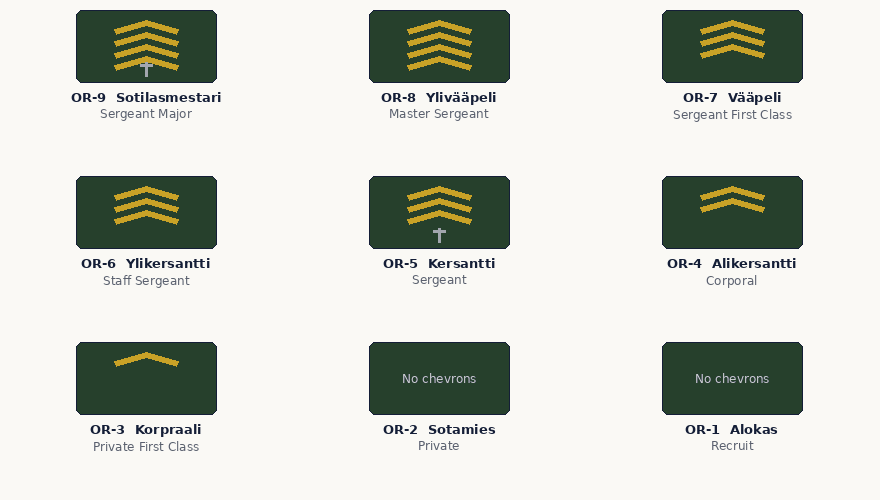
Enlisted insignia are built from chevrons — angled stripes on the collar in the Army and Air Force, and on the sleeve in the Navy:
- More chevrons means a higher rank. Privates wear no chevrons at all, lance corporals wear a single chevron, and the number rises through corporal and sergeant to the senior NCO grades. A Sergeant (Kersantti) wears three chevrons.
- A small sword marks a career sergeant. Because conscripts, reservists and career soldiers can all hold the rank of sergeant, career NCO sergeants wear a small heraldic sword under their chevrons to set themselves apart.
- A silver line marks an NCO student. NCO students wear no collar insignia — their only mark is a single silver line on the shoulder or arm, or on the chest of the M05 field uniform.
- The private’s title is the branch, not the rank. The generic rank Sotamies (Private) is no longer used on its own. A soldier is called by a title that names their arm: Jääkäri (Jaeger) in the infantry, Tykkimies (Gunner) in the artillery, Pioneeri (Engineer) in the engineers, Viestimies (Signalman) in signals, Panssarimies (Armourman) in tank units, Lentosotamies (Airman) in the Air Force, and Matruusi (Seaman) in the Navy. Note too that some titles are positions, not ranks: the company first sergeant is called Komppanian vääpeli, but that is a job, and the person holding it may hold anything from sergeant to senior lieutenant.
Conscription, Conscript Ranks and the Reserve
Conscription explains why the rank ladder looks the way it does. Finland practises universal conscription of men — roughly three quarters of each age class serves — and women may volunteer. Service lasts 165, 255 or 347 days: 165 for basic rank-and-file duties, 255 for specialist roles, and 347 for NCO or officer training and the most demanding specialist tasks.
About 20 percent of each age class is trained as junior NCOs and about 10 percent as reserve officers. Everyone starts as an Alokas (Recruit) and, after taking the military oath, becomes a private under their branch title.
NCO students (Aliupseerioppilas) hold the permanent rank of private or lance corporal while they train, then are promoted to Alikersantti (Corporal) or Kersantti (Sergeant). Officer students (Upseerioppilas) go on to the Reserve Officer School, then serve as officer candidates (Upseerikokelas) — a rank equal in standing to a conscript sergeant but senior to them. At the end of service, officer candidates are promoted to Vänrikki (Second Lieutenant), or Aliluutnantti (Ensign) in the Navy, and pass into the reserve. Cadets at the National Defence University are senior to a second lieutenant.
That reserve is the real Finnish army. In peacetime the Defence Forces number only about 24,000 active personnel, but the trained reserve is roughly 900,000 people, and the wartime strength is about 280,000 soldiers who can be mobilised in days.
Key point: in peacetime, reservists are inactive — no pay and no place in the chain of command until mobilised or called to a refresher exercise. There is no distinction between reserve and active ranks, and reservists can be promoted in the reserve, in exceptional cases as far as lieutenant colonel.
Badges, Branch Colours and Special Ranks
Rank insignia shows a Finn’s grade. The rest of the uniform shows their branch, specialty and history. The branch colours on the Army and Air Force collar patches are the clearest example: the colour and lining of the patch identify the arm of service, from infantry and jaegers to armour, artillery, engineers, signals and logistics. On field uniforms these colours are dropped, but the national flag and the unit insignia are worn on the arm instead.
A few special cases are worth knowing. Military civil servants (sotilasvirkamies) — technical staff without leadership training — hold a position graded to their civilian education, equivalent to staff sergeant, lieutenant or first lieutenant. Military professionals (sotilasammattihenkilö) — non-combat staff such as photographers and drivers — wear a single heraldic sword as their insignia and rank above conscripts but below all other paid personnel.
How Promotion Works in Finland
Promotion in Finland is split by who has the authority to grant it. Rank-and-file soldiers and non-commissioned officers are promoted by the commander of their brigade or equivalent formation. The two most senior NCO ranks are exceptions: a Ylivääpeli (Master Sergeant) is promoted by the service commander, and a Sotilasmestari (Sergeant Major) by the Chief of Staff of Defence Command.
Every officer from Vänrikki (Second Lieutenant) upward is promoted and commissioned by the President of Finland. The career officer path runs through the National Defence University: officers graduate first with a Bachelor of Military Science, which carries an automatic promotion to Luutnantti (Lieutenant), then serve three to four years as temporary officers.
They return for a Master of Military Science, are promoted to Yliluutnantti (First Lieutenant), and on graduation are promoted to Kapteeni (Captain) and given a permanent commission. Promotion beyond that is by selection and time in grade, with command — of a company, a battalion, a brigade — as the defining career gate.
For conscripts, promotion is part of training: NCO students leave as corporals or sergeants, officer candidates as second lieutenants or ensigns, and most rank-and-file soldiers as privates or lance corporals. In the reserve, promotion continues slowly and on merit — a reservist who performs well, holds the training for a higher duty and is billeted to it can be promoted, in rare cases as far as major or, for special service, lieutenant colonel.
A Note on Finnish Tradition
Two things explain almost everything about Finnish ranks. The first is the Jaeger tradition: the Finnish Jaegers were volunteers who trained in Germany during the First World War and became the officer corps of independent Finland, and the title Jääkäri (Jaeger) still names the ordinary infantryman today. The second is the country’s history of fighting alone — above all the Winter War of 1939–40 — which is why the system rests on a small professional cadre and a vast trained reserve rather than a large standing army.
The most famous exception belongs to that history. The ranks of field marshal (Sotamarsalkka) and Marshal of Finland (Suomen marsalkka) were bestowed on Carl Gustaf Emil Mannerheim in 1933 and 1942. They were officially honorific titles rather than military ranks, but they were used as ranks senior to general, with an insignia of a general’s lions and roses plus crossed marshal’s batons — the equivalent of NATO OF-10. No one has held them since. All generals are addressed as “Sir/Madam General” (herra/rouva kenraali), and admirals the same way.
Read next
FAQs
What is the highest rank in the Finnish military?
General (Kenraali) in the Army and Air Force and Admiral (Amiraali) in the Navy, both NATO OF-9. There is no serving OF-10 rank; the only higher titles ever used were Field Marshal and Marshal of Finland, held solely by Carl Gustaf Emil Mannerheim.
Why do Finnish generals wear lions instead of stars?
Finnish insignia uses no stars at all. Generals wear the Lion of Finland, from the national coat of arms, while other officers wear heraldic roses.
What is the difference between a Vänrikki and a Luutnantti?
Both are NATO OF-1, but Vänrikki (Second Lieutenant) is the rank a newly trained reserve officer leaves service with, while Luutnantti (Lieutenant) is the first rank of a career officer.
Do all Finnish men have to serve in the military?
Almost all men are liable for conscription from age 18, and about 75 percent of each age class serves; women may volunteer. Service lasts 165, 255 or 347 days depending on the role, and after service everyone passes into the reserve, which numbers roughly 900,000 people.
What rank does a Finnish conscript leave service with?
Most leave as a private (under their branch title) or as a lance corporal (Korpraali). Junior NCOs leave as corporal (Alikersantti) or sergeant (Kersantti), and reserve officers leave as second lieutenant (Vänrikki) or, in the Navy, ensign (Aliluutnantti).
Are Finnish ranks the same in the Army, Navy and Air Force?
The grades match exactly, but the titles differ: the Army and Air Force share rank names, while the Navy uses seagoing titles — Admiral for General, Commander for Lieutenant Colonel, Seaman for Private. NATO codes are the same in all three services.
All insignia diagrams and images in this article are original graphics created for Forces Guide.