
The Special Boat Service Reserve — SBS(R) — is the part-time, reserve element of Britain’s naval special forces unit. The key fact: SBS Reserve ranks are not a system of their own. SBS(R) personnel are Royal Marines Reservists, so they hold Royal Navy and Royal Marines ranks, wear the same insignia as their regular counterparts, and are recognised as special forces operators by their beret, cap badge and qualifications — not by a separate rank ladder.
This guide explains the unit first — what SBS(R) is, how selection works and what its people wear — then sets out the Royal Marines and Royal Navy rank tables SBS(R) personnel actually use.
Key facts
- Country: United Kingdom
- Branch: Royal Navy — Royal Marines (His Majesty’s Naval Service)
- Unit: Special Boat Service Reserve (SBS(R)), R Squadron of the SBS, part of United Kingdom Special Forces
- Headquarters: RM Poole, Hamworthy Barracks, Poole, Dorset
- Other ranks: Marine to Warrant Officer Class 1 (OR-2 to OR-9)
- Officers: Second Lieutenant to Major General (OF-1 to OF-7)
- Motto: “By Strength and Guile”

What Is the SBS Reserve?
The SBS(R) is the reserve element of the Special Boat Service, the Royal Navy’s special forces unit — “an integrated part of the Special Boat Service within United Kingdom Special Forces (UKSF) Group”, in the Royal Navy’s words, and “the pinnacle of reserve service”. Its people hold civilian jobs and train in their spare time, to the same standards as the regular SBS.
Unlike the SAS reserve regiments — 21 and 23 SAS, which operate as formed squadrons — the SBS(R) supplies individual reservists who augment the regular SBS, joining regular squadrons and troops rather than deploying as a separate unit. That is why its members wear the ranks, uniform and insignia of the regular Naval Service. It is based at various locations around the UK and recruits nationwide; exact detachment locations are not published, and training is concentrated in the south of England.
A Short History of the SBS
The SBS traces its roots to the Second World War. In mid-1940, commando Roger Courtney won permission to build a small raiding force around folding canoes — the Folboat Troop, soon renamed No. 1 Special Boat Section. Alongside it, the Royal Marines Boom Patrol Detachment, formed in July 1942 under Major Herbert “Blondie” Hasler, raided and reconnoitred across the Mediterranean and the Far East.
After the war the boat role survived inside the Royal Marines as the Special Boat Company (1951), Special Boat Squadron (1974) and finally Special Boat Service (28 July 1987), when the unit took on maritime counter-terrorism. In October 2001 command passed from the Commandant General Royal Marines to the Commander-in-Chief Fleet, under the Director Special Forces alongside the SAS. The SBS has served in the Falklands, the Gulf War, Sierra Leone, Afghanistan and Iraq, and boarded the tanker Nave Andromeda off the Isle of Wight in 2020. The reserve element dates back to Royal Marines Reserve sections in the boat units of the 1950s; today the SBS(R) is R Squadron of the SBS.
Key point: there is no such thing as an “SBS rank”. A reservist who passes SBS(R) selection keeps the Royal Marines rank they already hold — Marine, Corporal, Sergeant, Captain, Major — and is recognised as an SBS operator by the green beret, the SBS cap badge and the Swimmer Canoeist qualification, not by a different rank title. Any website listing “SBS ranks” as a separate ladder is inventing them.
Royal Marines Officer Ranks (OF-1 to OF-7)
SBS(R) officers hold Royal Marines commissions, using the British Army’s rank structure — Second Lieutenant to Major General — worn in a smaller size on brown or dark blue shoulder boards. Officers below Colonel wear “RM” beneath their insignia, and Major General has been the Corps’ highest rank since 1996.
| Rank | NATO Code | Insignia | Typical Role |
|---|---|---|---|
| Second Lieutenant (2Lt) | OF-1 | One pip (Bath star) | Troop commander |
| Lieutenant (Lt) | OF-1 | Two pips | Troop commander |
| Captain (Capt) | OF-2 | Three pips | Troop commander |
| Major (Maj) | OF-3 | One crown | Squadron 2IC |
| Lieutenant Colonel (Lt Col) | OF-4 | Crown above one pip | SBS commanding officer |
| Colonel (Col) | OF-5 | Crown above two pips | Senior staff role |
| Brigadier (Brig) | OF-6 | Crown above three pips | Brigade commander |
| Major General (Maj Gen) | OF-7 | Crossed baton and sword, star above | Commandant General RM |
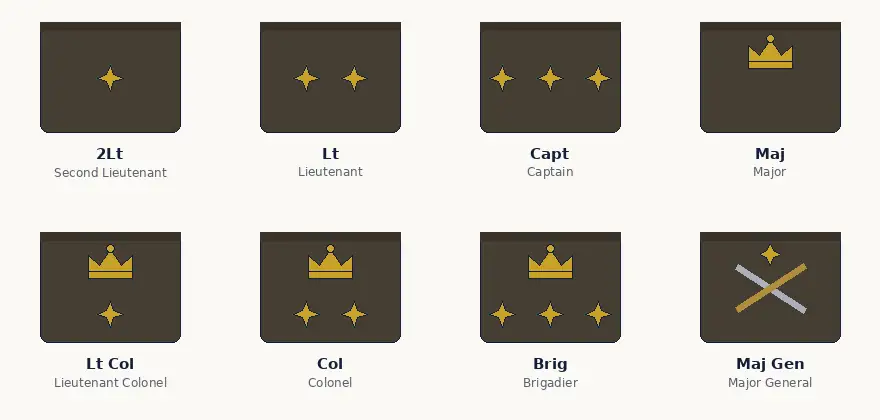
How to Read Royal Marines Officer Insignia
Royal Marines officer insignia uses three devices. Pips — four-pointed Bath stars — mark junior officers: one for Second Lieutenant, two for Lieutenant, three for Captain. The crown alone marks a Major; from Lieutenant Colonel upward it combines with pips. Crossed baton and sword with a star above marks a Major General, and officers below Colonel wear a small “RM” beneath their insignia.
Royal Marines Other Ranks (OR-2 to OR-9)
Most SBS(R) personnel are other ranks — everyone below commissioned officer — running from Marine to Warrant Officer Class 1, worn as sleeve chevrons, with a crown for Colour Sergeant and the Royal Coat of Arms for the senior warrant officer. The Royal Marines have no OR-6 rank: there is no Staff Sergeant equivalent, and the step above Sergeant is Colour Sergeant at OR-7.
| Rank | NATO Code | Insignia | Typical Role |
|---|---|---|---|
| Marine (Mne) | OR-2 | No insignia | Trained commando |
| Lance Corporal (LCpl) | OR-3 | One chevron | Fire-team second-in-command |
| Corporal (Cpl) | OR-4 | Two chevrons | Section commander |
| Sergeant (Sgt) | OR-5 | Three chevrons | Troop sergeant |
| Colour Sergeant (CSgt) | OR-7 | Three chevrons and a crown | Company sergeant major |
| Warrant Officer Class 2 (WO2) | OR-8 | Crown inside a wreath | Regimental quartermaster sergeant |
| Warrant Officer Class 1 (WO1) | OR-9 | Royal Coat of Arms in a wreath | Regimental sergeant major |
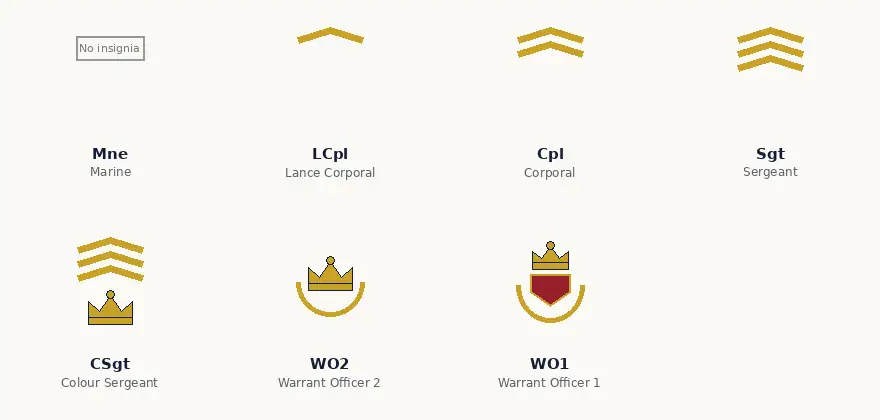
Did you know? A Royal Marines Colour Sergeant wears three chevrons with a crown above them — the same crown that marks an Army Staff Sergeant — because the Marines never adopted that rank. The crowned chevrons sit at OR-7, one NATO grade above the Army’s Staff Sergeant.
Royal Navy Officer Ranks — Sleeve Stripes (OF-1 to OF-9)
Because the SBS is the Royal Navy’s special forces unit, some of its officers hold Royal Navy commissions, read by the gold rings on their sleeves rather than by pips and crowns. The top ring of a line officer carries a loop — the executive curl — the quickest way to tell a Royal Navy sleeve from any other navy.
| Rank | NATO Code | Sleeve Insignia | Typical Role |
|---|---|---|---|
| Midshipman (Mid) | OF-1 | No stripe | Officer under training |
| Sub-Lieutenant (Slt) | OF-1 | One thin stripe with curl | Junior officer |
| Lieutenant (Lt) | OF-2 | Two stripes, top with curl | Department head |
| Lieutenant Commander (Lt Cdr) | OF-3 | Thin stripe between two medium, top with curl | Department head |
| Commander (Cdr) | OF-4 | Three medium stripes, top with curl | Small ship commander |
| Captain (Capt) | OF-5 | Four medium stripes, top with curl | Major warship commander |
| Commodore (Cdre) | OF-6 | One broad stripe with curl | Flotilla commander |
| Rear Admiral (RAdm) | OF-7 | Broad stripe, one narrow above, top with curl | Flag officer |
| Vice Admiral (VAdm) | OF-8 | Broad stripe, two narrow above, top with curl | Senior flag officer |
| Admiral (Adm) | OF-9 | Broad stripe, three narrow above, top with curl | Highest serving Royal Navy rank |
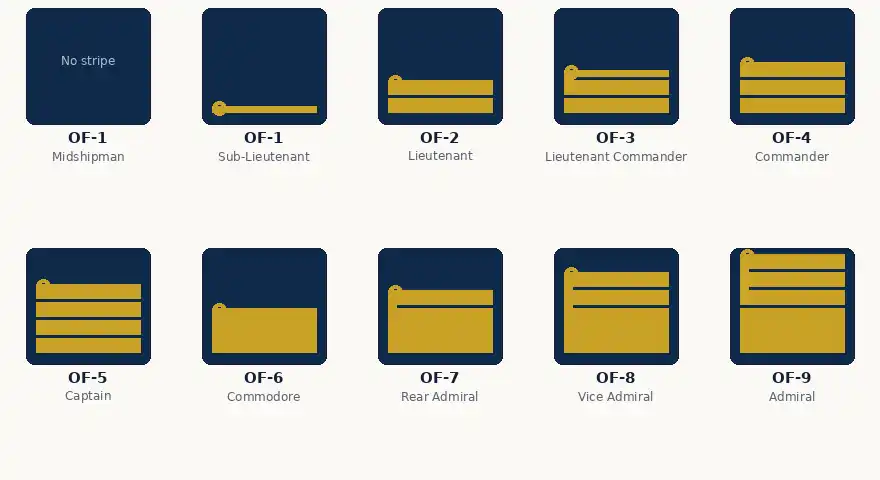
Above Admiral sits Admiral of the Fleet (OF-10) , a broad stripe with four narrow stripes above it, now an honorary rank held by no serving officer. Cross-reference by NATO code, not title: a Navy Lieutenant (OF-2) matches a Marines Lieutenant, while a Navy Lieutenant Commander matches a Marines Major. The reading rule is simple: more gold means more senior. A Sub-Lieutenant wears a single thin ring, a Lieutenant two medium rings, and a Lieutenant Commander adds a thin ring between two medium ones — the famous “two and a half” stripes. The broad stripe marks flag rank: a Commodore wears one broad band, and Rear Admirals, Vice Admirals and Admirals add one, two and three narrow stripes above it.
Beret and Cap Badge
Headgear is where an SBS(R) operator is recognised. SBS personnel wear the green commando beret — earned by passing the Commando Course — with their own cap badge rather than the Royal Marines’ Globe and Laurel. The unit was granted its own cap badge on 18 November 2003; before that, its people wore the standard Royal Marines badge.
The badge is a shield carrying an upright sword with two blue wavy lines behind it — the waves for the sea, the sword for the fighting role — with the motto “By Strength and Guile” beneath it, a shortened form of the original phrase “Not by Strength, by Guile”. It is normally worn in cloth on the beret, with metal and bronze versions for other orders of dress. The hero image above is a stylised Forces Guide drawing, not a copy of the real cap badge. Commando-qualified personnel also wear the Commando dagger badge — the Fairbairn-Sykes fighting knife on a small sleeve patch — for life.
Qualification Badges
Rank insignia shows a person’s grade; qualification badges show what they are trained to do — and in the SBS(R) they matter at least as much. The most important is the title every operator earns on completing selection: Swimmer Canoeist. It is not a rank and carries no pay grade — it is the name for a qualified SBS operator, signalling mastery of swimming, diving, canoeing, parachuting, navigation, demolition and reconnaissance.
- Swimmer Canoeist — awarded after the eight-week SC3 maritime course following joint UKSF selection, with more advanced SC2 and SC1 courses later.
- Parachutist badge (jump wings) — SBS operators are trained parachutists, and wings are a standard part of the qualified operator’s dress.
- Diving qualification — SBS operators are trained military divers, working with rebreathers and from submarines and surface craft. The exact diving badges worn are not published.
- Commando dagger badge — the sleeve badge of everyone who has passed the Commando Course, worn for life.
One caution: the Ministry of Defence publishes no full list of SBS(R) qualification badges, and the unit’s dress regulations are not public documents. The badges above are those consistently described in the public record; where a detail is not publicly confirmed, this guide says so rather than guessing.
Selection and Training
Joining the SBS(R) is deliberately hard and not open to the general public. The Royal Navy takes applications from men and women with previous military service — regular or reserve — who must be no older than 42 years and 6 months when the Aptitude phase of selection begins. Public reporting adds that candidates need previous regular service or at least two years in the Royal Marines Reserve, plus commitment to intense training and deploying on operations.
Selection begins with a four-day initial course in the south of England: a 12.8-kilometre combat fitness test carrying 25 kilograms in 1 hour 50 minutes; a 500-metre swim in uniform, including retrieving an object from 5 metres down; gym tests; and two advanced marches — 15 kilometres with 25 kilograms, then 24 kilometres with 30 kilograms. Survivors go on to joint UKSF selection, the roughly six-month course SAS candidates take — hills aptitude, jungle training, and escape and evasion with resistance to interrogation.
Passing joint selection is not the end. They continue to the eight-week SC3 course — Swimmer Canoeist Third Class — covering canoeing, diving, boating, underwater navigation, demolition, surf zones and submarine infiltration, including a 34-mile canoe course. Only then do they join an operational troop on probation as a qualified Swimmer Canoeist. Open-source reporting says SBS(R) training covers the full regular mission except maritime counter-terrorism and submarine operations — reported, not confirmed. SBS(R) personnel have deployed alongside regular counterparts in Afghanistan and Iraq.
What the Public Record Does Not Say
Readers researching the SBS(R) should know where the public record stops. The Ministry of Defence does not comment on special forces operations, deployments, current equipment, or the identities of serving personnel. The structure here — R Squadron within a four-squadron SBS of C, M, X and Z Squadrons — comes from open sources; the MoD publishes almost nothing about it, and the reserve’s strength, detachment locations and organisation are not published. Press figures — usually “a couple of hundred” for the regular SBS — are estimates, not official numbers, and no equivalent figure exists for the reserve. Women have been eligible for UKSF since 2018, but there is no official information about women serving in the SBS.
Read next
British Military Ranks · Royal Navy Ranks · US Navy Ranks · US Military Branches
FAQs
Does the SBS Reserve have its own ranks?
No. Its personnel are Royal Marines Reservists holding Royal Marines ranks — Marine to Warrant Officer Class 1, and Second Lieutenant to Major General for officers. Some officers hold Royal Navy commissions and wear Navy sleeve stripes instead.
What rank do SBS Reserve operators hold?
Whatever rank they already hold. Passing selection earns the title of Swimmer Canoeist and the right to wear the SBS cap badge on the green beret, but it does not change their rank.
What beret does the SBS Reserve wear?
The green commando beret with the SBS cap badge — a shield with an upright sword and two blue wavy lines, motto “By Strength and Guile”. The badge was granted on 18 November 2003; before that, SBS personnel wore the Royal Marines’ Globe and Laurel.
How do I join the SBS Reserve?
Applicants need previous military service (regular or reserve), must be no older than 42 years and 6 months when the Aptitude phase begins, and must commit to intense training and deploying on operations. Selection starts with a four-day initial course — fitness marches, a 500-metre uniform swim and gym tests — followed by joint UKSF selection and the eight-week SC3 course.
What is a Swimmer Canoeist?
A qualified member of the SBS. The title is earned by passing joint UKSF selection and the SC3 boating and diving course, and marks an operator trained in swimming, diving, canoeing, parachuting, navigation, demolition and reconnaissance. It is a qualification, not a rank.
What is the highest rank in the SBS Reserve?
There is no SBS-specific ceiling. The highest Royal Marines rank is Major General and the highest serving Royal Navy rank is Admiral; the SBS itself is usually commanded by a Lieutenant Colonel. SBS(R) members serve across the full range of ranks from Marine upward.
All insignia diagrams and images in this article are original graphics created for Forces Guide. The beret illustration is a stylised representation and does not reproduce the real SBS cap badge.