
Albania has one of the smallest armed forces in NATO, but its rank system is a full one: three services, nine officer grades and nine enlisted and non-commissioned officer grades, all mapped to NATO codes. An Albanian soldier’s rank is read from gold stars and bars on shoulder boards for officers, gold sleeve stripes for naval officers, and chevrons on the sleeve for enlisted personnel and NCOs. This guide covers every Albanian military rank with its insignia, from Ushtar I (OR-1) to Gjeneral lejtant (OF-8), plus badges, promotion and the unusual history behind the system.
The Albanian Armed Forces (Forcat e Armatosura të Shqipërisë) number around 7,500 active personnel, all volunteers since conscription ended in 2010, with about 2,100 reservists. They are organised into three branches: the Albanian Land Force (Forca Tokësore), the Albanian Naval Force (Forca Detare), which includes the Coast Guard, and the Albanian Air Force (Forca Ajrore). Albania joined NATO on 1 April 2009, and the rank system in use today dates from a reform of 2011, when the grades were aligned with NATO’s OF and OR codes. The Land Force is the largest branch, built around infantry regiments and a Special Operations Battalion; the Navy is a small coastal patrol force; and the Air Force is helicopter-centred, flying transport and utility helicopters rather than fast jets.
Key facts
- Country: Albania
- Branches: Albanian Land Force, Naval Force and Air Force
- Enlisted ranks: OR-1 to OR-9 (Ushtar I to Kryekapter)
- Officer ranks: OF-1 to OF-8 (Nëntoger to Gjeneral lejtant)
- Highest rank: Gjeneral lejtant (OF-8) — Admiral in the Navy
- NATO member: since 1 April 2009
- Notable fact: Albania abolished all military ranks in 1966 and served without them for 25 years, until ranks were re-established in 1991
Albanian Army Officer Ranks (OF-1 to OF-8)
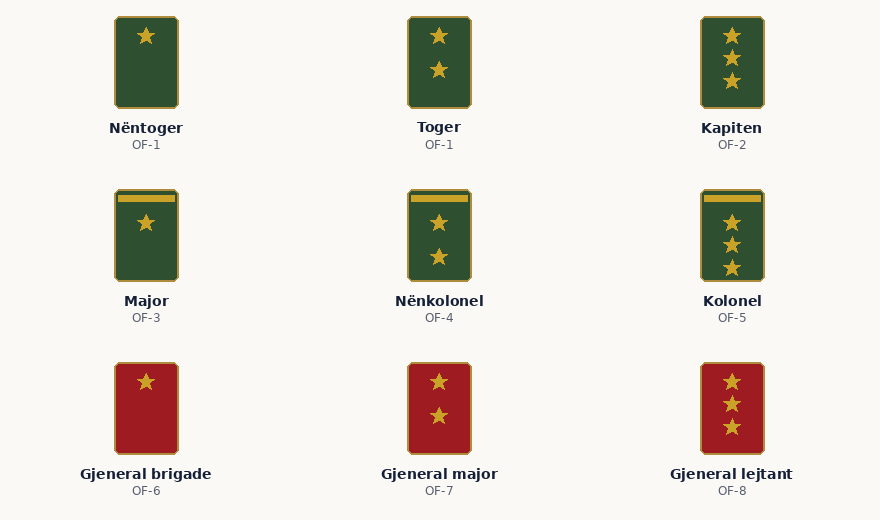
Albanian Army officers wear their rank on shoulder boards (epaulettes). Junior officers are marked by gold stars alone, field officers add a gold bar, and generals wear their stars on a red field. There are nine commissioned officer grades, and notably no OF-9 or OF-10: the highest rank in the Albanian system is Gjeneral lejtant, a three-star lieutenant general (OF-8). The Chief of the General Staff, the most senior officer in the armed forces, holds a general’s rank within this scale.
| Rank | NATO Code | Insignia | Typical Role |
|---|---|---|---|
| Nëntoger | OF-1 | One gold star on a green shoulder board | Second lieutenant; platoon commander, entry-level commissioned officer |
| Toger | OF-1 | Two gold stars on a green shoulder board | Lieutenant; platoon commander or deputy company commander |
| Kapiten | OF-2 | Three gold stars on a green shoulder board | Captain; company commander |
| Major | OF-3 | One gold star with a gold bar on a green shoulder board | Major; battalion staff officer or deputy battalion commander |
| Nënkolonel | OF-4 | Two gold stars with a gold bar on a green shoulder board | Lieutenant colonel; battalion commander |
| Kolonel | OF-5 | Three gold stars with a gold bar on a green shoulder board | Colonel; regiment or brigade staff commander, senior staff officer |
| Gjeneral brigade | OF-6 | One gold star on a red shoulder board | Brigadier general; brigade commander |
| Gjeneral major | OF-7 | Two gold stars on a red shoulder board | Major general; senior command or General Staff appointment |
| Gjeneral lejtant | OF-8 | Three gold stars on a red shoulder board | Lieutenant general; the highest rank in the Albanian Armed Forces |
Key point: There is no fourth star in the Albanian system. Unlike the US or British systems, Albania has no four-star or five-star rank — three stars on a red shoulder board is the top of the ladder.
How to Read Albanian Army and Air Force Officer Insignia
Army and Air Force officer insignia follow the same code, so once you can read one service you can read the other — only the colour of the shoulder board changes. The rules are:
- Count the stars. Stars are the basic unit of seniority: one star for Nëntoger, two for Toger, three for Kapiten. The same one-two-three count repeats at the higher grades.
- Look for the gold bar. A gold bar across the top of the shoulder board marks a field officer. One star plus a bar is a Major, two stars plus a bar is a Nënkolonel, three stars plus a bar is a Kolonel.
- Check the colour of the field. Generals are set apart by a red shoulder board, while other officers wear the branch colour — green for the Land Force, blue for the Air Force. One star on red is a Gjeneral brigade, two a Gjeneral major, three a Gjeneral lejtant.
- Remember there is no fourth star. Unlike the US or British systems, Albania has no four-star or five-star rank. Three stars on a red board is the top of the ladder.
- Note the shared OF-1 grade. Nëntoger and Toger are both OF-1 in NATO terms — the Albanian equivalent of second lieutenant and lieutenant — so the distinction between them is the number of stars, not the NATO code.
Albanian Naval Force Officer Ranks (OF-1 to OF-8)
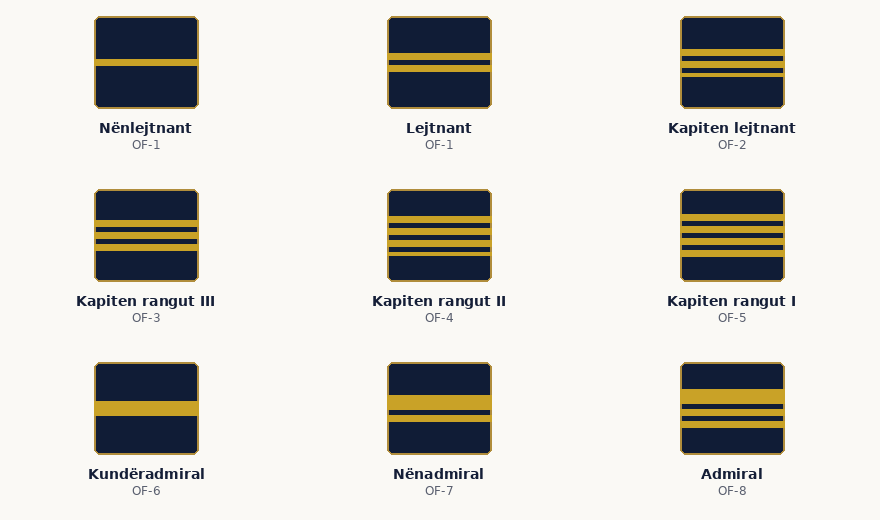
The Naval Force is the smallest Albanian service, a coastal patrol and maritime security force, but it keeps a complete naval rank ladder of its own. Naval officers use naval titles rather than army ones, and their rank is shown by gold stripes on the sleeve, in the NATO naval tradition, as well as by stars on shoulder boards. As in the Army, the top grade is OF-8 — here called Admiral — and there is no OF-9 or OF-10.
| Rank | NATO Code | Insignia | Typical Role |
|---|---|---|---|
| Nënlejtnant | OF-1 | One gold sleeve stripe | Sub-lieutenant; junior officer aboard a patrol vessel |
| Lejtnant | OF-1 | Two gold sleeve stripes | Lieutenant; watch officer or department head aboard ship |
| Kapiten lejtnant | OF-2 | Two gold sleeve stripes with a narrow stripe between them | Lieutenant commander; senior watch officer or small-vessel commander |
| Kapiten rangut III | OF-3 | Three gold sleeve stripes | Lieutenant commander / commander; commands a patrol vessel |
| Kapiten rangut II | OF-4 | Three gold sleeve stripes with a narrow stripe | Commander; commands a larger vessel or a shore establishment |
| Kapiten rangut I | OF-5 | Four gold sleeve stripes | Captain; senior seagoing commander or flotilla commander |
| Kundëradmiral | OF-6 | One broad gold sleeve stripe | Rear admiral; senior naval staff appointment |
| Nënadmiral | OF-7 | One broad gold sleeve stripe with a narrow stripe above it | Vice admiral; deputy commander of the Naval Force |
| Admiral | OF-8 | One broad gold sleeve stripe with two stripes above it | Admiral; commander of the Naval Force, the highest naval rank |
How to Read Albanian Naval Officer Insignia
Naval insignia work by stripes rather than stars, and the width of the stripe is the key:
- Narrow stripes count up. Junior and senior officers wear narrow gold stripes on the lower sleeve: one for Nënlejtnant, two for Lejtnant, two plus a narrow stripe for Kapiten lejtnant, three for Kapiten rangut III, three plus a narrow stripe for Kapiten rangut II, and four for Kapiten rangut I.
- A broad stripe means a flag officer. From Kundëradmiral upward the lowest stripe becomes a broad band. The stripes above it count the grade: none above it for Kundëradmiral, one for Nënadmiral, two for Admiral.
- Rank titles follow the sea, not the land. A Kapiten rangut I is not the same as an army Kapiten — the naval “Kapiten” grades are senior officers, roughly equivalent to commander and captain, while the army Kapiten is a junior officer (OF-2). Always check the service before translating a title.
- Two ranks share OF-1. As in the Army, Nënlejtnant and Lejtnant are both OF-1, the equivalents of sub-lieutenant and lieutenant.
Albanian Air Force Officer Ranks (OF-1 to OF-8)
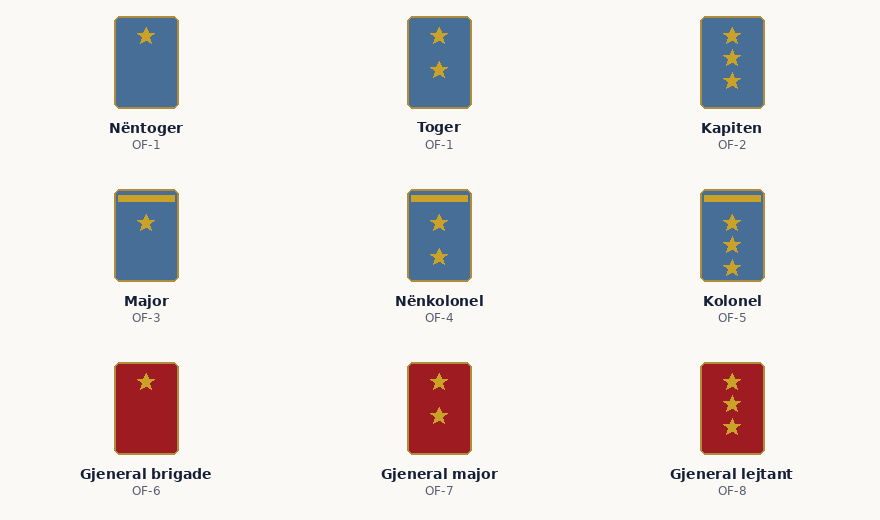
The Albanian Air Force uses exactly the same officer ranks and titles as the Land Force — the same nine grades from Nëntoger to Gjeneral lejtant, with the same NATO codes. The only visible difference is the shoulder board itself, which is blue rather than green. The Air Force is a small, helicopter-centred service focused on transport, search and rescue, medical evacuation and border surveillance, so its senior officers are few in number — but the rank ladder is complete, and an Air Force Gjeneral lejtant holds the same grade as an Army one.
| Rank | NATO Code | Insignia | Typical Role |
|---|---|---|---|
| Nëntoger | OF-1 | One gold star on a blue shoulder board | Second lieutenant; junior officer, often a newly qualified pilot or technician |
| Toger | OF-1 | Two gold stars on a blue shoulder board | Lieutenant; flight or section leader |
| Kapiten | OF-2 | Three gold stars on a blue shoulder board | Captain; flight commander |
| Major | OF-3 | One gold star with a gold bar on a blue shoulder board | Major; squadron staff officer or deputy squadron commander |
| Nënkolonel | OF-4 | Two gold stars with a gold bar on a blue shoulder board | Lieutenant colonel; squadron commander |
| Kolonel | OF-5 | Three gold stars with a gold bar on a blue shoulder board | Colonel; air base commander or senior staff officer |
| Gjeneral brigade | OF-6 | One gold star on a red shoulder board | Brigadier general; senior air command appointment |
| Gjeneral major | OF-7 | Two gold stars on a red shoulder board | Major general; senior command or General Staff appointment |
| Gjeneral lejtant | OF-8 | Three gold stars on a red shoulder board | Lieutenant general; the highest rank in the Albanian Armed Forces |
Albanian Enlisted and NCO Ranks (OR-1 to OR-9)
Below the officers, all three services share the same nine Albanian rank titles, from Ushtar I to Kryekapter — only the English translation changes between the Army and the Navy. The titles are worth learning because they do not translate word for word: Ushtar means “soldier”, Tetar is the corporal family, Rreshter the sergeant family, and Kapter the senior NCO family, with Krye- meaning “chief”. Enlisted personnel and NCOs wear their rank as gold chevrons on the upper sleeve, with the number of chevrons rising with the grade and senior NCOs distinguished by additional devices above the chevrons.
| Rank (Albanian) | NATO Code | Army / Air Force Title | Navy Title | Insignia |
|---|---|---|---|---|
| Ushtar I | OR-1 | Private | Seaman Recruit | No insignia |
| Ushtar II | OR-2 | Private | Seaman Apprentice | One gold chevron |
| Ushtar III | OR-3 | Private First Class | Seaman | Two gold chevrons |
| Ushtar IV | OR-4 | Corporal | Petty Officer Third Class | Three gold chevrons |
| Nëntetar | OR-5 | Sergeant | Petty Officer Second Class | Three gold chevrons with a bar |
| Tetar | OR-6 | Staff Sergeant | Petty Officer First Class | Three gold chevrons with two bars |
| Rreshter | OR-7 | Sergeant First Class | Chief Petty Officer | Chevrons with a gold arc and star |
| Kapter | OR-8 | First Sergeant | Senior Chief Petty Officer | Chevrons with a gold arc and two stars |
| Kryekapter | OR-9 | Sergeant Major | Master Chief Petty Officer | Chevrons with a gold arc and three stars |
The senior NCO grades carry real authority in a small force. A Kryekapter (OR-9) is the most senior enlisted member of a unit or branch, advising the commanding officer on discipline, welfare and standards — the Albanian equivalent of a sergeant major or master chief petty officer. A Kapter (OR-8) typically serves as the senior enlisted leader of a company or a ship, while a Rreshter (OR-7) is the senior NCO of a platoon or department. At the bottom of the ladder, an Ushtar I wears no insignia at all, and the numbered Ushtar grades (I to IV) mark the first steps of a soldier’s career rather than separate jobs.
How to Read Albanian Enlisted Insignia
- Count the chevrons. The V-shaped stripes on the upper sleeve are the basic unit: one for Ushtar II, two for Ushtar III, three for Ushtar IV and above.
- Look above the chevrons. From Nëntetar upward, bars, arcs and stars above the chevrons mark the NCO grades. The more devices above the chevrons, the more senior the NCO.
- No insignia means OR-1. Like the US Marine Corps’ Private, an Ushtar I wears a bare sleeve — the only Albanian rank with nothing to show.
- The same titles, three services. A Kryekapter in the Navy is a Master Chief Petty Officer, in the Army a Sergeant Major — same Albanian word, same OR-9 grade, different English title. The service uniform, not the rank word, tells you which one you are looking at.
Did you know? In 1966 Albania abolished military ranks altogether, following the Chinese example, and its armed forces served rankless for 25 years until ranks were re-established in 1991.
Albanian Military Badges
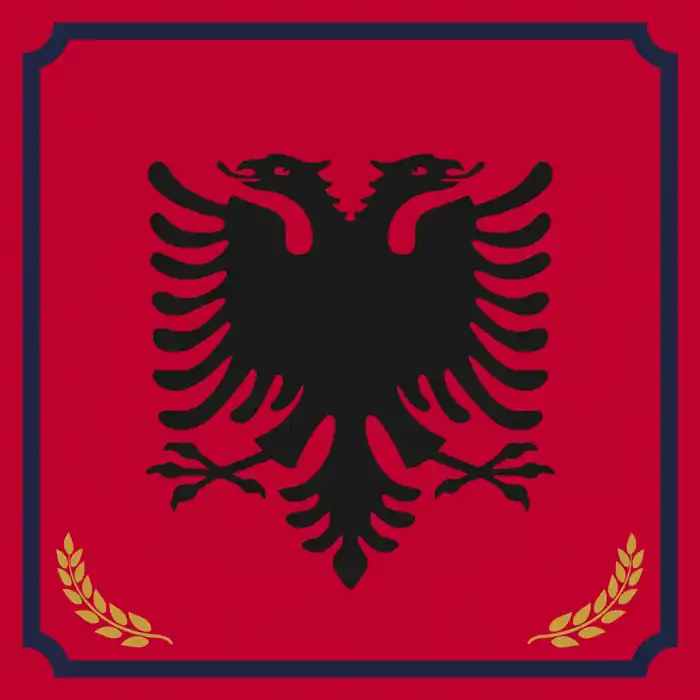
Rank insignia shows a soldier’s grade. Badges show what they are qualified to do, and which branch they belong to. The most recognisable Albanian military emblem is the double-headed eagle of the national flag, which appears on cap badges and uniform insignia across the armed forces — a black eagle on a red field, a symbol of Albania since the medieval hero Skanderbeg. Branch badges distinguish the services: crossed rifles for the Land Force, an anchor for the Naval Force, and wings for the Air Force.
Qualification badges include pilot wings for Air Force aircrew, parachutist wings for airborne and special forces personnel, and marksmanship and specialist badges earned on courses. Officers and NCOs who complete advanced professional military education — including the courses run by the Training and Doctrine Command — wear the corresponding course insignia on their uniforms. As in other NATO forces, medals and ribbons are worn separately from rank and mark service, campaigns and merit rather than grade.
How Promotion Works in the Albanian Armed Forces
Promotion in the Albanian Armed Forces is governed by law and by the needs of the service, and it works differently for each career path. Officers are commissioned through the Armed Forces Academy in Tirana and then advance by a combination of time in grade, professional courses, merit and available vacancies — with command appointments, of a company, a battalion or a ship, as the defining gates of an officer’s career. Because the force is small, senior posts are few, and promotion to the general grades is by selection at the highest level.
NCOs are trained at the Non-Commissioned Officer Academy and advance through the OR grades on time in service, qualifications and merit, with senior NCO appointments — platoon sergeant, company first sergeant, branch sergeant major — marking the career milestones. Enlisted soldiers advance through the numbered Ushtar grades in their first years of service. Albania’s all-volunteer force, in place since conscription ended in 2010, means every promotion now competes for career soldiers who have chosen to stay, and NATO-standard professional military education counts heavily in selection boards.
A Note on Albanian Military Tradition
Albanian ranks carry an unusual history. The first ranks were created in 1926, during the reign of King Zog I, on Austrian and then Italian models. After the Second World War the communist regime replaced them with Soviet-style ranks, and then in 1966 Albania did something almost no other country has done: it abolished military ranks altogether, following the Chinese example and a doctrine of guerrilla warfare, leaving the armed forces rankless for 25 years. Ranks were re-established in 1991, after the fall of the communist regime, on a Western model, and revised in 2004 and again in 2011 into the NATO-aligned system used today.
That history explains two things about the modern system. First, the rank titles are a deliberate blend of Albanian words — Gjeneral, Kolonel, Kapiten, Ushtar — with a Western, NATO structure underneath, rather than a copy of any single foreign army. Second, the force is small and deliberately NATO-interoperable: Albania’s soldiers serve alongside allies in NATO missions such as KFOR in Kosovo, and the OF and OR codes in the tables above are the same codes a British, American or German officer uses to find their Albanian counterpart. In a force of about 7,500, a rank is not just a title — it is a working description of what that person commands, from a platoon of thirty to the armed forces as a whole.
For comparison with other NATO members, see our guides to US Navy ranks, Turkish military ranks, Italian military ranks, the US military uniform and the US military branches.
Read next
US Navy Ranks · Turkish Military Ranks · Italian Army Ranks · US Military Uniform · US Military Branches
FAQs
What is the highest rank in the Albanian military?
Gjeneral lejtant (OF-8), a three-star lieutenant general, is the highest rank in the Albanian Armed Forces. The Navy’s equivalent is Admiral (OF-8). Albania has no OF-9 or OF-10 grades — no four-star or five-star rank exists in the system.
What are the Albanian Army officer ranks in order?
From lowest to highest: Nëntoger (OF-1), Toger (OF-1), Kapiten (OF-2), Major (OF-3), Nënkolonel (OF-4), Kolonel (OF-5), Gjeneral brigade (OF-6), Gjeneral major (OF-7) and Gjeneral lejtant (OF-8). The Air Force uses exactly the same ranks and titles.
What is a Kryekapter?
Kryekapter is the most senior enlisted rank in the Albanian Armed Forces (OR-9). In the Army and Air Force it translates as Sergeant Major; in the Navy it is Master Chief Petty Officer. A Kryekapter is the senior enlisted adviser to a commanding officer.
Do Albanian Navy officers have different ranks from the Army?
Yes. The Navy uses naval titles — Nënlejtnant, Lejtnant, Kapiten lejtnant, Kapiten rangut I, II and III, Kundëradmiral, Nënadmiral and Admiral — and shows rank with gold sleeve stripes rather than shoulder-board stars. The NATO codes match the Army grade for grade, so a naval Kapiten rangut I (OF-5) equals an Army Kolonel (OF-5).
How many people serve in the Albanian Armed Forces?
Around 7,500 active personnel, all volunteers, with about 2,100 reservists. The Land Force is the largest branch, followed by the Air Force and the small Naval Force. Albania joined NATO in 2009 and ended conscription in 2010.
Why did Albania once have no military ranks at all?
In 1966 the communist regime abolished all military ranks, following the Chinese example and a doctrine of guerrilla warfare. The armed forces served without ranks for 25 years until ranks were re-established in 1991 after the fall of communism, and the current NATO-aligned system dates from a reform in 2011.
All insignia diagrams and images in this article are original graphics created for Forces Guide.