
Armenia’s rank system is a direct heir of the Soviet Army: gold stars and stripes on shoulder boards, the same titles in the Army and the Air Force, and a ladder that runs from Private to Army General. What makes it unusual is what is missing. Armenia is a landlocked country with no navy, so there are no admirals, no sailors and no naval ranks at all — just two services, the Ground Forces and the Air Force, sharing one set of Armenian military ranks. This guide covers every one of them, with the insignia, the Armenian names, NATO equivalents and how promotion works.
The Armed Forces of Armenia took their current form on 28 January 1992, when the Ministry of Defence was created after the break-up of the Soviet Union. They were built largely from Soviet units stationed in the Armenian SSR — above all the 7th Guards Army — but their roots reach back further, to the army of the First Republic of Armenia founded in 1918. In total there are 19 ranks: 11 commissioned officers and 8 warrant officers, non-commissioned officers and enlisted soldiers. The same rank titles are used in both branches; the services are told apart by the colour of the shoulder board and by branch badges, not by different names.
Key facts
- Country: Armenia
- Branches: Ground Forces and Air Force (no navy — Armenia is landlocked)
- Commissioned officers: 11 ranks, OF-1 to OF-9 (Junior Lieutenant to Army General)
- Other ranks: 8 ranks, OR-1 to OR-9 (Private to Senior Warrant Officer)
- Highest rank: Army General (OF-9) — there is no five-star or OF-10 rank
- Founded in current form: 28 January 1992
- Notable fact: the same rank titles are used in both services — only the shoulder-board colour changes (olive-khaki for the Ground Forces, light blue for the Air Force)
Armenian Army Officer Ranks
Armenian commissioned officers are divided into three groups: general officers (OF-6 to OF-9), senior officers (OF-3 to OF-5) and junior officers (OF-1 to OF-2). The highest rank in the country is Army General (Banaki general, Բանակի գեներալ), equivalent to OF-9. There is no five-star or OF-10 rank in Armenia, so Army General is the ceiling of the whole system.
Rank names are given below in English, with the Armenian original and a transliteration. The NATO codes are approximate equivalents — Armenia is not a NATO member, but the codes are the standard way of comparing ranks across countries.
| Rank | Armenian (Transliteration) | NATO Code | Insignia | Typical Role |
|---|---|---|---|---|
| Army General | Բանակի գեներալ (Banaki general) | OF-9 | Plain board, four large gold stars | Chief of the General Staff or the most senior command appointment |
| Colonel General | գեներալ-գնդապետ (General-gndapet) | OF-8 | Plain board, three large gold stars | Deputy chief of staff or commander of a major command |
| Lieutenant General | գեներալ-լեյտենանտ (General-leytenant) | OF-7 | Plain board, two large gold stars | Corps commander or senior staff appointment |
| Major General | գեներալ-մայոր (General-mayor) | OF-6 | Plain board, one large gold star | Division commander or head of a directorate |
| Colonel | գնդապետ (Gndapet) | OF-5 | Two stripes, three gold stars | Brigade commander or senior staff officer |
| Lieutenant Colonel | փոխգնդապետ (P’vokhgndapet) | OF-4 | Two stripes, two gold stars | Battalion commander or deputy brigade commander |
| Major | մայոր (Mayor) | OF-3 | Two stripes, one gold star | Battalion executive officer or senior staff officer |
| Captain | կապիտան (Kapitan) | OF-2 | One stripe, four gold stars | Company commander |
| Senior Lieutenant | ավագ լեյտենանտ (Avag leytenant) | OF-1 | One stripe, three gold stars | Platoon commander or company executive officer |
| Lieutenant | լեյտենանտ (Leytenant) | OF-1 | One stripe, two gold stars | Platoon commander |
| Junior Lieutenant | կրտսեր լեյտենանտ (Krtser leytenant) | OF-1 | One stripe, one gold star | Junior platoon commander; entry-level commissioned officer |
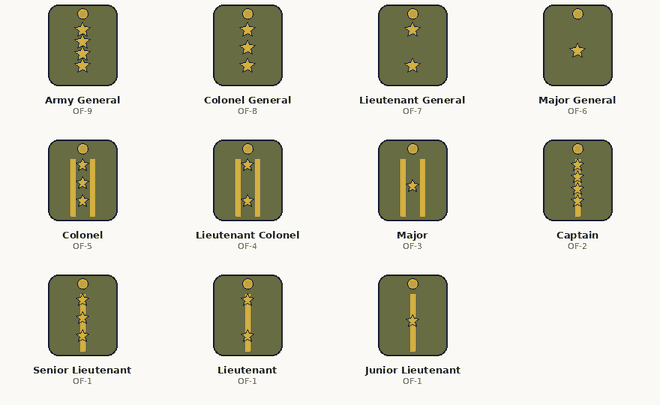
Did you know? Armenia has no five-star or OF-10 rank, so Army General — four large gold stars on a plain shoulder board — is the ceiling of the whole system.
How to Read Armenian Officer Insignia
Armenian officer rank is worn on shoulder boards (usadirs), and the whole code is built from just two elements — stripes and stars — read together:
- The stripes — the long gold lines running down the board. Generals have none at all: their boards are plain. Senior officers (Major to Colonel) have two stripes; junior officers (Junior Lieutenant to Captain) have one stripe. So the stripes alone tell you which of the three groups an officer belongs to.
- The stars — gold five-pointed stars set in a column down the centre of the board. Within each group, more stars mean higher rank. A Major General wears one large star, a Lieutenant General two, a Colonel General three and an Army General four. Among senior officers the count runs the other way down the ladder: Major one star, Lieutenant Colonel two, Colonel three. Among junior officers: Junior Lieutenant one, Lieutenant two, Senior Lieutenant three, Captain four.
- The board colour — Ground Forces boards are olive-khaki green, while Air Force boards are light blue. The rank itself is identical; only the field colour changes.
- The button — a small gold button sits at the top of the board, a classic feature of the Soviet-style shoulder board that Armenia kept.
One naming detail catches out readers of older sources. The rank of Lieutenant Colonel is now officially P’vokhgndapet (փոխգնդապետ, literally “deputy colonel”), and that is the form used in Armenia’s Law on Military Service and the Status of Servicemen. Older English-language references often render it as Gndapet-leytenant instead. Both names describe the same rank.
Armenian Other Ranks: Warrant Officers, NCOs and Enlisted
Below the officers sit the other ranks: two warrant officer grades, four sergeant grades and two enlisted grades. In the post-Soviet system the warrant officers — the yent’aspa ranks — are the senior technical specialists of the army, a separate ladder that sits between the sergeants and the commissioned officers. They are not the same as the warrant officers of the US or British armies, and they have no direct equivalent in Western rank tables, though they are usually compared to senior NCOs and warrant officer class 1.
| Rank | Armenian (Transliteration) | NATO Code | Insignia | Typical Role |
|---|---|---|---|---|
| Senior Warrant Officer | ԱՎԱԳ ԵՆԹԱՍՊԱ (Avag yent’aspa) | OR-9 | Plain board, three small gold stars | Most senior technical specialist; advisor at battalion level and above |
| Warrant Officer | ԵՆԹԱՍՊԱ (Yent’aspa) | OR-8 | Plain board, two small gold stars | Technical specialist in charge of equipment, stores or a workshop |
| Sergeant Major | ԱՎԱԳ (Avag) | OR-7 | One wide chevron bar and one narrow bar | Senior enlisted soldier of a company or battalion |
| Senior Sergeant | ԱՎԱԳ ՍԵՐԺԱՆՏ (Avag serzhant) | OR-6 | One wide chevron bar | Platoon sergeant; deputy to the platoon commander |
| Sergeant | ՍԵՐԺԱՆՏ (Serzhant) | OR-5 | Three narrow chevron bars | Squad leader |
| Junior Sergeant | ԿՐՏՍԵՐ ՍԵՐԺԱՆՏ (Krtser serzhant) | OR-4 | Two narrow chevron bars | Assistant squad leader or team leader |
| Lance Corporal | ԵՖՐԵՅՏՈՐ (Yefreytor) | OR-2 | One narrow chevron bar | Senior private; the first step above the ranks |
| Private | շարքային (Shark’ayin) | OR-1 | Bare shoulder board, no insignia | New conscript or recruit; entry-level soldier |
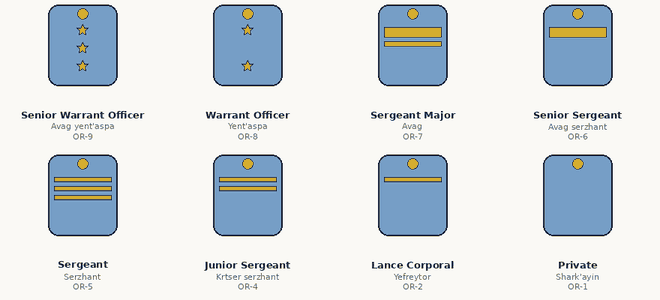
Key point: a Private wears a bare shoulder board with no mark at all — the only rank with nothing to show, and the rank most conscripts hold when they enter service, since Armenia retains compulsory military service of about two years.
How to Read Armenian Enlisted and NCO Insignia
The other ranks are read from the same shoulder boards as the officers, but the code is different — chevron bars for sergeants, small stars for warrant officers, and nothing at all for a private:
- Chevrons — gold bars laid across the board. A Yefreytor (Lance Corporal) wears one narrow bar, a Junior Sergeant two, a Sergeant three. Then the bars get wider instead of more numerous: a Senior Sergeant wears one wide bar, and a Sergeant Major (Avag) wears one wide bar with a narrow bar beside it. Count the bars first, then check their width.
- Warrant officer stars — the two yent’aspa ranks wear small gold stars on a plain board with no stripes: two stars for a Warrant Officer, three for a Senior Warrant Officer. The small size of the stars is the giveaway — officer stars are larger, and every officer board except a general’s carries at least one stripe.
- The bare board — a Private (Shark’ayin) wears a plain shoulder board with no mark at all. It is the only rank with nothing to show, and it is also the rank held by most conscripts: Armenia retains compulsory military service, and most young Armenian men serve about two years, entering as privates.
- The board colour — as with officers, the field is olive-khaki for the Ground Forces and light blue for the Air Force.
Two translation notes are worth keeping. The lowest rank, Shark’ayin (շարքային), is the form used in Armenia’s current military service law; older sources give Zinvor (Զինվոր), which literally means “soldier”. And Avag (ԱՎԱԳ) on its own means “senior” or “elder” — in the rank table it is the title of the Sergeant Major, the most senior sergeant grade, and it also appears inside the titles of the Senior Warrant Officer (Avag yent’aspa) and the Senior Sergeant (Avag serzhant).
Armenian Air Force Ranks
The Armenian Air Force uses exactly the same rank titles as the Ground Forces — the same eleven officers and eight other ranks, in the same order. The difference is visual: Air Force shoulder boards are light blue instead of olive-khaki, and airmen wear Air Force branch badges. There is no separate set of air force ranks to learn, and no separate air force rank table is needed.
Air defence is organised inside the Air Force — the service is formally the Air Force and Air Defence Force, and air defence units fall under the same command. Air defence personnel hold the same ranks and wear the same insignia as other airmen; there are no distinct air defence ranks. Armenia’s air arm is small, built around helicopters, transport aircraft and a handful of combat jets, with ground-based air defence forming a large part of its strength.
Why Armenia Has No Navy — and No Naval Ranks
Armenia is a landlocked country, bordered by Georgia, Azerbaijan, Iran and Türkiye, with no coastline of any kind. It therefore has no navy, no admirals and no naval ranks — the armed forces consist of only the two branches above, under a General Staff headquartered in Yerevan. This puts Armenia in a small group of countries whose rank tables end at the army and the air force; neighbouring Georgia is in the same position, while Azerbaijan and Türkiye, with Caspian and Mediterranean coastlines, both maintain navies and full naval rank systems.
Armenian Military Badges and Emblems
Rank insignia shows a soldier’s grade. Badges and emblems show their service, branch and qualifications:
- The national emblem — Armenia’s coat of arms, an eagle and a lion supporting a shield that shows Mount Ararat, appears on caps and as the emblem of the armed forces. It is the most recognisable Armenian military symbol after the flag itself.
- The flag patch — the red, blue and orange tricolour of Armenia is worn as a shoulder patch, the quickest way to identify an Armenian soldier in a multinational setting.
- Branch badges — collar and beret badges mark the arm of service: crossed rifles for the infantry, and specialist devices for artillery, armour, engineers, signals and other corps. Air Force personnel wear aviation badges, and qualified pilots wear wings.
- Qualification badges — parachutist wings for airborne-qualified soldiers, and marksmanship and specialist badges earned through training courses, are worn on the chest of the service uniform.
- Berets and headgear — beret colours vary by branch, as in most post-Soviet armies, with the branch badge worn at the front.
How Promotion Works in Armenia
Promotion in the Armenian Armed Forces follows the post-Soviet pattern: a mix of time in grade, service record, professional training and selection. A conscript private who shows ability can be promoted to Yefreytor and then to Junior Sergeant during service, and contract soldiers can build a career through the sergeant grades. Entry to the warrant officer ladder comes from the senior sergeant ranks, for soldiers who become technical specialists rather than commanders.
Officers are commissioned after graduating from a military academy — above all the Vazgen Sargsyan Military University in Yerevan — and then advance through the junior and senior officer grades as they complete command appointments and staff courses. Each step requires a minimum time in the current rank and a vacant post at the next grade. The most senior appointments, including promotion to general officer rank, are made at the highest level of government, by presidential decree. Because the armed forces are comparatively small — roughly 44,000 active personnel — the pyramid is steep: there are far fewer colonels than captains, and only a handful of generals at the top.
A Note on Armenian Military Tradition
Two threads run through Armenian military tradition. The first is the fedayee heritage — the volunteer fighters who defended Armenian communities in the late 19th and early 20th centuries, and whose spirit was invoked again when volunteer detachments formed the core of the new army in the early 1990s. The second is the Soviet inheritance: the ranks, the shoulder boards, the structure of the General Staff and the academies all come from the Soviet Army, and Armenia has kept them with only small changes since independence. The result is a rank system that looks Russian at a glance but carries Armenian names, Armenian words of command and the tricolour on the sleeve. Since the 2020 war in Nagorno-Karabakh, Armenia has been carrying out a top-to-bottom reform of its armed forces, moving toward a more professional, contract-based force — but the ranks themselves, set down in law, have not changed.
For comparison with the other services, see our guides to US Navy ranks, the US military uniform and the US military branches. For the closest comparison of all, see our guide to Russian military ranks, the system Armenia’s ranks descend from, and our guide to Iranian military ranks, for Armenia’s southern neighbour.
Read next
Russian Military Ranks · Iranian Military Ranks · US Navy Ranks · US Military Uniform · US Military Branches
FAQs
What is the highest rank in the Armenian military?
Army General (Banaki general, OF-9), worn as four large gold stars on a plain shoulder board. There is no OF-10 or five-star rank in Armenia, so Army General is the ceiling of the system.
Does Armenia have a navy?
No. Armenia is landlocked, with no coastline, so it has no navy and no naval ranks. The armed forces consist of the Ground Forces and the Air Force (which includes air defence) only.
Are Armenian Army and Air Force ranks the same?
Yes. Both services use the same 19 rank titles in the same order. The difference is visual: Ground Forces shoulder boards are olive-khaki, Air Force boards are light blue, and each service wears its own branch badges.
What does “yent’aspa” mean?
Yent’aspa (ԵՆԹԱՍՊԱ) is the Armenian rendering of the Russian praporshchik — the warrant officer. A Yent’aspa is a senior technical specialist, and an Avag yent’aspa (Senior Warrant Officer) is the most senior grade of that ladder, roughly comparable to a warrant officer class 1.
How do you read an Armenian shoulder board?
Look at the stripes first: none means a general or a warrant officer, two means a senior officer, one means a junior officer. Then count the stars: more stars mean higher rank within the group. Sergeants are different — they wear gold chevron bars instead of stars, and a private wears a bare board with nothing on it.
What is the lowest rank in the Armenian Army?
Private (Shark’ayin, շարքային, OR-1), worn as a bare shoulder board with no insignia. Most conscripts enter service at this rank; Armenia retains compulsory military service of about two years.
All insignia diagrams and images in this article are original graphics created for Forces Guide.