
Modern Greek military ranks look unfamiliar at first glance — the names are long, they are written in Greek, and the same seniority can carry three different titles depending on whether the wearer serves on land, at sea or in the air. Once you know the pattern, though, the system is easy to read. This guide covers every rank of the Hellenic Armed Forces as they exist today: the Hellenic Army, the Hellenic Navy and the Hellenic Air Force, from Private to General, with Greek names, NATO grades and what each insignia looks like.
One important note before we begin: this article is about modern Greece only. The rank names borrow words from Ancient Greek and Byzantine usage — a captain is still a lochagos, “leader of a company” — but the ranks, uniforms and insignia described here belong to the armed forces of the present-day Hellenic Republic, a NATO member since 1952. Ancient Greek ranks, from the hoplite phalanx to the armies of Alexander, are a different subject and are covered separately on this site.
Key facts
- Country: Greece (Hellenic Republic)
- Branches: Hellenic Army, Hellenic Navy and Hellenic Air Force
- Commissioned officers: OF-1 to OF-9 (Second Lieutenant to General / Admiral)
- NCOs and other ranks: OR-1 to OR-9 (Private to Anthypaspistis)
- Highest rank: General (OF-9) in the Army and Air Force, Admiral (OF-9) in the Navy — Greece has no OF-10 rank in use
- Notable fact: NATO member since 1952; Greece still retains compulsory military service for men, and the armed forces number roughly 140,000 active personnel
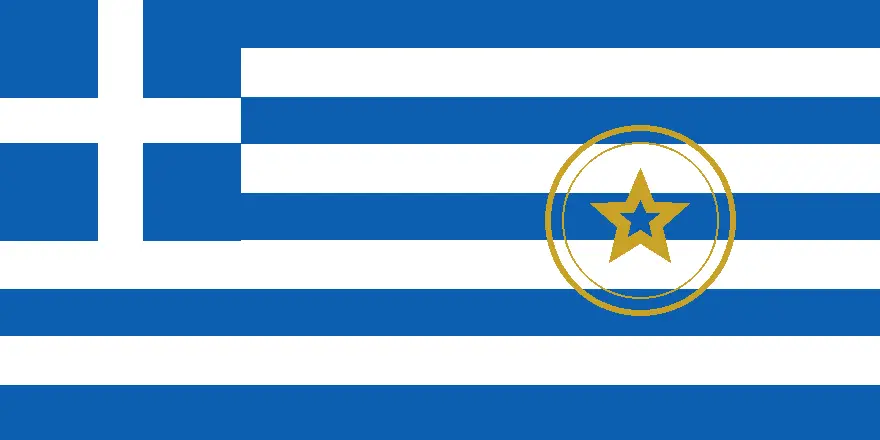
Greek ranks fall into two groups, the same split NATO uses everywhere: commissioned officers (OF-1 to OF-9) and non-commissioned officers and other ranks (OR-1 to OR-9). Greece has no OF-10 rank in use — the highest rank in each service is OF-9.
The three services answer to the Hellenic National Defence General Staff, and the President of the Hellenic Republic is the nominal commander-in-chief. The armed forces number roughly 140,000 active personnel, and Greece still retains compulsory military service for men, so conscript ranks sit alongside the professional ranks in the tables below.
Hellenic Army Officer Ranks (OF-1 to OF-9)
The Hellenic Army is the largest of the three services and the oldest in its present form. Its officer ranks run from second lieutenant to general, and the names describe the unit each rank traditionally commands: a tagmatarchis commands a tagma (battalion), a lochagos commands a lochos (company), and a syntagmatarchis takes his name from the syntagma (regiment). The senior officer of the Army is the Chief of the Hellenic Army General Staff, a stratigos.
| Rank (Greek) | Transliteration | NATO | English Equivalent | Typical Role |
|---|---|---|---|---|
| Στρατηγός | Stratigos | OF-9 | General | Chief of the Army General Staff; the Army’s most senior officer |
| Αντιστράτηγος | Antistratigos | OF-8 | Lieutenant General | Corps commander or senior staff appointment |
| Υποστράτηγος | Ypostratigos | OF-7 | Major General | Division commander |
| Ταξίαρχος | Taxiarchos | OF-6 | Brigadier General | Brigade commander |
| Συνταγματάρχης | Syntagmatarchis | OF-5 | Colonel | Senior staff officer or brigade executive officer |
| Αντισυνταγματάρχης | Antisyntagmatarchis | OF-4 | Lieutenant Colonel | Battalion commander or senior staff officer |
| Ταγματάρχης | Tagmatarchis | OF-3 | Major | Battalion executive officer or staff officer |
| Λοχαγός | Lochagos | OF-2 | Captain | Company commander |
| Υπολοχαγός | Ypolochagos | OF-1 | First Lieutenant | Platoon commander or company second-in-command |
| Ανθυπολοχαγός | Anthypolochagos | OF-1 | Second Lieutenant | Platoon commander; entry-level commissioned officer |
How to Read Hellenic Army Officer Insignia
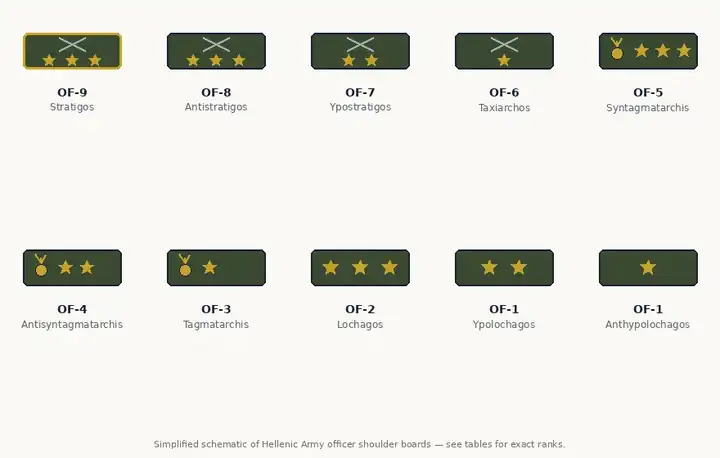
Army officers wear their rank on shoulder boards, and the code is built from gold stars and one famous emblem:
- Stars — gold stars mark seniority. Company officers (OF-1 to OF-2) wear one to three stars; field officers (OF-3 to OF-5) wear one to three stars alongside the flaming grenade; general officers (OF-6 to OF-9) wear stars with crossed swords.
- The flaming grenade — the emblem of the Hellenic Army, worn by field officers and on the insignia of the service itself. It has appeared on Army officer insignia since 1975, when it replaced the phoenix introduced during the military regime of 1967–1974. The underlying shoulder-board style dates from 1970.
- Crossed swords — general officers’ boards carry crossed swords with their stars, marking the general ranks apart from the field officers below them.
- Branch colours — the colour of the shoulder board and collar tabs shows the officer’s arm or corps: infantry, armour, artillery, engineers, signals, medical and the rest each have their own colour, so two officers of the same rank can look different at a glance.
Hellenic Army NCO and Other Ranks (OR-1 to OR-9)
Greek non-commissioned officers come from three streams: graduates of the Permanent NCO Schools (ΣΜΥ), long-term volunteers and professional soldiers (ΕΜΘ and ΕΠΟΠ), and conscripts serving their compulsory term. The senior NCO of all, the anthypaspistis, is the equivalent of a warrant officer or sergeant major and wears the arm or corps badge rather than the chevron pattern of the ranks below him.
| Rank (Greek) | Transliteration | NATO | English Equivalent | Typical Role |
|---|---|---|---|---|
| Ανθυπασπιστής | Anthypaspistis | OR-9 | Warrant Officer / Sergeant Major | Senior NCO of a formation; advisor to the commander |
| Αρχιλοχίας | Archilochias | OR-8 | Master Sergeant | Senior NCO at battalion level |
| Επιλοχίας | Epilochias | OR-7 | Sergeant First Class | Senior NCO at company level |
| Λοχίας | Lochias | OR-6 | Staff Sergeant | Platoon sergeant; the Army’s working sergeant |
| Δεκανέας | Dekaneas | OR-4 | Corporal | Section leader; leads a squad of about ten soldiers |
| Υποδεκανέας | Ypodekaneas | OR-3 | Lance Corporal | Assistant section leader |
| Στρατιώτης | Stratiotis | OR-1 | Private | Entry-level soldier; a conscript private wears no insignia |
There is no direct Greek equivalent for OR-5 or OR-2 in the Army table — the ladder simply skips those grades. Army NCOs wear their rank as gold chevrons on the sleeve, and the stream shows in the detail above them: permanent NCOs wear two arcs above their chevrons, while long-term volunteers and professional soldiers wear the chevrons without arcs. A conscript can also rise to lochias, dekaneas or ypodekaneas during his service, and a conscript officer candidate holds the rank of Dokimos Efedros Axiomatikos (reserve officer candidate, OF(D)) while training.
Did you know? The Army NCO ladder skips OR-5 and OR-2 entirely — there is simply no Greek rank at those grades — and a conscript private wears no insignia at all.
Hellenic Navy Officer Ranks (OF-1 to OF-9)
The Hellenic Navy is the service with the longest continuous tradition in Greece, refounded during the War of Independence of 1821–1830 and today responsible for the Aegean and the eastern Mediterranean. Its officer ranks keep the structure introduced in 1936, and its titles are genuinely naval — a captain at sea is a ploiarchos, “ship-leader”, and an admiral is a navarchos. The Navy’s most senior officer is the Chief of the Hellenic Navy General Staff.
| Rank (Greek) | Transliteration | NATO | English Equivalent | Typical Role |
|---|---|---|---|---|
| Ναύαρχος | Navarchos | OF-9 | Admiral | Chief of the Navy General Staff; the Navy’s most senior officer |
| Αντιναύαρχος | Antinavarchos | OF-8 | Vice Admiral | Fleet commander or senior staff appointment |
| Υποναύαρχος | Yponavarchos | OF-7 | Rear Admiral | Naval command or flotilla commander |
| Αρχιπλοίαρχος | Archiploiarchos | OF-6 | Commodore | Senior naval commander |
| Πλοίαρχος | Ploiarchos | OF-5 | Captain | Commanding officer of a major warship |
| Αντιπλοίαρχος | Antiploiarchos | OF-4 | Commander | Commanding officer of a smaller warship |
| Πλωτάρχης | Plotarchis | OF-3 | Lieutenant Commander | Executive officer or department head aboard ship |
| Υποπλοίαρχος | Ypoploiarchos | OF-2 | Lieutenant | Department head or watch officer aboard ship |
| Ανθυποπλοίαρχος | Anthypoploiarchos | OF-1 | Sub-Lieutenant | Junior officer aboard ship |
| Σημαιοφόρος | Simaioforos | OF-1 | Ensign | Entry-level commissioned officer |
How to Read Hellenic Navy Insignia
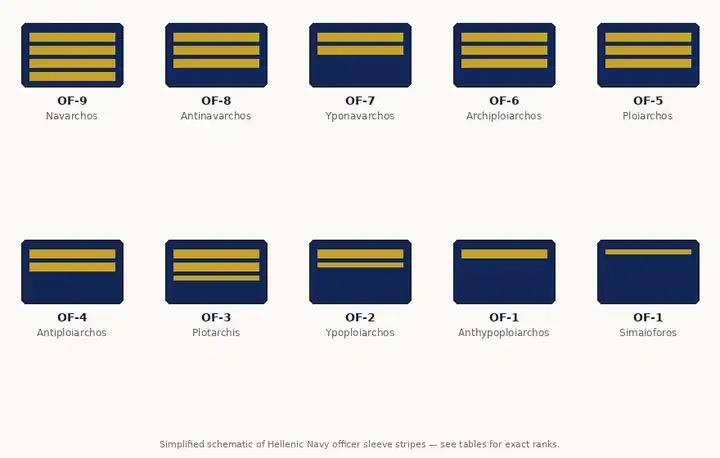
Navy officers wear their rank as gold braid stripes on the sleeves of the dark-blue uniform, in the tradition shared by most European navies:
- Stripes — the number and width of the gold stripes show the rank. An ensign wears a single narrow stripe; the stripes grow broader and more numerous with seniority, and flag officers (OF-6 and above) wear a broad stripe among them. Count the stripes and you have the rank.
- The loop — line (executive) officers wear a small loop, or curl, in the top stripe. Specialist officers — engineers, doctors, supply and others — wear the same stripes without the loop, so the loop is the quick way to tell a seaman officer from a specialist of the same grade.
- Shoulder boards — on white shirts and working dress the same stripes appear on removable shoulder boards, topped by a button carrying an anchor.
- The anchor — the fouled anchor is the Navy’s own emblem and appears on caps, buttons and badges. It is not a rank, but it is the mark of the service.
Key point: the loop is the giveaway. A line officer and a specialist of the same grade wear the same gold stripes — only the small loop in the top stripe tells you which one is the seaman officer.
Hellenic Navy NCO and Other Ranks (OR-1 to OR-9)
Navy NCOs are petty officers, and their titles come from the old word kelefstis, a petty officer. As in the Army, permanent NCOs are marked by two arcs above their chevrons, while long-term volunteers wear one arc. Conscript sailors follow the same ladder at the lower grades.
| Rank (Greek) | Transliteration | NATO | English Equivalent | Typical Role |
|---|---|---|---|---|
| Ανθυπασπιστής | Anthypaspistis | OR-9 | Warrant Officer / Master Chief | Senior NCO of a ship or naval command |
| Αρχικελευστής | Archikelefstis | OR-8 | Master Chief Petty Officer | Senior petty officer aboard ship |
| Επικελευστής | Epikelefstis | OR-7 | Senior Chief Petty Officer | Department senior petty officer |
| Κελευστής | Kelefstis | OR-6 | Chief Petty Officer | Petty officer in charge of a section or watch |
| Δίοπος | Diopos | OR-4 | Leading Seaman | Senior sailor; leads a small working party |
| Ναύτης | Naftis | OR-1 | Seaman | Entry-level sailor |
There is no direct Greek equivalent for OR-5, OR-3 or OR-2 in the Navy table. Navy petty officers also wear a specialty badge above their chevrons — an anchor for seamen, a propeller for engine-room ratings and similar devices — so the chevrons give the rank and the badge gives the trade. A conscript officer candidate in the Navy holds the rank of Simaioforos Epikouros Axiomatikos (reserve ensign) while training.
Hellenic Air Force Officer Ranks (OF-1 to OF-9)
The Hellenic Air Force is the youngest of the three services, founded in 1930. Its insignia are based on the British Royal Air Force, while its rank titles follow the Army pattern when translated into English — so a Greek air force colonel-equivalent is a sminarchos, from sminos, a squadron. The Air Force’s most senior officer is the Chief of the Hellenic Air Force General Staff.
| Rank (Greek) | Transliteration | NATO | English Equivalent | Typical Role |
|---|---|---|---|---|
| Πτέραρχος | Pterarchos | OF-9 | General | Chief of the Air Force General Staff; the Air Force’s most senior officer |
| Αντιπτέραρχος | Antipterarchos | OF-8 | Lieutenant General | Senior air command or staff appointment |
| Υποπτέραρχος | Ypopterarchos | OF-7 | Major General | Air command or division-level appointment |
| Ταξίαρχος | Taxiarchos | OF-6 | Brigadier General | Wing or brigade-level commander |
| Σμήναρχος | Sminarchos | OF-5 | Colonel | Wing commander or senior staff officer |
| Αντισμήναρχος | Antisminarchos | OF-4 | Lieutenant Colonel | Squadron commander or senior staff officer |
| Επισμηναγός | Episminagos | OF-3 | Major | Squadron executive officer or flight commander |
| Σμηναγός | Sminagos | OF-2 | Captain | Flight commander; often a pilot |
| Υποσμηναγός | Yposminagos | OF-1 | First Lieutenant | Junior pilot or officer |
| Ανθυποσμηναγός | Anthyposminagos | OF-1 | Second Lieutenant | Entry-level commissioned officer |
How to Read Hellenic Air Force Insignia
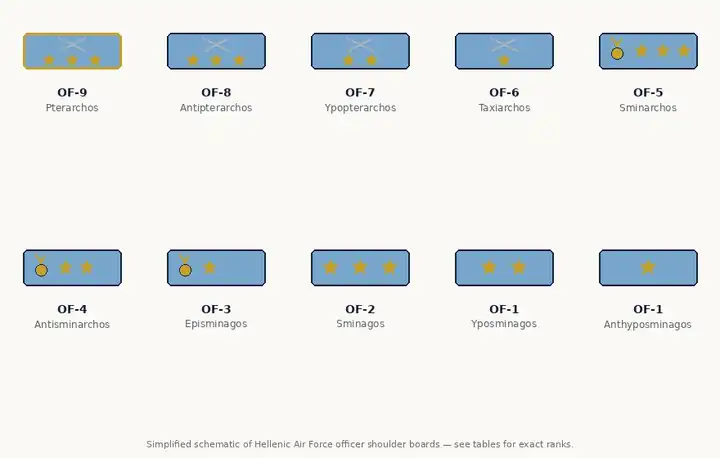
Air Force officers wear their rank on shoulder boards, following the RAF pattern the service adopted at its founding:
- Stars — as in the Army, gold stars mark seniority: one to three for junior officers, one to three with an emblem for field officers, and stars with crossed swords for the air officers (OF-6 to OF-9).
- Light blue — the Air Force uniform is a light blue-grey, distinct from the Army’s green and the Navy’s dark blue, so the service is recognisable before any rank is read.
- Wings — pilots wear the Air Force pilot’s wings, a winged badge on the chest. The wings are a qualification, not a rank: a junior pilot and a senior officer can wear the same wings, and the shoulder boards still show who outranks whom.
- RAF-style equivalents — in English, Air Force ranks are sometimes given their RAF equivalents instead of the Army-style titles in the table above: pterarchos as Air Chief Marshal, sminarchos as Group Captain, sminagos as Flight Lieutenant and so on. The NATO grade is identical either way.
Hellenic Air Force NCO and Other Ranks (OR-1 to OR-9)
Air Force NCO titles come from sminias, an airman-sergeant, and the stream marking follows the Army model: permanent NCOs wear two arcs above their chevrons, while long-term volunteers and professional airmen wear the chevrons without arcs.
| Rank (Greek) | Transliteration | NATO | English Equivalent | Typical Role |
|---|---|---|---|---|
| Ανθυπασπιστής | Anthypaspistis | OR-9 | Warrant Officer / Sergeant Major | Senior NCO of a wing or command |
| Αρχισμηνίας | Archisminias | OR-8 | Master Sergeant | Senior NCO at wing level |
| Επισμηνίας | Episminias | OR-7 | Technical Sergeant | Senior NCO at squadron level |
| Σμηνίας | Sminias | OR-6 | Staff Sergeant | Section leader; the Air Force’s working sergeant |
| Υποσμηνίας | Yposminias | OR-4 | Junior Sergeant | Assistant section leader |
| Σμηνίτης | Sminitis | OR-1 | Airman | Entry-level airman; a conscript airman wears no insignia |
There is no direct Greek equivalent for OR-5, OR-3 or OR-2 in the Air Force table. A conscript who rises during his service holds the rank of Klirotos Sminias (conscript sergeant).
Greek Military Badges
Rank insignia shows a service member’s grade. Badges show what they are qualified to do, and the Greek services have several worth knowing:
- The flaming grenade — the emblem of the Hellenic Army, worn on officer insignia and as a collar and cap badge. It replaced the phoenix in 1975 and is the single most recognisable Greek Army symbol.
- The fouled anchor — the emblem of the Hellenic Navy, on caps, buttons and badges, marking the Navy’s maritime identity.
- Pilot’s wings — the winged badge of a qualified Hellenic Air Force pilot, worn on the chest. Navigator and other aircrew wear their own winged badges.
- Parachutist wings — worn by soldiers and airmen qualified in military parachuting, including special forces personnel.
- Specialty badges — Navy petty officers and Air Force technicians wear trade badges above their chevrons, from anchors and propellers to crossed tools, showing their specialisation at a glance.
- The Evzone uniform — the ceremonial Presidential Guard (Evzones) wear the famous white kilt (fustanella) at the Tomb of the Unknown Soldier in Athens. It is a ceremonial dress, not a rank, but it is the image of the Greek soldier most visitors remember.
How Promotion Works in the Greek Armed Forces
Officers enter through the three service academies — the Hellenic Military Academy (Evelpidon) for the Army, the Hellenic Naval Academy for the Navy and the Hellenic Air Force Academy for the Air Force — and are commissioned as second lieutenants, ensigns or pilot officers. NCOs enter through the Permanent NCO Schools, or join as long-term volunteers and professional soldiers. Promotion then follows time in grade, qualifications and selection boards, with command — of a company, a ship, a squadron, a battalion — as the defining career gate.
Junior officers advance largely on time served and satisfactory reports. Promotion to the field grades (OF-3 and above) and to the general and flag ranks is by selection board, and the pyramid narrows sharply: there are far fewer colonels than majors, and only a handful of generals and admirals in each service.
Under the rules in force before a planned reform, permanent NCOs could be promoted into the officer corps as second lieutenants after long service. A reform proposed for 2027 would replace that path with a new warrant-officer style ladder and selection for the most senior NCO appointments — but as of 2026 the ranks in the tables above are the ones in use.
A Note on Greek Military Tradition
Two things explain almost everything about Greek ranks. The first is language: the names are not translations of foreign ranks but Greek words for the job itself. A lochagos leads a lochos, a tagmatarchis commands a tagma, a navarchos rules the ships and a pterarchos — from pteron, a wing — commands the air. The suffixes -agos (“to lead”) and -archos (“to rule”) run through the whole system, and they are the reason Greek ranks sound ancient even though the system is a modern NATO one.
The second is history. The Army’s officer insignia keeps the style introduced in 1970, with the flaming grenade restored in 1975 after the fall of the military regime; the Navy’s ranks keep the structure introduced in 1936; and the Air Force, founded in 1930, still shows its British RAF parentage in its insignia. Greece’s geography explains the rest: a country of islands and long coastlines needs a strong navy, a mountainous mainland needs a large army, and the Aegean needs an air force that can reach across it. The three rank systems look different because the three services do different jobs — but the NATO grades underneath them are the same.
Read next
US Navy Ranks · US Military Branches · US Military Uniform · Turkish Military Ranks · Italian Army Ranks
FAQs
What is the highest rank in the Greek military?
General (OF-9) in the Army and Air Force — Stratigos and Pterarchos — and Admiral (OF-9), Navarchos, in the Navy. Greece has no OF-10 rank in use. The most senior officer overall is the Chief of the Hellenic National Defence General Staff. The highest NCO rank in all three services is Anthypaspistis (OR-9).
What does “Stratigos” mean?
Stratigos (Στρατηγός) literally means “army-leader” and is the Greek word for general. It is one of the oldest military words in the language — the ancient Athenians elected ten strategoi each year — but the modern rank is a NATO OF-9 general, not an ancient office.
Why do Greek ranks have different names in each service?
Because the names describe the job in each environment. The Army names ranks after the land units they command (lochos, tagma), the Navy after ships (ploion), and the Air Force after squadrons and wings (sminos, pteron). The NATO OF and OR grades underneath are identical, so an Army OF-5, a Navy OF-5 and an Air Force OF-5 all hold the same seniority.
How do I read a Greek Navy officer’s rank?
Count the gold stripes on the sleeve: more and broader stripes mean a more senior rank, from one narrow stripe for an ensign up to the broad stripe of a flag officer. A small loop in the top stripe marks a line (executive) officer; specialist officers wear the same stripes without the loop.
What is an Anthypaspistis?
Anthypaspistis (Ανθυπασπιστής, OR-9) is the most senior non-commissioned rank in all three Greek services, usually translated as Warrant Officer or Sergeant Major. The holder is the senior enlisted advisor to a commander, and in the Army he wears the arm or corps badge rather than the chevron pattern of the lower NCO ranks.
Do Greek conscripts hold ranks?
Yes. Greece retains compulsory military service for men, and conscripts can be promoted to lochias, dekaneas or ypodekaneas in the Army, to the equivalent grades in the Navy and Air Force, or selected as reserve officer candidates (Dokimos Efedros Axiomatikos). A new conscript private, seaman or airman wears no rank insignia.
All insignia diagrams and images in this article are original graphics created for Forces Guide. Rank names and NATO grades follow the modern Hellenic Armed Forces as listed in the “Greek military ranks” reference tables; a reform of the NCO ladder proposed for 2027 is noted where relevant and is not yet in force.