
Kuwait has one of the simplest rank systems in the Gulf — and one of the easiest to misread. The whole armed forces use a single ladder of just 17 titles, and the names never change from one service to another. What changes is only the English translation, and only for the navy. Learn those 17 names and you can read any Kuwaiti uniform, from a new private to the general at the top. This guide goes through every Kuwait military rank in plain language: the Arabic name, the English equivalent, the NATO-style code, and the job that goes with each rank — including the two rungs missing from the ladder altogether.
AT A GLANCE
Services: Kuwait Land Forces, Kuwait Air Force and Kuwait Naval Force, plus the Kuwait National Guard — all four use the same 17-rank ladder.
Total ranks: 17 — 10 officers and 7 other ranks, from Jundiun (Private) to Fariq ‘awal (General).
Top rank: Fariq ‘awal, graded OF-9. There is no higher rank in Kuwait.
Watch for: there is no OR-5 and no OR-3 — the ladder jumps from OR-6 to OR-4, then to OR-2 and OR-1.
One Ladder for Four Services
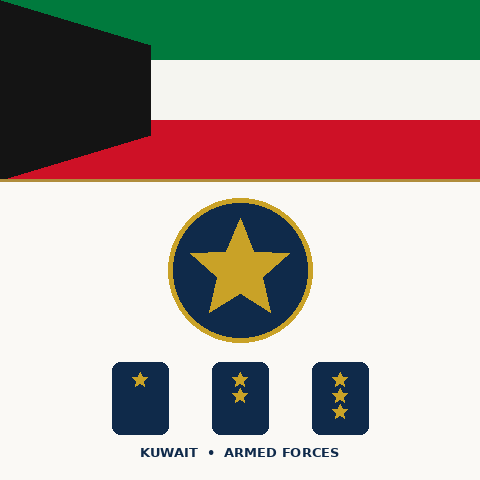
The Kuwait Armed Forces are made up of three services: the Kuwait Land Forces, the Kuwait Air Force and the Kuwait Naval Force. Alongside them stands a fourth armed body, the Kuwait National Guard, an independent institution that does not sit under the Ministry of Defence. What matters for this guide is that all four use the identical 17-rank ladder: a soldier, a sailor, an airman and a guardsman at the same level all carry the same Arabic title.
That single ladder makes Kuwait unusual. In many countries each service keeps its own rank names, so a reader has to learn three or four ladders at once. In Kuwait there is only one set of names to learn, and only the English equivalent changes — and only for the navy, as the section below explains. A colonel in the Land Forces and a colonel in the Air Force are both Aqid.
The Commander-in-Chief of the armed forces is the Emir of Kuwait. The Land Forces are the largest part of the force, with around 17,500 personnel. The ranks below are the whole system: ten officer titles and seven other-rank titles, and nothing else. There is no separate warrant-officer ladder and no second set of titles hiding in a fourth service.
Key point: Do not treat the National Guard as a fourth branch of the armed forces. It is an independent institution, separate from the Ministry of Defence — but it still uses exactly the same ranks as the Land Forces, the Air Force and the Naval Force. Same titles, same ladder, different chain of command.
The Other Ranks: Seven Titles, With Two Gaps
Every Kuwaiti service member who is not an officer holds one of seven other-rank titles, from Jundiun at the bottom to Wakil ‘awal at the top. The ladder starts with the two private grades. A new recruit is a Jundiun, a Private, and the next step up is Jundiun awwal, a Private First Class. The word awwal means first, and it marks the senior grade of a pair — a pattern that runs through the whole Kuwaiti ladder, as the section on Arabic names explains.
Above the privates comes Earif, a Corporal, the first rank with real authority over other soldiers. Then the ladder takes its first jump: there is no OR-3, so the next title after Earif is Raqib, a Staff Sergeant, graded OR-6, followed by its senior partner, Raqib ‘awal, a Sergeant First Class at OR-7. The top two titles are the two grades of Wakil: Wakil, a First Sergeant at OR-8, and Wakil ‘awal, a Sergeant Major at OR-9 — the highest rank any other-rank service member can reach.
The English titles in the table are the Army versions. The Navy and the Air Force use different English words for the same Arabic titles — a Wakil ‘awal is a Master Chief Petty Officer at sea and a Chief Master Sergeant in the air — and the navy section below gives the full list. The Arabic title never changes.
| Rank (Arabic + Transliteration) | English Equivalent | NATO Equivalent | Insignia | Typical Role |
|---|---|---|---|---|
| جندي — Jundiun | Private / Seaman Recruit / Airman Basic | OR-1 | Not described in sources | New recruit in basic training |
| جندي أول — Jundiun awwal | Private First Class / Seaman Apprentice / Airman | OR-2 | Not described in sources | Trained junior service member |
| عريف — Earif | Corporal / Petty Officer 3rd Class / Senior Airman | OR-4 | Not described in sources | Junior leader; first rank with authority over others |
| رقيب — Raqib | Staff Sergeant / Petty Officer 1st Class / Technical Sergeant | OR-6 | Not described in sources | Experienced non-commissioned officer; section or team leader |
| رقيب أول — Raqib ‘awal | Sergeant First Class / Chief Petty Officer / Master Sergeant | OR-7 | Not described in sources | Senior non-commissioned officer; adviser at company level |
| وكيل — Wakil | First Sergeant / Senior Chief Petty Officer / Senior Master Sergeant | OR-8 | Not described in sources | Senior enlisted adviser at battalion level |
| وكيل أول — Wakil ‘awal | Sergeant Major / Master Chief Petty Officer / Chief Master Sergeant | OR-9 | Not described in sources | Most senior other rank; adviser to senior commanders |
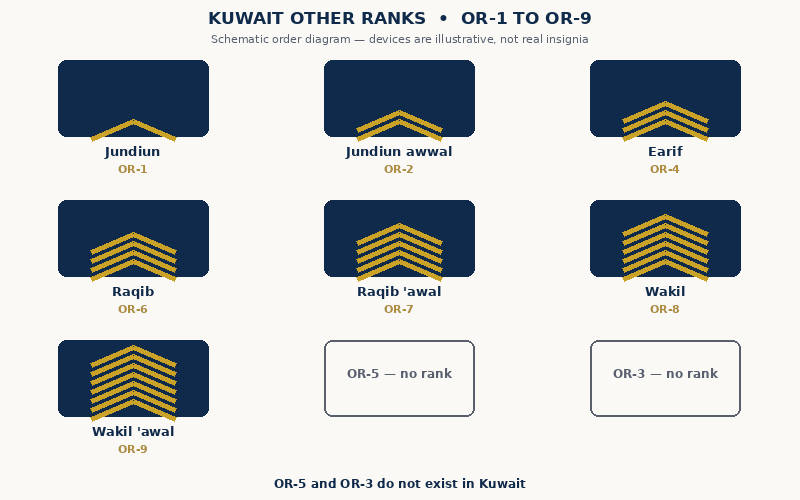
Did you know? The Kuwaiti other-ranks ladder is missing two whole rungs. There is no OR-5 and no OR-3, so the ladder jumps from Raqib at OR-6 straight to Earif at OR-4, and from Earif straight down to Jundiun awwal at OR-2. The gaps are real — this guide does not fill them in with invented ranks, and neither should any other list you read.
Officers: Ten Titles From Mulazim to Fariq ‘awal
The officer ladder has ten titles, running in a straight line from the newest lieutenant to the most senior general. It starts with the two lieutenant grades: Mulazim, a Second Lieutenant, and Mulazim awwal, a First Lieutenant. Both sit at OF-1 — in most armies the two junior lieutenant grades share one code. Above them come Naqib, a Captain at OF-2, and Ra’id, a Major at OF-3.
The middle of the ladder holds the two field officers: Muqaddam, a Lieutenant Colonel at OF-4, and Aqid, a Colonel at OF-5. Above the colonels sit the four generals, each one step apart: Amid, a Brigadier General at OF-6; Liwa, a Major General at OF-7; Fariq, a Lieutenant General at OF-8; and Fariq ‘awal, a General at OF-9, the top of the whole ladder.
Unlike the other ranks, the officer ladder has no gaps: every grade from OF-1 to OF-9 is filled, and the two OF-1 grades are the only place where two titles share a code. There is also nothing above Fariq ‘awal — Kuwait has no OF-10 rank, so OF-9 is the ceiling. Whether anyone holds Fariq ‘awal at the moment is not confirmed, and this guide names no holder.
| Rank (Arabic + Transliteration) | English Equivalent | NATO Equivalent | Insignia | Typical Role |
|---|---|---|---|---|
| ملازم — Mulazim | Second Lieutenant (Navy: Ensign) | OF-1 | Not described in sources | Newly commissioned officer; platoon leader |
| ملازم أول — Mulazim awwal | First Lieutenant (Navy: Lieutenant junior grade) | OF-1 | Not described in sources | Junior officer; platoon leader |
| نقيب — Naqib | Captain (Navy: Lieutenant) | OF-2 | Not described in sources | Company commander |
| رائد — Ra’id | Major (Navy: Lieutenant Commander) | OF-3 | Not described in sources | Staff officer; company or battery commander |
| مقدم — Muqaddam | Lieutenant Colonel (Navy: Commander) | OF-4 | Not described in sources | Battalion commander |
| عقيد — Aqid | Colonel (Navy: Captain) | OF-5 | Not described in sources | Regiment or brigade commander; senior staff officer |
| عميد — Amid | Brigadier General (Navy: Rear Admiral lower half) | OF-6 | Not described in sources | Brigade commander; first general rank |
| لواء — Liwa | Major General (Navy: Rear Admiral) | OF-7 | Not described in sources | Division commander; senior staff officer |
| فريق — Fariq | Lieutenant General (Navy: Vice Admiral) | OF-8 | Not described in sources | Corps commander; service chief |
| فريق أول — Fariq ‘awal | General (Navy: Admiral) | OF-9 | Not described in sources | Most senior officer in the armed forces; current holder unconfirmed |
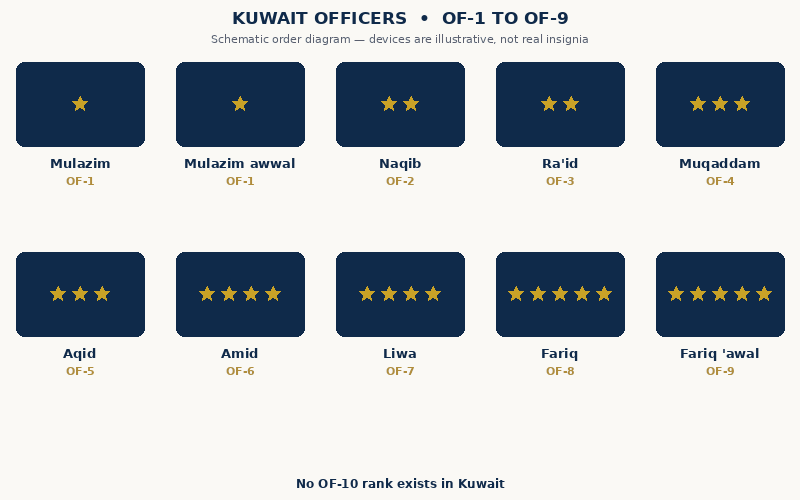
Key point: Kuwait is not a NATO member, so the OF and OR codes in this guide are equivalents for comparison, not official NATO grades. They show roughly where a Kuwaiti rank sits beside its counterpart in another army — a Kuwaiti Aqid lines up with a colonel elsewhere — but no NATO document grades these ranks. Read the codes as a translation aid, not as an official stamp.
How the Navy Titles Translate
The navy is where Kuwait’s one ladder gets interesting, because the Arabic title stays the same while the English title changes completely. A naval officer called Fariq ‘awal is an Admiral, not a General. One step down, Fariq is a Vice Admiral; Liwa is a Rear Admiral; and Amid is a Rear Admiral lower half, the junior rear-admiral grade. The same four generals become four admirals, in the same order.
The middle of the naval officer ladder follows the same rule. Aqid, a Colonel on land, is a Captain at sea. Muqaddam is a Commander, Ra’id is a Lieutenant Commander, and Naqib is a Lieutenant. Mulazim awwal is a Lieutenant junior grade and Mulazim is an Ensign, the most junior naval officer. The trap for a reader is the word Captain: a naval Captain is a senior officer at OF-5, while an Army Captain is a junior officer at OF-2. Same word, five grades apart — always check which service the title belongs to.
The other ranks translate the same way. At sea, Wakil ‘awal is a Master Chief Petty Officer and Wakil is a Senior Chief Petty Officer. Raqib ‘awal is a Chief Petty Officer, Raqib is a Petty Officer 1st Class, and Earif is a Petty Officer 3rd Class — the jump from 1st Class straight to 3rd Class mirrors the missing OR-5 and OR-3. At the bottom, Jundiun awwal is a Seaman Apprentice and Jundiun is a Seaman Recruit.
The Air Force has its own English words too. A Wakil ‘awal in the air is a Chief Master Sergeant, a Wakil is a Senior Master Sergeant, and a Raqib ‘awal is a Master Sergeant. Raqib becomes a Technical Sergeant, Earif a Senior Airman, Jundiun awwal an Airman and Jundiun an Airman Basic. The Air Force officer titles, by contrast, match the Army’s — an Air Force Aqid is a Colonel, just like his Army counterpart. So the rule is simple: the Arabic title is always the same, and only the navy — and the Air Force other ranks — use different English words.
Reading the Arabic Names
Five of Kuwait’s 17 titles come in pairs, and the pairing is the fastest way to learn the ladder. In each pair the senior title is the junior title with ‘awal — meaning first — added to it. Fariq and Fariq ‘awal are Lieutenant General and General. Mulazim and Mulazim awwal are Second Lieutenant and First Lieutenant. Wakil and Wakil ‘awal are First Sergeant and Sergeant Major. Raqib and Raqib ‘awal are Staff Sergeant and Sergeant First Class. Jundiun and Jundiun awwal are Private and Private First Class.
The five pairs account for ten of the 17 titles; the seven titles without a partner — Naqib, Ra’id, Muqaddam, Aqid, Amid, Liwa and Earif — are the single grades in between. Once you know that ‘awal marks the senior half of a pair, the order of the ladder is much easier to hold: look for the ‘awal, and you have found the higher of the two.
The tables in this guide give each title in Arabic script as well as in transliteration, so a reader can match a name seen on a Kuwaiti document with the English equivalent here. Learn the Arabic title first and the English translation second, and the navy translations in the section above will make sense at a glance.
Did you know? The word ‘awal does all the work in five Kuwaiti titles at once. It appears in the top general (Fariq ‘awal), the senior lieutenant (Mulazim awwal), the senior sergeant major (Wakil ‘awal), the senior staff sergeant (Raqib ‘awal) and the senior private (Jundiun awwal). One word, five promotions — learn it once and five titles fall into place.
The Gaps in the Ladder — and the Top Rank
Kuwait’s ladder is short, and the two missing rungs are its most distinctive feature. The other ranks run OR-9, OR-8, OR-7, OR-6 — then skip OR-5 entirely to reach Earif at OR-4. From Earif the ladder skips OR-3 as well, dropping straight to Jundiun awwal at OR-2 and Jundiun at OR-1. The sources give the ladder exactly as it stands, gaps included, and this guide does the same.
The gaps matter when comparing Kuwaiti ranks with another country’s ladder. In most armies a Corporal sits at OR-4 and a Private First Class at OR-2, and Kuwait matches that — but the step between them is empty, so no Kuwaiti rank lines up with the OR-3 grade other countries use. Higher up there is likewise no rank at OR-5, so a Staff Sergeant at OR-6 is followed directly by a Corporal at OR-4.
At the top the picture is simpler but less certain. Fariq ‘awal at OF-9 is the highest rank in Kuwait, and there is no OF-10 above it — no field marshal, no five-star grade. What is not confirmed is whether anyone holds Fariq ‘awal today: the sources seen for this guide do not confirm a current holder, so this guide names nobody for the top rank. Many rank lists quietly attach a name to the top grade without checking whether it is actually held; until a fresh check confirms a holder, the honest entry is the rank itself, with no name beside it.
Kuwait’s Armed Forces in Brief
The force behind these ranks is a small one by the standards of the region. The Land Forces, the largest part of it, number around 17,500 personnel. They stand alongside the Air Force and the Naval Force as the three services of the Kuwait Armed Forces, with the National Guard as a separate, independent institution beside them. The Emir of Kuwait is the Commander-in-Chief, and the 17 titles in this guide are the ranks worn across all four bodies.
That small size is part of why the single ladder works: with one set of titles shared by every service, a member can move between the Land Forces, the Air Force, the Naval Force and the National Guard without learning a new rank system — only the English translation changes, and only for the navy. For a reader the same simplicity applies: learn 17 Arabic titles, learn which English words the navy uses instead, remember the two missing rungs, and the whole Kuwaiti system is in hand.
To set Kuwait beside the forces it is most often compared with, see our guides to US Army ranks, US Navy ranks, British military ranks, Turkish military ranks and the military ranks and insignia overview.
Read next
US Army Ranks · US Navy Ranks · British Military Ranks · Turkish Military Ranks · Military Ranks and Insignia Overview
FAQs
How many ranks are there in the Kuwait military?
There are 17 titles: 10 officer ranks, from Mulazim to Fariq ‘awal, and 7 other ranks, from Jundiun to Wakil ‘awal. All four armed bodies — the Land Forces, the Air Force, the Naval Force and the National Guard — use the same ladder.
What is the highest rank in Kuwait?
Fariq ‘awal, a General (Admiral in the navy), graded OF-9. There is no OF-10 rank above it. Whether anyone holds Fariq ‘awal is not confirmed, so this guide names no holder.
Does the Kuwait Navy use the same ranks as the Army?
The Arabic titles are the same, but the English names are naval: Admiral, Vice Admiral, Rear Admiral and Rear Admiral lower half for the generals, then Captain, Commander, Lieutenant Commander, Lieutenant, Lieutenant junior grade and Ensign. The other ranks become chief petty officers, petty officers and seamen.
Are Kuwait’s NATO codes official?
No. Kuwait is not a NATO member, so the OF and OR codes here are equivalents for comparison only, showing roughly where a Kuwaiti rank sits beside its counterpart elsewhere. No NATO document grades these ranks.
Why are OR-5 and OR-3 missing from the Kuwaiti ladder?
They do not exist in Kuwait. The ladder jumps from Raqib at OR-6 straight to Earif at OR-4, and from Earif straight to Jundiun awwal at OR-2. This guide leaves the gaps empty rather than inventing ranks to fill them.
What is the Kuwait National Guard?
It is an independent armed institution, separate from the Ministry of Defence and from the three services of the Kuwait Armed Forces. It uses exactly the same 17 ranks as the Land Forces, the Air Force and the Naval Force.
All images in this article are original graphics drawn for Forces Guide. The charts are simplified, schematic diagrams of rank order — not photographs of real insignia. The sources used for this guide do not describe the appearance of Kuwaiti insignia, so no insignia details are shown or claimed.