
Forces Guide · Berets Guide
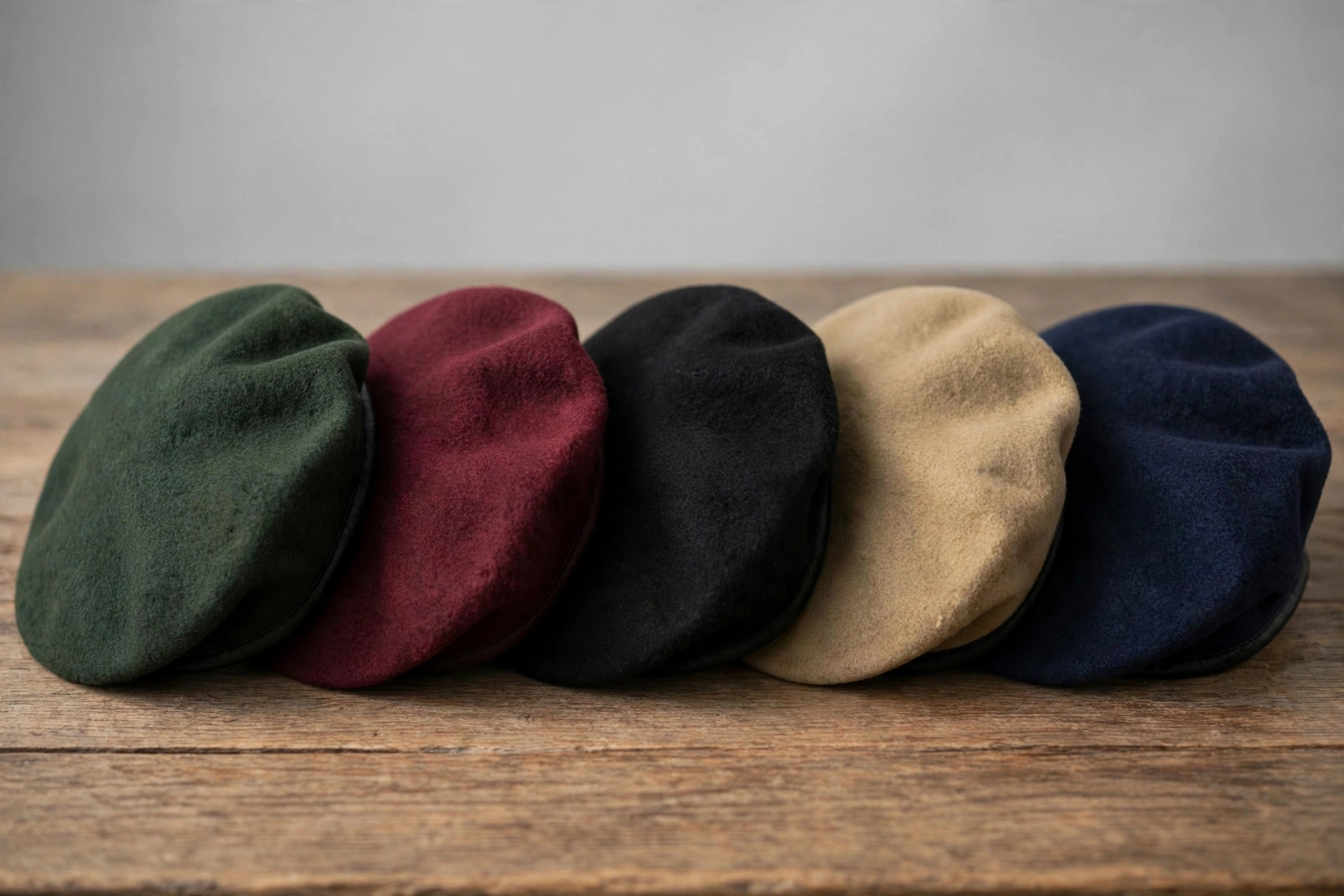
Few items of uniform carry as much meaning as a coloured beret. A soldier’s beret colour is never a fashion choice — it is a badge of belonging, earned through selection courses, parachute wings or years of regimental tradition. Read the colour across a parade square and you can tell, at a glance, who jumps from aircraft, who crews tanks and who polices the battlefield.
This guide explains the main military beret colours — green, maroon, black, tan, red and blue — and the famous units that wear each one, from Britain’s Royal Marines and the SAS to Pakistan’s SSG commandos and United Nations peacekeepers.
What Is a Military Beret?
The beret is a soft, round, brimless cap made of wool felt, usually worn tilted to one side with the cap badge fixed over one eye. It began as civilian headwear in the Pyrenees and Basque country, and entered military service in the nineteenth century with France’s mountain troops, the Chasseurs Alpins, who valued a warm, squashable cap that stayed on in wind and could be pulled down over the ears.
The British Army adopted the beret during the First World War. Tank crews, crammed into noisy, oil-stained steel boxes, needed headgear that would not be knocked off and would not show the dirt; in 1918 the tank men began wearing a black beret modelled on the French style, and the Royal Tank Regiment made it famous. By the Second World War the beret had spread across armies, and colour — the simplest possible signal of identity — turned it into a language of its own.
Why Do Armies Use Different Beret Colours?
Beret colours work like a visual code. In the middle of the last century, as new kinds of unit appeared — commandos, paratroops, tank regiments, special forces — each wanted to stand out from ordinary infantry, and a distinctive colour was the quickest way to do it. The colour is normally tied to the unit, not the individual: pass the course, join the regiment, and you earn the right to wear it.
That is why certain colours command such respect. A maroon or green beret cannot simply be bought or issued by mistake; it certifies that its wearer has been tested, often to the edge of endurance, and found worthy. Colours also preserve history — the SAS still wears the sand shade of its desert beginnings, and the tanks still wear the black that hid the grease of 1918.
The Green Beret: Commandos and Special Forces
Green is the colour of the commando. In 1942 Britain’s new Commandos adopted a green beret, and it has belonged to them ever since. Today every Royal Marine earns the coveted green beret — the “green lid” — only after completing the gruelling commando course at Lympstone, ending with the famous thirty-mile speed march across Dartmoor. Other ranks from the Army, Navy and RAF who pass the All Arms Commando Course wear it too, and it remains one of the most respected sights in British service.
Across the Atlantic, green became synonymous with a whole force: the United States Army Special Forces are known to the world simply as the “Green Berets”, after the rifle-green beret formally authorised for them in 1961. Green also appears widely elsewhere — many of Pakistan’s army regiments wear shades of green, fitting for a force whose national colour is green — while rifle regiments traditionally favour very dark, almost black-green shades inherited from the skirmishers of the Napoleonic Wars.
The Maroon Beret: Airborne Forces Worldwide
If one colour owns the sky, it is maroon. Britain’s airborne forces adopted the maroon beret in 1942, and the men of the Parachute Regiment — nicknamed the “Red Devils” by their enemies — made it legendary at Arnhem and in every campaign since. Maroon spread with the parachute idea itself: to this day, airborne soldiers on almost every continent wear maroon, among them America’s 82nd Airborne Division and India’s Para (SF).
Pakistan follows the same proud tradition. The Special Services Group — the SSG, Pakistan’s elite special forces, raised in 1956 — wears a maroon beret, marking its airborne and commando role; SSG commandos are instantly recognisable in it, worn with their characteristic winged insignia. Members of Pakistan’s other parachute-trained units share the maroon family too, so in South Asia, as in Britain, maroon means one thing: soldiers who arrive by parachute and are expected to fight outnumbered.
The Black Beret: Armoured Regiments
Black is the colour of armour. The Royal Tank Regiment’s black beret, the original military beret of 1918, was chosen for brutally practical reasons: black hides oil, grease and cordite stains, and it does not catch on the hatches and machinery of a tank. Armoured and cavalry regiments around the world followed suit — Pakistan’s Armoured Corps wears black, as do tank regiments across Europe and the Commonwealth.
Black has occasionally been a general-issue colour as well. The United States Army famously made the black beret its standard headgear in 2001, a decision that caused lasting controversy because black had until then been the Rangers’ colour; the Army later restored the patrol cap for everyday wear. In many armies today black still says “tanks” first — a working colour for soldiers who fight from inside steel.
The Tan Beret: The SAS and the Rangers
The sandy tan — often called beige — beret belongs to the Special Air Service. When the SAS was born in the North African desert in 1941, its men adopted a sand-coloured beret to match their theatre of war; after a brief experiment with white in the earliest days, the sand shade stuck, and the British SAS wears it to this day with the famous winged dagger badge. Australia’s SAS Regiment wears a near-identical sandy beret.
Tan gained a second famous owner in 2001, when the United States Army Rangers — who had worn black — switched to a tan beret as their own distinctive colour, chosen to evoke the buckskin leggings of Rogers’ Rangers of the eighteenth century. Between the SAS and the Rangers, tan has come to mean quiet professionalism: special operations soldiers who prefer to let results speak.
The Red Beret: Military Police
True red — bright scarlet — is the colour of the military police. Britain’s Royal Military Police are instantly recognisable by their scarlet berets (and matching peaked caps), a deliberate choice: a military policeman must be visible. Whether directing traffic at a checkpoint, guarding prisoners or investigating crime in barracks, the red beret announces authority before a word is spoken.
Many other nations follow the same logic, issuing red or scarlet berets to provost and gendarmerie units — among them the military police of several Commonwealth and European armies. Confusingly, red is often mistaken for the paratroopers’ maroon; soldiers are quick to correct the error, because the deep wine shade of airborne forces and the bright scarlet of the police are worlds apart in meaning.
The Blue Beret: Peacekeepers and General Issue
Light blue belongs to the United Nations. Since the first UN emergency force deployed to Suez in 1956, peacekeepers have worn the pale blue beret (or helmet), chosen because blue appears on no army’s camouflage and matches the UN flag — a soldier in light blue is visibly there to keep peace, not to fight a nation’s war. Pakistan is among the world’s most consistent contributors of troops to UN missions, so Pakistani soldiers are regularly seen in the blue beret abroad, a point of national pride.
Darker blues are the workhorses of the beret world. Dark navy blue is a common general-issue colour — worn historically by many British line infantry regiments and by numerous armies as their everyday beret — while the Royal Air Force wears a blue-grey beret and the United States Air Force issues dark blue berets, with its security forces and special tactics airmen wearing colours of their own. Where a unit has no fiercely guarded special colour, blue, in one shade or another, is usually the answer.
Beret Colours at a Glance
| Beret colour | Best-known wearers | What it signifies |
|---|---|---|
| Green | Royal Marines Commandos (UK); US Army Special Forces; many Pakistan Army regiments | Commando and special forces status, earned on arduous courses |
| Maroon | Parachute Regiment (UK); US 82nd Airborne; Pakistan SSG; Indian Para (SF) | Airborne forces — soldiers who deploy by parachute |
| Black | Royal Tank Regiment (UK); armoured corps incl. Pakistan | Armoured units; black hides oil and grime in vehicles |
| Tan / beige | British and Australian SAS; US Army Rangers | Special operations heritage, born in the WWII desert |
| Scarlet red | Royal Military Police (UK); military police worldwide | Policing duties — chosen for high visibility and authority |
| Light blue | United Nations peacekeepers of all nations | Neutral peacekeeping service under the UN flag |
| Dark blue | General issue in many armies; RAF (blue-grey); US Air Force | Traditional everyday service colour |
Did You Know?
- The word “beret” comes from the French béret, itself from an old word for a woollen cap — soldiers have worn versions of it for centuries.
- The UN’s light blue was chosen precisely because it belongs to no nation: it could not be mistaken for any army’s own colours in a crisis zone.
- Britain’s Commandos picked green in 1942 partly from the racing colours of their first commander’s family crest — or so the regimental story goes.
- A beret is traditionally shaped by its owner: soaked in warm water, fitted to the head, and shaved of fluff until it sits exactly as regulation — and pride — demands.
How a Beret Is Worn
A beret worn badly is a small disgrace, and every army teaches the same basics. In British-style forces the beret sits level on the head with the band an inch above the eyebrows, the cap badge positioned over the left eye, and the soft crown pulled down to the right, clear of the right eye. The excess material is shaped — never floppy, never perched. American practice is similar, with the stiffener and flash centred over the left eye and the drape pulled to the right.
These details matter because the beret is inspected constantly and read instantly. A well-shaped beret signals a soldier who takes pride in the uniform; a sloppy one invites the attention of the regimental sergeant major. It is the final proof that the colours in this guide are not really about cloth at all — they are about the standards of the people underneath them.
Frequently Asked Questions
Which beret is the hardest to earn?
There is no official ranking, but the most feared selections are those behind the green and tan berets: the Royal Marines’ commando course, US Special Forces selection and the SAS’s mountain-and-jungle selection all fail the large majority of volunteers. The beret is treasured precisely because so few who try ever wear it.
Why does Pakistan’s SSG wear a maroon beret?
Because maroon is the international colour of airborne and commando forces. The SSG, raised in 1956 as Pakistan’s special forces, is built around parachute-delivered commandos, and its maroon beret proclaims that role — the same message sent by Britain’s Parachute Regiment and America’s 82nd Airborne.
What is the difference between a maroon beret and a red beret?
Maroon — a deep, dark wine red — means airborne forces such as paratroops and the SSG. Bright scarlet red means military police. From a distance the two are often confused, but to soldiers the distinction is absolute: one jumps from aircraft, the other enforces the law.
Why is the beret pulled to the right?
Tradition and practicality. With the badge fixed over the left eye, the spare material has to go somewhere, and pulling it to the right keeps it clear of the eyes and gives the beret its crisp, asymmetric shape. Most Commonwealth and American forces shape it the same way.
Can a soldier choose which colour beret to wear?
No. The colour belongs to the unit, not the individual. A soldier wears the beret of the regiment or corps they serve in, and the guarded colours — green, maroon, tan — can only be worn after passing the relevant course or selection. Wearing a colour you have not earned is one of uniform’s gravest offences.