
Slovakia is a small country with a small army — which makes its rank system easy to learn. There are just nineteen ranks in total, the Army and the Air Force share every single one of them, and there is no navy to memorise on top. If you can read a shoulder board, you can read the whole Slovak Armed Forces. This guide covers every Slovak military rank, from a brand-new private — a Vojak 1. stupňa — to Generál, with insignia, NATO grades and what each rank does all day.
Fair warning: the names look intimidating at first. Nadporučík, Štábny nadrotmajster — they are a mouthful. But most of them are built from a few everyday Slovak building blocks — nad means “over” or “senior”, pod means “under” — so a Nadrotmajster is simply a “senior company master”.
Key facts
- Country: Slovakia (Slovak Republic)
- Armed forces: Armed Forces of the Slovak Republic — Ground Forces and Air Force share one rank system, no navy
- Total ranks: 19 — 9 other ranks (OR-1 to OR-9) and 10 officer ranks (OF-1 to OF-9)
- Highest rank: Generál (General, OF-9) — no OF-10 or five-star rank
- Lowest rank: Vojak 1. stupňa (Private, OR-1)
- Size: a compact, fully professional force of around 16,000; conscription ended in 2006
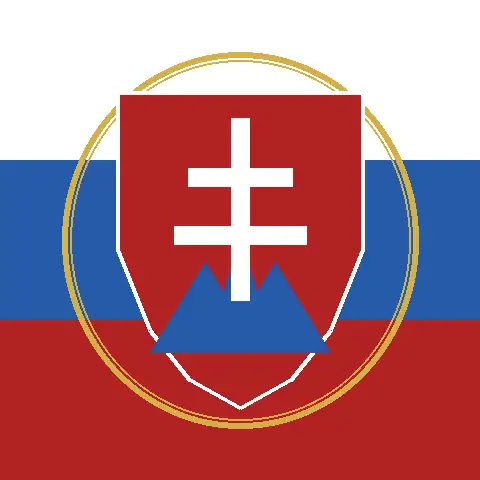
- Notable fact: the double cross of the Slovak coat of arms also serves as the Air Force roundel
Two Services, One Ladder — and No Navy
Slovakia has two services that wear the same ranks. A captain in the Ground Forces and a captain in the Air Force are both Kapitán, both OF-2, and both wear the same insignia. The only difference is the cloth under the stars — olive for the Army, blue for the Air Force. So you never have to learn two ladders. Learn one, and you have learned both.
And there is no navy, because there is nowhere to put one. Slovakia is landlocked, with not a metre of coastline. The armed forces are the Ground Forces, the Air Force and a small Special Operations element, under one General Staff. Slovakia joined NATO in March 2004, so every rank carries a NATO grade — the OF and OR codes in the tables below — which means a Slovak Major and a British major are exact equivalents.
The force is small and entirely professional. Compulsory service was abolished on 1 January 2006, so every Slovak soldier today is a volunteer — which makes the ladder below a career ladder, not a wartime one.
The Soldiers: Enlisted and NCO Ranks (OR-1 to OR-9)
Every Slovak soldier starts at the bottom of this table. These nine ranks cover everyone who is not a commissioned officer, from a recruit’s first week to the most senior sergeant major. Think of them in three groups: the ordinary soldiers (OR-1 to OR-4), the sergeants who run a platoon’s daily life (OR-5 to OR-7), and the two senior sergeant majors (OR-8 and OR-9) — the people the officers rely on to make everything work.
| Rank (Slovak) | English Equivalent | NATO Code | Insignia | What They Actually Do |
|---|---|---|---|---|
| Vojak 1. stupňa | Private | OR-1 | Plain board, no device | New recruit in basic training |
| Vojak 2. stupňa | Private First Class | OR-2 | One gold chevron | Trained soldier in a squad |
| Slobodník | Lance Corporal | OR-3 | Two gold chevrons | Experienced soldier, trusted with small jobs |
| Desiatnik | Corporal | OR-4 | Three gold chevrons | Leads a fire team |
| Čatár | Sergeant | OR-5 | One gold star, thin gold rim | First NCO rank; squad second-in-command |
| Rotný | Staff Sergeant | OR-6 | Two gold stars, thin gold rim | Squad leader |
| Rotmajster | Sergeant First Class | OR-7 | Three gold stars, thin gold rim | Senior sergeant; runs platoon routine |
| Nadrotmajster | First Sergeant | OR-8 | One gold star, thick gold rim | Company discipline and welfare |
| Štábny nadrotmajster | Sergeant Major | OR-9 | Two gold stars, thick gold rim | Senior other rank; adviser to the commander |
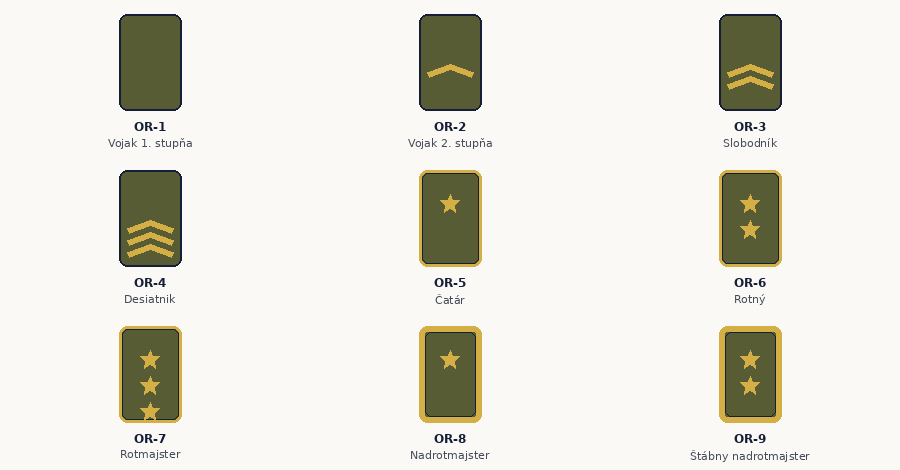
About the diagram above: an original simplified drawing, not a photograph of issued insignia. The board colour, the gold devices and the rank order are right, but the exact chevron and star count on each board could not be confirmed from a written source — treat the counts as a guide to the pattern, not a tailor’s specification.
Did you know? Vojak simply means “soldier”, and stupeň means “grade” — so a Vojak 1. stupňa is literally a “soldier of the 1st grade”. Slovakia splits its lowest rank in two, so a soldier gets a small promotion — and a first chevron — without changing jobs at all.
Reading a Slovak Soldier’s Shoulder Board
Reading the other ranks is counting and checking the edge of the board. Start with the chevrons — the gold V-shapes. One chevron is a Vojak 2. stupňa, two is a Slobodník, three is a Desiatnik. No chevrons at all, just a plain board, means a brand-new Vojak 1. stupňa. It is the same idea as the stripes on an American private’s sleeve, just worn on the shoulder instead.
At sergeant level, the chevrons give way to stars, and the edge of the board starts to matter. A Čatár, Rotný or Rotmajster wears one, two or three gold stars inside a thin gold rim. The two most senior sergeant majors — Nadrotmajster and Štábny nadrotmajster — wear a thicker gold rim, with one star for the first and two for the second. Rule of thumb: chevrons mean a junior soldier, stars mean a sergeant, and a thick gold edge means one of the two most senior sergeants in the system. The board’s colour tells you the service, never the rank: olive is the Ground Forces, blue the Air Force.
The Officers: From Poručík to Generál (OF-1 to OF-9)
Slovak officers come in three bands: junior officers wear a plain board, field officers a thin gold rim, generals a thick gold rim with an oak leaf. The rim tells you the band, the stars the step inside it.
There are ten officer ranks — a ladder short enough to hold in your head. At the bottom, a Poručík — a second lieutenant fresh out of the academy — leads a platoon of about thirty soldiers. A Kapitán commands a company of roughly a hundred. A Plukovník commands a regiment or a brigade’s staff. And at the very top sits Generál, a four-star rank held by the Chief of the General Staff. There is no five-star rank in Slovakia, so Generál is the ceiling.
| Rank (Slovak) | English Equivalent | NATO Code | Insignia | What They Actually Do |
|---|---|---|---|---|
| Poručík | Second Lieutenant | OF-1 | One gold star, plain board | Platoon leader; first command |
| Nadporučík | First Lieutenant | OF-1 | Two gold stars, plain board | Platoon leader or deputy company commander |
| Kapitán | Captain | OF-2 | Three gold stars, plain board | Company commander (around 100 soldiers) |
| Major | Major | OF-3 | One gold star, thin gold rim | Battalion staff officer |
| Podplukovník | Lieutenant Colonel | OF-4 | Two gold stars, thin gold rim | Battalion commander |
| Plukovník | Colonel | OF-5 | Three gold stars, thin gold rim | Regimental commander |
| Brigádny generál | Brigadier General | OF-6 | One gold star, thick gold rim, oak leaf | Brigade commander |
| Generálmajor | Major General | OF-7 | Two gold stars, thick gold rim, oak leaf | Senior formation commander |
| Generálporučík | Lieutenant General | OF-8 | Three gold stars, thick gold rim, oak leaf | Deputy chief of the General Staff |
| Generál | General | OF-9 | Four gold stars, thick gold rim, oak leaf | Highest rank; Chief of the General Staff |
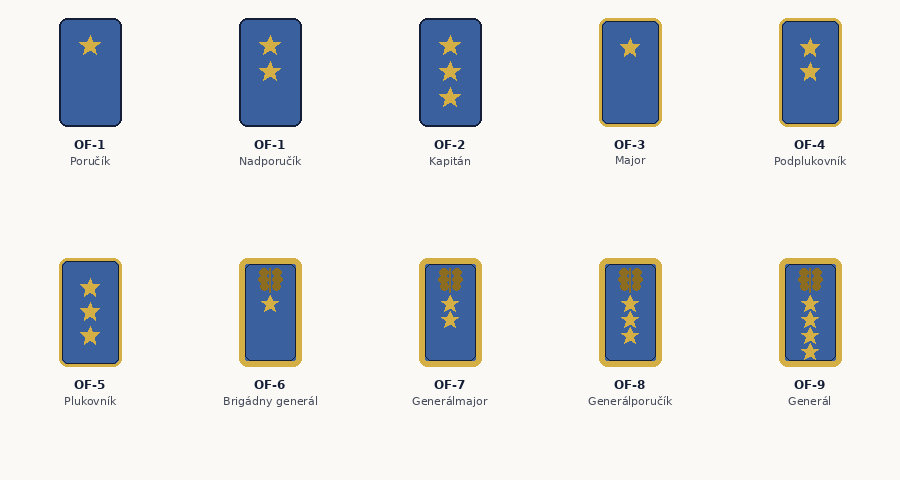
Key point: unlike the US system, where silver outranks gold, Slovak insignia are gold all the way up — seniority comes from the number of stars and the thickness of the gold rim, never the metal’s colour. And unlike the Czechs, whose junior officers wear unusual three-pointed stars, Slovak stars are the familiar five-pointed kind at every level.
Reading an Officer’s Shoulder Board
Here is the trick. First, look at the edge of the board. No gold edge at all? You are looking at a junior officer: one star is a Poručík, two is a Nadporučík, three is a Kapitán. A thin gold line around the edge? That is a field officer: one star a Major, two a Podplukovník, three a Plukovník. A thick, heavy gold edge with a little oak-leaf sprig at the top? That is a general: one star a Brigádny generál, two a Generálmajor, three a Generálporučík, four a Generál.
The oak leaf is worth knowing about, because it is the one decoration that only generals get. It sits at the top of the board, above the stars, and marks the board out as a general’s from across a parade ground. The branch badge — showing whether the officer is infantry, artillery, signals, a pilot, and so on — is worn separately, pinned just under the top button, for every rank except a full Generál.
A word of warning: Generálporučík is a lieutenant general (OF-8) and Generálmajor is a major general (OF-7) — the names look backwards translated word for word. And Podplukovník is a lieutenant colonel, though it sounds junior. Trust the NATO code, not the literal translation.
The Ranks Slovakia Left Behind: The 2016 Clear-Out
Look up Slovak ranks online and you will keep bumping into three names that no longer exist: Podpráporčík, Práporčík and Nadpráporčík. For years these were the warrant officers — the práporčík family — at the top of the other-ranks ladder. The most senior of them, Nadpráporčík, was the highest non-commissioned rank in the land, the Slovak chief warrant officer.
Then, on 1 January 2016, Slovakia swept them away. The three warrant-officer ranks were abolished outright, and the ladder was shortened to the nine other ranks in the table above. The top of the ladder is now Štábny nadrotmajster, a sergeant major, not a warrant officer. It was a deliberate simplification, and it is the main reason older lists of Slovak ranks disagree with newer ones. If a website still shows Nadpráporčík as a current Slovak rank, it is working from a list that is at least a decade out of date.
The officers got the same treatment earlier: the most junior officer rank, Podporučík, was abolished by law in 2002, which is why the officer ladder now starts at Poručík.
Czechoslovakia’s Children: Slovak Ranks vs Czech Ranks
The two countries took the old Czechoslovak system with them when they split in 1993, and the officer ladders are nearly identical from Poručík up to Generálporučík. The split comes at the very top: the Czechs kept the grand old title Armádní generál — General of the Army — as their OF-9, while the Slovaks use the plain, blunt Generál. Both are the same NATO grade — but the Slovak title is shorter: no frills, just “General”. The spelling gives the game away too — where the Czechs write Brigádní generál, the Slovaks write Brigádny generál. Same word, different accent.
The bigger split is lower down. The Czechs kept their warrant officers — Praporčík, Nadpraporčík and Štábní praporčík still top the Czech ladder, ten ranks in all. The Slovaks abolished theirs in 2016 and now have nine. And the metal is different: Czech other ranks wear silver devices — silver pips and rails on a khaki board — while Slovak insignia are gold throughout. Handed a photograph and asked “Czech or Slovak?”, check the metal: silver means Czech, gold means Slovak.
The Double Cross on the Shoulder
Look at any Slovak uniform and you will find the double cross — the white, two-barred cross at the centre of the flag, standing on three blue peaks. The cross arrived with the missionaries Cyril and Methodius in the ninth century; the peaks are the Tatra, Fatra and Matra ranges. It is the oldest symbol Slovakia has.
It is also a symbol that was once banned. Under communist rule, from 1960 to 1990, the double cross was forbidden — the regime saw it as a reminder of the wartime Slovak state — and it was replaced in the state emblem by a made-up symbol of Mount Kriváň and three flames. After the Velvet Revolution the old arms came back, restored on 1 March 1990, then carried into independence on 1 January 1993. Today the double cross is everywhere in Slovak military life — and the Slovak coat of arms itself is the roundel of the Slovak Air Force, painted on its aircraft.
That is why the hero image of this article is the emblem itself — the flag’s white, blue and red, the red shield, the silver double cross and the three blue peaks. If you remember one Slovak symbol, remember that one: everything else in the rank system hangs off the shoulder, but the double cross is the identity underneath.
What the Job Actually Looks Like: Promotion and the Road Up
So how does a Slovak soldier climb this ladder? Slowly, on merit — no shortcuts, and in a force this small nowhere to hide. Promotion rests on three things: time in the rank, the right course passed, and a vacancy waiting at the next rank up. You cannot simply serve out the clock, and in a force of around 16,000 people the senior posts are genuinely competitive.
Officers are made at the Armed Forces Academy of General Milan Rastislav Štefánik in Liptovský Mikuláš, in northern Slovakia. Cadets study for a degree alongside their military training and are commissioned as Poručík when they graduate — which means the youngest platoon commander you will meet in Slovakia is also a university graduate. NCOs come up through the ranks and specialist courses, and the step from Desiatnik (Corporal) to Čatár (Sergeant) is the first real career gate: the moment a soldier stops being supervised and becomes someone others answer to.
The very top of the ladder is different again. Generals are appointed by the President of Slovakia, who is the commander-in-chief of the armed forces. That is not a formality: the president personally appoints each general officer. Below that level the road is the same: do the job well, pass the course, wait for the vacancy — and earn the sergeants’ respect, because they make or break a young officer’s first command.
Compared with the American or British systems, the Slovak ladder feels compressed: no warrant-officer ranks any more, no five-star rank, no naval ladder, no second Air Force ladder. Nineteen ranks cover the whole armed forces.
Compare with other countries: German Army ranks, Italian Army ranks, French military ranks, British military ranks, Canadian Armed Forces ranks, US Army ranks and our overview of military ranks and insignia.
Read next
German Army Ranks · Italian Army Ranks · French Military Ranks · British Military Ranks · US Army Ranks · Military Ranks and Insignia
FAQs
What is the highest rank in the Slovak army?
Generál — General, NATO grade OF-9, with four gold stars inside a thick gold rim and an oak leaf on the shoulder board. It is held by the Chief of the General Staff; Slovakia has no five-star rank and no OF-10. The highest rank below the officers is Štábny nadrotmajster (Sergeant Major, OR-9).
How many ranks are there in the Slovak army?
Nineteen: nine other ranks (OR-1 to OR-9), from Vojak 1. stupňa to Štábny nadrotmajster, and ten officer ranks (OF-1 to OF-9), from Poručík to Generál. The Army and Air Force share all nineteen — no separate Air Force ladder, no navy.
What rank is Nadpráporčík?
It was a senior warrant officer rank — roughly a chief warrant officer — but it no longer exists. Slovakia abolished Nadpráporčík, along with Práporčík and Podpráporčík, on 1 January 2016, so any source listing it as current is out of date. The closest current rank is Štábny nadrotmajster (Sergeant Major, OR-9). The Czechs still have their Nadpraporčík.
Does Slovakia have a navy?
No. Slovakia is landlocked — it has no coastline at all — so it has no navy, no admirals and no naval ranks. The armed forces are the Ground Forces, the Air Force and a small Special Operations element — the same situation as the Czech Republic, Austria and Hungary.
What is the lowest rank in the Slovak army?
Vojak 1. stupňa — Private, NATO grade OR-1. It is the rank every Slovak soldier starts with, and the only rank with a completely plain shoulder board: no stars, no chevrons, nothing at all. The first promotion, to Vojak 2. stupňa (Private First Class, OR-2), brings the first gold chevron.
What do Slovak military ranks mean in English?
Most translate neatly. Poručík is Second Lieutenant, Nadporučík is First Lieutenant, Kapitán is Captain, Podplukovník is Lieutenant Colonel, Plukovník is Colonel, and the generals run Brigádny generál (Brigadier General), Generálmajor (Major General), Generálporučík (Lieutenant General) and Generál (General). Among the soldiers, Vojak is simply “soldier”, Slobodník is Lance Corporal, Desiatnik is Corporal and Čatár is Sergeant. Watch out for Generálporučík and Generálmajor — translated word for word they look backwards, so trust the NATO code, not the literal words.
All insignia diagrams and images in this article are original graphics created for Forces Guide; the charts are simplified diagrams — see the note under the enlisted chart.