
Sri Lanka’s armed forces wear their history on their shoulders. The Sri Lanka Army, the Sri Lanka Navy and the Sri Lanka Air Force all use rank systems inherited from the British forces: a soldier’s gold pips and crowns, a sailor’s gold sleeve rings and an airman’s light-blue braid. This guide covers every Sri Lanka military rank with its insignia, from Private to Field Marshal, including warrant officers, other ranks and the honorary five-star ranks at the very top.
There are 51 active ranks across the three services, plus three honorary five-star titles — Field Marshal, Admiral of the Fleet and Marshal of the Air Force — awarded only rarely and carrying no command appointment. The Army traces its roots to the Ceylon Army of 1949, the Navy to the Royal Ceylon Navy of 1950 and the Air Force to the Royal Ceylon Air Force of 1951; all three took their present names when Ceylon became Sri Lanka in 1972.
Key facts
- Country: Sri Lanka
- Branches: Sri Lanka Army, Sri Lanka Navy and Sri Lanka Air Force
- Officer ranks: OF-1 to OF-10 (Second Lieutenant to Field Marshal)
- Other ranks: OR-1 to OR-9 (Private to Warrant Officer Class I)
- Highest rank: Field Marshal (Army), Admiral of the Fleet (Navy) and Marshal of the Air Force (Air Force) — all honorary five-star ranks
- Notable fact: All three services use rank systems inherited from the British forces, but where Britain puts a crown, Sri Lanka puts the lion of the national emblem

Sri Lanka Army Officer Ranks
Army officers wear their rank on shoulder boards as gold pips (stars) and crowns, with crossed baton and sword for generals. Junior officers wear pips only, field officers (Major to Colonel) add a crown, and general officers wear the crossed baton and sword. The highest rank held by a serving officer is Lieutenant General, the rank of the Commander of the Army.
Full General is normally awarded to the Commander on the day of retirement, and Field Marshal is an honorary five-star rank awarded only once, to Sarath Fonseka in 2015.
| Rank | NATO Code | Insignia | Typical Role |
|---|---|---|---|
| Field Marshal | OF-10 | Crossed batons in a laurel wreath, crown above | Honorary five-star rank; no appointment, awarded once (2015) |
| General | OF-9 | Crossed baton and sword, star above, crown above | Four-star rank; awarded on retirement |
| Lieutenant General | OF-8 | Crossed baton and sword, crown above | Three-star rank; Commander of the Army |
| Major General | OF-7 | Crossed baton and sword, star above | Two-star rank; division commander |
| Brigadier | OF-6 | Crown above three stars | One-star rank; brigade commander |
| Colonel | OF-5 | Crown above two stars | Regimental or directorate command |
| Lieutenant Colonel | OF-4 | Crown above one star | Battalion commander |
| Major | OF-3 | Crown alone | Company commander or battalion second-in-command |
| Captain | OF-2 | Three stars | Company second-in-command |
| Lieutenant | OF-1 | Two stars | Platoon commander |
| Second Lieutenant | OF-1 | One star | Entry-level commissioned officer |
Did you know? Field Marshal is an honorary five-star rank awarded only once, to Sarath Fonseka in 2015. Full General is normally awarded to the Commander of the Army on the day of retirement.
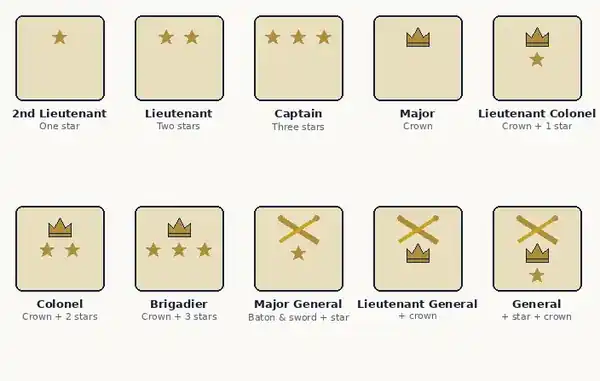
How to Read Sri Lanka Army Officer Insignia
Army officer insignia follow the classic British ladder of stars, crowns and crossed batons:
- Stars (pips) — one star means Second Lieutenant, two means Lieutenant and three means Captain.
- The crown — a crown alone marks a Major; add stars below it to climb to Lieutenant Colonel, Colonel and Brigadier.
- Crossed baton and sword — the mark of a general officer: a star above it means Major General, a crown above it means Lieutenant General, and both together mean General. Crossed batons in a wreath mark the Field Marshal.
In the artillery the emblem above the chevrons is replaced by a towed gun, and in the engineers by a bursting grenade. Officer cadets at the Sri Lanka Military Academy at Diyatalawa wear their own ranks, from Lance Corporal up to Battalion Under Officer.
Sri Lanka Army Other Ranks (Warrant Officers, NCOs and Enlisted)
Below the commissioned officers sit the other ranks: the warrant officers who run the regiment day to day, the non-commissioned officers who lead sections and platoons, and the private soldiers. Their badges are worn on the sleeve as chevrons, topped by the national emblem for the senior grades. A Warrant Officer Class I is known by appointment as a Regimental Sergeant Major, and a Warrant Officer Class II as a Sergeant Major.
| Rank | NATO Code | Insignia | Typical Role |
|---|---|---|---|
| Warrant Officer Class I | OR-9 | National emblem (coat of arms) | Regimental Sergeant Major |
| Warrant Officer Class II | OR-8 | National emblem within a laurel wreath | Sergeant Major of a battalion or company |
| Staff Sergeant | OR-7 | Emblem above three chevrons | Company quartermaster or specialist supervisor |
| Sergeant | OR-6 | Three chevrons | Section or platoon second-in-command |
| Corporal / Bombardier | OR-4 | Two chevrons | Section commander; called Bombardier in the artillery |
| Lance Corporal / Lance Bombardier | OR-3 | One chevron | Second-in-command of a section |
| Private (or equivalent) | OR-1 | No insignia | Trained soldier; Gunner/Trooper/Sapper in some corps |
There is no OR-2 or OR-5 grade in the Sri Lanka Army: a soldier goes straight from Private to Lance Corporal, and from Sergeant to Staff Sergeant — a direct inheritance from the British Army.
Did you know? There is no OR-2 or OR-5 grade in the Sri Lanka Army: a soldier goes straight from Private to Lance Corporal, and from Sergeant to Staff Sergeant — a direct inheritance from the British Army.
Sri Lanka Navy Officer Ranks
Naval officers wear their rank as gold rings on the sleeve of the dark-blue uniform, following the Royal Navy pattern. The number of rings rises with seniority, flag officers add a broad band, and the top ring carries the executive curl. The Commander of the Navy holds the three-star rank of Vice Admiral. Full Admiral is usually awarded to the Commander on his retirement day, and Admiral of the Fleet has been awarded only once, as an honorary rank to Wasantha Karannagoda.
| Rank | NATO Code | Insignia | Typical Role |
|---|---|---|---|
| Admiral of the Fleet | OF-10 | Broad band with four narrow rings | Honorary five-star rank; awarded only once |
| Admiral | OF-9 | Broad band with three narrow rings | Four-star rank; awarded on retirement |
| Vice Admiral | OF-8 | Broad band with two narrow rings | Three-star rank; Commander of the Navy |
| Rear Admiral | OF-7 | Broad band with one narrow ring | Two-star rank; chief of staff or regional commander |
| Commodore | OF-6 | Broad band alone | One-star rank; directorate director |
| Captain | OF-5 | Four narrow rings | Commanding officer of a major ship |
| Commander | OF-4 | Three narrow rings | Commanding officer of a ship |
| Lieutenant Commander | OF-3 | Two narrow rings with a thin ring between | Department head or executive officer |
| Lieutenant | OF-2 | Two narrow rings | Watchkeeping officer or departmental officer |
| Sub-Lieutenant | OF-1 | One narrow ring | Junior watchkeeping officer |
| Midshipman | OF-D | No rings; a white patch on the collar | Officer cadet under training at sea |
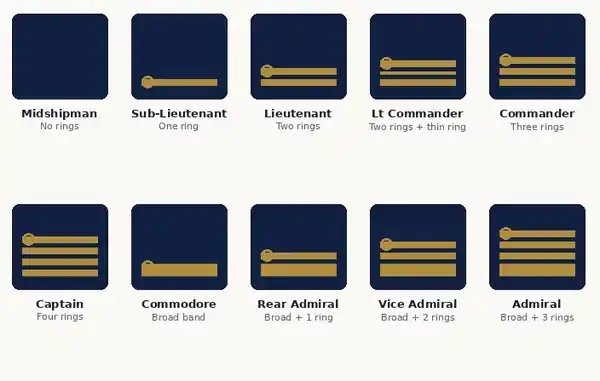
How to Read Sri Lanka Navy Insignia
Naval insignia are counted in rings, and the broad band is the dividing line between captains and admirals:
- Count the narrow rings — one ring is a Sub-Lieutenant, two a Lieutenant, three a Commander and four a Captain. A Lieutenant Commander is the exception: two narrow rings with a thin half-ring between them.
- Look for the broad band — a single broad gold band marks a Commodore. Add narrow rings above it and you climb the flag ranks: one for Rear Admiral, two for Vice Admiral, three for Admiral and four for Admiral of the Fleet.
- The executive curl and distinction cloth — the top ring ends in a small loop, the mark of the executive (seaman) branch. Other branches wear coloured cloth between the rings instead: scarlet for Engineering, orange for Medical, white for Logistics, dark green for Electrical, silver grey for Shipwrights, blue for Information Technology, brown for Naval Patrolman and purple for Legal. A Midshipman wears no rings at all, only a white patch.
Older tables also list Acting Sub-Lieutenant, a probationary grade now folded into Sub-Lieutenant.
Sri Lanka Navy Other Ranks (Ratings)
Sailors below commissioned rank are called ratings, and their badges are worn on the sleeve in gold on dark blue, built around the fouled anchor — an anchor with its rope twisted around it. A Petty Officer’s crossed anchors are one of the most recognisable badges in the service, and a Leading Seaman’s single vertical anchor is the first badge a sailor earns.
| Rank | NATO Code | Insignia | Typical Role |
|---|---|---|---|
| Master Chief Petty Officer | OR-9 | Gold shoulder boards: national emblem above a fouled anchor | Senior rating of a ship or establishment |
| Fleet Chief Petty Officer | OR-8 | Gold shoulder boards: fouled anchor with lion emblem | Senior rating at fleet level |
| Chief Petty Officer | OR-7 | Fouled anchor in a wreath below the national emblem | Head of a ship’s department |
| Petty Officer | OR-6 | Two crossed fouled anchors below the national emblem | Senior supervisor of a watch or section |
| Leading Seaman | OR-4 | Single vertical fouled anchor | Leading hand of a small working party |
| Able Seaman | OR-2 | No insignia | Trained sailor; qualified in seamanship duties |
| Seaman Recruit | OR-1 | No insignia | New recruit in basic training |
Ratings also carry a trade title with their rank — a Leading Radar Plotter or a Leading Engineering Mechanic — so the full title describes both seniority and job.
Sri Lanka Air Force Officer Ranks
Air Force officers wear light-blue braid on the sleeve and shoulder, in the Royal Air Force pattern adopted when the service was formed in 1951. Rank is read by the number and width of the bands. The Commander of the Air Force holds the three-star rank of Air Marshal; Air Chief Marshal is normally awarded on the day of retirement, and Air Chief Marshal Roshan Goonetileke was the only air force officer to hold the four-star rank while in active service.
| Rank | NATO Code | Insignia | Typical Role |
|---|---|---|---|
| Marshal of the Air Force | OF-10 | Broad bands with stars and the air force eagle | Honorary five-star rank |
| Air Chief Marshal | OF-9 | Broad band, narrow bands and four stars | Four-star rank; awarded on retirement |
| Air Marshal | OF-8 | Broad band, narrow bands and three stars | Three-star rank; held by the Commander of the Air Force |
| Air Vice-Marshal | OF-7 | Broad band, narrow bands and two stars | Two-star rank; chief of staff |
| Air Commodore | OF-6 | Broad band with narrow bands and a star | One-star rank; director |
| Group Captain | OF-5 | Four medium bands | Station or base commander |
| Wing Commander | OF-4 | Three medium bands with a thin band between | Squadron or wing commander |
| Squadron Leader | OF-3 | Three medium bands | Flight or squadron commander |
| Flight Lieutenant | OF-2 | Two medium bands with a thin band between | Flight commander |
| Flying Officer | OF-1 | One thin band above one medium band | Junior pilot |
| Pilot Officer | OF-1 | One thin band | Entry-level commissioned officer |
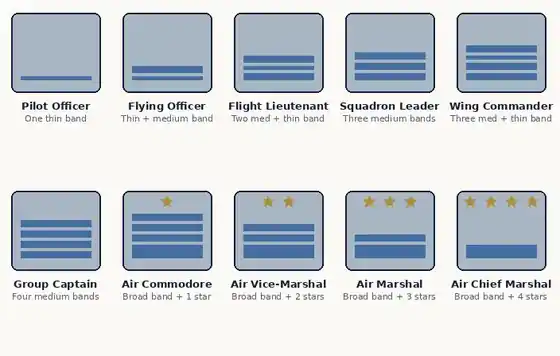
Sri Lanka Air Force Other Ranks
Air Force other ranks follow the Royal Air Force pattern too: chevrons for junior NCOs, an emblem above the chevrons for a Flight Sergeant, and the national emblem for the warrant officers. Aircraftman wears nothing; a Leading Aircraftman wears the two-bladed propeller badge that has marked the grade since the days of the Royal Flying Corps.
| Rank | NATO Code | Insignia | Typical Role |
|---|---|---|---|
| Master Warrant Officer | OR-9 | National emblem within a laurel wreath | Senior airman of a station |
| Warrant Officer | OR-8 | National emblem | Warrant officer of a squadron |
| Flight Sergeant | OR-7 | Emblem above three chevrons | In charge of a flight or section |
| Sergeant | OR-6 | Three chevrons | Supervisor of a working party or crew |
| Corporal | OR-4 | Two chevrons | Team leader |
| Leading Aircraftman | OR-2 | Horizontal two-blade propeller badge | Trained airman with additional responsibility |
| Aircraftman | OR-1 | No insignia | New airman in basic training |
How to Read Sri Lanka Air Force Insignia
Air force insignia are read by counting bands for officers and chevrons for other ranks:
- Thin and medium bands — a single thin band is a Pilot Officer; add a medium band below it for a Flying Officer, and two medium bands with a thin one between make a Flight Lieutenant.
- Three and four bands — three medium bands mark a Squadron Leader, three medium bands with a thin band between them a Wing Commander, and four medium bands a Group Captain. A broad band marks the flag ranks, with stars rising to four for Air Chief Marshal.
- Chevrons and the propeller — two chevrons are a Corporal and three a Sergeant; a Flight Sergeant adds the emblem above the three chevrons, and a Leading Aircraftman is recognised by the small propeller badge. The national emblem alone is a Warrant Officer; inside a laurel wreath, a Master Warrant Officer.
Equivalent Ranks Across the Three Services
Because the three services use different titles, the NATO code is the quickest way to compare them: a Major in the Army, a Lieutenant Commander in the Navy and a Squadron Leader in the Air Force are all OF-3 and hold equal rank.
| NATO Code | Sri Lanka Army | Sri Lanka Navy | Sri Lanka Air Force |
|---|---|---|---|
| OF-10 | Field Marshal | Admiral of the Fleet | Marshal of the Air Force |
| OF-9 | General | Admiral | Air Chief Marshal |
| OF-8 | Lieutenant General | Vice Admiral | Air Marshal |
| OF-7 | Major General | Rear Admiral | Air Vice-Marshal |
| OF-6 | Brigadier | Commodore | Air Commodore |
| OF-5 | Colonel | Captain | Group Captain |
| OF-4 | Lieutenant Colonel | Commander | Wing Commander |
| OF-3 | Major | Lieutenant Commander | Squadron Leader |
| OF-2 | Captain | Lieutenant | Flight Lieutenant |
| OF-1 | Lieutenant / Second Lieutenant | Sub-Lieutenant | Flying Officer / Pilot Officer |
| OR-9 | Warrant Officer Class I | Master Chief Petty Officer | Master Warrant Officer |
| OR-8 | Warrant Officer Class II | Fleet Chief Petty Officer | Warrant Officer |
| OR-7 | Staff Sergeant | Chief Petty Officer | Flight Sergeant |
| OR-6 | Sergeant | Petty Officer | Sergeant |
| OR-4 | Corporal | Leading Seaman | Corporal |
| OR-2 | — | Able Seaman | Leading Aircraftman |
| OR-1 | Private | Seaman Recruit | Aircraftman |
Two traps catch out newcomers: a Navy Captain (OF-5) is the equivalent of an Army Colonel, not an Army Captain, and the Army has no OR-2 grade while the Air Force has no OR-3, so the ladders do not line up row for row at the bottom.
Key point: A Navy Captain (OF-5) is the equivalent of an Army Colonel, not an Army Captain. Always check the NATO code, not just the title — the three services use different titles for the same grade.
Sri Lanka Military Badges and Emblems
Rank insignia show a person’s grade. Badges show what they are qualified to do:
- The national emblem — the lion holding a sword, from Sri Lanka’s coat of arms, replaces the crown of the British system in the badges of warrant officers and senior ratings.
- Parachutist wings — worn by soldiers of the Commando Regiment and other airborne-qualified personnel; aircrew wings are worn by pilots above the left breast pocket.
- Naval trade badges — ratings wear trade badges above their rank insignia showing their specialisation, from diving to radar plotting.
- Regimental and corps badges — each Army regiment and corps wears its own cap badge, so a soldier’s unit can be read alongside his rank: the gun for artillerymen, the grenade for engineers. Gallantry decorations, including the Parama Weera Vibhushanaya for bravery, are worn above the rank insignia on ceremonial dress.
How Promotion Works in Sri Lanka’s Armed Forces
Promotion mixes time in rank, examination and selection, in the British tradition. A Private who passes his trade tests can expect promotion to Lance Corporal after a few years, and the ladder to Sergeant and Staff Sergeant runs on merit, courses and vacancies. Promotion to Warrant Officer is by selection, and Regimental Sergeant Major is the summit of a soldier’s career.
Officers are commissioned after training at the Sri Lanka Military Academy (Army), the Naval and Maritime Academy at Trincomalee (Navy) or the Air Force Academy at China Bay (Air Force). Junior officers are promoted largely on time served, but promotion to Lieutenant Colonel and above goes before a selection board.
Command — of a battalion, a ship or a squadron — is the career gate that separates the officers who rise from those who do not.
A Note on Sri Lankan Military Tradition
Two things explain almost everything about Sri Lanka’s rank system. The first is the British inheritance: the pips and crowns, the sleeve rings, the light-blue braid and the chevrons all arrived with the Ceylon services and survived independence, the republic of 1972 and a 26-year civil war essentially unchanged. The second is the national emblem: where Britain puts a crown, Sri Lanka puts the lion — the clearest symbol of how the island took a colonial rank system and made it its own.
Read next
US Navy Ranks · US Military Uniform · US Military Branches · Indian Army Ranks · Bangladesh Military Ranks
FAQs
What is the highest rank in the Sri Lanka military?
Field Marshal (Army), Admiral of the Fleet (Navy) and Marshal of the Air Force (Air Force) — all honorary five-star ranks. Field Marshal has been awarded only once, to Sarath Fonseka in 2015, and Admiral of the Fleet only once, to Wasantha Karannagoda. The highest rank held by a serving officer is Lieutenant General, Vice Admiral or Air Marshal — the ranks of the three service commanders.
What is the lowest rank in the Sri Lanka Army?
Private (OR-1), who wears no rank insignia. In some corps the same grade has a different title — Gunner in the artillery, Trooper in the armoured corps, Sapper in the engineers.
How do you tell a Sri Lanka Army officer’s rank?
Read the shoulder boards: stars (pips) for junior officers — one for Second Lieutenant, two for Lieutenant, three for Captain — then a crown for Major, with stars added below the crown for Lieutenant Colonel, Colonel and Brigadier, and the crossed baton and sword for generals.
What is the difference between a Warrant Officer Class I and a Warrant Officer Class II?
Class I is the senior grade. A Warrant Officer Class I is usually the Regimental Sergeant Major, while a Class II serves as a Sergeant Major at battalion or company level. The Class I badge is the national emblem alone; the Class II badge is the emblem inside a laurel wreath.
Is a Navy Captain the same rank as an Army Captain?
No. A Navy Captain is OF-5, the equivalent of an Army Colonel and an Air Force Group Captain. An Army Captain is OF-2, the equivalent of a Navy Lieutenant and an Air Force Flight Lieutenant. Always check the NATO code, not just the title.
All insignia diagrams and images in this article are original graphics created for Forces Guide.