
Thailand’s armed forces wear one of the most distinctive rank systems in Asia. A Thai officer’s rank is read from gold stars and a grand crown on the shoulder board, a Thai sailor’s from gold lace stripes on the sleeve, and a Thai airman’s from stars on a sky-blue board — and every rank has a Thai name built from a handful of words that, once learned, unlock the whole system. This guide covers every Thai military rank, from Private (Phon Thahan) to Field Marshal (Chom Phon), across the Royal Thai Army, Royal Thai Navy and Royal Thai Air Force.
The Royal Thai Armed Forces have three services: the Royal Thai Army, the Royal Thai Navy and the Royal Thai Air Force. Each service has the same ladder of ten commissioned officer ranks and seven enlisted ranks — 17 ranks per service, 51 in total — but each gives its ranks different Thai names and different insignia.
Thai rank names are built like a code. Learn four words and you can work out almost any rank: Phon (general), Phan (senior officer), Roi (junior officer) and Sip (sergeant). Add the numbers Ek (first), Tho (second) and Tri (third) and the name tells you the place in the ladder: Roi Ek is the senior Roi rank — a Captain — while Roi Tri is the junior one — a Second Lieutenant.
Key facts
- Country: Thailand
- Branches: Royal Thai Army, Royal Thai Navy, Royal Thai Air Force
- Officer ranks: OF-1 to OF-10 (Second Lieutenant to Field Marshal)
- Enlisted ranks: OR-1 to OR-9 (Private to Sergeant Major 1st Class)
- Highest rank: Field Marshal (Chom Phon) — held only by the King of Thailand
- Notable fact: Thailand has no serving Brigadier General; the rank is replaced by Senior Colonel
Royal Thai Army Officer Ranks
The Royal Thai Army is the largest service. Its officers wear their rank on gold shoulder boards on white and khaki uniforms, or on the sleeve on dark blue uniforms. The boards carry five-pointed gold stars, and from Major upward the gold grand crown.
| English Rank | Thai Name | NATO Code | Insignia | Typical Role |
|---|---|---|---|---|
| Field Marshal | Chom Phon (จอมพล) | OF-10 | Crown, crossed sword and baton, 5 stars | Five-star rank, held only by the King; no officer appointed since 1973 |
| General | Phon Ek (พลเอก) | OF-9 | Crown, crossed sword and baton, 4 stars | Army chief |
| Lieutenant General | Phon Tho (พลโท) | OF-8 | Crown, crossed sword and baton, 3 stars | Corps commander |
| Major General | Phon Tri (พลตรี) | OF-7 | Crown, crossed sword and baton, 2 stars | Division commander |
| Colonel | Phan Ek (พันเอก) | OF-5 | Grand crown, 3 stars | Regiment commander |
| Lieutenant Colonel | Phan Tho (พันโท) | OF-4 | Grand crown, 2 stars | Battalion commander |
| Major | Phan Tri (พันตรี) | OF-3 | Grand crown, 1 star | Battalion second-in-command |
| Captain | Roi Ek (ร้อยเอก) | OF-2 | 3 stars | Company commander |
| Lieutenant | Roi Tho (ร้อยโท) | OF-1 | 2 stars | Platoon commander |
| Second Lieutenant | Roi Tri (ร้อยตรี) | OF-1 | 1 star | Platoon commander; entry-level officer |
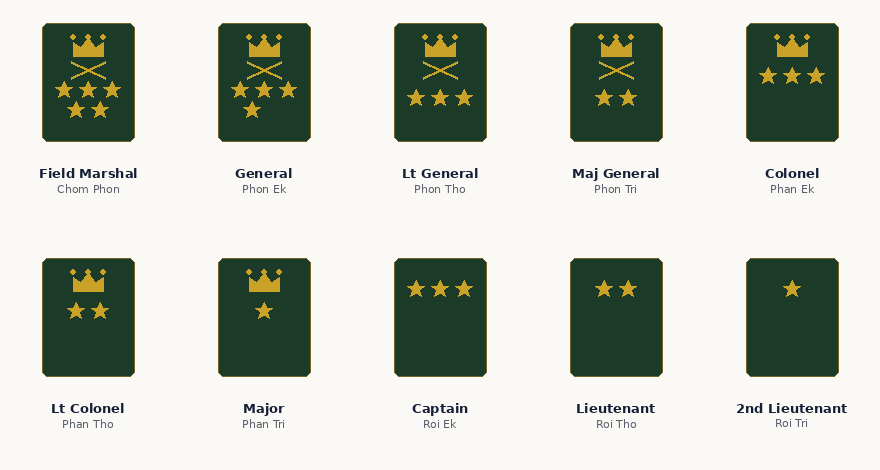
Two Army ranks deserve a special note. There is no OF-6 rank in the Thai table: the one-star Brigadier General (Phon Chattawa, พลจัตวา) stopped being awarded in 1963, though it still exists on paper. Its place is taken by the Senior Colonel (Phan Ek Phiset, พันเอกพิเศษ) — a Colonel on a general officer’s pay grade, marked out by a crossed baton and sword collar device. At the top, Chom Phon is a rank apart: the only five-star rank, worn today only by the King, who is also Chom Tap, Head of the Armed Forces.
Did you know? The five-star rank of Chom Phon has not been given to any officer since 1973. Today it is worn only by the King of Thailand, who is also Head of the Armed Forces.
Royal Thai Navy Officer Ranks
The Royal Thai Navy guards Thailand’s coasts in the Gulf of Thailand and the Andaman Sea, from its main base at Sattahip. Its officer ranks follow the Royal Navy pattern: rank is worn as gold lace stripes on the sleeve, with shoulder boards on white uniforms.
| English Rank | Thai Name | NATO Code | Insignia | Typical Role |
|---|---|---|---|---|
| Admiral of the Fleet | Chom Phon Ruea (จอมพลเรือ) | OF-10 | Broad stripe, 4 stripes, star | Five-star rank, held only by the King |
| Admiral | Phon Ruea Ek (พลเรือเอก) | OF-9 | Broad stripe, 3 stripes | Navy chief |
| Vice Admiral | Phon Ruea Tho (พลเรือโท) | OF-8 | Broad stripe, 2 stripes | Fleet commander |
| Rear Admiral | Phon Ruea Tri (พลเรือตรี) | OF-7 | Broad stripe, 1 stripe | Flotilla commander |
| Captain | Nawa Ek (นาวาเอก) | OF-5 | 4 stripes | Ship commander |
| Commander | Nawa Tho (นาวาโท) | OF-4 | 3 stripes | Ship commander |
| Lieutenant Commander | Nawa Tri (นาวาตรี) | OF-3 | 2 stripes, thin stripe between | Department head aboard ship |
| Lieutenant | Ruea Ek (เรือเอก) | OF-2 | 2 stripes | Watchkeeping officer |
| Lieutenant Junior Grade | Ruea Tho (เรือโท) | OF-1 | 1 stripe, thin stripe above | Junior watchkeeping officer |
| Sub Lieutenant | Ruea Tri (เรือตรี) | OF-1 | 1 stripe | Junior officer; entry-level rank |
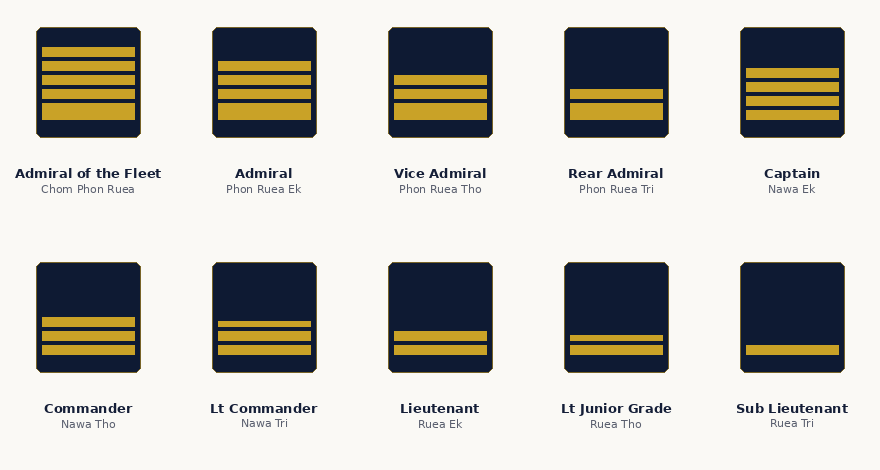
Key point: the trap for English speakers is the translation. A Thai Navy Nawa Ek is a Captain, not a Colonel, and a Navy Ruea Ek is a Lieutenant, not a Captain, even though the Thai words match the Army’s Colonel and Captain exactly. Always read the service first, then the rank.
Royal Thai Air Force Officer Ranks
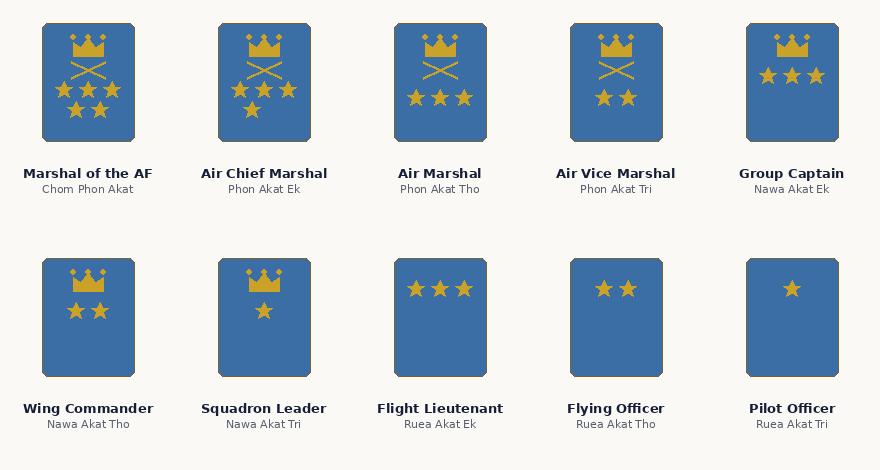
The Royal Thai Air Force defends Thai airspace from air bases across the country. Its ranks are the Navy’s system adapted for the air: the names add Akat (air), and the English titles follow the Royal Air Force. Officers wear gold stars on sky-blue shoulder boards.
| English Rank | Thai Name | NATO Code | Insignia | Typical Role |
|---|---|---|---|---|
| Marshal of the Air Force | Chom Phon Akat (จอมพลอากาศ) | OF-10 | Crown, crossed sword and baton, 5 stars | Five-star rank, held only by the King |
| Air Chief Marshal | Phon Akat Ek (พลอากาศเอก) | OF-9 | Crown, 4 stars | Air Force chief |
| Air Marshal | Phon Akat Tho (พลอากาศโท) | OF-8 | Crown, 3 stars | Air division commander |
| Air Vice Marshal | Phon Akat Tri (พลอากาศตรี) | OF-7 | Crown, 2 stars | Air base commander |
| Group Captain | Nawa Akat Ek (นาวาอากาศเอก) | OF-5 | Crown, 3 stars | Wing commander |
| Wing Commander | Nawa Akat Tho (นาวาอากาศโท) | OF-4 | Crown, 2 stars | Squadron group commander |
| Squadron Leader | Nawa Akat Tri (นาวาอากาศตรี) | OF-3 | Crown, 1 star | Squadron commander |
| Flight Lieutenant | Ruea Akat Ek (เรืออากาศเอก) | OF-2 | 3 stars | Flight commander |
| Flying Officer | Ruea Akat Tho (เรืออากาศโท) | OF-1 | 2 stars | Junior flying officer |
| Pilot Officer | Ruea Akat Tri (เรืออากาศตรี) | OF-1 | 1 star | Junior officer; entry-level rank |
How to Read Thai Officer Insignia
Once you know the code, a Thai officer’s shoulder board can be read in seconds:
- Count the stars. Within each tier the stars run one to three: Tri has one, Tho has two, Ek has three. Two stars on a plain gold board is a Lieutenant, not a general.
- Look for the crown. The gold grand crown appears on the boards of field-grade officers — Major and above — and on every general’s board. Stars with no crown mean a junior officer (Nai Roi).
- Generals add the crossed sword and baton. General officers (Nai Phon) carry the crossed sword and baton with the crown; their stars run from two (Major General) to four (General), and the field marshal’s board carries five.
- Check the service by the board and the name. The Army’s boards are gold on a dark ground; the Air Force’s are gold on sky blue; the Navy wears gold lace stripes on the sleeve instead of stars.
- Watch for the special paygrade. A Colonel on a general’s pay grade — a Senior Colonel — wears a Colonel’s board, and is told apart by the crossed baton and sword device on the collar.
Thai Enlisted and Non-Commissioned Officer Ranks
Below the officers are the enlisted ranks, in two tiers. The senior tier (Ja Nai Sib) holds the sergeants major, chief petty officers and flight sergeants; the junior tier (Nai Sib) holds the sergeants, corporals and lance corporals. At the bottom is the Private — Phon Thahan — the same name in all three services, and the only rank with no insignia. Thailand has mandatory military service, so most privates are conscripts.
| Army | Navy | Air Force | Thai Name (Army) | NATO Code | Insignia |
|---|---|---|---|---|---|
| Sergeant Major 1st Class | Chief Petty Officer 1st Class | Flight Sergeant 1st Class | Cha Sip Ek (จ่าสิบเอก) | OR-9 | Three chevrons with three bars |
| Sergeant Major 2nd Class | Chief Petty Officer 2nd Class | Flight Sergeant 2nd Class | Cha Sip Tho (จ่าสิบโท) | OR-8 | Three chevrons with two bars |
| Sergeant Major 3rd Class | Chief Petty Officer 3rd Class | Flight Sergeant 3rd Class | Cha Sip Tri (จ่าสิบตรี) | OR-7 | Three chevrons with one bar |
| Sergeant | Petty Officer 1st Class | Sergeant | Sip Ek (สิบเอก) | OR-5 | Three chevrons |
| Corporal | Petty Officer 2nd Class | Corporal | Sip Tho (สิบโท) | OR-4 | Two chevrons |
| Lance Corporal | Petty Officer 3rd Class | Senior Airman | Sip Tri (สิบตรี) | OR-3 | One chevron |
| Private | Seaman | Airman | Phon Thahan (พลทหาร) | OR-1 | No insignia |
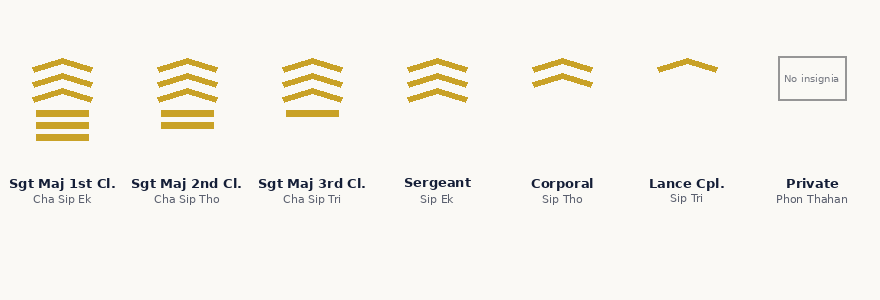
Did you know? There is no OR-6 and no OR-2 in the Thai system, so a Sergeant (OR-5) is promoted straight to Sergeant Major 3rd Class (OR-7). The Navy’s names differ again — Phan Cha for the chief petty officers and Cha for the petty officers — while the Air Force adds Akat.
How to Read Thai Enlisted Insignia
Enlisted insignia are worn on the sleeve, built from gold chevrons — the V-shaped stripes most armies use for non-commissioned officers:
- One, two or three chevrons mark the junior NCOs: one for Lance Corporal (Sip Tri), two for Corporal (Sip Tho) and three for Sergeant (Sip Ek).
- Bars below the chevrons mark the senior NCOs: one bar for 3rd Class, two for 2nd Class and three for 1st Class.
- No insignia means Private. A Phon Thahan wears no rank insignia at all — the only Thai rank with nothing to show.
- The Navy adds the anchor. Chief petty officers’ sleeve badges carry the fouled anchor of the Navy.
Special Ranks, Badges and Honours
Rank insignia shows a Thai service member’s grade. Badges and special ranks show something extra:
- Special Sergeant Major 1st Class (Cha Sip Ek Phiset, จ่าสิบเอกพิเศษ) — an honorary rank for senior enlisted members who deserve recognition beyond the highest enlisted rank. The Navy equivalent is Fleet Chief Petty Officer (Phan Cha Ek Phiset) and the Air Force equivalent is Special Flight Sergeant 1st Class (Phan Cha Akat Ek Phiset). The insignia is unchanged — but in a group they are normally put in charge, and they draw higher pay.
- Branch insignia — crossed rifles for infantry, crossed cannons for artillery, and similar devices for the other arms — are worn on the collar and show a soldier’s corps, not their rank. The crossed baton and sword collar device marks a Senior Colonel or a general officer.
- Parachutist wings and pilot wings — Thai airborne troops and aircrew wear qualification wings on the chest, earned through parachute and flying training. The Royal Thai Army Special Warfare Command in Lopburi is the home of Thailand’s special forces.
- Acting rank (Waa Ti Yos, ว่าที่ยศ) — officers below general rank may be given an acting rank by the Minister of Defence while their substantive rank awaits grant by royal decree. Acting rank holders wear the insignia and hold the rights of the rank. All commissioned ranks in Thailand are granted by royal decree.
How Promotion Works in the Thai Military
Promotion in the Thai armed forces runs on time in service, education and selection. Enlisted personnel advance through the NCO tiers as they complete service time and pass the required courses, with the senior sergeant major ranks filled by selection. Officers are commissioned from the military academies — Chulachomklao for the Army, and the Naval and Air Force academies — and advance through the Roi and Phan tiers on time in grade and merit.
Promotion to general officer is different: Thai generals are promoted only when they are assigned to an office that carries the rank, and no acting rank is issued at that level. This is why the Thai forces have many generals relative to their size — the rank follows the appointment. Colonels on the special paygrade hold general-grade pay and seniority while keeping a Colonel’s title, filling the gap left by the abolished Brigadier General rank.
A Note on Thai Military Tradition
Two things explain almost everything about Thai military ranks. The first is the monarchy: the King is Head of the Armed Forces, the five-star rank belongs to him alone, and every officer’s commission comes by royal decree. The crown on the shoulder board is the mark of the King’s authority carried into the ranks. The second is the British influence: Thailand was never colonised, but its armed forces borrowed freely from the British system — the Navy’s sleeve lace, the Air Force’s RAF-style titles, and the crown-and-stars logic of the Army’s boards.
Read next
US Navy Ranks · Indonesian Military Ranks · Japanese Military Ranks · US Military Uniform · US Military Branches
FAQs
What is the highest rank in the Thai military?
Field Marshal (Chom Phon) in the Army, Admiral of the Fleet (Chom Phon Ruea) in the Navy and Marshal of the Air Force (Chom Phon Akat) in the Air Force. All three are five-star ranks held only by the King, and no officer has been appointed since 1973. The highest rank a serving officer can hold is General, Admiral or Air Chief Marshal.
What does Roi Ek mean?
Roi Ek (ร้อยเอก) is a Captain in the Royal Thai Army. Roi is the junior officer tier and Ek means first, so it is the senior of the three junior grades: Roi Tri (Second Lieutenant), Roi Tho (Lieutenant) and Roi Ek (Captain). In the Navy the same grade is Ruea Ek (Lieutenant) and in the Air Force Ruea Akat Ek (Flight Lieutenant).
What is a Senior Colonel in Thailand?
A Senior Colonel (Phan Ek Phiset) is a Colonel on a general officer’s pay grade, senior to a regular Colonel. It fills the place of the Brigadier General rank (Phon Chattawa), which stopped being awarded in 1963. A Senior Colonel wears a Colonel’s shoulder board and is marked out by a crossed baton and sword device on the collar.
What rank is a Thai Private?
A Private is Phon Thahan (พลทหาร) in all three services — the same Thai name for Army, Navy and Air Force. It is the only rank with no insignia. In the Navy the English equivalent is Seaman and in the Air Force it is Airman. Most Thai privates are conscripts serving mandatory military service.
Do Thai Navy and Army ranks with the same Thai name mean the same thing?
No. A Navy Nawa Ek is a Captain while the matching Army word Phan Ek is a Colonel, and a Navy Ruea Ek is a Lieutenant while the Army’s Roi Ek is a Captain. Always check the service before translating a Thai rank into English.
All insignia diagrams and images in this article are original graphics created for Forces Guide.