
The 18 UKSF Signals ranks are not a rank system of their own. 18 (UKSF) Signal Regiment is a special forces communications unit of the Royal Corps of Signals, and everyone who serves in it wears British Army ranks — from Private (OR-1) to Field Marshal (OF-10) — with the insignia of their parent service. This guide explains the regiment itself, its history, role, selection course, beret and badges, and then gives the full British Army rank tables with notes on how they apply inside this very secretive unit.
That distinction matters. The regiment is a joint unit: most of its people are Army signallers, but its SBS Signal Squadron includes Royal Navy personnel, who wear naval ranks. Its job is to give Britain’s special forces the communications they need to operate anywhere in the world — and to keep those communications working, and secret, while they do it.
Key facts
- Unit: 18 (UKSF) Signal Regiment — 18 (UKSF) Sig Regt
- Country: United Kingdom
- Branch: British Army, Royal Corps of Signals; part of United Kingdom Special Forces (UKSF)
- Formed: 5 April 2005 (lineage traces to 18 Signal Regiment, formed 1959 in Singapore)
- Headquarters: Stirling Lines, Hereford
- Rank system: British Army ranks — officers OF-1 to OF-10, other ranks OR-1 to OR-9
- Motto: Colloquendo Imperamus — “Command through Communications”
What Is 18 (UKSF) Signal Regiment?
18 (UKSF) Signal Regiment is the communications arm of the United Kingdom Special Forces. It provides Communications and Information Systems (CIS), electronic warfare (EW) and signals intelligence (SIGINT) support to the UKSF — the SAS, the SBS and the Special Reconnaissance Regiment (SRR) — under the operational command of the Director Special Forces, from its headquarters at Stirling Lines, Hereford, alongside 22 SAS.
Its task is to deliver the military communications capability that enables UK Special Forces operations worldwide. In plain terms, its operators go wherever special forces go and make sure they can talk to each other, to headquarters and to supporting aircraft and ships — and that the enemy cannot listen in or jam them.
The regiment was formed on 5 April 2005, at the same time as the Special Reconnaissance Regiment, from the communications capabilities the SAS and SBS already had: 264 (SAS) Signal Squadron at Stirling Lines, the SBS Signal Squadron at RM Poole in Dorset, and 63 (SAS) Signal Squadron (V) of the Territorial Army, now the Army Reserve. The name was not new — an earlier 18 Signal Regiment had been formed in 1959 in Singapore and disbanded in 1971. It has served in the War in Afghanistan and the Iraq War, and several of its operators have been killed on special forces operations.
Did you know? The regiment’s motto, Colloquendo Imperamus, is Latin for “Command through Communications”. It sums up the whole idea of the unit: in special forces operations, whoever controls the communications controls the mission.
The Regiment’s Squadrons
The regiment is made up of five squadrons, each tied to one of the UKSF units it supports. Four are regular squadrons and one is an Army Reserve squadron:
| Squadron | Supports | Based At |
|---|---|---|
| 264 (SAS) Signal Squadron | 22 SAS | Stirling Lines, Hereford |
| SBS Signal Squadron | Special Boat Service | RM Poole, Dorset |
| 267 (SRR) Signal Squadron | Special Reconnaissance Regiment | Stirling Lines, Hereford |
| 268 (UKSF) Signal Squadron | UKSF strategic communications | Stirling Lines, Hereford |
| 63 (UKSF) Signal Squadron | UKSF (Army Reserve) | United Kingdom (reserve) |
264 (SAS) Signal Squadron is the oldest part of the regiment: formed in July 1966 to support 22 SAS, it traces its lineage to a signal troop formed in 1951 for the Malayan Scouts. 63 (UKSF) Signal Squadron began in 1967 as 63 (SAS) Signal Squadron (V) and was re-designated around 2014. 267 (SRR) and 268 (UKSF) Signal Squadrons were added as the regiment took shape, the latter for long-range strategic communications.
The regiment is a joint unit: its squadrons include personnel from both the Royal Corps of Signals and the Royal Navy, the naval communicators serving mainly in the SBS Signal Squadron. So most of the regiment wears Army ranks, but the sailors in it wear Royal Navy ranks — see our guide to Royal Navy ranks.
Selection and Training: The Special Forces Communicator Course
The regiment runs its own selection course, separate from the joint SAS and SBS course. Regular members of all three armed services, and members of the Army Reserve, can apply. Those who pass become Special Forces Communicators (SFCs).
The route in has three stages: a five-day Briefing Course, an optional three-week SFC Preparation Course, and then the main event — the 25-week UK Special Forces Communicators Course (UKSFCC), built from six phases: technical trade assessment, general support communications, physical aptitude, close support communications, conduct after capture, military training, and special forces parachute training.
The physical and tactical navigation stage is described as virtually identical to the one faced by SAS and SBS operator candidates — but SFC candidates do not have a jungle phase. At the end, successful candidates complete the same military parachuting course as the operators, earning the British Army parachute wings. Reservists take a different route into 63 (UKSF) Signal Squadron: an Assessment Course over three weekends, then a two-week communications course and a probationary year before they are declared Fit for Mobilisation.
Key point: The Ministry of Defence does not comment on special forces matters, so little about the course is published officially. The structure above comes from the Royal Corps of Signals’ own magazine, The Wire; exact timings and pass rates are not publicly confirmed.
Beret, Cap Badge and Qualification Badges
Because the regiment is part of UKSF, its dress differs from an ordinary Royal Signals unit — but not every detail is officially published, so this section separates what is documented from what is only reported.
The regimental cap badge is documented. Endorsed on 18 August 2020, it shows a Xiphos sword with three signal flashes for the three regiments the unit supports: the SAS, the SBS and the SRR. It marks out qualified Special Forces Communicators from other Royal Signals personnel attached to UKSF units.
The beret is less certain. Older published accounts state that Army personnel who complete the SFC course are awarded the sand-coloured beret of the SAS, worn with their parent unit’s cap badge, while Royal Marine communicators in the SBS Signal Squadron keep the green commando beret. That matches the wider UKSF pattern, but the Ministry of Defence has not published a current statement confirming it for this regiment, so treat it as reported rather than officially confirmed. Ordinary Royal Signals soldiers wear the navy blue beret.
The qualification badges an SFC can earn are the standard British Army ones, plus the regimental cap badge itself. The most visible is the parachute badge — the “wings” worn after military parachute training on the UKSFCC. Signallers also wear Corps trade badges, such as the Yeoman of Signals qualification for senior communications planners. The Corps’ own cap badge, worn by signallers who have not qualified as SFCs, is the figure of Mercury — known as “Jimmy”. There is no unique rank badge for the regiment.
British Army Officer Ranks (OF-1 to OF-10)
Officers of the regiment are commissioned into the Royal Corps of Signals after Sandhurst and specialist training at the Royal School of Signals, Blandford Camp, Dorset. Their ranks run from Second Lieutenant (OF-1) to Field Marshal (OF-10), read from pips (the Bath star), crowns and, for generals, a crossed sword and baton.
| Rank | NATO Grade | Insignia | Typical Role |
|---|---|---|---|
| Second Lieutenant (2Lt) | OF-1 | One pip (star) | Troop commander |
| Lieutenant (Lt) | OF-1 | Two pips | Troop commander |
| Captain (Capt) | OF-2 | Three pips | Squadron second-in-command |
| Major (Maj) | OF-3 | One crown | Squadron commander |
| Lieutenant Colonel (Lt Col) | OF-4 | Crown above one pip | Regiment commanding officer |
| Colonel (Col) | OF-5 | Crown above two pips | Senior staff officer |
| Brigadier (Brig) | OF-6 | Crown above three pips | Brigade commander |
| Major General (Maj Gen) | OF-7 | Crossed sword and baton, star above | Division commander |
| Lieutenant General (Lt Gen) | OF-8 | Crossed sword and baton, crown above | Corps commander |
| General (Gen) | OF-9 | Crossed sword and baton, crown and star above | Army commander |
| Field Marshal (FM) | OF-10 | Crossed batons in a wreath, crown above | Ceremonial rank |
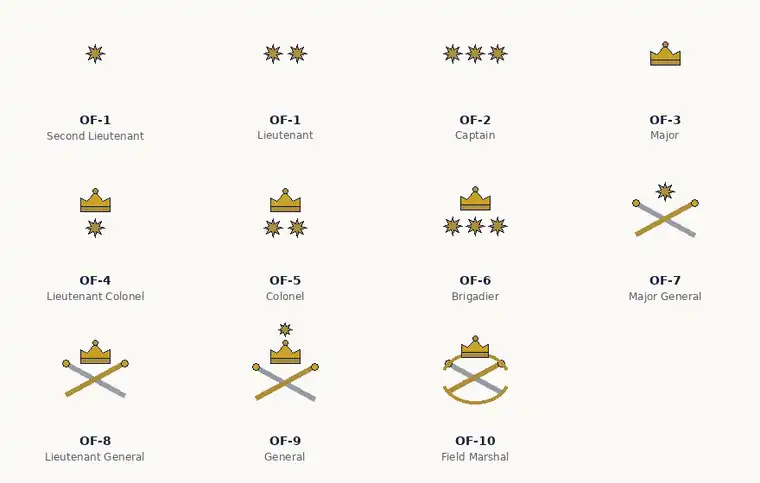
The pip is a star — the star of the Order of the Bath. One pip marks a Second Lieutenant, two a Lieutenant, three a Captain. A Major wears a single crown and no pip at all. Above Major, the crown stays and the pips return: crown and one pip for a Lieutenant Colonel, crown and two for a Colonel, crown and three for a Brigadier. From Major General upward, the insignia is a crossed sword and baton, with a star above it for a Major General, a crown for a Lieutenant General, and both for a full General. Field Marshal wears crossed batons in a wreath with a crown above, but the rank is ceremonial and no longer awarded in peacetime. The regiment’s commanding officer is a Lieutenant Colonel; squadron commanders are normally Majors.
British Army Other Ranks (OR-1 to OR-9)
Most of the regiment’s people are other ranks — soldiers and non-commissioned officers (NCOs), mostly signallers by trade. Their ranks run from Private (OR-1) to Warrant Officer Class 1 (OR-9), read from chevrons (V-shaped stripes worn point-down on the sleeve), crowns and the Royal Arms.
| Rank | NATO Grade | Insignia | Typical Role |
|---|---|---|---|
| Private (Pte) | OR-1 | No insignia | Signaller in a troop |
| Lance Corporal (LCpl) | OR-2 | One chevron | Team member |
| Corporal (Cpl) | OR-4 | Two chevrons | Section commander |
| Sergeant (Sgt) | OR-6 | Three chevrons | Troop sergeant |
| Staff Sergeant (SSgt) | OR-7 | Three chevrons with a crown above | Senior technical NCO |
| Warrant Officer Class 2 (WO2) | OR-8 | Crown within a laurel wreath | Squadron Sergeant Major |
| Warrant Officer Class 1 (WO1) | OR-9 | The Royal Arms | Regimental Sergeant Major |
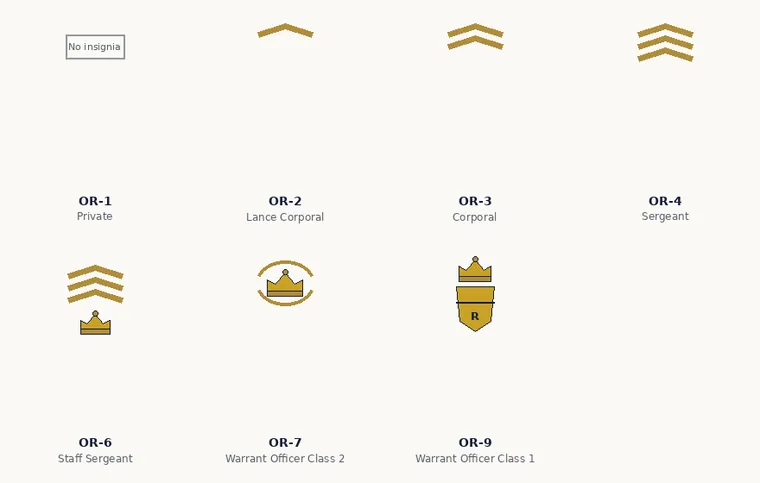
The ladder has two quirks. There is no OR-3 or OR-5 in the British Army: the grades jump from OR-2 (Lance Corporal) to OR-4 (Corporal), and from OR-4 to OR-6 (Sergeant). And the Staff Sergeant wears three chevrons with a crown above them, while the Warrant Officer Class 2 wears a crown inside a laurel wreath — a plain crown instead when appointed as a Squadron Sergeant Major. At the top, the Warrant Officer Class 1 wears the Royal Arms; in the regiment, the WO1 is the Regimental Sergeant Major (RSM), the senior soldier in the unit. Signallers also hold trade appointments: a Yeoman of Signals is the senior communications planning specialist, and Foreman of Signals is the senior technical appointment.
How to Read British Army Rank Insignia
Once you know the building blocks, you can read almost any British Army rank at a glance:
- Chevrons — V-shaped stripes, point down, on the upper sleeve. One is a Lance Corporal, two a Corporal, three a Sergeant; a crown above three chevrons means Staff Sergeant.
- Pips — eight-pointed stars, the star of the Order of the Bath. One, two or three pips mark Second Lieutenant, Lieutenant and Captain; a crown above pips marks the field officers.
- Crowns — the St Edward’s Crown. Alone it marks a Major; inside a wreath, a Warrant Officer Class 2; above crossed sword and baton, the senior generals.
- The Royal Arms — the monarch’s full coat of arms, marking a Warrant Officer Class 1.
- No insignia at all — a Private wears nothing.
What the Regiment Does Not Have: Its Own Ranks
It is worth stating plainly: 18 (UKSF) Signal Regiment has no rank system of its own. There is no “Special Forces Communicator” rank, no special forces chevron and no separate pay scale published for the regiment. A Sergeant here is a Sergeant in the British Army, with the same three chevrons as a Sergeant in any other Royal Signals unit, promoted under the same Army rules. What is different is the selection, the training and the job: SFCs are chosen through a course of their own and expected to keep communications running where failure means the mission fails. Their distinction is shown by the cap badge, the beret and the parachute wings — not by their rank. The same is true across UKSF: the SAS, the SRR and the Special Forces Support Group use ordinary British Army ranks, and the SBS uses Royal Navy ranks. For how the three services’ ranks line up, see our guide to the British military ranks.
How Promotion Works
Promotion follows the normal British Army system: other ranks advance on merit and on passing the required courses, with boards for the senior ranks; officers are promoted by central selection boards, with command as the defining career step. Two things shape a signaller’s promotion most: trade qualification, up through Yeoman and Foreman of Signals, and the SFC qualification itself, which opens postings inside UKSF not available to other signallers. The Ministry of Defence releases no figures for a unit of this size and sensitivity, so any precise promotion timeline for it would be guesswork.
18 (UKSF) Signal Regiment in the Wider UKSF
The regiment is one part of a small group. United Kingdom Special Forces is built around the SAS, the SBS, the Special Reconnaissance Regiment, the Special Forces Support Group and the Joint Special Forces Aviation Wing — and 18 (UKSF) Signal Regiment provides the communications that tie them together. Without it, none of the others could operate: a patrol that cannot call for extraction, pass intelligence or coordinate air support is a patrol in trouble. That is why its people are trained far beyond ordinary signallers: fit enough to keep up with special forces patrols, tough enough to pass conduct-after-capture training, qualified parachutists, and expert enough to run satellite, high-frequency and tactical communications in hostile territory.
Read next
British Military Ranks · Royal Navy Ranks · US Navy Ranks · US Military Branches
FAQs
Does 18 (UKSF) Signal Regiment have its own ranks?
No. The regiment uses ordinary British Army ranks, from Private (OR-1) to Field Marshal (OF-10), because its personnel are members of the Royal Corps of Signals. Royal Navy personnel in the SBS Signal Squadron use Royal Navy ranks instead. There is no separate rank system unique to the regiment.
What does 18 (UKSF) Signal Regiment do?
It provides communications and information systems (CIS), electronic warfare and signals intelligence support to the United Kingdom Special Forces — the SAS, SBS and Special Reconnaissance Regiment. Its operators deploy alongside special forces patrols and keep their communications working and secure.
Where is 18 (UKSF) Signal Regiment based?
Its headquarters is at Stirling Lines, Hereford, alongside 22 SAS. Its SBS Signal Squadron is based at RM Poole in Dorset, and its reserve squadron, 63 (UKSF) Signal Squadron, is part of the Army Reserve.
How do you join 18 (UKSF) Signal Regiment?
Regular members of all three armed services and Army Reserve members can apply. Applicants must pass a five-day Briefing Course and then complete the 25-week UK Special Forces Communicators Course (UKSFCC). An optional three-week preparation course is available first.
What beret does 18 (UKSF) Signal Regiment wear?
Published accounts state that Army personnel who qualify as Special Forces Communicators wear the sand-coloured beret of the SAS with their parent unit’s cap badge, while Royal Marine communicators keep the green commando beret. This is reported rather than officially confirmed — the Ministry of Defence does not publish current dress details for the regiment. Ordinary Royal Signals soldiers wear the navy blue beret.
What is the cap badge of 18 (UKSF) Signal Regiment?
The regimental cap badge, endorsed on 18 August 2020, is a Xiphos sword with three signal flashes, representing the three regiments the unit supports: the SAS, the SBS and the SRR. It marks qualified Special Forces Communicators.
All insignia diagrams and images in this article are original graphics created for Forces Guide. Rank insignia shown are stylised representations of the standard British Army patterns, not copies of official badges. Some details of this unit are not publicly disclosed by the Ministry of Defence; where a fact is not publicly confirmed, this article says so.