
Complete Detail of the Australian Military Ranks with insignias of the ranks with mentioned their Roles and Duties in Australian Defence Forces. Well Explained and Comprehensive Chart Tables of all the ranks of ADF. Images of the Ranks that help to uderstand easily the Hierarchy of Rank. This Complete article will clear every thing from A to Z about the ranks of Australian Military Ranks and Insignias.
Table of Contents
1- Enlisted Ranks: Foundations to Senior Non-Commissioned Leadership
1.1- Australian Military Ranks Chart Table List With Detail
| Rank | Typical Time to Achieve | Key Responsibilities | Reporting To | Insignia Description |
|---|---|---|---|---|
| Private | Entry-level after basic training | Develop core soldiering skills, discipline, and tactical proficiency. | Junior NCOs | Typically no insignia (blank). |
| Lance Corporal | Approximately 3 years as Private | Lead small teams of up to four soldiers and supervise routine tasks safely. | Corporal | Single chevron. |
| Corporal | 6–8 years | Lead sections or detachments and mentor junior soldiers. | Sergeants | Two chevrons. |
| Sergeant | Approximately 12 years | Serve as second-in-command of platoons (around 40 soldiers), managing discipline, training, and welfare. | Warrant Officers or Commissioned Officers | Three chevrons. |
| Staff Sergeant | Several years as Sergeant | Oversee administration and logistics while coordinating resources across multiple sections. | Warrant Officers | Three chevrons topped with a crown. |
| Warrant Officer Class 2 (WO2) | Not specified (Senior NCO rank) | Manage companies or squadrons of around 200 soldiers, enforce discipline, and perform technical or logistical duties. | Warrant Officer Class 1 or Senior Officers | Australian Coat of Arms within a wreath. |
| Warrant Officer Class 1 (WO1) | Approximately 18 years of exemplary service | Act as the principal adviser to commanding officers, oversee up to 650 soldiers, and maintain unit standards and cohesion. | Commanding Officers | Full Australian Coat of Arms. |
| Regimental Sergeant Major of the Army (RSMA) | Singular appointment (Most Senior Enlisted Rank) | Advise the Chief of Army, represent enlisted soldiers, and promote discipline, welfare, and professional standards across the Australian Army. | Chief of Army | Distinctive RSMA insignia (unique appointment). |
1.2- Ranks Insignias of The Foundation Ranks from Lowest to Highest
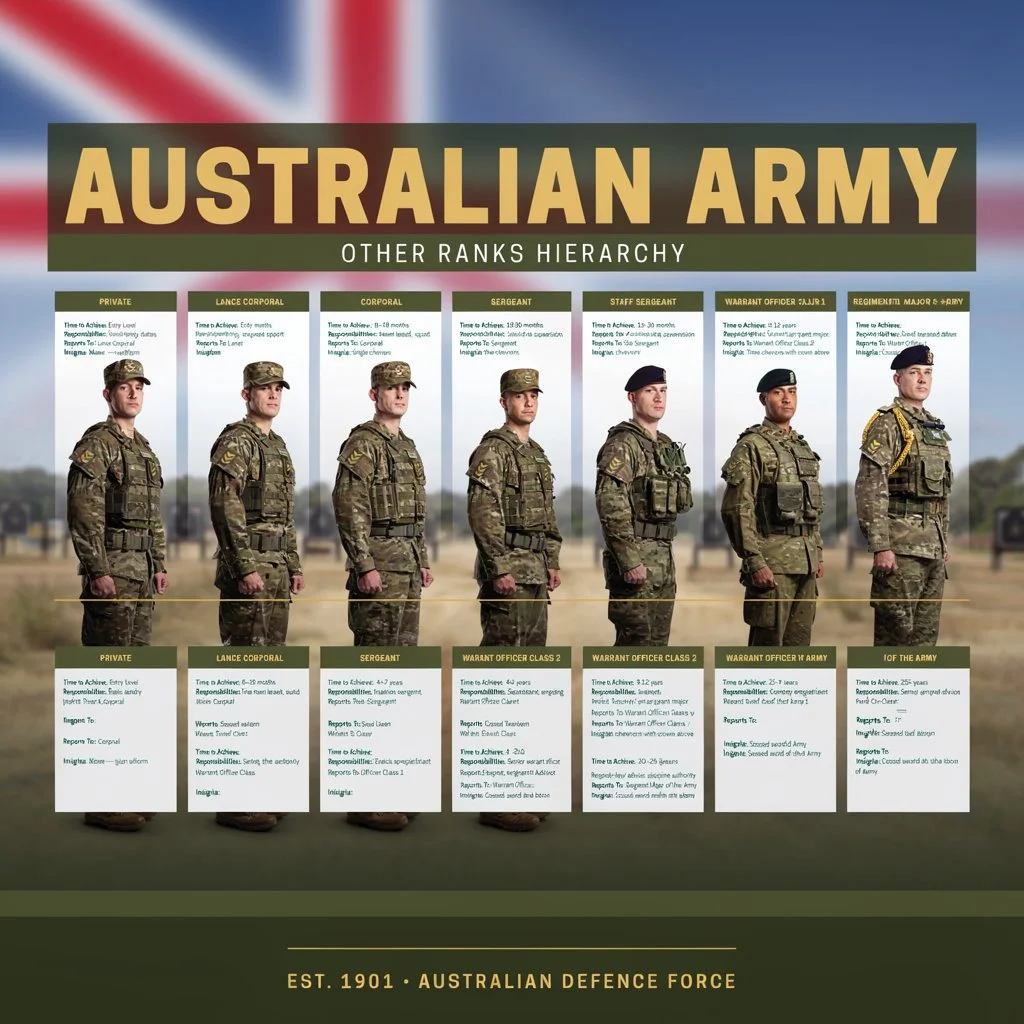
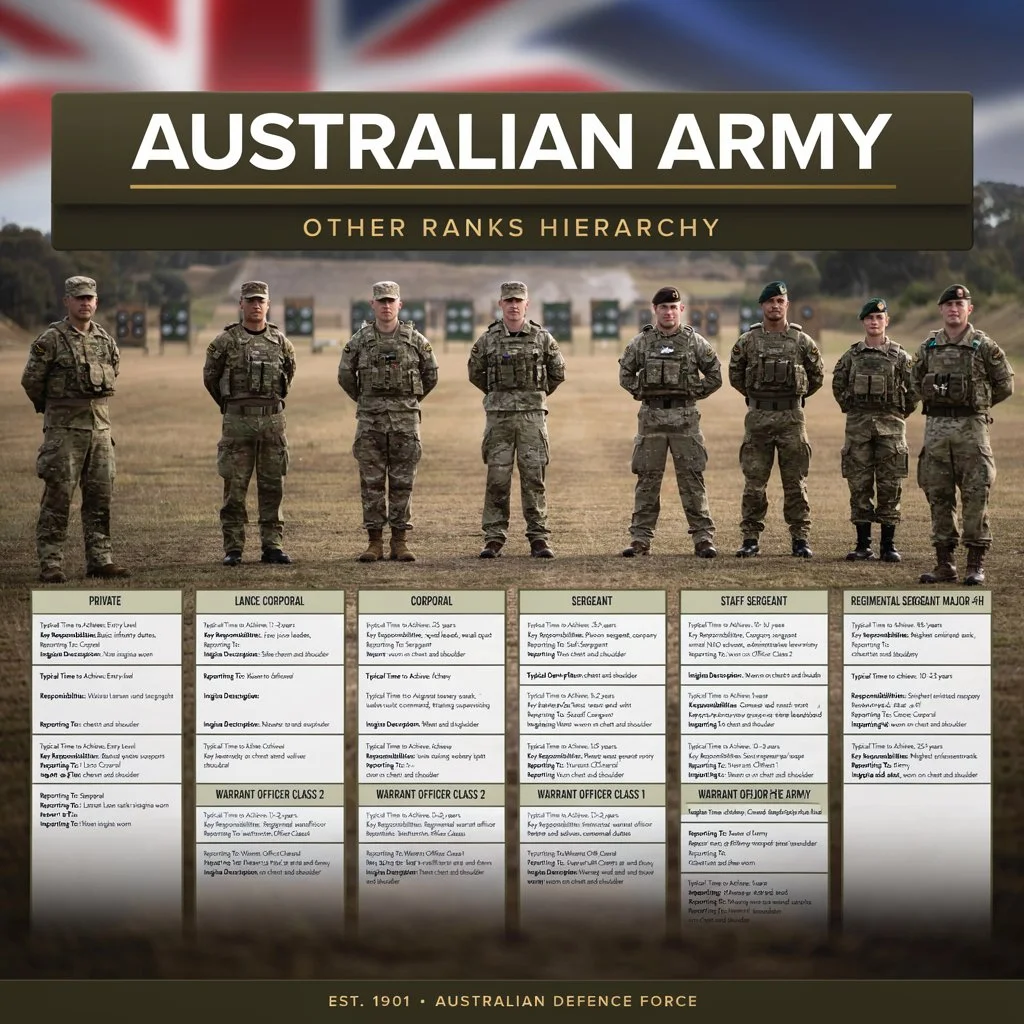
1.3- Detail of the Ranks Of Australian Military From Private To Chief
Private Rank Role in Australian Defence Force
Private. Private is the entry point for soldiers in the Australian Army once they have completed basic training and moved into their assigned core or regiment. Although the title private is widely used, the specific designation may change depending on the soldier’s trade with alternatives such as sapper, gunner, craftsman, musician, patrolman, or signaler.
Lance Corporal Rank In Australian Military
Lance Corporal. Lance Corporal is usually the first promotion a soldier receives, generally achieved after initial employment training or approximately 3 years of service as a private. At this level, they supervise small teams of up to four soldiers and begin to take on leadership responsibilities within their unit. Their duties often include ensuring tasks are completed safely and effectively while guiding newer soldiers through basic skills. Their single chevron insignia represents their entry into the Australian Army’s junior leadership tier and acknowledges potential for further advancement.
Corporal Rank In Astralian Military
Corporal is commonly reached after 6 to 8 years of service depending on a soldier’s leadership ability, professional performance, and trade qualifications. Corporals lead sections, crews, or detachments and are responsible for supervising, training, and mentoring junior soldiers every day. The two chevron insignia reflects their broader responsibility and established position within the non-commissioned officer structure.
Sergeant In Australian Military
Sergeants hold a senior leadership position and typically reach this rank after roughly 12 years of service. Although progression depends on a soldier’s performance and suitability, they act as second in command within platoons or similar units, overseeing around 40 soldiers and supporting junior officers in planning and directing operations. Their duties include managing discipline, training programs, welfare matters, and the professional development of non-commissioned officers
under their supervision. Sergeants report directly to warrant officers or commissioned officers, depending on the unit structure. Their three chevron insignia symbolizes experience, authority, and high trust within the army.
Staff Sergeant in Australian Military
Staff Sergeants achieve this rank after serving several years as a sergeant, assuming broader administrative and logistical responsibilities. Although still part of the non-commissioned officer leadership structure, their work focuses more on coordination, personnel management, and overseeing essential support functions. Their insignia includes three chevrons topped with a crown, marking their elevated position and long-standing service.
Lance Corporal In ADF
Warrant Officer Class 2 serves in a critical management and supervisory capacity within companies, squadrons, and batteries of up to 200 soldiers. The insignia, featuring the Australian Coat of Arms within a wreath, reflects their senior non-commissioned authority and deep professional knowledge.
Lance Corporal In ADF
Warrant Officer Class 1 is one of the highest non-commissioned ranks in the Australian Army and typically requires around 18 years of exemplary service. WO1s serve as principal advisers to commanding officers, providing guidance on discipline, training, morale, and soldier welfare across units of up to 650 personnel. They may also hold senior technical or instructional appointments throughout the Army. WO1s report directly to commanding officers and play a vital role in maintaining cohesion and professional standards. Their insignia features the full Australian coat of arms, symbolizing authority, expertise, and long-standing service.
Regimental Sergenat In ADF
Regimental Sergeant Major of the Army. The Regimental Sergeant Major of the Army, RSMA, is the most senior enlisted soldier in the Australian Army, with only one individual holding this position at any time. They serve as a direct adviser to the Chief of Army, ensuring that information, concerns, and perspectives from soldiers across all ranks are communicated effectively. The RSMA promotes professional standards, discipline, leadership development, and Army-wide welfare initiatives. Their distinctive insignia signifies the singular responsibility and influence associated with this appointment.
1.4- Key Insights of the Non-Commissioned Ranks In Australian Defence Force (ADF)
Progression from Private to Lance Corporal marks entry into junior leadership.
Sergeants and above hold critical supervisory and training duties, managing from small teams to large platoons.
WO1 and RSMA ranks focus heavily on professional standards, discipline, and unit cohesion at senior levels.
Insignia evolve to reflect responsibility and authority, from blank at entry-level to the Australian Coat of Arms at senior NCO ranks.
Video Tutorial For Better Understanding of Australian Military Ranks & Insignias
2. Commissioned Officer Ranks: Tactical Leadership to Strategic Command
2.1- Chart Table of the Commissioned Officers Ranks of Australian Army With Detail
| Rank | Typical Time / Duration | Key Responsibilities | Reporting To | Insignia Description |
|---|---|---|---|---|
| Second Lieutenant | Entry-level officer rank | Learn command responsibilities, develop leadership skills, and assist with platoon leadership. | Lieutenants or Captains | Single pip. |
| Lieutenant | Approximately 3 years | Command a platoon of around 30 soldiers, plan missions, and lead operations. | Captains | Two pips. |
| Captain | Not specified | Serve as second-in-command of sub-units (around 120 soldiers), oversee tactical planning, administration, and personnel management. | Majors | Three pips. |
| Major | 8–10 years | Command sub-units, perform key staff duties, coordinate operations, and supervise training. | Lieutenant Colonels | Crown. |
| Lieutenant Colonel | Not specified | Command units of approximately 650 soldiers, oversee operational planning, and hold senior staff appointments. | Colonels or Brigadiers | Crown above one pip. |
| Colonel | Not specified | Hold senior staff positions, manage training and military capability, and oversee planning and policy development. | Brigadiers or Higher Commanders | Crown above two pips. |
| Brigadier | Not specified | Command brigades, oversee personnel management, operational readiness, and strategic planning. | Major Generals | Single star. |
| Major General | Not specified | Command divisions, serve in senior defense appointments, and contribute to strategic military planning. | Lieutenant Generals | Two stars. |
| Lieutenant General | One of the highest officer ranks | Serve as Chief of Army or in other top defense leadership roles, directing major defense programs and joint operations. | Chief of the Defence Force | Three stars. |
| General | Highest active rank | Serve as the Chief of the Defence Force, providing overall leadership, strategic direction, and command of the Australian Defence Force. | Minister for Defence and the Australian Government | Four stars. |
2.2- Ranks Insignias of the Commissioned Officers Ranks
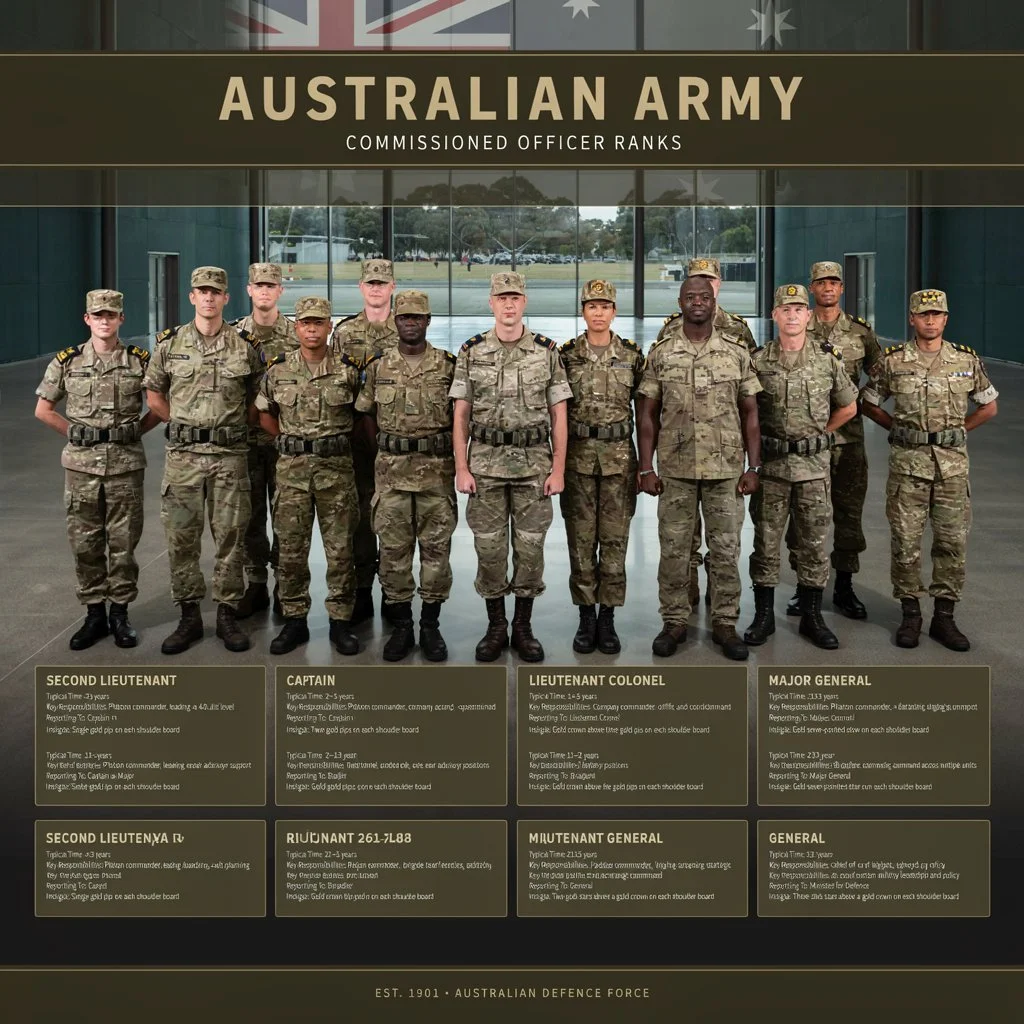
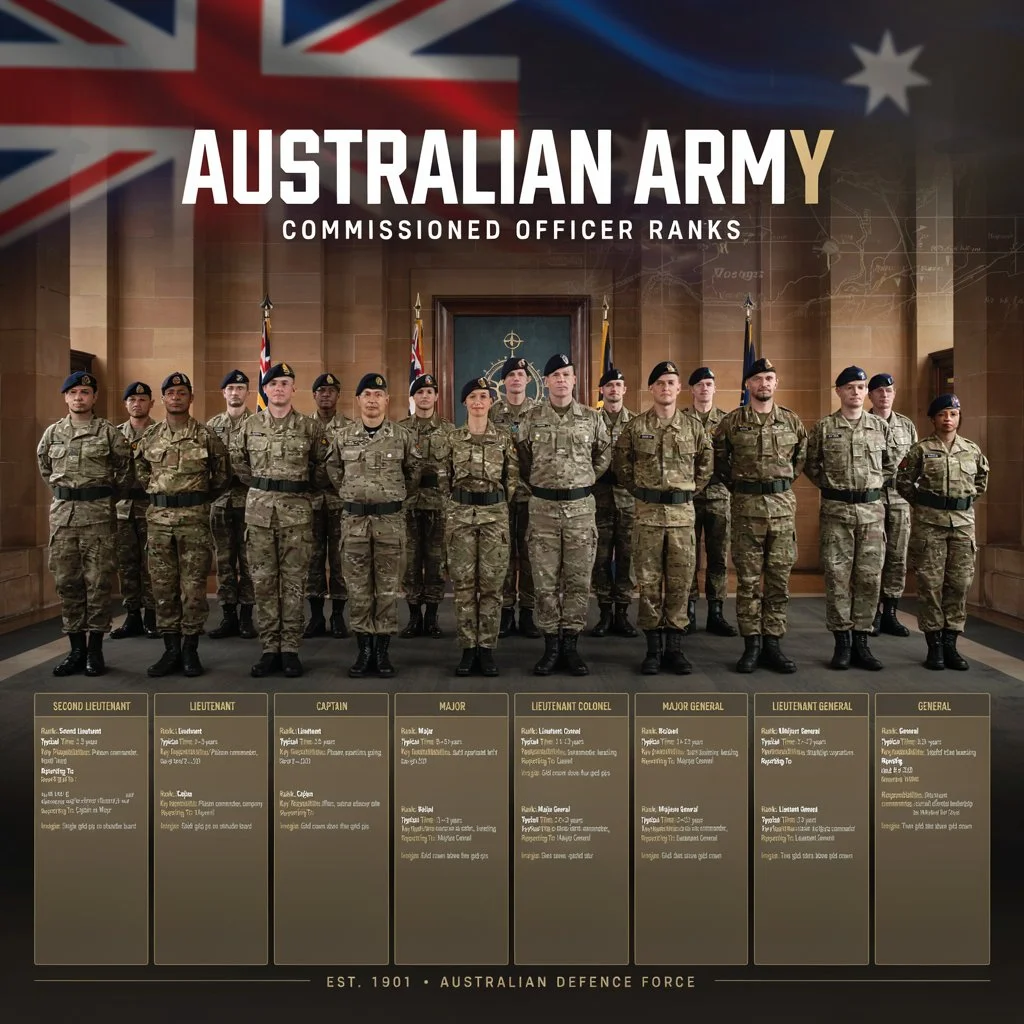
2.3- Detail of The Australian Army Commissioned Officers Ranks
Second Lieutenant Rank Role In Australian Military
Second Lieutenant. Second Lieutenant is the entry-level commissioned officer rank and is typically held during initial appointments, training periods, or early career placements in institutions such as university regiments. Officers at this level begin learning command duties and take on responsibilities similar to those of a lieutenant, often under supervision. They may assist with leading platoons, overseeing training, and working closely with non-commissioned officers who provide guidance and support. Second lieutenants report to lieutenants or captains, depending on their assignment. Their single pip insignia reflects their status as emerging leaders in the Army’s officer corps.
Lieutenant Rank Role and Duties In Australian Military
Lieutenant. Lieutenants generally hold this rank for approximately 3 years, commanding platoons or troops of around 30 soldiers. They are responsible for planning, coordinating, and leading their teams during operations, training exercises, and day-to-day activities. Lieutenants rely heavily on sergeants and corporals for professional expertise and support in managing their personnel. They report to captains who supervise sub-unit operations and provide further guidance. The two-pip insignia signifies their growing leadership role and expanding responsibility within tactical units.
Captain Rank Role and Duties In Australian Military
Captain. Captains serve as second-in-command of sub-units containing up to 120 soldiers. They play an essential role in planning, administration, and tactical decision-making, working closely with senior non-commissioned officers to ensure operational readiness. Captains manage logistics, oversee training programs, and support platoon-level leaders through coordination and guidance. They report to majors who serve as sub-unit commanders and hold overall responsibility. The three-pip insignia demonstrates a captain’s position as an experienced officer with established leadership duties
Major Rank Role and Duties In Australian Military
Major. Majors typically achieve this rank after eight to 10 years of service and are recognized as field-grade officers. They command sub-units or serve in key staff positions, overseeing up to 120 soldiers and ensuring effective training, welfare, and operational execution. Majors coordinate closely with captains and lieutenants to develop tactical plans and maintain unit readiness. They report to lieutenant colonels who command larger formations. The insignia of a crown reflects their mid-level leadership status and the trust placed in them to manage significant responsibilities.
Lieutenant Colonel Rank Role and Duties In Australian Military
Lieutenant Colonel. Lieutenant colonels command units of around 650 soldiers consisting of three to five sub-units. They are responsible for operational effectiveness, long-term planning, training, and administration within their formation. Lieutenant colonels may also serve as senior staff officers at brigade level or within higher headquarters. They report to colonels or brigadiers, depending on the organizational structure. Their insignia, a crown above a pip, symbolizes their senior field command role and strategic responsibilities.
Colonel Rank Role and Duties In Australian Military
Colonel. Colonels typically serve in senior staff appointments rather than commanding units directly. They may work within training centers, doctrinal development organizations, or capability management programs, ensuring that Army initiatives are properly coordinated and implemented. Colonels often act aschiefs of staff within headquarters, overseeing planning and policy activities. They report to brigadiers or higher-level commanders. The insignia featuring a crown and two pips reflects their seniority and broad influence across the Army.
Brigadier Rank Role & Duties In Australian Military
Brigadier. A brigadier is a one-star general officer who commands brigades or serves as a director general within Army headquarters. They oversee major functions such as personnel management, operational planning, and career development across multiple units. Brigadiers coordinate with subordinate commanders to ensure readiness and capability across their formation. They report to major generals who lead divisions and hold higher operational authority. The single-star insignia marks their entry into the general officer ranks and their role in shaping large-scale Army operations.
Major General Rank Role & Duties In Australian Military
Major General. Major General is a two-star general rank responsible for commanding divisions or holding senior appointments within the Department of Defense. They oversee planning, readiness, and resource allocation for large formations and inter-service operations. Major Generals work closely with brigadiers and lieutenant generals to align strategic objectives with operational outcomes. They report directly to lieutenant generals who manage broader defense responsibilities. The two-star insignia highlights their elevated leadership role and influence across national defense activities.
Lieutenant General Rank Role In Australian Military
Lieutenant General. Lieutenant General is a three-star general rank and one of the highest active positions in the Australian Army. It is held by the Chief of Army and may also be held by officers serving as Vice Chief of the Defense Force, Chief of Joint Operations, or Chief of Capability Development. These officers guide major defense programs, oversee joint operations, and shape long-term military strategy. Lieutenant Generals report to the Chief of the Defense Force. The three-star insignia represents their high authority, experience, and strategic leadership.
General Rank Role In Australian Military
General. General is the highest active rank in the Australian Army and is held only when an officer is appointed as Chief of the Defense Force. This position carries responsibility for the overall leadership, direction, and strategic priorities of the Australian Defense Force. Generals oversee joint operations, capability development, international partnerships, and defense policy implementation.
3. Summary of Rank Progression and Responsibilities
| Rank Group | Primary Focus | Leadership Scope | Approximate Service Time |
|---|---|---|---|
| Entry-Level Soldiers | Develop fundamental soldiering skills, military discipline, and operational proficiency. | Individual responsibilities and small team tasks. | 0–3 years |
| Junior Non-Commissioned Officers (NCOs) | Supervise small squads, mentor junior soldiers, and build leadership experience. | Teams of up to 10 soldiers. | 3–8 years |
| Senior Non-Commissioned Officers (NCOs) | Manage larger groups, oversee training, enforce discipline, and ensure troop welfare. | Platoons and sub-units (approximately 40–200 personnel). | 8+ years |
| Warrant Officers | Provide senior leadership, technical expertise, and professional advice to commanders. | Companies and senior enlisted leadership positions. | 12+ years |
| Junior Officers | Lead platoons, conduct tactical planning, and command troops during operations. | Platoons and smaller sub-units. | Entry to approximately 8 years |
| Field-Grade Officers | Command larger formations, oversee operations, and perform key staff duties. | Sub-units to battalion-sized units (approximately 120–650 personnel). | 8+ years |
| Senior Officers | Provide strategic leadership, oversee major formations, and manage Army capability and planning. | Brigades, divisions, and Army-wide leadership roles. | Variable |
| General Officers | Direct national defense strategy, joint military operations, and overall defense policy. | National-level and joint defense leadership. | Variable |
2 thoughts on “Australian Military Ranks & Insignias”