
Portugal has one of the oldest military traditions in Europe, and its rank system shows it. The Portuguese Armed Forces (Forças Armadas) use two rank systems side by side: the Army (Exército) and the Air Force (Força Aérea) share traditional land ranks, while the Navy (Marinha) uses traditional naval ranks dating back to the age of sail. This guide covers every Portuguese military rank with its insignia, from Soldado (Private) to Marechal do Exército (Marshal of the Army).
Portugal is a founding member of NATO, and its ranks are mapped to the NATO OF (officer) and OR (other ranks) grades, so a Portuguese Coronel is the direct equivalent of a Colonel in any allied army. The armed forces number around 24,000 active personnel (2024), all volunteers since conscription ended in 2004, and are built around three services: the Army, the Navy (which includes the Marine Corps, the Corpo de Fuzileiros), and the Air Force.
Portuguese ranks fall into three large categories: officers (oficiais), sergeants (sargentos) and enlisted personnel (praças). Officers are further divided into general officers (oficiais generais), senior officers (oficiais superiores) and junior officers (oficiais subalternos).
There is no separate warrant officer corps as in the United States — the sergeant ranks fill that senior technical and leadership role. The same land rank system is also used by the National Republican Guard (Guarda Nacional Republicana, GNR), the gendarmerie that can come under Armed Forces command in wartime, although the GNR has its own titles for its enlisted grades.
Key facts
- Country: Portugal
- Branches: Portuguese Armed Forces — Army (Exército), Navy (Marinha) and Air Force (Força Aérea)
- Officers: OF-1 to OF-10 (Alferes to Marechal)
- Sergeants and enlisted: OR-1 to OR-9 (Soldado / grumete to Sargento-mor)
- Warrant officers: none — the sergeant ranks fill the senior technical role
- Highest rank: Marechal do Exército, Almirante da Armada and Marechal da Força Aérea (OF-10), rarely held
- Notable fact: founding NATO member (1949); an all-volunteer force since conscription ended in 2004
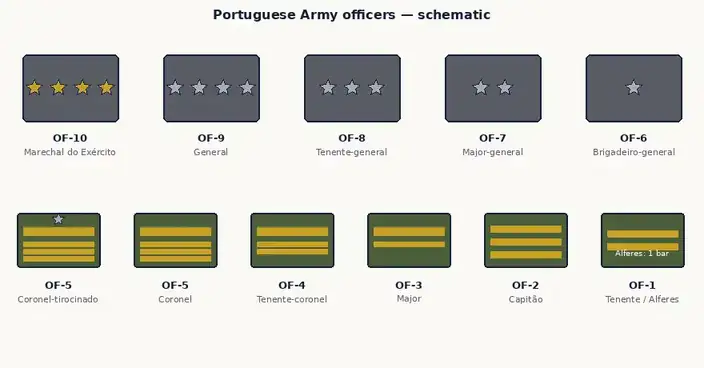
Portuguese Army Officer Ranks (OF-1 to OF-10)
Army officers wear their rank on shoulder boards and sleeve stripes. General officers are read by the silver stars on their shoulder boards, while the Marshal wears four gold stars. Senior and junior officers are read by gold sleeve stripes (galões): field officers wear a broad stripe with narrow stripes beneath it, and company officers wear narrow stripes alone.
| Rank (Portuguese) | English Equivalent | NATO Grade | Insignia | Typical Role |
|---|---|---|---|---|
| Marechal do Exército | Marshal of the Army | OF-10 | Four gold stars | Highest Army rank; rarely held |
| General | General | OF-9 | Four silver stars | Army commander |
| Tenente-general | Lieutenant General | OF-8 | Three silver stars | Senior command |
| Major-general | Major General | OF-7 | Two silver stars | Division commander |
| Brigadeiro-general | Brigadier General | OF-6 | One silver star | Brigade commander |
| Coronel-tirocinado | Senior Colonel | OF-5 | Colonel’s stripes + silver star | Colonel qualified for general rank |
| Coronel | Colonel | OF-5 | Broad stripe + 3 narrow | Regiment commander |
| Tenente-coronel | Lieutenant Colonel | OF-4 | Broad stripe + 2 narrow | Battalion commander |
| Major | Major | OF-3 | Broad stripe + 1 narrow | Battalion staff officer |
| Capitão | Captain | OF-2 | 3 narrow gold stripes | Company commander |
| Tenente | Lieutenant | OF-1 | 2 narrow gold stripes | Platoon commander |
| Alferes | Second Lieutenant | OF-1 | 1 narrow gold stripe | Entry-level officer |
Did you know? Between 1929 and 1937 the Coronel-tirocinado grade was called Brigadeiro — and the Marshal rank at the top of the scale is effectively honorary and has only rarely been held.
The Coronel-tirocinado is the rank most likely to confuse a foreign reader. It is not a separate grade above Colonel in the NATO scale — both are OF-5 — but a Colonel who has passed the general officer training course and is qualified for promotion to general, marked by adding a silver general’s star to the Colonel’s sleeve stripes.
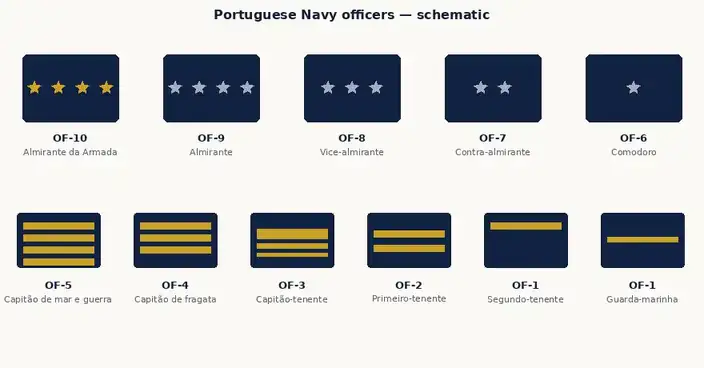
Portuguese Navy Officer Ranks (OF-1 to OF-10)
The Navy uses a completely different set of titles, in the classic naval tradition. Its flag officers wear stars on dark blue shoulder boards, while captains and lieutenants are read by the gold rings on the sleeve cuff, the number of rings rising with rank. The senior captain is the Capitão de mar e guerra, literally “Captain of sea and war”, a title Portugal shares with Brazil and the other Portuguese-speaking navies, dating back to the sixteenth century.
| Rank (Portuguese) | English Equivalent | NATO Grade | Insignia | Typical Role |
|---|---|---|---|---|
| Almirante da Armada | Admiral of the Fleet | OF-10 | Four gold stars | Highest naval rank; rarely held |
| Almirante | Admiral | OF-9 | Four silver stars | Naval chief of staff |
| Vice-almirante | Vice Admiral | OF-8 | Three silver stars | Senior naval command |
| Contra-almirante | Rear Admiral | OF-7 | Two silver stars | Naval formation commander |
| Comodoro | Commodore | OF-6 | One silver star; broad sleeve ring | Flotilla commander |
| Capitão de mar e guerra | Captain | OF-5 | Four gold sleeve rings | Frigate commander |
| Capitão de fragata | Commander | OF-4 | Three gold sleeve rings | Ship commander |
| Capitão-tenente | Lieutenant Commander | OF-3 | Broad ring with narrow rings | Senior ship’s officer |
| Primeiro-tenente | Lieutenant | OF-2 | Two gold sleeve rings | Department head |
| Segundo-tenente | Sub-Lieutenant | OF-1 | One gold sleeve ring | Junior ship’s officer |
| Guarda-marinha / Subtenente | Midshipman | OF-1 | One narrow gold sleeve ring | First sea appointment |
Key point: an Army Capitão (OF-2) and a Navy Capitão de mar e guerra (OF-5) share a word but not a grade. Always check the service before translating a Portuguese rank.
Note the two titles at OF-1: a new naval officer is a Guarda-marinha (Midshipman) and then a Subtenente, the two names covering the same junior grade. Navy officer cadets train at the Naval School (Escola Naval), and the Navy’s Marine Corps — the Corpo de Fuzileiros, its amphibious and special operations force — uses these same naval officer ranks.
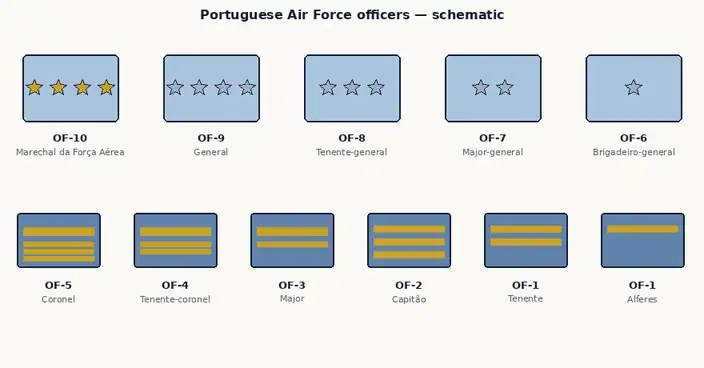
Portuguese Air Force Officer Ranks (OF-1 to OF-10)
The Air Force uses the same land ranks as the Army, with one difference at the top: its Marshal is the Marechal da Força Aérea (Marshal of the Air Force), and it has no Coronel-tirocinado grade — its Colonels go straight from OF-5 to Brigadier General. Air Force officers wear the same system of stars and sleeve stripes, on light blue shoulder boards and uniforms.
| Rank (Portuguese) | English Equivalent | NATO Grade | Insignia | Typical Role |
|---|---|---|---|---|
| Marechal da Força Aérea | Marshal of the Air Force | OF-10 | Four gold stars | Highest Air Force rank; rarely held |
| General | General | OF-9 | Four silver stars | Air chief of staff |
| Tenente-general | Lieutenant General | OF-8 | Three silver stars | Senior command or staff appointment |
| Major-general | Major General | OF-7 | Two silver stars | Formation commander |
| Brigadeiro-general | Brigadier General | OF-6 | One silver star | Wing commander |
| Coronel | Colonel | OF-5 | Broad stripe + 3 narrow | Wing commander |
| Tenente-coronel | Lieutenant Colonel | OF-4 | Broad stripe + 2 narrow | Squadron commander |
| Major | Major | OF-3 | Broad stripe + 1 narrow | Squadron executive officer or staff officer |
| Capitão | Captain | OF-2 | 3 narrow gold stripes | Flight commander |
| Tenente | Lieutenant | OF-1 | 2 narrow gold stripes | Pilot or technical officer |
| Alferes | Second Lieutenant | OF-1 | 1 narrow gold stripe | Entry-level commissioned officer |
How to Read Portuguese Officer Insignia
Once you know the code, any Portuguese officer can be read at a glance:
- Stars mean generals and admirals. Silver stars count the general and flag ranks: one for a Brigadier General or Commodore, two for a Major General or Rear Admiral, three for a Lieutenant General or Vice Admiral, four for a General or Admiral. Four gold stars mark the Marshal grades.
- Stripes mean senior and junior officers. In the Army and Air Force, a broad stripe with narrow stripes beneath it marks the field officers, and narrow stripes alone mark the company officers (one for Alferes, two for Tenente, three for Capitão).
- Rings mean naval officers. In the Navy the same idea is worn as gold rings around the sleeve cuff: four rings for a Capitão de mar e guerra, three for a Capitão de fragata, down to a single narrow ring for a Guarda-marinha.
- The extra star is the trap. A Colonel’s stripes with a silver star added is not a general — it is a Coronel-tirocinado, a Colonel qualified for general rank but not yet promoted.
- Colour tells you the service. Army shoulder boards are grey-green, Navy boards are dark blue, and Air Force boards are light blue — the same rank, worn in three colours.
Portuguese Sergeants and Enlisted Ranks — Army and Air Force (OR-1 to OR-9)
The Army and Air Force share the same sergeant and enlisted ranks. Sergeants (sargentos) are the professional backbone of both services: the Sargento-mor (Sergeant Major, OR-9) is the most senior non-commissioned rank, advising commanders in the same way a Sergeant Major does in other NATO armies. Below the sergeants come the praças — the corporals and privates.
The rank of Furriel is a distinctive Portuguese title with no exact English match, coming from the old quartermaster-sergeant role, and it sits in the sergeant band, above the corporals.
| Rank (Portuguese) | English Equivalent | NATO Grade | Insignia | Typical Role |
|---|---|---|---|---|
| Sargento-mor | Sergeant Major | OR-9 | Senior chevrons | Senior sergeant advisor |
| Sargento-chefe | Chief Sergeant | OR-8 | Chevrons | Formation senior sergeant |
| Sargento-ajudante | Adjutant Sergeant | OR-7 | Chevrons | Senior administrative sergeant |
| Primeiro-sargento | First Sergeant | OR-6 | Chevrons | Company-level senior sergeant |
| Segundo-sargento | Second Sergeant | OR-5 | Chevrons | Platoon sergeant |
| Furriel | Sergeant (Furriel) | OR-5 | Chevrons | Section sergeant |
| Segundo-furriel | Second Furriel | OR-5 | Chevrons | Junior section sergeant |
| Cabo de secção | Section Corporal | OR-4 | Chevrons | Section deputy |
| Cabo-adjunto | Adjutant Corporal | OR-4 | Chevrons | Senior corporal |
| Primeiro-cabo | First Corporal | OR-3 | Chevrons | Team leader |
| Segundo-cabo | Second Corporal | OR-2 | Chevrons | Junior team leader |
| Soldado | Private / Soldier | OR-1 | No insignia | New recruit |
Portuguese Navy Ratings — Sergeants and Enlisted (OR-1 to OR-9)
Navy sergeants carry the same top five titles as the land services — Sargento-mor down to Segundo-sargento — but the junior ranks are naval: Subsargento (Sub-Sergeant), Cabo-mor and Cabo (the leading seamen), then Primeiro-marinheiro and Segundo-marinheiro (First and Second Seaman), and finally the grumetes, the apprentice seamen. The two grumete grades wear no insignia at all, the easiest way to spot the newest sailor on a ship.
| Rank (Portuguese) | English Equivalent | NATO Grade | Insignia | Typical Role |
|---|---|---|---|---|
| Sargento-mor | Master Chief Petty Officer | OR-9 | Senior chevrons | Senior rating advisor |
| Sargento-chefe | Senior Chief Petty Officer | OR-8 | Chevrons | Formation senior rating |
| Sargento-ajudante | Chief Petty Officer | OR-7 | Chevrons | Senior administrative rating |
| Primeiro-sargento | First Sergeant / Petty Officer First Class | OR-6 | Chevrons | Department senior |
| Segundo-sargento | Petty Officer Second Class | OR-5 | Chevrons | Division petty officer |
| Subsargento | Sub-Sergeant | OR-5 | Chevrons | Junior petty officer |
| Cabo-mor | Leading Seaman (senior) | OR-4 | Chevrons | Senior leading seaman |
| Cabo | Leading Seaman | OR-3 | Chevrons | Work party leader |
| Primeiro-marinheiro | Able Seaman | OR-2 | Chevrons | Experienced seaman |
| Segundo-marinheiro | Ordinary Seaman | OR-1 | Chevrons | Trained seaman |
| Primeiro-grumete | Apprentice Seaman (First Class) | OR-1 | No insignia | Seaman in training |
| Segundo-grumete | Apprentice Seaman (Second Class) | OR-1 | No insignia | New recruit sailor |
How to Read Portuguese Sergeant and Enlisted Insignia
Sergeant and enlisted insignia are worn as chevrons on the upper sleeve — upward-pointing stripes, more of them for the senior grades. The pattern is the same in all three services:
- Sergeants wear the most chevrons. The sergeant band runs from Sargento-mor (OR-9) down to Segundo-sargento and Furriel (OR-5).
- Corporals wear fewer chevrons. The cabo grades sit below the sergeants, with fewer and simpler chevrons.
- No insignia means the bottom of the ladder. A Soldado in the Army or Air Force wears no rank insignia, and in the Navy the two grumete grades wear none either.
- Army and Air Force are identical; the Navy is different. The Air Force uses the same titles as the Army. The Navy keeps the same five senior sergeant titles, then switches to its own seaman titles.
Did you know? The two grumete (apprentice seaman) grades wear no rank insignia at all — just as a Soldado in the Army and Air Force wears none. Bare sleeves mark the newest member of the service.
Student Officer Ranks
Officer cadets hold their own training ranks: Army cadets progress through Cadete aluno (1st to 4th year), then Aspirante aluno, Alferes aluno and Tenente aluno; Navy cadets hold Cadete grades and then Aspirante; Air Force cadets go up to Aspirante-a-Oficial. These are not part of the OF scale: a cadet outranks no commissioned officer.
Portuguese Military Badges and Emblems
Rank insignia shows grade. Badges show what a service member is qualified to do:
- The national emblem — the Portuguese coat of arms appears on the peaked caps of all three services, and the armillary sphere, the symbol of Portugal’s seafaring age, appears across Portuguese military heraldry.
- Service badges — pilot wings in the Air Force, naval aviator and submariner badges in the Navy, and parachutist wings in the Army.
- The Fuzileiros badge — the Marine Corps (Corpo de Fuzileiros) wears its own corps insignia within the Navy.
- Berets — beret colour marks the unit, from the green beret of the Commandos to the dark blue of the Fuzileiros.
How Promotion Works in the Portuguese Armed Forces
Promotion in Portugal is governed by the Statute of Military Personnel (Estatuto dos Militares das Forças Armadas), and it is a mix of time in grade, courses and selection. Junior officers advance largely on time served and satisfactory reports; promotion to the senior grades goes through selection boards, with vacancies deciding how many are promoted each year.
The clearest example is the Coronel-tirocinado: a Colonel must complete the general officer course before they can be considered for a general’s star. Sergeants are promoted through a similar mix of seniority, courses and selection, and Sargento-mor is reached only after a full career. Enlisted personnel (praças) advance by time in grade and qualification, on fixed-term or permanent contracts in the all-volunteer force.
A Note on Portuguese Military Tradition
Two things explain almost everything about Portuguese ranks. The first is the sea: Portugal’s navy is among the oldest in the world, and titles such as Capitão de mar e guerra, Guarda-marinha and grumete sailed with the caravels of the Age of Discoveries and never left. The second is NATO: Portugal was one of the twelve founding signatories of the North Atlantic Treaty in 1949, and its rank system has been aligned to the NATO OF and OR scales ever since. The result is a system deeply Portuguese in its language and fully interoperable with its allies.
For comparison with other services, see our guides to US Navy ranks, French military ranks, British military ranks, the US military uniform and the US military branches.
Read next
US Navy Ranks · French Military Ranks · British Military Ranks · US Military Uniform · US Military Branches
FAQs
What is the highest rank in the Portuguese military?
Marechal do Exército (Marshal of the Army), Almirante da Armada (Admiral of the Fleet) and Marechal da Força Aérea (Marshal of the Air Force) — all OF-10. In practice these marshal ranks are very rarely held; the highest rank ordinarily held is General or Almirante (OF-9). The highest sergeant rank is Sargento-mor (OR-9).
What is a Coronel-tirocinado?
A Colonel in the Portuguese Army who has completed the general officer training course and is qualified for promotion to general. It is still NATO grade OF-5, the same as a regular Coronel, and it is marked by adding a silver general’s star to the Colonel’s sleeve stripes.
What is the difference between a Capitão in the Army and a Capitão de mar e guerra in the Navy?
They share a word but not a grade. An Army Capitão is a company commander at OF-2, the equivalent of a US Army Captain. A Navy Capitão de mar e guerra is a ship captain at OF-5, the equivalent of a US Navy Captain. Always check the service before translating a Portuguese rank.
Do Portuguese officers use NATO rank grades?
Yes. Portugal is a founding NATO member and its ranks map to the NATO OF-1 to OF-10 scale for officers and OR-1 to OR-9 for sergeants and enlisted personnel.
Why do Portuguese Navy junior sailors wear no insignia?
The two grumete (apprentice seaman) grades wear no rank insignia, just as a Soldado (Private) in the Army and Air Force wears none. Bare sleeves mark the newest member of the service.
All insignia diagrams and images in this article are original graphics created for Forces Guide.