
Belarus is one of the few European countries whose armed forces still wear the classic Soviet-style rank system almost unchanged. A Belarusian soldier’s rank is read from the shoulder boards on the uniform — the coloured straps on the shoulders, known as pagony — and the code is a simple one: stripes and stars for officers, gold bars for sergeants, and small stars for warrant officers. This guide covers every Belarusian military rank with its insignia, from Private (Radavy) to Colonel General (Gjeneral-palkoŭnik), for both the Army and the Air Force.
The Armed Forces of Belarus have two main combat branches that use these ranks: the Ground Forces and the Air Force and Air Defence Forces, a single combined branch. There is one thing you will not find here: a navy. Belarus is landlocked and has no navy, so there are no admirals or naval ranks in its system at all. The same 18 ranks — 10 officers and 8 other ranks — apply in both branches; the only difference between an Army officer and an Air Force officer of the same rank is the colour of the shoulder board.
Key facts
- Country: Belarus
- Branches: Ground Forces; Air Force and Air Defence Forces (one combined branch)
- Commissioned officers: OF-1 to OF-8 (Junior Lieutenant to Colonel General)
- Other ranks: OR-1 to OR-9 (Private to Senior Warrant Officer)
- Highest rank: Colonel General (OF-8)
- Notable fact: Belarus is landlocked — it has no navy and no naval ranks at all
The Armed Forces of Belarus at a Glance
Belarus became independent in 1991, when the Soviet Union broke apart, and its armed forces were built from the Soviet units stationed on its territory — above all the former Red Banner Belorussian Military District. That origin explains almost everything about the rank system: Belarus kept the Soviet ranks, the Soviet shoulder boards and the Soviet habit of showing rank on the shoulders rather than on the collar or sleeve.
Today the Armed Forces of the Republic of Belarus number around 45,000 active personnel. Alongside the Ground Forces and the Air Force and Air Defence Forces, there are three smaller branches — the Special Operations Forces, the Transport Troops and the Territorial Defence Forces — and all of them use the same rank ladder.
Rank names are given in Belarusian, the country’s official language alongside Russian — note the letter Ґ in Ґенэрал (General), a letter that exists in Belarusian but not in Russian. The uniform and the insignia are laid down by presidential Decree No. 388 of 21 July 2009, “On military uniform, insignia of military rank”.
Belarusian Army Commissioned Officer Ranks
Belarusian officers wear their rank on shoulder boards, and the pattern follows the old Soviet code. Junior officers — the three lieutenants and the captain — wear one lengthwise stripe down the middle of the board, with small gold stars. Senior officers — major, lieutenant colonel and colonel — wear two lengthwise stripes, with larger stars. Generals wear no stripes at all: their boards carry one, two or three large gold stars on a gold-embroidered field.
Above the regular officer ladder sits one special title. The Supreme Commander-in-Chief (Viarchoŭny haloŭnakamandujučy) is not a rank a soldier can be promoted to: it is the title held by the President of Belarus as commander-in-chief, and it appears only in the Ground Forces rank table.
| Rank (English) | Rank (Belarusian) | NATO Code | Insignia | Typical Role |
|---|---|---|---|---|
| Supreme Commander-in-Chief * | Вярхоўны галоўнакамандуючы | — | Special shoulder board of the commander-in-chief | President of Belarus; commander-in-chief of the armed forces |
| Colonel General | Ґенэрал-палкоўнік | OF-8 | Three large gold stars, no stripes | Highest regular rank; General Staff and Ministry of Defence posts |
| Lieutenant General | Ґенэрал-лейтэнант | OF-7 | Two large gold stars, no stripes | Operational Command commander; General Staff posts |
| Major General | Ґенэрал-маёр | OF-6 | One large gold star, no stripes | Deputy commanders and formation commanders |
| Colonel | Палкоўнік | OF-5 | Three stars, two stripes | Brigade commander; senior staff officer |
| Lieutenant Colonel | Падпалкоўнік | OF-4 | Two stars, two stripes | Battalion commander; senior staff officer |
| Major | Маёр | OF-3 | One star, two stripes | Battalion executive officer or staff officer |
| Captain | Капітан | OF-2 | Four small stars, one stripe | Company commander (around 100 soldiers) |
| Senior Lieutenant | Старшы лейтэнант | OF-1 | Three small stars, one stripe | Platoon commander or company deputy commander |
| Lieutenant | Лейтэнант | OF-1 | Two small stars, one stripe | Platoon commander |
| Junior Lieutenant | Малодшы лейтэнант | OF-1 | One small star, one stripe | Platoon commander; entry-level officer |
* The Supreme Commander-in-Chief is a title of office held by the President, not a rank earned through promotion.
Key point: count the stripes before the stars. A Captain wears four stars on a one-stripe board, while a Major wears one star on a two-stripe board — and the Major outranks the Captain.
Two features of this table surprise readers used to Western armies. First, Colonel General is the highest regular rank — Belarus has no four-star Army General and no Marshal, the ranks that sit above Colonel General in the Russian system. Second, all three lieutenants share the same NATO code, OF-1: the differences between them are shown by the number of stars, not by any change in the stripe.
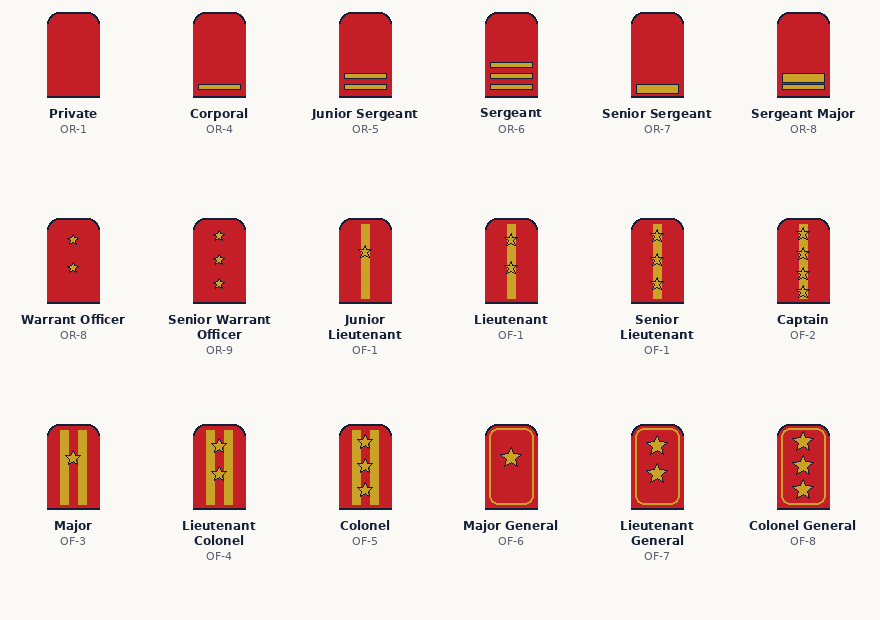
How to Read Belarusian Officer Shoulder Boards
Once you know the code, you can read any Belarusian officer’s rank in seconds:
- Count the stripes. One stripe means a junior officer (lieutenant or captain). Two stripes mean a senior officer (major, lieutenant colonel or colonel). No stripes at all mean a general.
- Count the stars. Among junior officers, the stars run one, two, three — and then four for a Captain, the senior junior officer. Among senior officers, one star is a Major, two a Lieutenant Colonel, three a Colonel. Among generals, one star is a Major General, two a Lieutenant General, three a Colonel General.
- Check the star size. Generals’ stars are much larger than officers’ stars, and their boards are edged and embroidered with gold thread. A single large star is a Major General; a single small star on a two-striped board is a Major.
- Check the board colour. Ground Forces boards are red. Air Force boards are light blue. The rank markings are the same in both branches — only the field colour changes.
One more thing the shoulder board will not tell you: which branch of service the wearer belongs to beyond the Army–Air Force colour split. Belarusian shoulder boards show rank only — there is no branch-of-service emblem on the board itself. On everyday and field uniforms the boards are subdued, in green or camouflage tones, rather than red or blue.
Belarusian Army Other Ranks (Enlisted and Warrant Officers)
Below the officers, the Belarusian system has eight other ranks in three groups: the enlisted soldiers (Private and Corporal), the sergeants who lead squads and sections, and the warrant officers (praparščyk) — experienced, usually career soldiers who sit between the sergeants and the commissioned officers, a category inherited directly from the Soviet Army.
| Rank (English) | Rank (Belarusian) | NATO Code | Insignia | Typical Role |
|---|---|---|---|---|
| Senior Warrant Officer | Старшы прапаршчык | OR-9 | Three small stars down the centre of the board, no stripes | Most senior warrant officer; senior technical specialist |
| Warrant Officer | Прапаршчык | OR-8 | Two small stars down the centre of the board, no stripes | Technical specialist or platoon-level leader |
| Sergeant Major | Старшына | OR-8 | One wide gold bar and one narrow gold bar across the board | Senior sergeant of a company; discipline and routine |
| Senior Sergeant | Старшы сяржант | OR-7 | One wide gold bar across the board | Deputy platoon commander; senior squad leader |
| Sergeant | Сяржант | OR-6 | Three narrow gold bars across the board | Squad leader of around ten soldiers |
| Junior Sergeant | Малодшы сяржант | OR-5 | Two narrow gold bars across the board | Squad leader or second-in-command of a squad |
| Corporal | Яфрэйтар | OR-4 | One narrow gold bar across the board | Senior private; leads a small team |
| Private | Радавы | OR-1 | Plain shoulder board, no insignia | New recruit; entry-level soldier |
Did you know? There is no OR-2 or OR-3 in the Belarusian ladder — a Private jumps straight to Corporal at OR-4, and the sergeant ranks run OR-5 to OR-7.
Also notice that Staršyna (Sergeant Major) and Praparščyk (Warrant Officer) share the same NATO code, OR-8: equals in seniority, but on different career paths. The sergeant major is the top of the sergeant ladder, while the warrant officer belongs to a separate professional category.
Belarusian Air Force and Air Defence Ranks
The Air Force and Air Defence Forces (Ваенна-паветраныя сілы і войскі супрацьпаветранай абароны) are a single combined branch: one command runs both the flying units and the ground-based air defence missile units that protect Belarusian airspace. Its ranks are identical in name and order to the Army’s — the same ten officer ranks and the same eight other ranks. The only difference is the shoulder board: Air Force boards are light blue, where Army boards are red.
That colour is the branch’s one visible distinction: in the Soviet system, light blue was the colour of aviation, and Belarus kept it. Air Force generals wear the same large-star boards as Army generals, just on a blue field, and Air Force sergeants wear the same gold bars. There is no separate rank of “airman” as in the British or American air forces — an Air Force private is still a Radavy, and an Air Force sergeant is still a Siaržant.
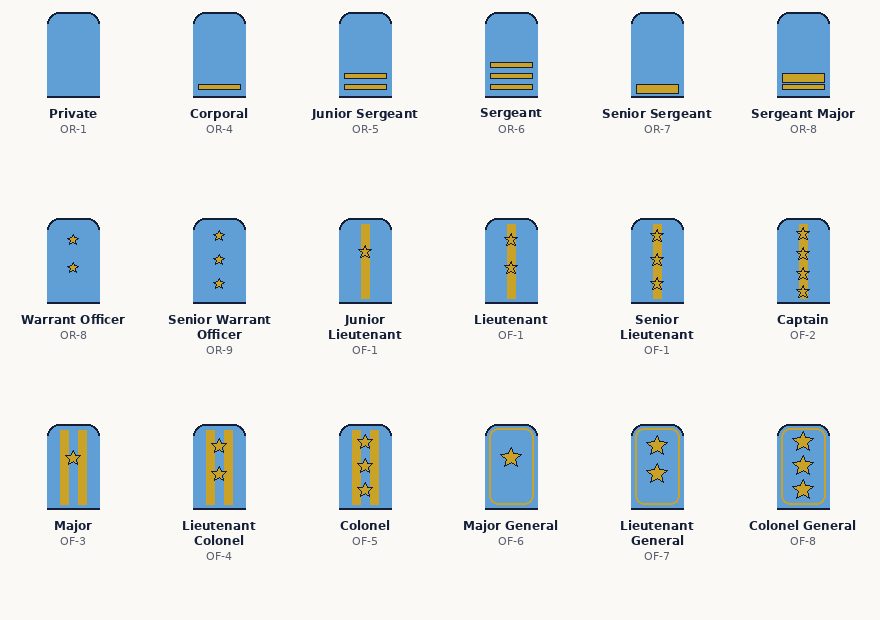
Did you know? Light blue has marked aviation since the Soviet era. Belarus kept the colour, so an Air Force shoulder board is instantly recognisable even before you count its stars.
How to Read Enlisted and Warrant Officer Shoulder Boards
The other ranks are read by bars and stars, not by stripes:
- No insignia at all — a plain shoulder board means a Private (Radavy), the only rank with nothing to show.
- Narrow gold bars — one bar is a Corporal, two bars a Junior Sergeant, three bars a Sergeant. Count the bars and you have the rank.
- A wide gold bar — one wide bar marks a Senior Sergeant. Add a narrow bar above it and you have a Sergeant Major (Staršyna), the most senior sergeant.
- Small stars, no stripes — two small stars down the centre of the board mark a Warrant Officer, three a Senior Warrant Officer. The absence of a stripe is the giveaway: officers have stripes, warrant officers have stars only.
- Board colour — as with officers, red means Army and light blue means Air Force. The bars and stars are gold in both branches.
Belarusian Military Badges
Rank insignia shows a soldier’s grade. Badges show what the soldier is qualified to do, and they are worn on the chest. The most important are:
- Pilot and aircrew wings — worn by Air Force pilots, navigators and other flying personnel: the mark of a qualified aviator, and one of the most respected qualifications in the branch.
- Parachutist badge — worn by soldiers qualified in military parachuting, above all in the Special Operations Forces and the airborne brigades.
- Guards badges — worn by units carrying the honorary title “Guards”, such as the 38th Air Assault and 103rd Airborne Brigades — a tradition carried over from the Soviet Army.
- Branch and unit sleeve patches — show the soldier’s branch or formation on the sleeve. Because the shoulder boards carry no branch emblem, the sleeve patch is where unit identity lives.
- Marksmanship and specialist qualification badges — awarded for weapons proficiency and specialist military skills.
How Promotion Works in Belarus
Promotion in the Belarusian armed forces is a mix of time in grade, education and selection. Junior officer ranks come largely with time served and a clean record: a Junior Lieutenant who serves well can expect to reach Captain in the early years of a career. Promotion to Major and above is slower and more selective, depending on performance, education and whether a suitable post is vacant.
Officers are mostly trained at the Military Academy of the Republic of Belarus in Minsk, the country’s main officer school. Warrant officers are usually experienced sergeants selected for the warrant officer path and given specialist training, while sergeants are promoted from the ranks on the recommendation of their commanders.
Belarus still uses conscription: most conscripts serve 18 months (12 months for those with higher education), so much of the rank and file is in its first year of service. The career backbone — sergeants, warrant officers and officers — is made up of contract soldiers who serve longer.
A Note on Belarusian Military Tradition
Two things explain almost everything about Belarusian military ranks. The first is continuity with the Soviet Army: Belarus kept the Soviet rank names, the Soviet shoulder boards and the Soviet split between soldiers, sergeants, warrant officers and officers, changing the language of the rank names to Belarusian but little else. The second is modesty of scale: with around 45,000 active personnel and no navy, Belarus runs a compact, land-and-air force, and its rank ladder stops at Colonel General — there is no four-star rank and no marshal’s star at the top, because a force of this size has no post for one.
Read next
Russian Military Ranks · US Army Ranks · US Navy Ranks · US Military Uniform · US Military Branches
FAQs
What is the highest rank in the Belarusian military?
Colonel General (Gjeneral-palkoŭnik, OF-8), with three large gold stars on a shoulder board with no stripes. Above it sits only the title of Supreme Commander-in-Chief, held by the President of Belarus as commander-in-chief — a title of office, not a rank earned by promotion. Belarus has no Army General or Marshal rank.
Does Belarus have a navy?
No. Belarus is landlocked and has no navy, so its armed forces have no naval ranks at all. The rank system covers only the Ground Forces and the Air Force and Air Defence Forces, plus the smaller branches, which use the same ranks.
Are Belarusian Army and Air Force ranks the same?
Yes. Both branches use the same 18 ranks with the same names, in the same order. The only difference is the shoulder board colour: red for the Ground Forces, light blue for the Air Force. The stripes, stars and bars that show the rank are identical.
How do you read a Belarusian officer’s shoulder board?
Count the stripes first, then the stars. One stripe means a junior officer, two stripes a senior officer, no stripes a general. Then count the stars: one to four for Junior Lieutenant, Lieutenant, Senior Lieutenant and Captain; one to three for Major, Lieutenant Colonel and Colonel; one to three large stars for Major General, Lieutenant General and Colonel General.
What is a Praporshchik?
A Praparščyk (Warrant Officer, OR-8) is a career soldier in a separate rank category between the sergeants and the commissioned officers — an experienced technical specialist and unit-level leader, marked by two small stars on a shoulder board with no stripes. The senior grade, Senior Warrant Officer (OR-9), wears three stars and is the highest other rank in the Belarusian armed forces.
Why do Belarusian ranks look like Russian ranks?
Because both come from the Soviet Army. Belarus kept the Soviet rank system after independence in 1991, including the shoulder boards, the stripes-and-stars code and the warrant officer category. The rank names are spelled in Belarusian rather than Russian — for example Ґенэрал with the Belarusian letter Ґ — but the structure is the same.
All insignia diagrams and images in this article are original graphics created for Forces Guide.