Azerbaijan’s armed forces wear a rank system that tells the story of the country itself. The names and the ladder come from the Soviet tradition — Azerbaijan was part of the Soviet Union until independence in 1991 — but the look of the insignia has been moving steadily toward Turkey, Azerbaijan’s closest military partner. The result is a system that feels familiar to anyone who knows Russian or Turkish ranks, yet has its own distinctly Azerbaijani marks: the eight-pointed star of the national flag, the crescent moon, and rank names in the Azerbaijani language. This guide covers every Azerbaijani military rank with its insignia, across the Army, the Navy and the Air Force, from the newest private to the four-star Army General.
The Azerbaijani Armed Forces (Azərbaycan Silahlı Qüvvələri) have three services: the Land Forces, the Navy — which operates only in the Caspian Sea, the world’s largest enclosed body of water — and the Air and Air Defence Force, which combines combat aircraft and air defence in a single branch. All three services share one rank ladder, with naval ranks taking their own traditional names. Officers are divided into junior officers, senior officers and general or flag officers; below them sit the warrant officers (the gizir ranks), the sergeants (the çavuş ranks) and the enlisted soldiers and sailors.
One thing to know before reading any Azerbaijani rank: the words themselves are your best guide. Baş means “chief” or “head”, kiçik means “junior” or “little”, general and leytenant are the familiar European words, and ordu means “army”. So Baş leytenant is a senior lieutenant, Kiçik leytenant is a junior lieutenant, and Ordu generalı is literally the “Army General” — the highest rank in the land forces. Once you know those few words, the whole ladder starts to make sense.
Key facts
- Country: Azerbaijan
- Branches: Land Forces, Navy, and Air and Air Defence Force
- Commissioned officers: OF-1 to OF-9 (Kiçik leytenant to Ordu generalı)
- Warrant officers and NCOs: OR-4 to OR-9 (Kiçik çavuş to Baş gizir)
- Enlisted: OR-1 to OR-2 (Əsgər to Baş əsgər)
- Highest rank: Ordu generalı (Army General, OF-9), held only in the Land Forces
- Notable fact: Rank stars are eight-pointed, matching the star on the Azerbaijani flag, and the Navy operates only in the Caspian Sea
Azerbaijani Army Officer Ranks
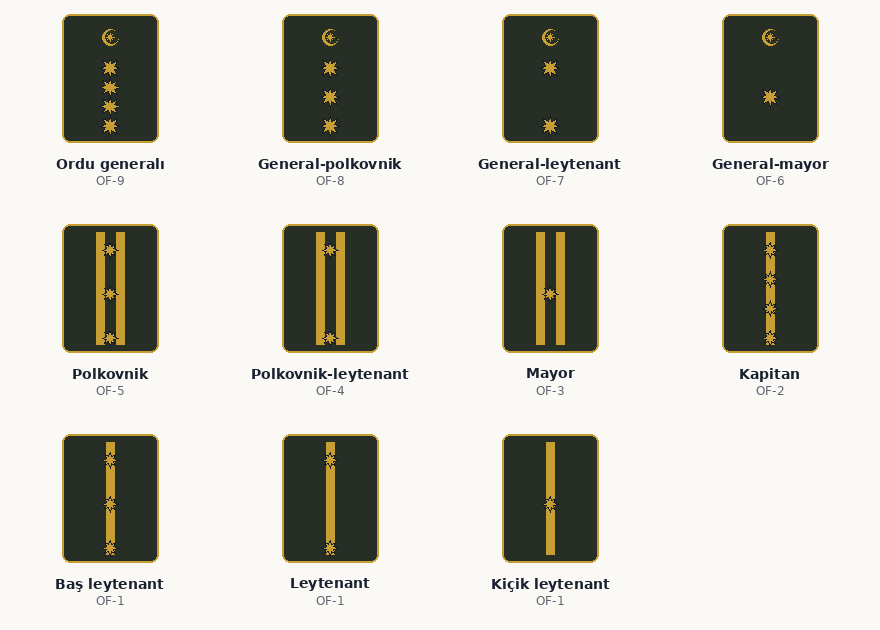
The Land Forces have eleven commissioned officer ranks, the most of any Azerbaijani service. The ladder runs from Kiçik leytenant (Junior Lieutenant) up to Ordu generalı (Army General), the only four-star rank in the country. There is no five-star rank in Azerbaijan, and the rank of Army General is held only by the most senior officers — typically the Chief of the General Staff. The table below gives each rank with its NATO code, its English equivalent and what its insignia looks like.
| Rank (Azerbaijani) | NATO Code | English Equivalent | Insignia | Typical Role |
|---|---|---|---|---|
| Ordu generalı | OF-9 | Army General | Four large eight-pointed stars with the crescent-and-star emblem in a laurel wreath | Chief of the General Staff; the most senior officer in the Armed Forces |
| General-polkovnik | OF-8 | Colonel General | Three large eight-pointed stars with the national emblem | Deputy minister or commander of a major command |
| General-leytenant | OF-7 | Lieutenant General | Two large eight-pointed stars with the national emblem | Army corps commander or senior headquarters officer |
| General-mayor | OF-6 | Major General | One large eight-pointed star with the national emblem | Division or brigade commander; senior staff officer |
| Polkovnik | OF-5 | Colonel | Three small eight-pointed stars on two gold bars | Regiment or brigade commander |
| Polkovnik-leytenant | OF-4 | Lieutenant Colonel | Two small eight-pointed stars on two gold bars | Battalion commander or senior staff officer |
| Mayor | OF-3 | Major | One small eight-pointed star on two gold bars | Battalion executive officer or staff officer |
| Kapitan | OF-2 | Captain | Four small eight-pointed stars on one gold bar | Company commander |
| Baş leytenant | OF-1 | Senior Lieutenant | Three small eight-pointed stars on one gold bar | Platoon commander or company executive officer |
| Leytenant | OF-1 | Lieutenant | Two small eight-pointed stars on one gold bar | Platoon commander |
| Kiçik leytenant | OF-1 | Junior Lieutenant | One small eight-pointed star on one gold bar | Entry-level commissioned officer; platoon commander |
How to Read Azerbaijani Officer Insignia
Azerbaijani officers wear their rank on shoulder boards (paqonlar) — stiff, dark boards on the shoulders, embroidered in gold thread. The system is a post-Soviet one, so if you have seen Russian or Turkish shoulder boards, the logic will feel familiar. Three things on the board tell you the rank: the bars, the stars and the emblem.
- Bars — a single gold bar running down the centre of the board marks a junior officer (OF-1 and OF-2), while two parallel gold bars mark a senior officer (OF-3 to OF-5). This is the old Soviet distinction, and it is the first thing to look for: one bar means junior, two bars means senior.
- Stars — the number of stars on the board gives the exact grade. Among junior officers the count rises from one star for a Junior Lieutenant to four for a Captain. Among senior officers it runs the other way in appearance but the same way in logic: one star for a Major, two for a Lieutenant Colonel and three for a Colonel. The stars are eight-pointed, matching the eight-pointed star on the Azerbaijani flag — a small national touch that sets these boards apart from Russian ones, which use five-pointed stars.
- The general’s emblem — general officers wear no bars at all. Instead their boards carry large eight-pointed stars — one for a Major General, two for a Lieutenant General, three for a Colonel General and four for an Army General — together with the national emblem: a crescent moon and star inside a laurel wreath, embroidered in gold. The emblem is the mark of a general, and the number of stars is the mark of which general.
- Board colour — the base of the board is dark for the Army, with gold embroidery throughout. Air Force boards follow the same pattern but on a sky-blue base, and naval boards are dark navy, often with a small anchor. The colour tells you the service; the bars and stars tell you the rank.
One detail worth remembering is that the star counts can surprise readers used to Western systems. A Captain in Azerbaijan wears four stars, more than a Major’s one — because the bars, not the stars alone, separate the junior and senior ladders. Read the bars first, then count the stars, and the rank falls into place.
Key point: Read the bars first, then count the stars. One gold bar means a junior officer, two bars mean a senior officer, and no bars at all — only large stars and the national emblem — marks a general.
Azerbaijani Navy Officer Ranks
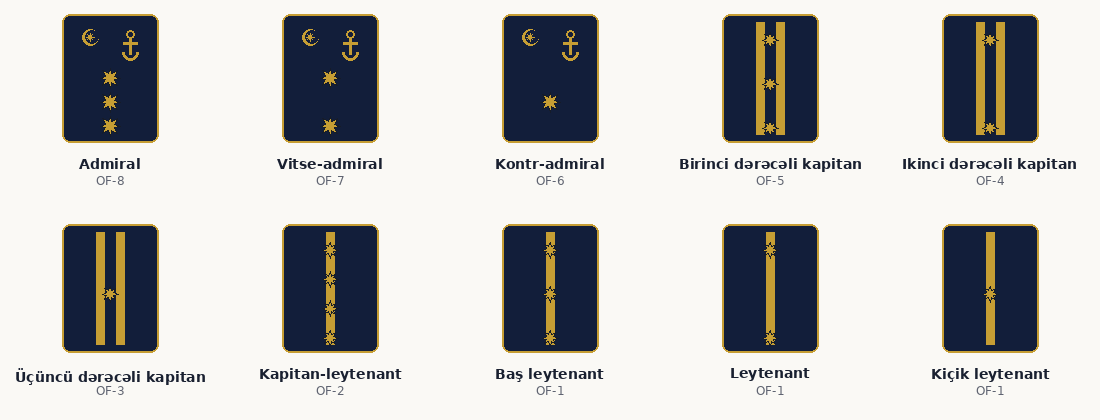
The Azerbaijani Navy (Azərbaycan Hərbi Dəniz Qüvvələri) is a small force of around 2,200 personnel and about two dozen vessels, based in Baku and operating entirely in the Caspian Sea — Azerbaijan has no ocean coastline. Its officers follow the classic naval pattern: instead of generals, the Navy has admirals, and instead of captains of companies, it has captains of ships, ranked by the size of the vessel they command. There are ten naval officer ranks, and the top rank, Admiral, is equivalent to a Lieutenant General in the Army (OF-8) — there is no naval rank equal to the Army’s four-star Ordu generalı.
| Rank (Azerbaijani) | NATO Code | English Equivalent | Insignia | Typical Role |
|---|---|---|---|---|
| Admiral | OF-8 | Admiral | Three large eight-pointed stars with the national emblem; broad gold sleeve stripes | Commander of the Naval Forces |
| Vitse-admiral | OF-7 | Vice Admiral | Two large eight-pointed stars with the national emblem | Deputy naval commander |
| Kontr-admiral | OF-6 | Rear Admiral | One large eight-pointed star with the national emblem | Flotilla or base commander |
| Birinci dərəcəli kapitan | OF-5 | Captain 1st Rank | Three small eight-pointed stars on two gold bars | Commander of a large warship |
| Ikinci dərəcəli kapitan | OF-4 | Captain 2nd Rank | Two small eight-pointed stars on two gold bars | Commander of a medium warship |
| Üçüncü dərəcəli kapitan | OF-3 | Captain 3rd Rank | One small eight-pointed star on two gold bars | Commander of a small warship |
| Kapitan-leytenant | OF-2 | Captain-Lieutenant | Four small eight-pointed stars on one gold bar | Department head aboard ship |
| Baş leytenant | OF-1 | Senior Lieutenant | Three small eight-pointed stars on one gold bar | Watch officer or division officer |
| Leytenant | OF-1 | Lieutenant | Two small eight-pointed stars on one gold bar | Junior watch officer |
| Kiçik leytenant | OF-1 | Junior Lieutenant | One small eight-pointed star on one gold bar | Entry-level naval officer |
The three “captain of rank” titles — Birinci, Ikinci and Üçüncü dərəcəli kapitan, meaning Captain of the First, Second and Third Rank — are the direct inheritance of the old Russian and Soviet naval system. The “rank” in the title refers to the class of ship the officer is qualified to command: a Captain 1st Rank commands the largest vessels, a Captain 3rd Rank the smallest. On the uniform, naval officers wear the same gold-embroidered shoulder boards as their Army counterparts, with an anchor device, and gold sleeve stripes on the dark blue service uniform in the long-standing naval tradition — broad stripes for admirals, narrower ones for the captains and lieutenants.
Did you know? Azerbaijan has no ocean coastline, yet its Navy of around 2,200 personnel operates in the Caspian Sea — the world’s largest enclosed body of water — with ranks running up to Admiral (OF-8).
Azerbaijani Air Force Officer Ranks
The Azerbaijani Air Force is formally the Air and Air Defence Force (Azərbaycan Hərbi Hava Qüvvələri), a single branch that operates combat, transport and training aircraft, attack and utility helicopters, and the country’s air defence systems. Its officer ranks are identical to the Army’s, with one exception: there is no Ordu generalı in the Air Force, so the ladder tops out at General-polkovnik (Colonel General, OF-8). The insignia follow the same bars-and-stars pattern as the Army, worn on sky-blue shoulder boards that mark the wearer as air force at a glance.
| Rank (Azerbaijani) | NATO Code | English Equivalent | Insignia | Typical Role |
|---|---|---|---|---|
| General-polkovnik | OF-8 | Colonel General | Three large eight-pointed stars with the national emblem | Commander of the Air and Air Defence Force |
| General-leytenant | OF-7 | Lieutenant General | Two large eight-pointed stars with the national emblem | Deputy air force commander |
| General-mayor | OF-6 | Major General | One large eight-pointed star with the national emblem | Air base or air defence commander |
| Polkovnik | OF-5 | Colonel | Three small eight-pointed stars on two gold bars | Air base commander or regiment commander |
| Polkovnik-leytenant | OF-4 | Lieutenant Colonel | Two small eight-pointed stars on two gold bars | Squadron commander or senior staff officer |
| Mayor | OF-3 | Major | One small eight-pointed star on two gold bars | Flight commander or staff officer |
| Kapitan | OF-2 | Captain | Four small eight-pointed stars on one gold bar | Flight commander; experienced pilot |
| Baş leytenant | OF-1 | Senior Lieutenant | Three small eight-pointed stars on one gold bar | Pilot or junior staff officer |
| Leytenant | OF-1 | Lieutenant | Two small eight-pointed stars on one gold bar | Junior pilot |
| Kiçik leytenant | OF-1 | Junior Lieutenant | One small eight-pointed star on one gold bar | Newly commissioned pilot or officer |
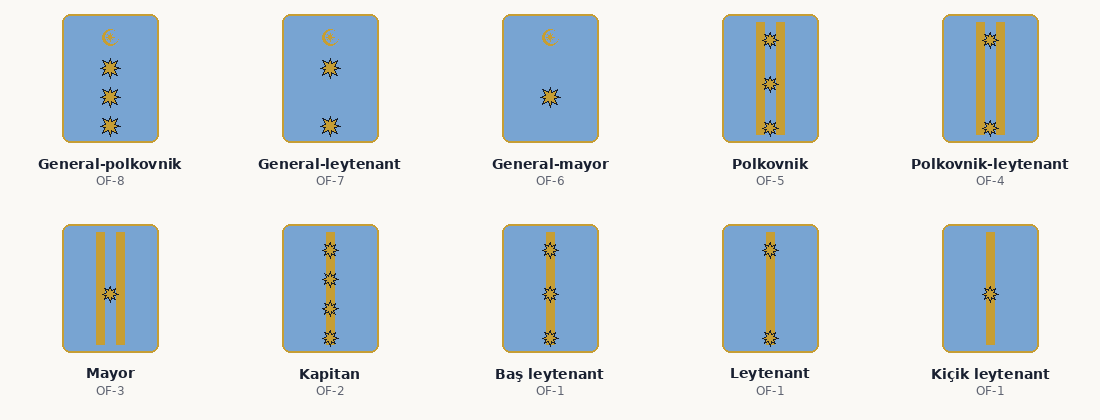
Azerbaijani Enlisted and NCO Ranks
Below the commissioned officers sit the other ranks: the warrant officers, the sergeants and the enlisted soldiers. The senior tier is the gizir family — gizir is the Azerbaijani word for warrant officer, a rank group inherited from the Soviet system, where these long-serving specialists sit between the NCOs and the commissioned officers. Below them are the çavuş (sergeant) ranks, and at the bottom the əsgər (soldier). The Army and Air Force use exactly the same eight ranks; the Navy uses the same structure with naval names, replacing the gizir family with miçman and the əsgər with matros (seaman).
Army and Air Force Other Ranks
| Rank (Azerbaijani) | NATO Code | English Equivalent | Insignia | Typical Role |
|---|---|---|---|---|
| Baş gizir | OR-9 | Chief Warrant Officer | Three wide gold chevrons on the shoulder board | Senior warrant officer; the most senior enlisted advisor in a unit |
| Gizir | OR-8 | Warrant Officer | Two wide gold chevrons on the shoulder board | Experienced technical specialist and platoon-level leader |
| Kiçik gizir | OR-7 | Junior Warrant Officer | One wide gold chevron on the shoulder board | Junior warrant officer; technical specialist |
| Baş çavuş | OR-6 | Staff Sergeant | Three narrow gold chevrons | Platoon sergeant; senior NCO of a platoon |
| Çavuş | OR-5 | Sergeant | Two narrow gold chevrons | Squad leader |
| Kiçik çavuş | OR-4 | Junior Sergeant / Corporal | One narrow gold chevron | Team leader; first NCO rank |
| Baş əsgər | OR-2 | Senior Private / Private First Class | One narrow gold chevron stripe | Experienced private; assistant team member |
| Əsgər | OR-1 | Private | No insignia — plain shoulder board | New recruit or conscript soldier |
Navy Other Ranks
| Rank (Azerbaijani) | NATO Code | English Equivalent | Insignia | Typical Role |
|---|---|---|---|---|
| Baş miçman | OR-9 | Chief Warrant Officer | Three wide gold chevrons | Senior naval warrant officer; ship’s senior enlisted advisor |
| Miçman | OR-8 | Warrant Officer | Two wide gold chevrons | Experienced naval specialist |
| Kiçik miçman | OR-7 | Junior Warrant Officer | One wide gold chevron | Junior naval warrant officer |
| Baş çavuş | OR-6 | Chief Petty Officer | Three narrow gold chevrons | Senior petty officer aboard ship |
| Çavuş | OR-5 | Petty Officer 1st Class | Two narrow gold chevrons | Petty officer; section leader |
| Kiçik çavuş | OR-4 | Petty Officer 2nd Class | One narrow gold chevron | Junior petty officer |
| Baş matros | OR-2 | Leading Seaman | One narrow gold chevron stripe | Experienced seaman |
| Matros | OR-1 | Seaman | No insignia — plain shoulder board | New recruit or conscript sailor |
For the other ranks, the shoulder board is the whole story. NCOs and warrant officers wear gold chevrons — angled stripes — on their shoulder boards, with the width of the chevron marking the tier and the number marking the grade: wide chevrons for the gizir and miçman warrant officers, narrower ones for the çavuş sergeants. The lowest rank, Əsgər or Matros, wears a plain shoulder board with no insignia at all, which is itself a clear identifier: a soldier with bare boards is a private. Cadets at the military academies wear their own student insignia, marked by their year of study from first to fifth year (kurs), before they are commissioned as Kiçik leytenant.
Azerbaijani Military Badges and Emblems
Rank insignia shows a service member’s grade. Badges show what they are qualified to do, and the most important Azerbaijani badge is one every soldier recognises: the national emblem itself. The crescent moon and eight-pointed star of the Azerbaijani flag appears on generals’ shoulder boards inside a laurel wreath, on officers’ peaked caps, and as the centrepiece of the Armed Forces’ own emblem. The eight-pointed star is an old Turkic symbol, and its presence on the uniform is a deliberate break from the Soviet five-pointed star that the same boards carried before independence.
- The national emblem — the crescent and eight-pointed star in a laurel wreath, worn by general and flag officers on their shoulder boards and by officers on their caps. It is the single most distinctive mark of the Azerbaijani uniform.
- The anchor — worn by naval officers and sailors, marking service in the Caspian flotilla. It appears on naval shoulder boards and cap badges, and on the naval ensign flown by Azerbaijani warships.
- Pilot wings — gold wings worn by Air Force pilots, in the tradition shared by air forces everywhere. Azerbaijani pilots train on a mix of Soviet-origin and modern aircraft, and the wings mark qualification rather than rank.
- Parachutist badge — worn by airborne-qualified personnel, including the special forces units that played a prominent role in the 2020 Second Nagorno-Karabakh War.
- Branch and unit badges — sleeve and chest badges identifying the wearer’s branch, formation and corps, including the numbered army corps of the Land Forces. These are worn alongside the rank insignia, not instead of it.
How Promotion Works in Azerbaijan
Azerbaijan’s armed forces mix conscripts and professionals. Young men are conscripted for 18 months of service (12 months for university graduates), and most conscripts serve as Əsgər, rising at most to Baş əsgər or Kiçik çavuş during their term. The professional core — the career NCOs, warrant officers and officers — is what the rank ladder is really built for, and promotion there is a slower, more formal process than in the conscript ranks.
Officers are commissioned after graduating from a military academy — the Heydar Aliyev Azerbaijan Higher Military Academy in Baku for the Army and Air Force, and the naval academy for the Navy — entering service as Kiçik leytenant. Promotion through the junior and senior officer ranks is based on time in grade, professional courses, performance reports and available posts, with each step requiring a minimum period in the current rank. Promotion to the general and flag ranks is different: generals and admirals are appointed by presidential decree, and the number of general officers is small, so the step from Polkovnik to General-mayor is the hardest promotion in an Azerbaijani officer’s career. Warrant officers are promoted from the senior sergeant ranks on the basis of long service and technical qualification, and the Baş gizir — the chief warrant officer — is the most senior enlisted position in a unit, the Azerbaijani equivalent of a sergeant major.
A Note on Azerbaijani Military Tradition
Two dates explain almost everything about Azerbaijani ranks. The first is 1918, when the Azerbaijan Democratic Republic created the country’s first national army — the first democratic republic in the Muslim world, with its own officers, its own epaulettes and its own national symbols. The second is 1991, when independence from the Soviet Union restored that army after seventy years, and the rank system was rebuilt by a regulation of the Ministry of Defence dated 25 June 2001, which fixed the insignia still worn today.
The result is a deliberate blend. The ladder of ranks — the lieutenants, captains, majors, colonels and generals, the warrant officers and sergeants — is the Soviet inheritance, kept because it was the system every Azerbaijani officer already knew. The look of the insignia, though, has been moving toward Turkey ever since: gold-embroidered shoulder boards, the crescent and the eight-pointed star, and a growing emphasis on professional NCOs and warrant officers in the Turkish style. The 2020 Second Nagorno-Karabakh War accelerated that professionalisation, and the modern Azerbaijani military — smaller, better equipped and increasingly professional — is the force these ranks now describe.
For comparison with the systems Azerbaijan’s ranks descend from and borrow from, see our guides to Russian military ranks and Turkish military ranks, and for the very different Western systems, our guides to the US Navy ranks, the US military uniform and the US military branches.
FAQs
What is the highest rank in the Azerbaijani military?
Ordu generalı — Army General (OF-9) — is the highest rank, held only in the Land Forces, typically by the Chief of the General Staff. The Navy’s highest rank is Admiral (OF-8) and the Air Force’s highest is General-polkovnik, Colonel General (OF-8).
What does “Ordu generalı” mean?
It is Azerbaijani for “Army General”: ordu means army and generalı means general. It is the equivalent of a four-star general in Western armies, and there is no higher or five-star rank in Azerbaijan.
Why do Azerbaijani officers wear eight-pointed stars?
The eight-pointed star is the national symbol of Azerbaijan — it appears on the flag, where the eight points traditionally represent the eight branches of the Turkic peoples. Azerbaijani rank stars are eight-pointed to match, which distinguishes them from the five-pointed stars used on Russian shoulder boards.
What is a “gizir”?
Gizir is the Azerbaijani rank of warrant officer, inherited from the Soviet system. Warrant officers are long-serving specialists who sit between the sergeants and the commissioned officers. The three grades are Kiçik gizir (Junior Warrant Officer), Gizir (Warrant Officer) and Baş gizir (Chief Warrant Officer). In the Navy the same tier is called miçman.
Does Azerbaijan have a navy if it has no ocean coastline?
Yes. The Azerbaijani Navy operates in the Caspian Sea, the world’s largest enclosed body of water, from its base in Baku. It has around 2,200 personnel and about two dozen vessels, and its officers wear naval ranks — admirals and captains of rank — rather than army generals.
What rank does a new Azerbaijani officer start at?
New officers graduate from the military academy as Kiçik leytenant (Junior Lieutenant, OF-1), wearing a shoulder board with a single gold bar and one eight-pointed star. From there they progress to Leytenant, Baş leytenant and Kapitan.
Do Azerbaijani ranks have NATO equivalents?
Yes. Azerbaijan’s ranks map to the NATO OF (officer) and OR (other ranks) codes used by NATO members: for example, Polkovnik is OF-5 (Colonel), Baş çavuş is OR-6 (Staff Sergeant) and Əsgər is OR-1 (Private). The codes are given in the tables above, although Azerbaijan is not a NATO member.
All insignia diagrams and images in this article are original graphics created for Forces Guide.