
Bulgaria’s rank system is easy to read once you know its code: stars on shoulder boards for officers, and chevrons on shoulder boards for everyone else. A Bulgarian soldier’s grade is shown by how many stars or stripes sit on the board — and by how ornate that board is. This guide covers every Bulgarian military rank with its insignia, from Rednik to General and from Matros to Admiral, across the Land Forces, the Navy and the Air Force.
Bulgaria has three services: the Bulgarian Land Forces, the Bulgarian Navy and the Bulgarian Air Force. The Army and the Air Force use exactly the same rank titles. The Navy uses its own sea-going titles, but the structure matches — ten officer ranks and seven enlisted and non-commissioned ranks in each service. All ranks carry a NATO code (OF for officers, OR for other ranks), which makes Bulgarian grades directly comparable with every other NATO ally.
Key facts
- Country: Bulgaria (NATO member since 2004)
- Branches: Land Forces, Navy (Black Sea) and Air Force
- Enlisted and NCO ranks: OR-3 to OR-9 (Rednik/Matros to Ofitserski kandidat)
- Commissioned officers: OF-1 to OF-9 (Leytenant to General, or Admiral in the Navy)
- Highest rank: General in the Army and Air Force; Admiral in the Navy — Bulgaria has no OF-10 rank
- Armed forces: around 36,000 active personnel
- Insignia style: Soviet-patterned shoulder boards — stars for officers, chevrons for other ranks
Bulgarian Army Officer Ranks (OF-1 to OF-9)
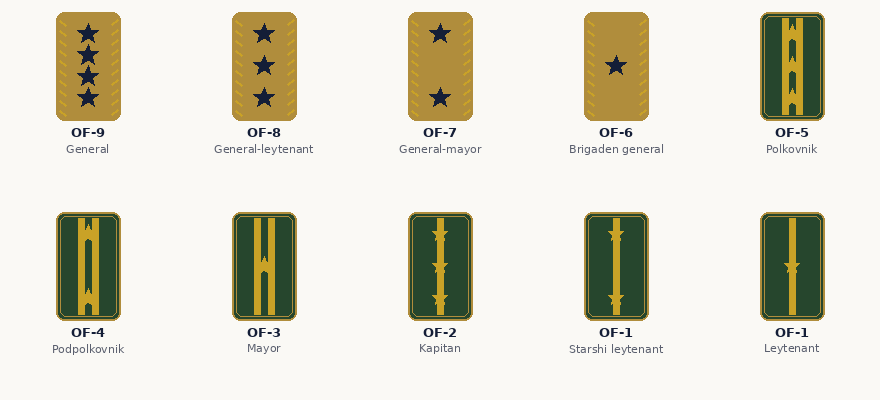
Bulgarian Army officers wear their rank on shoulder boards (pogoni). Junior officers (OF-1 to OF-2) have one gold stripe down the centre of the board with small stars. Senior officers (OF-3 to OF-5) have two stripes and larger stars. Generals (OF-6 to OF-9) wear fully gold, heavily braided boards with large stars — the most ornate boards in the army.
The Army has ten officer ranks and no five-star grade. The top rank, General (OF-9), is held by the Chief of Defence. Below the generals come three field-grade ranks and three company-grade ranks, ending with Leytenant, the first rank a new officer holds.
| Rank | NATO Code | Insignia | Typical Role |
|---|---|---|---|
| General (Генерал) | OF-9 | Ornate gold board, four large stars | Chief of Defence; the most senior officer in the armed forces |
| General-leytenant (Генерал-лейтенант) | OF-8 | Ornate gold board, three large stars | Deputy Chief of Defence or service commander |
| General-mayor (Генерал-майор) | OF-7 | Ornate gold board, two large stars | Division commander or senior staff appointment |
| Brigaden general (Бригаден генерал) | OF-6 | Ornate gold board, one large star | Brigade commander; the most junior general rank |
| Polkovnik (Полковник) | OF-5 | Two stripes, three large stars | Brigade or regiment commander; senior staff officer |
| Podpolkovnik (Подполковник) | OF-4 | Two stripes, two large stars | Battalion commander or senior staff officer |
| Mayor (Майор) | OF-3 | Two stripes, one large star | Battalion executive officer or staff officer |
| Kapitan (Капитан) | OF-2 | One stripe, three small stars | Company commander |
| Starshi leytenant (Старши лейтенант) | OF-1 | One stripe, two small stars | Platoon commander or company executive officer |
| Leytenant (Лейтенант) | OF-1 | One stripe, one small star | Platoon commander; entry-level commissioned officer |
Did you know? Bulgaria has no OF-10 rank. Unlike the United States, which has five-star generals on paper, or Russia, which once had a Marshal rank, the Bulgarian ladder stops at OF-9 — General in the Army and Air Force, Admiral in the Navy.
How to Read Bulgarian Army and Air Force Officer Insignia
Reading a Bulgarian officer’s board is a matter of counting two things — stripes and stars:
- The stripes — the gold bands running down the board. One stripe means a junior officer (OF-1 to OF-2). Two stripes mean a senior, or field-grade, officer (OF-3 to OF-5). Generals have no stripes at all — their whole board is gold braid.
- The stars — small stars for junior officers, larger stars for senior officers and generals. Within each group, more stars mean a higher rank: one star for Leytenant, two for Starshi leytenant, three for Kapitan; then one star for Mayor, two for Podpolkovnik, three for Polkovnik; then one to four stars for the generals.
- The board colour — the base colour and piping show the branch of service. Land Forces boards are dark green; Air Force boards are blue, with light-blue piping.
- The top of the ladder — a fully gold board with four large stars is a General (OF-9). There is nothing above it in the Bulgarian system.
The design is a legacy of Bulgaria’s history. As a former Warsaw Pact state closely aligned with the Soviet Union, Bulgaria kept the Soviet-pattern shoulder board after the Cold War ended. NATO membership in 2004 added the OF and OR codes, but it did not change the look of the insignia.
Bulgarian Navy Officer Ranks (OF-1 to OF-9)
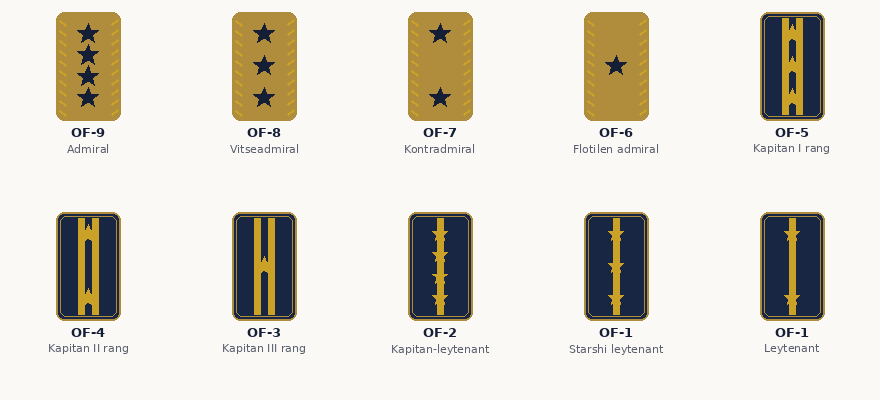
The Bulgarian Navy guards the country’s Black Sea coast from its bases at Varna and Burgas. Its officers use naval titles, but the ladder mirrors the Army exactly: four flag ranks, three senior (captain) ranks and three junior (lieutenant) ranks. The Navy’s top officer is an Admiral (OF-9).
Naval officers wear gold sleeve stripes on the cuffs of their dress uniform as well as stars on shoulder boards. Flag officers wear a broad gold stripe with narrower stripes above it. The lowest flag rank, Flotilen admiral (OF-6), is marked by a single star worn above a broad stripe and a narrow one — a pattern shared with the German, Danish and Belgian navies, which use the same rank.
| Rank | NATO Code | Insignia | Typical Role |
|---|---|---|---|
| Admiral (Адмирал) | OF-9 | Ornate gold board, four large stars | Most senior naval officer; commands the Navy |
| Vitseadmiral (Вицеадмирал) | OF-8 | Ornate gold board, three large stars | Deputy Navy commander |
| Kontradmiral (Контраадмирал) | OF-7 | Ornate gold board, two large stars | Flotilla commander or senior naval appointment |
| Flotilen admiral (Флотилен адмирал) | OF-6 | Ornate gold board, one large star | Formation commander; the most junior flag rank |
| Kapitan I rang (Капитан I ранг) | OF-5 | Two stripes, three large stars | Commands a frigate or large ship |
| Kapitan II rang (Капитан II ранг) | OF-4 | Two stripes, two large stars | Commands a corvette or smaller warship |
| Kapitan III rang (Капитан III ранг) | OF-3 | Two stripes, one large star | Ship’s department head or executive officer |
| Kapitan-leytenant (Капитан-лейтенант) | OF-2 | One stripe, four small stars | Department head aboard ship |
| Starshi leytenant (Старши лейтенант) | OF-1 | One stripe, three small stars | Division officer or watch officer |
| Leytenant (Лейтенант) | OF-1 | One stripe, two small stars | Junior officer aboard ship; entry-level naval officer |
Key point: a Navy Kapitan is not an Army Kapitan. Kapitan I rang (OF-5) is the equal of an Army Polkovnik (Colonel), while an Army Kapitan (OF-2) is the equal of a Navy Kapitan-leytenant. Always check the NATO code — OF-5, OF-2 — not just the name.
Bulgarian Enlisted and NCO Ranks — Army and Air Force (OR-3 to OR-9)
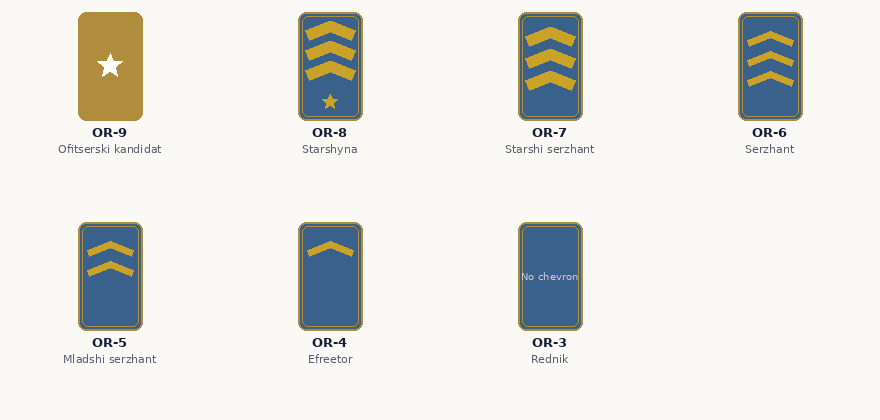
Enlisted soldiers and airmen wear their rank as chevrons on the shoulder board. The rule is simple: a new soldier, a Rednik, wears a plain board with no chevron at all. Each promotion adds chevrons, and the chevrons get wider as the soldier climbs into the senior NCO grades. The top enlisted rank is Ofitserski kandidat (OR-9), the senior warrant-officer grade.
There are seven grades. The first two are the enlisted ranks — Rednik and Efreetor. Then come four sergeant grades, from Mladshi serzhant up to Starshyna. The Air Force uses the same titles and chevrons; only the blue boards set airmen apart from soldiers.
| Rank | NATO Code | Insignia | Typical Role |
|---|---|---|---|
| Ofitserski kandidat (Офицерски кандидат) | OR-9 | Gold board with a large star | Senior warrant officer; senior enlisted advisor to a commander |
| Starshyna (Старшина) | OR-8 | Three wide chevrons with a star | First sergeant; senior NCO of a company |
| Starshi serzhant (Старши сержант) | OR-7 | Three wide chevrons | Platoon sergeant |
| Serzhant (Сержант) | OR-6 | Three chevrons | Squad leader |
| Mladshi serzhant (Младши сержант) | OR-5 | Two chevrons | Team leader; first NCO rank |
| Efreetor (Ефрейтор) | OR-4 | One chevron | Senior private; experienced soldier |
| Rednik (Редник) | OR-3 | Plain board, no chevron | Private; entry-level soldier or airman |
Did you know? Bulgaria’s lowest rank, Rednik, is listed at OR-3 in the NATO comparison tables — there is no OR-1 or OR-2 grade in the Bulgarian system. NATO’s own STANAG 2116 lists Rednik across OR-1 to OR-3 by service class, but the rank itself is a single grade: the new private.
Bulgarian Air Force Ranks
The Bulgarian Air Force uses the same ranks as the Land Forces — the same ten officer titles and the same seven enlisted titles, in the same order. An Air Force Polkovnik and an Army Polkovnik are equals, and an Air Force Rednik wears the same plain board as an Army Rednik.
What sets the Air Force apart is colour, not rank. Air Force shoulder boards are blue, with light-blue piping, while Army boards are dark green. The Air Force flies a small fleet of fighters, transports and helicopters from bases including Graf Ignatievo.
Bulgarian Navy Enlisted and Petty Officer Ranks (OR-3 to OR-9)
Sailors do not use sergeant titles. The Navy’s enlisted ladder runs from Matros (seaman) through the petty officer grades to Michman and finally Ofitserski kandidat at the top. As in the Army, the lowest grade wears a plain board, and the number and width of the chevrons grow with each promotion.
The Navy’s senior enlisted grades carry real authority aboard ship. A Glaven starshina (chief petty officer) runs a ship’s department day to day, and a Michman is the Navy’s senior warrant-officer grade.
| Rank | NATO Code | Insignia | Typical Role |
|---|---|---|---|
| Ofitserski kandidat (Офицерски кандидат) | OR-9 | Gold board with a large star | Senior warrant officer; senior enlisted advisor |
| Michman (Мичман) | OR-8 | Three wide chevrons with a star | Senior warrant officer; department senior aboard ship |
| Glaven starshina (Главен старшина) | OR-7 | Three wide chevrons | Chief petty officer; runs a ship’s department |
| Starshina 1 stepen (Старшина 1 степен) | OR-6 | Three chevrons | Petty officer first class; section leader |
| Starshina 2 stepen (Старшина 2 степен) | OR-5 | Two chevrons | Petty officer second class; team leader |
| Starshi matros (Старши матрос) | OR-4 | One chevron | Leading seaman; experienced sailor |
| Matros (Матрос) | OR-3 | Plain board, no chevron | Seaman; entry-level sailor |
Bulgarian Military Badges
Rank insignia shows a Bulgarian service member’s grade. Badges show what they are qualified to do. The most important Bulgarian badges and emblems are:
- The cap badge and cockade — Bulgarian service caps carry the national cockade in the white, green and red of the flag, with the golden lion of the Bulgarian coat of arms. It is the most visible national symbol on the uniform.
- Parachutist badge — worn by soldiers qualified in military parachuting, including special forces personnel. Bulgaria maintains a special forces brigade, and jump wings are one of its most respected qualifications.
- Pilot wings — gold wings worn by Air Force pilots and navigators, marking qualification on fast jets, transports or helicopters.
- Marksmanship and specialist badges — awarded for weapons qualification and for specialist trades such as signals, engineering and medicine.
How Promotion Works in the Bulgarian Armed Forces
Promotion in Bulgaria is governed by the Defence and Armed Forces Act, the law that sets out every rank and the rules for holding it. Enlisted soldiers advance through the sergeant grades on a mix of time in service, time in grade, training courses and vacancies — the course and the time must be served first.
Officer promotion is slower and more selective. A Leytenant must serve years in grade and complete professional military education before rising to Kapitan, and the step to senior officer — Mayor and above — requires staff college and a suitable appointment. Promotion to general or admiral rank is decided at the highest level, on the recommendation of the Minister of Defence, and the number of generals is limited by law. Because the armed forces are small, competition for the senior grades is intense.
A Note on Bulgarian Military Tradition
Two things explain almost everything about Bulgarian ranks. The first is the Soviet legacy: Bulgaria spent four decades in the Warsaw Pact, and its shoulder boards, stars and chevrons still follow the Soviet pattern. That is why Bulgarian insignia looks familiar to anyone who has seen Russian ranks — the system was inherited, not invented.
The second is NATO. Since joining the alliance in 2004, Bulgaria has kept its traditional insignia but aligned its grades to the NATO OF and OR scale. That is why a Bulgarian Polkovnik and a British Colonel serving together in a NATO headquarters know exactly where each other stands. For comparison with other NATO allies, see our guides to French military ranks, German Army ranks and Turkish military ranks.
Read next
US Navy Ranks · US Military Branches · US Military Uniform · French Military Ranks · German Army Ranks
FAQs
What is the highest rank in the Bulgarian military?
General (OF-9) in the Army and Air Force, and Admiral (OF-9) in the Navy. Bulgaria has no OF-10 rank, so a four-star General or Admiral is the top of the ladder. The Chief of Defence holds the rank of General.
What are Bulgarian military ranks in English?
The main translations are: General, Lieutenant General (General-leytenant), Major General (General-mayor), Brigadier General (Brigaden general), Colonel (Polkovnik), Lieutenant Colonel (Podpolkovnik), Major (Mayor), Captain (Kapitan), Senior Lieutenant (Starshi leytenant) and Lieutenant (Leytenant). Enlisted ranks translate as Warrant Officer Candidate (Ofitserski kandidat), Sergeant Major (Starshyna), Senior Sergeant, Sergeant, Junior Sergeant, Corporal (Efreetor) and Private (Rednik).
Do the Bulgarian Army and Air Force use the same ranks?
Yes. The Army and the Air Force share exactly the same rank titles, in the same order, for officers and enlisted personnel alike. Only the colour of the shoulder boards differs — dark green for the Army, blue for the Air Force. The Navy uses its own naval titles.
How can you tell a Bulgarian officer’s rank?
Count the stripes and the stars on the shoulder board. One stripe means a junior officer, two stripes a senior officer, and a fully gold braided board means a general. Within each group, more stars mean a higher rank — one to three small stars for lieutenants and captains, one to three large stars for majors to colonels, and one to four large stars for generals.
What is a Flotilen admiral?
Flotilen admiral is the Bulgarian Navy’s lowest flag rank (OF-6), the equal of an Army Brigaden general. It is marked by one star above a broad gold stripe and a narrow one. Bulgaria shares this rank with Germany, Denmark, Belgium and several other European navies.
What does Rednik mean?
Rednik (Редник) is the Bulgarian word for a private soldier — the entry-level rank in the Army and Air Force. A Rednik wears a plain shoulder board with no chevron. The Navy’s equivalent is Matros, a seaman. NATO lists Rednik at OR-3, since Bulgaria has no OR-1 or OR-2 grade.
All insignia diagrams and images in this article are original graphics created for Forces Guide.