
Serbia’s rank system is one of the most distinctive in Europe — and one of the easiest to misread. Its titles come from the old Yugoslav army, its generals are named differently from their NATO counterparts, and its “navy” sails on a river. This guide explains every Serbian military rank with its insignia, from Vojnik (Private) to General, across the Serbian Army, the Air Force and Air Defence, and the River Flotilla.
The Serbian Armed Forces (Vojska Srbije) use two ladders: commissioned officers and non-commissioned officers and enlisted soldiers. There is no separate warrant officer corps as in the US system — the most senior NCOs carry the historic title of Zastavnik instead. Officer ranks run from Potporučnik (Second Lieutenant) to General, and the whole structure is shown with NATO codes (OF-1 to OF-9, OR-1 to OR-9) for comparison with other armies.
Key facts
- Country: Serbia
- Branches: Serbian Army, Air Force and Air Defence, and the River Flotilla
- Commissioned officers: OF-1 to OF-9 (Potporučnik to General)
- NCOs and enlisted: OR-1 to OR-9 (Vojnik to Zastavnik I klase)
- Warrant officers: none — the most senior NCOs hold the historic title of Zastavnik instead
- Highest rank: General (OF-9), held by the Chief of the General Staff
- Notable fact: Serbia is landlocked — its “navy” is the River Flotilla, which patrols the Danube, Sava and Tisza rivers
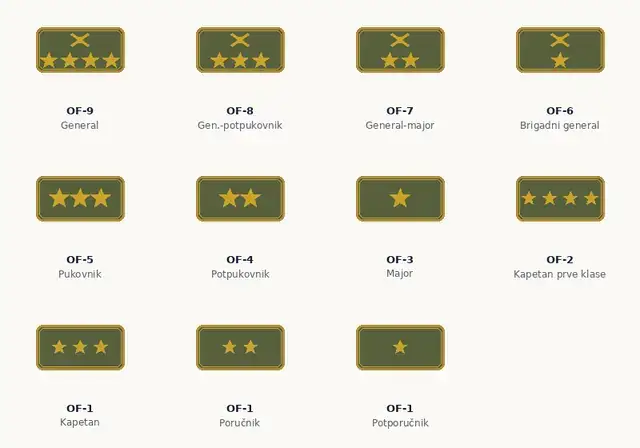
Serbian Army Officer Ranks (OF-9 to OF-1)
The Serbian Army (Kopnena vojska) is the largest branch of the Serbian Armed Forces, and its officer ladder sets the pattern for the whole military. It has eleven commissioned ranks in four groups: four generals, three senior officers and four junior officers. The Army and the Air Force use exactly the same officer titles — only the River Flotilla, with its naval tradition, is different.
| Rank (Serbian) | English Equivalent | NATO Code | Insignia | Typical Role |
|---|---|---|---|---|
| Генерал (General) | General | OF-9 | Shoulder board with branch emblem and four gold stars | Chief of the General Staff; the highest rank in the Serbian Armed Forces |
| Генерал-потпуковник (General-potpukovnik) | Lieutenant General | OF-8 | Shoulder board with branch emblem and three gold stars | Deputy chief of staff or service commander |
| Генерал-мајор (General-major) | Major General | OF-7 | Shoulder board with branch emblem and two gold stars | Senior commander or directorate chief |
| Бригадни генерал (Brigadni general) | Brigadier General | OF-6 | Shoulder board with branch emblem and one gold star | Brigade commander or senior staff officer |
| Пуковник (Pukovnik) | Colonel | OF-5 | Shoulder board with three large gold stars | Brigade commander or senior staff officer |
| Потпуковник (Potpukovnik) | Lieutenant Colonel | OF-4 | Shoulder board with two large gold stars | Battalion commander or staff officer |
| Мајор (Major) | Major | OF-3 | Shoulder board with one large gold star | Battalion executive officer or staff officer |
| Капетан прве класе (Kapetan prve klase) | Captain First Class | OF-2 | Shoulder board with four small gold stars | Senior company commander |
| Капетан (Kapetan) | Captain | OF-1 | Shoulder board with three small gold stars | Company commander |
| Поручник (Poručnik) | Lieutenant | OF-1 | Shoulder board with two small gold stars | Platoon commander |
| Потпоручник (Potporučnik) | Second Lieutenant | OF-1 | Shoulder board with one small gold star | Platoon commander; entry-level commissioned officer |
Did you know? General-potpukovnik is a Lieutenant General (OF-8), not a “lieutenant colonel general” — the compound general names come from the Yugoslav system and reverse the English word order.
How to Read Serbian Officer Insignia
Serbian officers wear their rank on shoulder boards (epolete), not on the collar or sleeve. Once you know the code, the boards read like a ladder:
- Count the stars. Junior officers wear small gold stars: one for Potporučnik, two for Poručnik, three for Kapetan and four for Kapetan prve klase. Senior officers wear larger gold stars: one for Major, two for Potpukovnik and three for Pukovnik.
- Look for the branch emblem. Generals wear a branch emblem on the shoulder board above their stars — crossed sword and cannon for the Army, an eagle for the Air Force — with one star for Brigadni general, two for General-major, three for General-potpukovnik and four for General.
- Check the board colour. The shoulder board itself is in the branch colour: olive-green for the Army and blue-grey for the Air Force and Air Defence. The colour tells you the service; the stars tell you the rank.
- Watch the trap in the names. General-potpukovnik is a Lieutenant General (OF-8), not a “lieutenant colonel general”, and General-major is a Major General (OF-7). The compound names come from the Yugoslav system and reverse the English word order.
- Kapetan prve klase is the odd one out. It means “Captain First Class” and sits between Major and Kapetan as a senior captain grade (OF-2) — the only rank with a class suffix, and easy to confuse with an ordinary Kapetan.
The diagrams in this article are simplified schematics of the shoulder boards, not exact reproductions of the official embroidered insignia.
Serbian Air Force and Air Defence Officer Ranks
The Serbian Air Force and Air Defence (Ratno vazduhoplovstvo i protivvazduhoplovna odbrana) uses exactly the same eleven officer titles as the Army, from Potporučnik to General, with the same NATO codes. What changes is the uniform: air force shoulder boards are blue-grey rather than olive-green, and the generals’ emblem is an eagle rather than the Army’s crossed sword and cannon.
Serbia’s air arm is older than most people expect. The Serbian Air Force was founded in 1912, making Serbia one of the first fifteen countries in the world to have a military air service — it flew combat missions in the Balkan Wars before the First World War. Today the Air Force and Air Defence operates fighter aircraft, helicopters and surface-to-air missile units, and its officers follow the same career path as their Army counterparts, training at the Military Academy in Belgrade and commissioning as Potporučnik.
Air force officers also wear qualification badges Army officers do not: pilot wings for aviators and specialist badges for air defence and technical personnel, worn above the breast pocket.
The River Flotilla: Serbia’s Navy on the Danube
Serbia is landlocked, so it has no navy in the ordinary sense — no sea-going fleet, no admirals of the ocean. What it has instead is the River Flotilla (Rečna flotila), a brigade-level force subordinate to the Serbian Army that patrols the Danube, Sava and Tisza rivers with patrol boats, minesweepers and landing craft. It is a brown-water navy in every sense, and it keeps the full naval rank tradition: its officers are admirals and ship captains, not generals.
| Rank (Serbian) | English Equivalent | NATO Code | Army / Air Force Equivalent |
|---|---|---|---|
| Адмирал (Admiral) | Admiral | OF-9 | General |
| Вицеадмирал (Viceadmiral) | Vice Admiral | OF-8 | General-potpukovnik |
| Контраадмирал (Kontraadmiral) | Rear Admiral | OF-7 | General-major |
| Комодор (Komodor) | Commodore | OF-6 | Brigadni general |
| Капетан бојног брода (Kapetan bojnog broda) | Captain of a Ship of the Line | OF-5 | Pukovnik |
| Капетан фрегате (Kapetan fregate) | Frigate Captain | OF-4 | Potpukovnik |
| Капетан корвете (Kapetan korvete) | Corvette Captain | OF-3 | Major |
| Поручник бојног брода (Poručnik bojnog broda) | Ship-of-the-Line Lieutenant | OF-2 | Kapetan prve klase |
| Поручник фрегате (Poručnik fregate) | Frigate Lieutenant | OF-1 | Kapetan |
| Поручник корвете (Poručnik korvete) | Corvette Lieutenant | OF-1 | Poručnik |
| Потпоручник (Potporučnik) | Sub-Lieutenant | OF-1 | Potporučnik |
Did you know? A River Flotilla captain is named for the class of ship he is qualified to command — a ship of the line, a frigate or a corvette — even though the flotilla patrols rivers, not the sea.
The flotilla’s rank names come from the Yugoslav Navy: a captain is named for the class of ship he is qualified to command — a ship of the line, a frigate or a corvette. In practice the flotilla is small, so its senior ranks are rarely all filled at once. Its NCOs and sailors use the same titles as the rest of the armed forces, listed below.
Serbian NCO and Enlisted Ranks (OR-9 to OR-1)
Serbia’s NCOs and enlisted soldiers use the same nine ranks in every branch — Army, Air Force and Air Defence, and River Flotilla alike. The ladder splits into senior NCOs, junior NCOs and enlisted soldiers, and it is the part of the system most often confused by outsiders, because its top rank, Zastavnik, sounds like an officer’s title.
| Rank (Serbian) | English Equivalent | NATO Code | Insignia | Typical Role |
|---|---|---|---|---|
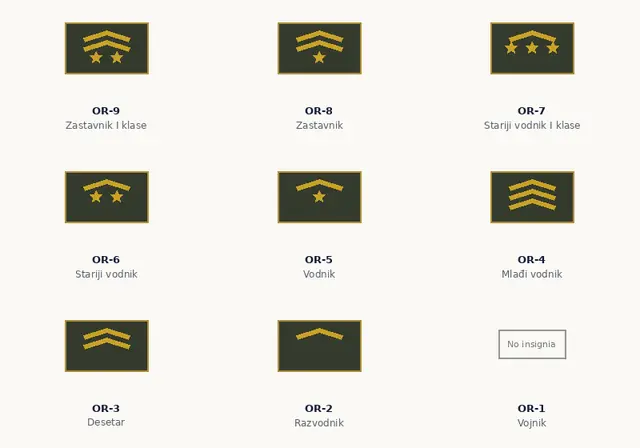
| Заставник I класе (Zastavnik I klase) | Warrant Officer 1st Class | OR-9 | Two chevrons with two stars | Most senior NCO in a unit; advisor to the commander |
| Заставник (Zastavnik) | Warrant Officer | OR-8 | Two chevrons with one star | Senior NCO; technical and administrative expert |
| Старији Водник I класе (Stariji Vodnik I klase) | Senior Sergeant 1st Class | OR-7 | One chevron with three stars | Senior NCO at company or battalion level |
| Старији Водник (Stariji Vodnik) | Senior Sergeant | OR-6 | One chevron with two stars | Platoon sergeant or senior specialist |
| Водник (Vodnik) | Sergeant | OR-5 | One chevron with one star | Squad leader |
| Млађи водник (Mlađi vodnik) | Junior Sergeant | OR-4 | Three chevrons | Team leader; first NCO rank |
| Десетар (Desetar) | Corporal | OR-3 | Two chevrons | Senior soldier; assistant team leader |
| Разводник (Razvodnik) | Lance Corporal | OR-2 | One chevron | Experienced soldier with extra responsibility |
| Војник (Vojnik) | Private | OR-1 | No insignia | New soldier in training or in the ranks |
Key point: Zastavnik sounds like an officer’s title, but it is the senior NCO tier — roughly equivalent to a warrant officer — and Zastavnik I klase (OR-9) is the most senior NCO in the Serbian Armed Forces.
How to Read Serbian NCO Insignia
NCO and enlisted insignia are worn on the sleeve as gold chevrons, and the code is a two-part count — chevrons plus stars:
- Junior ranks count chevrons only. Razvodnik wears one chevron, Desetar two and Mlađi vodnik three. No stars appear below the rank of Vodnik.
- From Vodnik upward, stars are added. A single chevron with one star is a Vodnik, with two stars a Stariji Vodnik and with three stars a Stariji Vodnik I klase. The chevron stays the same; the stars do the counting.
- Two chevrons mark the Zastavnik grades. Zastavnik wears two chevrons with one star, and Zastavnik I klase two chevrons with two stars — the most senior NCOs in the Serbian Armed Forces.
- No insignia at all means Vojnik. A private wears no rank insignia, just as in many other armies. It is the only rank in the Serbian system with nothing to show.
- The same insignia is worn in all three branches. The chart above shows it as worn by Air Force and Air Defence personnel; the Army and the River Flotilla use the identical pattern — only the uniform colour behind it changes.
Serbian Military Badges
Rank insignia shows a soldier’s grade. Badges show what they are qualified to do, and Serbia’s badges are full of national symbolism:
- The double-headed eagle — the white double-headed eagle from Serbia’s coat of arms is the emblem of the Serbian Armed Forces. It appears on cap badges, with different designs for generals, officers, NCOs and soldiers, and on unit patches. It is the single most recognisable symbol of the Serbian military.
- Cap badges by rank group. Generals, officers, NCOs and enlisted soldiers each wear their own cap badge design, so the cap alone gives a rough read of the wearer’s rank group before the shoulder boards are even visible.
- Pilot wings — gold wings worn by Air Force aviators, in the tradition of the 1912 air service. Parachutist wings mark airborne-qualified soldiers, and specialist badges mark technical trades such as signals, engineering and military police.
- The šajkača — the soft, folded national cap with its distinctive V-shaped top is still worn on ceremonial occasions. Its shape is said to recall the overturned boats of the old river sailors, the same tradition the River Flotilla carries on today.
How Promotion Works in the Serbian Armed Forces
Promotion in the Serbian Armed Forces depends on time in grade, professional courses, performance reports and available posts. Soldiers advance from Vojnik to Razvodnik and Desetar after basic training; the step to Mlađi vodnik, the first NCO rank, requires an NCO course and marks the start of a leadership career.
Officers commission as Potporučnik after graduating from the Military Academy in Belgrade, then advance through the junior ranks as they gain command experience — a platoon, then a company. Promotion to Major, Potpukovnik and Pukovnik requires staff college and selection, and promotion to general is by presidential decree on the proposal of the Minister of Defence. The senior NCO grades, Zastavnik and Zastavnik I klase, are reached only after long service and senior NCO schooling, and their holders serve as the commander’s principal enlisted advisors, much like a sergeant major in other armies.
Serbia’s armed forces are professional and all-volunteer — conscription was suspended in 2011 — so promotion is competitive throughout. With a total active strength of roughly 28,000, the force is small, and senior posts are few, which makes the senior NCO and general ranks genuinely selective.
A Note on Serbian Military Tradition
Two traditions explain almost everything about Serbian ranks. The first is the Yugoslav inheritance: the current system was created in 2006, when Serbia became independent after the dissolution of the state union with Montenegro, but its titles, its shoulder boards and its chevrons come straight from the Yugoslav People’s Army. That is why the names look familiar to anyone who has studied the armies of the former Yugoslavia — and why Zastavnik is a senior NCO rank in Serbia today, even though the same word was a junior officer rank in the old Royal Serbian Army.
The second is the Royal Serbian Army, whose highest rank was Vojvoda — a field marshal in all but name, awarded only in wartime for exceptional service. Only four men ever held it: Radomir Putnik (1912), Stepa Stepanović (1914), Živojin Mišić (1914) and Petar Bojović (1918), who led Serbia through the Balkan Wars and the First World War. The rank disappeared with the monarchy, but the double-headed eagle those generals wore remains on every Serbian cap badge today.
For comparison with other rank systems, see our guides to US Navy ranks, Russian military ranks, German military ranks, the US military uniform and the US military branches.
FAQs
What is the highest rank in the Serbian military?
General (OF-9), with four gold stars and a branch emblem on the shoulder board. The Chief of the General Staff holds this rank. The highest enlisted rank is Zastavnik I klase (OR-9), the most senior NCO in the Serbian Armed Forces.
Does Serbia have a navy?
No. Serbia is landlocked and has no sea-going navy. Instead it has the River Flotilla, a brigade-level force subordinate to the Serbian Army that patrols the Danube, Sava and Tisza rivers. Its officers use naval titles — Admiral down to Potporučnik — even though the force is small and river-based.
Are Serbian Army and Air Force ranks the same?
Yes. The Army and the Air Force and Air Defence use exactly the same officer titles, from Potporučnik to General, and the same NCO and enlisted titles. Only the uniform differs: air force shoulder boards are blue-grey with an eagle emblem for generals, while army boards are olive-green with a crossed sword and cannon.
What does Zastavnik mean?
Zastavnik is the senior NCO tier of the Serbian Armed Forces — roughly equivalent to a warrant officer (OR-8), with Zastavnik I klase as the most senior NCO grade (OR-9). The word originally meant “standard-bearer”, and in the old Royal Serbian Army it was a junior officer rank, which is why the title confuses readers today.
What is Kapetan prve klase?
Kapetan prve klase means “Captain First Class”. It is a senior captain grade (OF-2) sitting between Major and Kapetan, and it is the only Serbian officer rank with a class suffix. It has no direct equivalent in the US or British systems.
Why do Serbian generals have different names from NATO generals?
Serbian general ranks use compound names inherited from the Yugoslav system: General-potpukovnik is a Lieutenant General (OF-8), General-major is a Major General (OF-7) and Brigadni general is a Brigadier General (OF-6). The NATO codes are the same as in other armies — only the Serbian titles differ.
All insignia diagrams and images in this article are original graphics created for Forces Guide.