
Ireland’s armed forces are small, professional and unlike those of most European countries. The Irish Defence Forces (Óglaigh na hÉireann) have just three branches — the Army, the Naval Service and the Air Corps — and Ireland is a neutral country that is not a member of NATO. Yet its rank system will look familiar to anyone who knows the British tradition: officers are read by gold pips and a harp on a rank slide, soldiers by chevrons on the sleeve, and sailors by gold stripes on the cuff. This guide covers every Irish military rank with its insignia, from Recruit to Lieutenant-General, across all three services.
Two things make the Irish system distinctive. First, there is no rank of Major in the Irish Army or Air Corps: the rank that fills that place is Commandant, a title inherited from the revolutionary period. Second, the most junior soldiers are graded as Private 2 Star and Private 3 Star, and the star grade is part of the rank itself. The Air Corps, meanwhile, is not an air force in the usual sense: it flies transport aircraft, helicopters and maritime patrol aircraft, but it has operated no fighter jets since 1999 and does not control Irish airspace.
Key facts
- Country: Ireland
- Branches: Army, Naval Service and Air Corps (Óglaigh na hÉireann)
- Commissioned officers: OF-1 to OF-8 (Second Lieutenant to Lieutenant-General; Ensign to Vice Admiral at sea)
- Other ranks: OR-1 to OR-9 (Recruit to Battalion Sergeant Major; Seaman Recruit to Warrant Officer)
- Highest rank: Lieutenant-General (OF-8), held by the Chief of Staff of the Defence Forces
- No Major: the Irish Army and Air Corps use Commandant instead of Major
- Notable: Ireland is neutral and not a member of NATO, though its ranks map to NATO codes
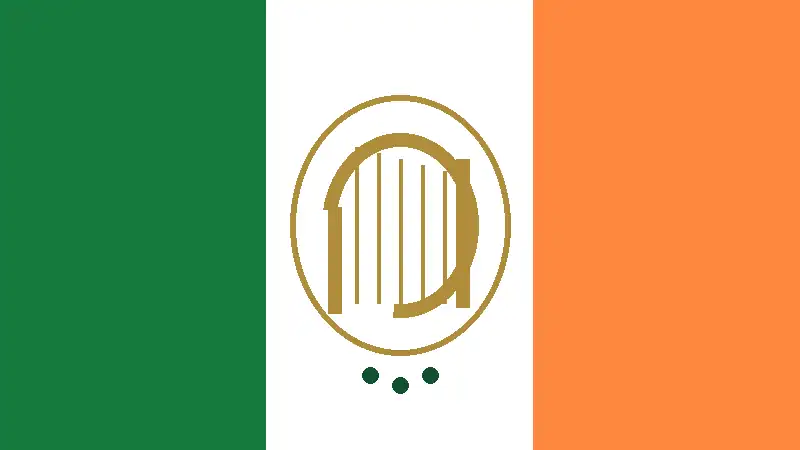
How the Irish Defence Forces Are Organised
The Defence Forces consist of the Permanent Defence Force, the full-time professional force, and the Reserve Defence Force (the Army Reserve and the Naval Service Reserve). The Army is the largest branch, responsible for land operations, internal security and support to the civil authorities; the Naval Service patrols Ireland’s large maritime area, protects fisheries and carries out search and rescue; and the Air Corps, based at Casement Aerodrome, Baldonnel, provides air support, air ambulance and search-and-rescue cover. The President of Ireland is the Supreme Commander of the Defence Forces, and officers receive their commission from the President.
As in other modern armed forces there are two rank ladders. Commissioned officers enter as officer cadets and, on completing training, are commissioned as Second Lieutenants in the Army and Air Corps or as Ensigns in the Naval Service. Other ranks enlist as recruits or apprentices and, on completing training, become Private Soldiers in the Army, Seamen in the Naval Service or Airmen in the Air Corps. Although Ireland is not in NATO, its ranks are officially mapped to NATO codes (OF for officers, OR for other ranks), which is why this guide gives the NATO equivalent for every rank.
Every rank has an Irish-language name alongside the English one. The Defence Forces are Óglaigh na hÉireann, a Commandant is a Ceannfort, a Sergeant is a Sáirsint. You will see both names in the tables below, because the Irish names are the official ones and they explain several abbreviations, such as Comdt for Commandant.
Irish Army and Air Corps Officer Ranks
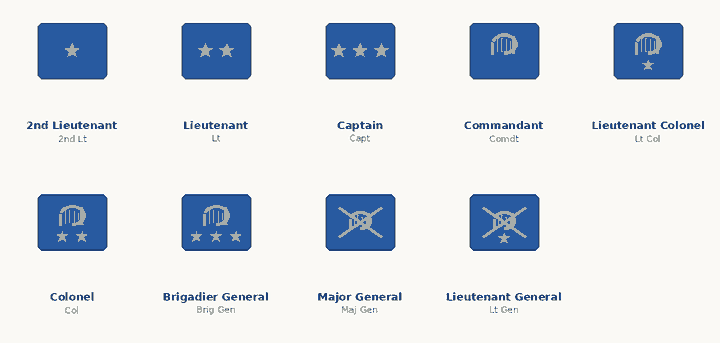
The Army and the Air Corps share the same officer ranks. Junior officers are Second Lieutenant, Lieutenant and Captain; the senior officers are Commandant, Lieutenant-Colonel and Colonel; and the generals are Brigadier-General, Major-General and Lieutenant-General. Lieutenant-General is the highest rank in current use — the Chief of Staff of the Defence Forces holds it — and there is no serving full General. Officer cadets train below the commissioned ranks, as Junior Cadet and then Senior Cadet.
| Rank | Irish Name | Abbreviation | NATO Code | Insignia | Typical Role |
|---|---|---|---|---|---|
| Second Lieutenant | Dara-lefteanant | 2nd Lt | OF-1 | One gold pip on the rank slide | Platoon commander; entry-level commissioned officer |
| Lieutenant | Lefteanant | Lt | OF-1 | Two gold pips on the rank slide | Platoon commander or second-in-command |
| Captain | Captaen | Capt | OF-2 | Three gold pips on the rank slide | Company second-in-command or company commander |
| Commandant | Ceannfort | Comdt | OF-3 | Gold harp on the rank slide | Company commander or battalion second-in-command; the Irish equivalent of a Major |
| Lieutenant-Colonel | Lefteanant-chornal | Lt Col | OF-4 | Gold harp with one pip on the rank slide | Battalion commanding officer |
| Colonel | Cornal | Col | OF-5 | Gold harp with two pips on the rank slide | Brigade staff officer or senior appointment |
| Brigadier-General | Briogáidire-ghinearál | Brig Gen | OF-6 | Gold harp with three pips on the rank slide | Brigade commander |
| Major-General | Maor-ghinearál | Maj Gen | OF-7 | Crossed sword and baton with harp on the rank slide | Senior staff appointment or deputy chief |
| Lieutenant-General | Lefteanant-ghinearál | Lt Gen | OF-8 | Crossed sword and baton with harp and star | Chief of Staff of the Defence Forces |
How to Read Irish Army and Air Corps Officer Insignia
Irish officer insignia are worn on a rank slide — a cloth tab on the chest or shoulder of the uniform, green for the Army and blue for the Air Corps — rather than on the collar or cuff. Once you know the two building blocks, you can read any slide at a glance:
- Pips — the small gold stars. Junior officers are counted by pips alone: one for a Second Lieutenant, two for a Lieutenant, three for a Captain.
- The harp — the gold harp is the Irish replacement for the crown used in the British system. It marks the field ranks: a harp on its own is a Commandant, and a harp with one, two or three pips marks Lieutenant-Colonel, Colonel and Brigadier-General.
- Crossed sword and baton — the generals’ device. A Major-General wears crossed sword and baton with the harp, and a Lieutenant-General adds a star.
- No Major — do not look for a Major’s insignia. The Irish Army has never had the rank in its modern structure; Commandant is the rank between Captain and Lieutenant-Colonel.
Key point: there is no Major in the Irish Army or Air Corps. Commandant is the OF-3 rank between Captain and Lieutenant-Colonel — if you are looking for a Major’s insignia, you will not find one.
The Air Corps uses exactly the same officer titles and the same pip-and-harp system as the Army; the difference is the colour of the uniform and the rank slide, which is blue rather than green.
Irish Army Other Ranks (Enlisted and NCOs)
Soldiers enlist as Recruits and wear no insignia. After basic training a soldier is upgraded — the Irish term is upgraded rather than promoted — to Private 2 Star, and after further corps training to Private 3 Star. The two grades are usually just called “Private”, but the star matters: a 3 Star private has completed their trade training. In the artillery the private is called a Gunner and in the cavalry a Trooper, though the rank and the insignia are the same.
Above the privates come the non-commissioned officers. Corporal is the first NCO rank, then Sergeant, and then the senior NCOs who run companies and battalions. The senior titles change with the unit: a battalion’s senior NCO is the Battalion Sergeant Major, a regiment’s is the Regimental Sergeant Major, and a company sergeant may be a Company, Battery or Squadron Sergeant depending on whether the unit is infantry, artillery or cavalry.
| Rank | Irish Name | Abbreviation | NATO Code | Insignia | Typical Role |
|---|---|---|---|---|---|
| Recruit | Earcach | Rec | OR-1 | No insignia | New entrant in basic training |
| Private 2 Star | Saighdiúir Singil, 2 Réalta | Pte 2* | OR-2 | No rank insignia | Soldier who has completed basic training |
| Private 3 Star | Saighdiúir Singil, 3 Réalta | Pte 3* | OR-3 | One chevron on the sleeve | Trained soldier; Gunner in the artillery, Trooper in the cavalry |
| Corporal | Ceannaire | Cpl | OR-4 | Two chevrons on the sleeve | Section commander; first NCO rank |
| Sergeant | Sáirsint | Sgt | OR-5 | Three chevrons on the sleeve | Platoon second-in-command or section commander |
| Company Quartermaster Sergeant | Ceathrúsháirsint Complachta | CQMS | OR-6 | Three chevrons with a harp device | Company stores and administration |
| Company Sergeant | Sáirsint Complachta | CS | OR-7 | Three chevrons with a harp device | Senior NCO of a company; discipline and standards |
| Battalion Quartermaster Sergeant | Ceathrúsháirsint Cathláin | BQMS | OR-8 | Three chevrons with harp and wreath | Battalion stores and logistics |
| Battalion Sergeant Major | Maor-Sáirsint Cathláin | BSM | OR-9 | Three chevrons with harp and wreath | Senior soldier of the battalion; advisor to the commanding officer |
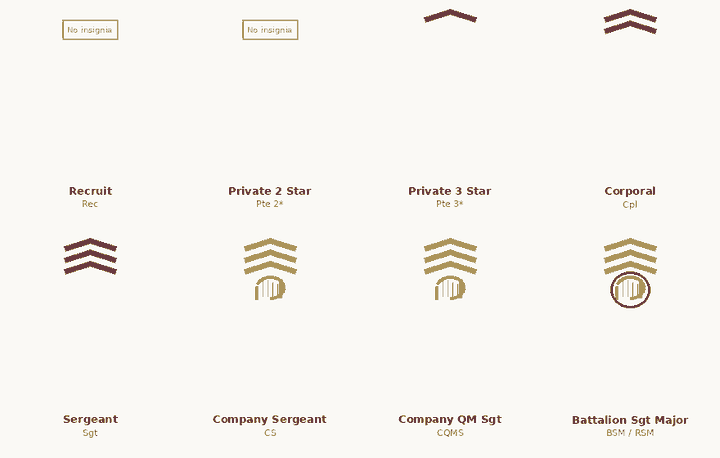
How to Read Irish Army Enlisted Insignia
Army other-rank insignia are chevrons — V-shaped stripes worn point-down on the upper sleeve, red with a yellow border on service dress and subdued on working dress:
- Count the chevrons — one chevron is a trained Private 3 Star, two is a Corporal and three is a Sergeant. A Private 2 Star and a Recruit wear none.
- Look for the harp — from Company Sergeant upward the chevrons carry a harp device, and the most senior NCOs add a wreath. The harp is what separates a senior NCO from a Sergeant at a glance.
- Titles follow the unit — the same OR-7 soldier is a Company Sergeant in the infantry, a Battery Sergeant in the artillery and a Squadron Sergeant in the cavalry. The insignia does not change; only the title does.
Did you know? A Private 3 Star wears a single chevron, while a Private 2 Star wears none — the star grade records that the soldier has finished corps training and is fully trade-qualified.
Irish Naval Service Ranks
The Naval Service (An tSeirbhís Chabhlaigh) is the smallest of the three branches — under a thousand personnel — but it has the most distinct rank system, because it follows naval tradition rather than Army tradition. Its officers are Ensign, Sub-Lieutenant, Lieutenant, Lieutenant-Commander, Commander, Captain, Commodore, Rear Admiral and Vice Admiral. The head of the Naval Service, the Flag Officer Commanding, holds the rank of Commodore, and Vice Admiral is the highest naval rank in current use. Note the trap for readers used to the Army: a naval Captain is a senior officer, equivalent to an Army Colonel, not to an Army Captain.
| Rank | Irish Name | Abbreviation | NATO Code | Insignia | Typical Role |
|---|---|---|---|---|---|
| Ensign | Meirgire | ENS | OF-1 | One gold sleeve stripe | Junior officer under training at sea |
| Sub-Lieutenant | Fo-lefteanant | Sub Lt | OF-1 | One gold sleeve stripe | Junior watchkeeping officer |
| Lieutenant | Lefteanant | Lt | OF-2 | Two gold sleeve stripes | Watchkeeper or department head on a patrol vessel |
| Lieutenant-Commander | Lefteanant-cheannasaí | Lt Cdr | OF-3 | Two gold stripes with a thinner stripe between | Executive officer or small-ship commander |
| Commander | Ceannasaí | Cdr | OF-4 | Three gold sleeve stripes | Commanding officer of a patrol vessel |
| Captain | Captaen | Capt | OF-5 | Four gold sleeve stripes | Senior staff appointment ashore |
| Commodore | Ceannasóir | Cmdre | OF-6 | Four stripes with a broad stripe | Flag Officer Commanding the Naval Service |
| Rear Admiral | Seach-aimiréal | R Adm | OF-7 | Broad gold stripe with stars above | Flag rank; senior Defence Forces appointment |
| Vice Admiral | Leas-aimiréal | V Adm | OF-8 | Broad gold stripe with two stars above | Highest naval rank; has held the Chief of Staff appointment |
Naval other ranks — sailors rather than soldiers — run from Seaman Recruit up to Warrant Officer. The most senior sailor is a Warrant Officer, and below that are the chief petty officers. Ratings are also known by their specialisation, so a leading seaman who is a radio technician is a Leading Radio Radar Technician — the rate is the job as well as the rank.
| Rank | Irish Name | Abbreviation | NATO Code | Insignia | Typical Role |
|---|---|---|---|---|---|
| Seaman Recruit | Earcach | Rec | OR-1 | No insignia | New entrant in basic training |
| Ordinary Seaman | Mairnéalach | OS | OR-2 | No rank insignia | Seaman who has completed basic training |
| Able Seaman | Mairnéalach Inniúil | AS | OR-3 | One chevron on the sleeve | Experienced seaman, qualified in a trade |
| Leading Seaman | Mairnéalach Ceannais | LS | OR-4 | One chevron with an anchor device | Junior NCO; leads a small party of sailors |
| Petty Officer | Mion-oifigeach | PO | OR-5 | Three chevrons with a crossed-anchor device | Senior NCO; in charge of a department at sea |
| Senior Petty Officer | Mion-oifigeach Sinsearach | SPO | OR-6 | Three chevrons with crossed anchors and a harp | Senior departmental NCO |
| Chief Petty Officer | Ard-mhion-oifigeach | CPO | OR-7 | Three chevrons with crossed anchors, harp and wreath | Chief of a department; the ship’s senior technical NCO |
| Senior Chief Petty Officer | Ard-mhion-oifigeach Sinsearach | SCPO | OR-8 | Three chevrons with crossed anchors, harp and wreath | Senior chief afloat or ashore |
| Warrant Officer | Oifigeach Barántais | WO | OR-9 | Royal arms device on the sleeve | Most senior sailor; advisor to the commanding officer |
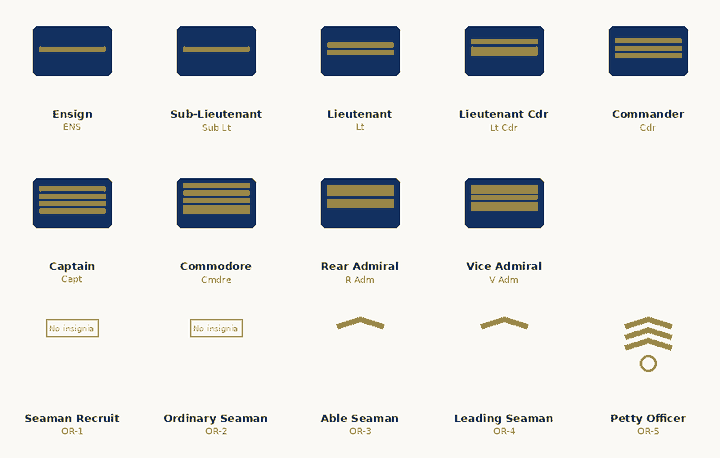
How to Read Irish Naval Insignia
Naval officers are read by gold stripes on the sleeve (and on shoulder boards in some orders of dress), in the Royal Navy pattern that the Irish Naval Service inherited:
- Count the stripes — one stripe for the most junior officers, two for a Lieutenant, three for a Commander and four for a Captain. A Lieutenant-Commander is recognised by the thin half-stripe between two full stripes.
- The broad stripe — flag officers wear a broad gold stripe. A Commodore has the broad stripe with four stripes, and admirals combine the broad stripe with stars.
- Same name, different rank — a naval Captain outranks an Army Captain by three grades, and a naval Lieutenant is the equivalent of an Army Captain. Always check the service before judging a naval title.
- Ratings wear chevrons and anchors — sailors’ rank is shown by sleeve chevrons, with crossed anchors marking the petty officers and the harp and wreath marking the chiefs.
Key point: a naval Captain (OF-5) is the equivalent of an Army Colonel, while an Army Captain (OF-2) equals a naval Lieutenant. Always check the service before judging a naval title.
Irish Air Corps Ranks
The Air Corps (An tAerchór) is the aviation arm of the Defence Forces, based at Casement Aerodrome, Baldonnel. It is small — under 900 personnel on its establishment — and it has no reserve component. Its aircraft are transport planes, helicopters and maritime patrol aircraft used for troop transport, air ambulance, search and rescue and support to the Garda Síochána, the civil police. Because Ireland is neutral and has no fighter force, the Air Corps’ work is support and surveillance rather than air defence, and its ranks reflect that: they are Army ranks with Air Corps titles at the bottom of the ladder.
Air Corps officers hold exactly the same ranks as Army officers — Second Lieutenant through Lieutenant-General, with Commandant in place of Major — and their insignia follow the same pip-and-harp pattern, worn on a blue rank slide. The General Officer Commanding the Air Corps is a Brigadier-General. Air Corps other ranks mirror the Army’s, but with Air Corps titles: the private is an Airman (or Airwoman), and the senior NCOs are Flight Sergeants rather than Company Sergeants.
| Rank | Irish Name | Abbreviation | NATO Code | Insignia | Typical Role |
|---|---|---|---|---|---|
| Recruit | Earcach | Rec | OR-1 | No insignia | New entrant in basic training |
| Airman 2 Star | Eitleoir, 2 Réalta | Amn 2* | OR-2 | No rank insignia | Airman who has completed basic training |
| Airman 3 Star | Eitleoir, 3 Réalta | Amn 3* | OR-3 | One chevron on the sleeve | Trained airman or airwoman |
| Corporal | Ceannaire | Cpl | OR-4 | Two chevrons on the sleeve | Junior NCO; section or team leader |
| Sergeant | Sáirsint | Sgt | OR-5 | Three chevrons on the sleeve | Senior technician or section commander |
| Flight Quartermaster Sergeant | Ceathrúsháirsint Eitleoige | FQMS | OR-6 | Three chevrons with a harp device | Flight stores and administration |
| Flight Sergeant | Sáirsint Eitleoige | FS | OR-7 | Three chevrons with a harp device | Senior NCO of a flight; discipline and standards |
| Regimental Quartermaster Sergeant | Ceathrúsháirsint Reisiminte | RQMS | OR-8 | Three chevrons with harp and wreath | Air Corps stores and logistics |
| Regimental Sergeant Major | Maor-sáirsint Reisiminte | RSM | OR-9 | Three chevrons with harp and wreath | Senior airman of the Air Corps |
Apprentices are a distinctive Air Corps entry route: young technicians join as apprentices and train for a trade — aircraft maintenance is the best known — before becoming Airmen. Air Corps pilots wear wings above their rank insignia, but the rank itself is read exactly as in the Army.
Irish Defence Forces Badges
Rank insignia shows a person’s grade. Badges show what they are qualified to do:
- The Defence Forces cap badge — the harp with the inscription “IV”, commemorating the Irish Volunteers of 1913. Officers wear a bronze version and senior officers a gilt badge backed with red cloth; other ranks wear an anodised brass-coloured badge.
- Corps badges — worn on the lapels of the service dress tunic, showing the wearer’s corps: infantry, artillery, cavalry, engineers, signals, military police, transport, medical and the rest.
- Pilot wings — gold wings worn by Air Corps pilots, with aircrew badges for other flying trades.
- Parachutist wings — worn by personnel qualified in military parachuting, including the Army Ranger Wing, the Defence Forces’ special operations unit.
- United Nations service — Ireland has a long record of UN peacekeeping, from the Congo in the 1960s to Lebanon, where Irish troops have served with UNIFIL for decades. Personnel on UN duty wear the UN blue beret and the mission insignia.
How Promotion Works in the Irish Defence Forces
Promotion in the Irish Defence Forces is by a mix of time, courses and competition, and it is slower than in larger armies because the force is small and there are few posts at each rank. A recruit becomes a Private 2 Star on finishing basic training and a Private 3 Star on finishing corps training — these are upgrades on completing a course, not promotions in the usual sense. Promotion to Corporal and Sergeant requires passing the relevant NCO course and being selected from those qualified, and the senior NCO appointments — Company Sergeant, Battalion Sergeant Major — are competitive posts that carry real authority over discipline, training and welfare.
Officers are commissioned as Second Lieutenants and promoted on time and merit through Lieutenant and Captain. Promotion to Commandant and above is by selection board, and command appointments — of a company, a battalion, a brigade — are the career gates that matter most.
A Note on Irish Military Tradition
Two traditions explain almost everything about Irish ranks. The first is the Volunteer tradition: the Defence Forces trace their lineage to the Irish Volunteers of 1913, which is why the cap badge carries the “IV” and why the rank of Commandant — a commander’s title from the revolutionary years — survived when other armies standardised on Major. The second is neutrality and peacekeeping: Ireland has stayed outside military alliances since independence, and the Defence Forces’ defining operational experience has been UN peacekeeping rather than war-fighting. That is why the most famous Irish soldiers are the men of “A” Company at Jadotville in the Congo in 1961, and why the UN blue beret is as recognisable in Ireland as any rank badge.
The Irish language is the third tradition, and it is visible in every rank table in this guide. Ranks are officially bilingual, and the Irish names — Ceannfort, Sáirsint, Mairnéalach — are used in formal orders and on official documents. For readers comparing Ireland with its neighbours, see our guides to French military ranks, German army ranks, the US Navy ranks, the US military uniform and the US military branches.
Read next
US Navy Ranks · French Military Ranks · German Army Ranks · US Military Uniform · US Military Branches
FAQs
What is the highest rank in the Irish military?
Lieutenant-General (OF-8), held by the Chief of Staff of the Defence Forces. In the Naval Service the highest rank is Vice Admiral (OF-8). There is no serving full General or Admiral, and the head of the Naval Service is a Commodore while the head of the Air Corps is a Brigadier-General.
Why is there no Major in the Irish Army?
The Irish Army uses Commandant (Ceannfort) in place of Major. It is a legacy of the revolutionary period, when commandant was a commander’s title, and it has been kept ever since. A Commandant is the OF-3 rank, equivalent to a Major in other armies.
What is a Private 3 Star?
A soldier who has completed both basic training and corps (trade) training. Recruits become Private 2 Star after basic training and Private 3 Star after their corps course. In the artillery the same rank is called Gunner and in the cavalry Trooper; in the Air Corps it is Airman 3 Star.
Does Ireland have an air force?
Not in the usual sense. The Air Corps is the aviation arm of the Defence Forces, flying transport aircraft, helicopters and maritime patrol aircraft for support, search and rescue and air ambulance work. It has operated no fighter jets since 1999 and does not control Irish airspace.
Is Ireland in NATO?
No. Ireland is militarily neutral and is not a NATO member, although its ranks are officially mapped to NATO codes (OF and OR) so they can be compared with allied ranks. Ireland does take part in UN peacekeeping and in the EU’s Partnership for Peace cooperation.
What is the difference between a naval Captain and an Army Captain?
They are three grades apart. A naval Captain (OF-5) is equivalent to an Army Colonel, while an Army Captain (OF-2) is equivalent to a naval Lieutenant. Always check which service a rank belongs to before comparing titles.
All insignia diagrams and images in this article are original graphics created for Forces Guide. Rank-slide diagrams are schematic illustrations of the pip, harp and stripe system.