
The Special Boat Service ranks work differently from most rank guides on this site — because the Special Boat Service, or SBS, has no rank system of its own. SBS operators wear Royal Navy ranks, from Able Rate up to Admiral of the Fleet, and what sets them apart is not a special set of stripes but their green beret, their own cap badge and a small set of qualification badges that mark them as swimmer canoeists. This guide explains the unit, its history and selection, and then gives the full Royal Navy officer and ratings tables with SBS notes.
The SBS is the maritime special forces unit of the United Kingdom, part of United Kingdom Special Forces (UKSF) alongside the Special Air Service (SAS). It is the Royal Navy’s contribution to UKSF and is often described as the SAS’s sister unit. Both units answer to the Director Special Forces, go through the same joint selection, and work side by side on operations — but the SBS owns the sea, the coastline and the rivers, while the SAS is land-focused.
Key facts
- Country: United Kingdom
- Branch: Royal Navy (Naval Service), part of United Kingdom Special Forces
- Rank system: Royal Navy ranks — there is no separate SBS rank system
- Officers: Midshipman to Admiral of the Fleet
- Ratings: Able Rate to Warrant Officer 1
- Base: RM Poole (Hamworthy Barracks), Poole, Dorset
- Motto: “By Strength and Guile”
- Beret: Commando green beret with the SBS cap badge (granted 2003)

What Is the Special Boat Service?
The Special Boat Service is the special forces unit of the Royal Navy. Its job is special operations in, on and around the water: covert beach reconnaissance, raids launched from submarines, small boats and canoes, the protection of ships and ports, and the rescue of hostages at sea. In peacetime it stands ready as the United Kingdom’s maritime counter-terrorism force, the team that boards a hijacked ferry, tanker or oil platform.
The unit’s publicly stated roles fall into four groups. Surveillance and reconnaissance means watching a target, reporting what it finds and marking targets for air strikes or naval gunfire. Offensive action covers raids, demolitions and direct attacks. Support and influence includes training friendly forces overseas. And counter-terrorism — both on land and at sea — means standing ready to end a hijacking or hostage situation at very short notice.
Key point: the SBS is a small unit — military sources quoted in 2020 put it at roughly a couple of hundred personnel, on standby at all times. The Ministry of Defence does not comment on special forces matters, so the exact strength is not officially published. Figures you see online are estimates, not official numbers.
A Short History of the SBS
The SBS traces its roots to the darkest days of the Second World War. In July 1940, commando officer Roger Courtney persuaded a sceptical Royal Navy that folding canoes — known as folbots — could slip saboteurs and scouts onto enemy-held coastlines. To prove the idea, he paddled up to the landing ship HMS Glengyle in the River Clyde, climbed aboard unseen, and left his initials on the captain’s cabin door. He was given twelve men, and the Folboat Troop was born.
That small troop became No. 1 Special Boat Section in early 1941, working from the Middle East with the 1st Submarine Flotilla at Alexandria — beach reconnaissance, landing agents and raiding enemy coasts. A second strand was the Royal Marines Boom Patrol Detachment, formed in July 1942 under Major Herbert “Blondie” Hasler. Its men paddled folding canoes 70 miles up the River Gironde in December 1942 — Operation Frankton, the “Cockleshell Heroes” raid — and crippled German blockade runners at Bordeaux with limpet mines.
By 1943 the raiding units had been brought together as the Special Boat Squadron, fighting across the Aegean, the Adriatic, Albania and Italy. At the end of the war the SBS was disbanded, and only the Boom Patrol Detachment survived intact — it became a school for beach and boat work, keeping the canoe and diving skills alive.
The modern unit took shape in stages: the Special Boat Company in 1951, the Special Boat Squadron in 1974, and the Special Boat Service on 28 July 1987, when it took responsibility for maritime counter-terrorism. SBS teams served in Korea, during the Indonesian Confrontation, in Northern Ireland and in the Falklands War of 1982, where they reconnoitred South Georgia and the San Carlos landing beaches.
Since then the SBS has been part of United Kingdom Special Forces alongside the SAS, serving in the Gulf War, in Sierra Leone in 2000 during the hostage rescue Operation Barras, and extensively in Afghanistan and Iraq. In recent years its most public operations have been at sea: storming the container ship Grande Tema in 2018 and the oil tanker Nave Andromeda off the Isle of Wight in 2020, both after stowaways seized control of the vessels.
The SBS Has No Rank System of Its Own
This is the single most important thing to understand about Special Boat Service ranks: there are none. The SBS does not issue its own titles, stripes or badges of rank. Everyone in the unit holds a rank from their parent service, and the tables below are the Royal Navy tables, because the SBS is the Royal Navy’s special forces unit.
There is one wrinkle worth knowing. Most SBS operators are drawn from the Royal Marines Commandos, and Royal Marines keep their own Army-style rank titles — Marine, Lance Corporal, Corporal, Sergeant and so on — while they serve with the SBS. So on an SBS troop you may meet a Royal Navy officer, a Royal Marine sergeant and a Royal Navy rating working side by side, each wearing the rank of their own service. The unit itself adds no extra rank on top. For the Royal Marines titles, see our guide to British military ranks.
What the SBS does add is identity. A qualified operator wears the green beret with the SBS cap badge, the swimmer canoeist badge and parachute wings. Those three marks, not a rank, are what tell you that the person in front of you is SBS.
Royal Navy Officer Ranks (OF-1 to OF-10)
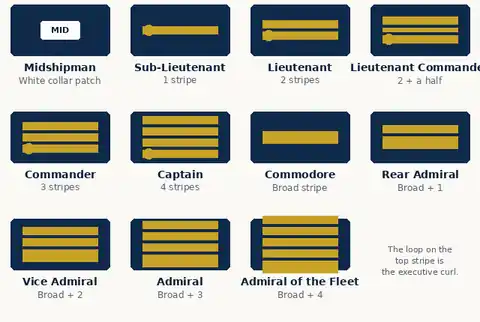
Royal Navy officers wear their rank as gold lace stripes on the sleeves of their uniform. The pattern is simple to read once you know it: count the stripes, and look for the executive curl — the small loop on the top stripe, worn by executive-branch officers. A midshipman wears no stripe at all, just a white patch on the collar, a badge that dates back to 1758.
| Rank | NATO Code | Sleeve Insignia | Typical Role |
|---|---|---|---|
| Midshipman (Mid) | OF-1 | No stripe; white collar patch | Officer under training at Britannia Royal Naval College |
| Sub-Lieutenant (Sub Lt) | OF-1 | One stripe with executive curl | Junior officer; first rank after training |
| Lieutenant (Lt) | OF-2 | Two stripes with executive curl | Watchkeeping officer; may command a small vessel |
| Lieutenant Commander (Lt Cdr) | OF-3 | Two stripes with a half stripe between (“two and a half”) | Department head; executive officer of a smaller unit |
| Commander (Cdr) | OF-4 | Three stripes with executive curl | Executive officer of a large ship; commands a smaller vessel |
| Captain (Capt) | OF-5 | Four stripes with executive curl | Commands a ship or a shore establishment |
| Commodore (Cdre) | OF-6 | One broad stripe with executive curl | Commands a group of ships or a large establishment |
| Rear Admiral (RAdm) | OF-7 | Broad stripe plus one stripe | Flag officer; leads a naval capability |
| Vice Admiral (VAdm) | OF-8 | Broad stripe plus two stripes | Senior flag officer; works at defence-policy level |
| Admiral (Adm) | OF-9 | Broad stripe plus three stripes | Highest serving rank; equivalent to a General |
| Admiral of the Fleet (AdmF) | OF-10 | Broad stripe plus four stripes | Honorary and ceremonial rank; no regular appointments since 1995 |
How to Read Royal Navy Officer Sleeve Stripes
The sleeve tells the whole story. One stripe is a Sub-Lieutenant and two is a Lieutenant. A Lieutenant Commander is the odd one out: two full stripes with a thin half stripe between them, which is why sailors call the rank “two and a half”. Three stripes is a Commander and four is a Captain — and a Navy Captain is a senior rank, equal to an Army Colonel, not the junior officer that the same word means in the Army. Above Captain, a broad stripe takes over: a Commodore wears it alone, and flag officers add one to three stripes above it.
Did you know? A Royal Navy Captain outranks an Army Captain by a long way. A Navy Captain (OF-5) equals an Army Colonel, while an Army Captain equals a Navy Lieutenant. The shared words are a trap — always check the service before comparing titles.
Royal Navy Ratings (OR-2 to OR-9)
In the Royal Navy, sailors below officer rank are not called soldiers or privates — they are ratings, and they hold a rate rather than a rank. Everyone joins as an Able Rate, and promotion is on merit, through Leading Rating, Petty Officer and Chief Petty Officer up to Warrant Officer. The Royal Navy’s own careers pages describe Warrant Officer 1 as the highest rank a rating can reach, and the crucial link between officers and the ratings serving under them.
| Rate | NATO Code | Insignia | Typical Role |
|---|---|---|---|
| Able Rate (AB) | OR-2 | No rate insignia | Entry rate; every sailor starts here |
| Leading Rating (LH) | OR-4 | Single fouled anchor | First promotion; leads a small team |
| Petty Officer (PO) | OR-6 | Crown over two crossed anchors | Senior rating; runs a section or department team |
| Chief Petty Officer (CPO) | OR-7 | Crown over an anchor within a laurel wreath | Senior rating; the “Chief” of a department |
| Warrant Officer 2 (WO2) | OR-8 | Crown within a laurel wreath | Pinnacle of technical skill in a specialisation |
| Warrant Officer 1 (WO1) | OR-9 | Royal Arms within a laurel wreath | Highest rating; link between officers and ratings |
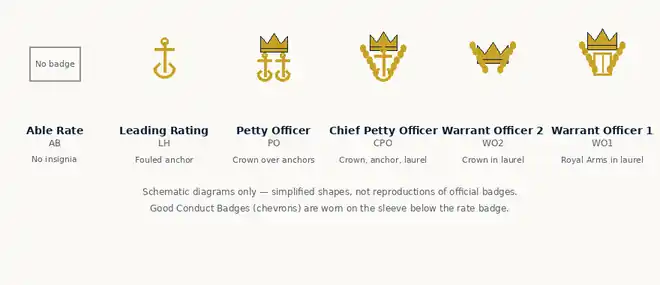
Note the gaps in the NATO codes: the Royal Navy has no OR-1, OR-3 or OR-5 rate in its current structure, so the ladder jumps from OR-2 (Able Rate) to OR-4 (Leading Rating) and from OR-4 to OR-6 (Petty Officer).
Ratings also wear Good Conduct Badges — gold chevrons on the sleeve, one for each period of good service. They are not a rate, but they tell you at a glance how long a sailor has served without blemish.
Key point: in an SBS troop the senior ratings and Royal Marines NCOs are the backbone of daily life. Officers set the mission and the senior rates and sergeants make it happen — a Warrant Officer 1 or a Colour Sergeant in the SBS carries the same weight as in any ship or commando unit.
SBS Beret, Cap Badge and Qualification Badges
Rank shows a person’s grade. Badges show what they are qualified to do — and in the SBS, the badges matter more than the rank for spotting an operator. There are three marks to know.
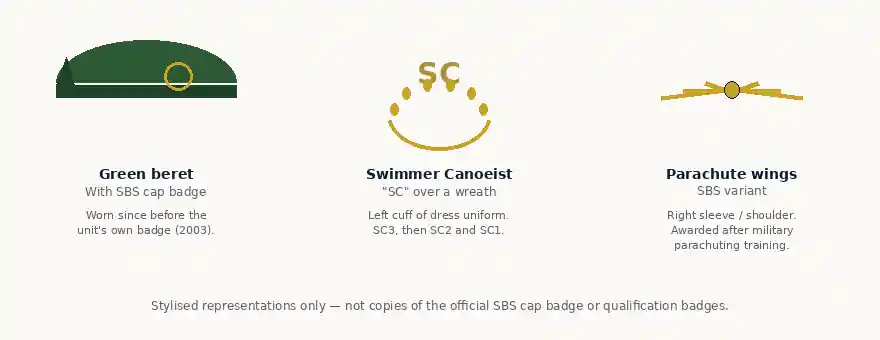
The first is the green beret. The SBS wears the commando green beret, the same beret worn by the Royal Marines Commandos, because most SBS operators come through the Commandos. The beret itself is a Commando mark, not an SBS-only one — what makes it SBS is the badge on it.
The second is the SBS cap badge, granted on 18 November 2003. Before that date SBS operators wore the cap badge of their parent unit. The SBS badge carries the unit motto, “By Strength and Guile”. The design itself — a sword over stylised waves — is the unit’s own emblem, and we do not reproduce it here: the drawings in this article are simplified, generic representations, not copies of the official badge.
The third group is the qualification badges. On qualifying as a swimmer canoeist, an SBS marine wears the “SC” badge — the letters SC over a wreath — on the left cuff of the dress uniform. The badge marks the three swimmer canoeist classes: SC3 on first qualifying, then the more advanced SC2 and SC1 as the operator gains experience and rank. Officers do not wear the SC branch badge, but they do wear the parachute wings — the SBS variant of the special forces parachutist badge, worn on the shoulder of the right sleeve — after completing military parachuting training.
Did you know? The SBS motto was once longer. The unit’s original motto was “Not By Strength, By Guile” — brains before brawn. It was later shortened to “By Strength and Guile”, which is the wording on the cap badge granted in 2003.
How to Join the SBS: Selection and Training
There is no direct entry into the SBS from civilian life. A candidate must already be serving in the British Armed Forces, with at least two years of regular service behind them, and most successful candidates come from the Royal Marines.
Before the main selection course, SBS hopefuls must pass a two-week pre-selection aptitude test. The first week is boating: a combat fitness test, a swimming test — 600 metres in 15 minutes, 50 metres clothed while carrying a weapon and belt kit, and 25 metres underwater on a single breath — and canoe trials that include carrying a folding canoe and a loaded bergen for three miles and a 20-mile paddle. The second week is diving, where candidates must complete a series of dives and show they can perform diving drills to a high standard.
Those who pass go on to Joint Special Forces Selection alongside SAS candidates. The course lasts around six months and runs twice a year, in winter and in summer. It opens with the aptitude phase — long cross-country marches over the Brecon Beacons carrying heavy loads, navigating by map and compass — and continues through jungle training, soldiering skills, and escape and evasion with resistance to interrogation.
Here the SAS and SBS paths split. An SAS candidate who finishes joint selection has passed. An SBS candidate still has the Swimmer Canoeist Third Class (SC3) course ahead — an eight-week boating and diving course covering canoeing, diving, boat handling, underwater navigation, demolitions, negotiating surf zones and infiltrating from submarines, including a 55-kilometre canoe course. Only after passing SC3 does an SBS candidate join an operational troop, on probation. Later, with experience and promotion, operators take the SC2 and then SC1 courses.
The SBS also has a Reserve element, SBS(R), which provides individual reservists to reinforce the regular unit. Reserve candidates need previous military experience, and their selection includes loaded marches, a 500-metre swim in uniform, and gym tests.
SBS Organisation — What Is (and Isn’t) Public
Writing about the SBS means being honest about what is not known. The Ministry of Defence does not comment on special forces matters, so much of what is published about the unit comes from military sources, veterans’ accounts and reporting rather than official releases.
What is publicly reported is this: the SBS is based at Hamworthy Barracks, RM Poole, in Poole, Dorset, and comes under the operational command of the Director Special Forces. Its reported structure is four regular squadrons — C, M, X and Z Squadrons — plus R Squadron for the SBS Reserve, and a specialist sub-unit known as the SDV Troop, which operates swimmer delivery vehicles launched from submarines. The squadrons rotate through the unit’s roles — counter-terrorism duty, then conventional operations — in the same way SAS squadrons rotate.
Women have been eligible to join United Kingdom Special Forces since 2018, but there is no official public information about women serving on the front line in the SBS. Likewise, the exact number of personnel, the internal layout of the squadrons and the details of current operations are not publicly confirmed, and this article does not guess at them.
SBS vs SAS — Sister Units, Different Homes
The SBS is often called the SAS’s sister unit, and the comparison is fair — but the differences matter for anyone reading about ranks and badges. Both units sit inside United Kingdom Special Forces, both take the same joint selection, and both wear the same approach to small-team special operations. The SAS is a British Army regiment; the SBS is the Royal Navy’s unit. That is why an SAS trooper holds Army ranks — Trooper, Corporal, Sergeant — while an SBS operator holds Royal Navy or Royal Marines ranks.
On operations the two units overlap constantly, and the practical split is the one the SBS was built for: the sea. If the mission involves a ship, a coastline, a river or a submarine, the SBS leads. For the Army side of the family, see our guide to British military ranks and the full Royal Navy ranks tables. The SBS also works closely with the United States Navy’s special warfare units; for the American system, see our US Navy ranks guide and the overview of US military branches.
Read next
Royal Navy Ranks · British Military Ranks · US Navy Ranks · US Military Branches
FAQs
Does the SBS have its own ranks?
No. The Special Boat Service has no rank system of its own. Its personnel hold Royal Navy ranks — officers from Midshipman to Admiral of the Fleet, and ratings from Able Rate to Warrant Officer 1. Most operators are Royal Marines, so they hold Royal Marines rank titles while serving with the SBS.
What is the highest rank in the SBS?
There is no SBS-specific highest rank, because the SBS uses Royal Navy ranks. The highest serving Royal Navy rank is Admiral (OF-9); Admiral of the Fleet (OF-10) is now an honorary and ceremonial rank. The highest rate a rating can reach is Warrant Officer 1 (OR-9).
What beret does the SBS wear?
The commando green beret, with the SBS’s own cap badge. The cap badge was granted on 18 November 2003 and carries the motto “By Strength and Guile”. Before 2003, SBS operators wore the cap badge of their parent unit.
What is a swimmer canoeist?
A swimmer canoeist is a qualified SBS operator. After passing joint UKSF selection, SBS candidates complete the eight-week Swimmer Canoeist Third Class (SC3) course in canoeing, diving, boating and demolition. Qualified operators wear the “SC” badge over a wreath on the left cuff, and take the SC2 and SC1 courses as they gain experience.
How long does SBS selection take?
Months. Candidates first pass a two-week pre-selection aptitude test, then around six months of Joint Special Forces Selection alongside SAS candidates, then the eight-week SC3 boating and diving course. Candidates must already have at least two years of regular service before they can apply.
What is the SBS motto?
“By Strength and Guile”. The original wording was “Not By Strength, By Guile”, later shortened to the current form. It reflects the unit’s history: small canoe and boat teams achieving outsized results through cunning and courage rather than numbers.
All insignia diagrams and images in this article are original graphics created for Forces Guide. They are simplified, stylised representations — not reproductions of the official SBS cap badge or of official insignia artwork. Details of SBS strength and internal structure are not officially published; figures given here are the best publicly reported estimates.