The Special Reconnaissance Regiment ranks are the ranks of the British Army — because the SRR has no rank system of its own. The regiment is the United Kingdom’s specialist covert surveillance unit, and its soldiers, sailors and airmen keep the ranks of the service they came from. This guide explains every rank an SRR operator can hold, from Private (OR-1) to General (OF-9), with the insignia for each, plus the regiment’s history, beret, cap badge and selection.
That is what makes the SRR unusual. It is a tri-service regiment, recruiting volunteers from the British Army, the Royal Navy and the Royal Air Force. Most of its personnel hold British Army ranks, which is what the tables below show — but a sailor or airman keeps their own service’s rank.
Key facts
- Country: United Kingdom
- Branch: British Army, as part of United Kingdom Special Forces (UKSF)
- Formed: 6 April 2005
- Role: Covert surveillance and special reconnaissance
- Other ranks: OR-1 to OR-9 (Private to Warrant Officer Class 1)
- Commissioned officers: OF-1 to OF-9 (Second Lieutenant to General)
- Beret: Emerald grey, with the SRR cap badge
- Headquarters: Stirling Lines, Credenhill, Hereford
What Is the Special Reconnaissance Regiment?
The Special Reconnaissance Regiment — the SRR — was formed on 6 April 2005, announced in Parliament the day before by Defence Secretary Geoff Hoon. It answered a demand for a dedicated special reconnaissance capability identified in the Strategic Defence Review: A New Chapter of 2002, published after the 11 September 2001 attacks on the United States.
Before the SRR existed, that surveillance work fell to the Special Air Service (SAS) and the Special Boat Service (SBS) — regiments pulled between direct-action raids and long, patient watching. The SRR took the watching off their hands, so the SAS and SBS could concentrate on the raids.
The new regiment was built around a core of 14 Intelligence Company — “The Det” — which had carried out covert surveillance against the Provisional IRA in Northern Ireland during the Troubles, giving the SRR decades of experience from its first day. Its first commanding officer was Lieutenant Colonel Tim Radford, and it is based at Stirling Lines, Credenhill, in Herefordshire, alongside the SAS, under the Director Special Forces. Its Colonel-in-Chief is Queen Camilla.
Did you know? The SRR is one of the youngest regiments in the British Army — formed in 2005 — yet it inherited experience stretching back to the 1970s through 14 Intelligence Company.
The Role of the SRR: Watching, Not Raiding
The SRR’s job is clandestine intelligence, surveillance, target acquisition and reconnaissance — usually shortened to ISTAR. Its operators watch people and places, quietly and for a long time, and pass what they learn to the units that act on it, in support of counter-terrorism and counter-insurgency.
A typical SRR task is close target reconnaissance: getting close enough to a person or a building to learn who comes and goes, when, and with whom — without being noticed. Operators work in small teams, often in plain clothes, using covert photography, hidden cameras, listening devices and electronic surveillance gear. The regiment’s mission is to find and identify human targets so that other units — usually the SAS or SBS — can act against them.
Public reporting shows where it has worked: Iraq, as part of Task Force Black/Knight in Baghdad from 2006; Afghanistan, where Captain David Patton of the SRR was killed during Operation Ilois near Sangin in June 2006; and alongside Metropolitan Police teams after the July 2005 London bombings. It has also been reported in Northern Ireland, Libya, Yemen and Somalia.
Much about the regiment is not public, and that is deliberate: the Ministry of Defence does not comment on its operations, and its exact strength is not published — public estimates range from around 200 to around 600 personnel.
A Tri-Service Regiment: How Ranks Work in the SRR
The SRR is unusual because it is tri-service: it recruits volunteers from all three armed services — the British Army, the Royal Navy and the Royal Air Force — and men and women are both eligible. A soldier, a sailor and an airman can serve side by side in the same surveillance team.
That creates a simple rule: members keep the rank of their parent service. An Army corporal who joins stays a corporal; a Royal Navy petty officer stays a petty officer; a Royal Air Force flight sergeant stays a flight sergeant. Joining the regiment gives nobody a new rank — the SRR has none of its own to give.
Because the regiment is administered by the British Army, and most of its personnel come from the Army, the tables below show the British Army rank structure. Navy and RAF ranks are equivalent in seniority — a Navy Chief Petty Officer and an RAF Flight Sergeant both sit at OR-7, the same level as an Army Staff Sergeant — but their titles and insignia are their own services’. Army ranks fall into two groups: other ranks (OR-1 to OR-9) and commissioned officers (OF-1 to OF-9).
Key point: there is no such thing as an “SRR rank” — every operator holds a standard Army, Navy or RAF rank, and the tables below are the Army ranks most SRR personnel hold.
SRR Other Ranks (OR-1 to OR-9)
Most SRR operators are other ranks — the soldiers who do the surveillance work on the ground. Their insignia is worn on the sleeve: chevrons for the junior ranks, a crown for senior non-commissioned officers, and the Royal Arms for the most senior warrant officer. Unlike American chevrons, British chevrons point downwards.
| Rank | NATO Code | Insignia | Typical Role in the SRR |
|---|---|---|---|
| Private (Pte) | OR-1 | No insignia | Junior soldier; few operators serve at this rank |
| Lance Corporal (LCpl) | OR-3 | One chevron | Junior non-commissioned officer; team member on surveillance tasks |
| Corporal (Cpl) | OR-4 | Two chevrons | Team member or small-team leader |
| Sergeant (Sgt) | OR-6 | Three chevrons | Team leader; runs a surveillance team in the field |
| Staff Sergeant / Colour Sergeant (SSgt / CSgt) | OR-7 | Three chevrons with a crown above | Senior team leader or troop sergeant |
| Warrant Officer Class 2 (WO2) | OR-8 | Crown within a wreath | Senior soldier in a troop or squadron |
| Warrant Officer Class 1 (WO1) | OR-9 | Royal Arms | Most senior soldier in the regiment |
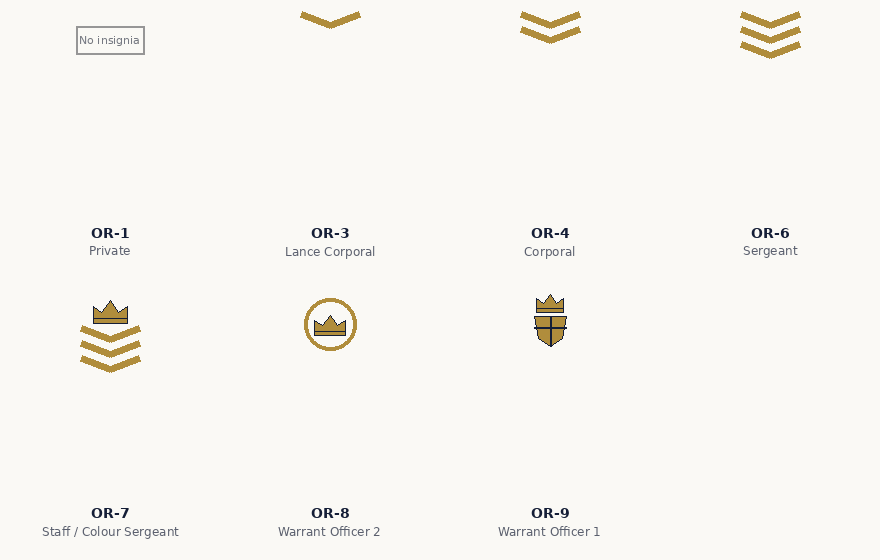
Two details are worth noting. There is no standard Army rank at OR-5: the ladder jumps from Sergeant (OR-6) to Corporal (OR-4). And a Private wears no insignia at all — but the SRR does not recruit straight from the street, so almost every operator already holds at least Lance Corporal on arrival. The typical SRR operator is a corporal or sergeant who proved themselves in a parent unit first. Reading the insignia is straightforward: one chevron means Lance Corporal, two means Corporal, three means Sergeant and above; a crown above three chevrons marks a Staff Sergeant, a crown within a wreath marks a Warrant Officer Class 2, and the Royal Arms marks a Warrant Officer Class 1.
SRR Commissioned Officer Ranks (OF-1 to OF-9)
Commissioned officers in the SRR command its troops, squadrons and the regiment itself; the commanding officer is normally a lieutenant colonel, as the regiment’s first commanding officer was. Officers wear their rank on the shoulder straps as pips (eight-pointed stars, properly called Bath stars) and crowns, with crossed baton and sword for generals.
| Rank | NATO Code | Insignia | Typical Role in the SRR |
|---|---|---|---|
| Second Lieutenant (2Lt) | OF-1 | One pip | Junior officer; rarely posted to the SRR at this rank |
| Lieutenant (Lt) | OF-1 | Two pips | Junior officer; troop second-in-command |
| Captain (Capt) | OF-2 | Three pips | Troop commander; leads a surveillance troop |
| Major (Maj) | OF-3 | One crown | Squadron second-in-command or staff officer |
| Lieutenant Colonel (Lt Col) | OF-4 | Crown above one pip | Commanding officer of the regiment |
| Colonel (Col) | OF-5 | Crown above two pips | Senior staff appointment |
| Brigadier (Brig) | OF-6 | Crown above three pips | Senior command or staff appointment |
| Major General (Maj Gen) | OF-7 | Crossed baton and sword with one pip | Director Special Forces |
| Lieutenant General (Lt Gen) | OF-8 | Crossed baton and sword with a crown | Senior command appointment |
| General (Gen) | OF-9 | Crossed baton and sword with crown and pip | Highest rank in the British Army |
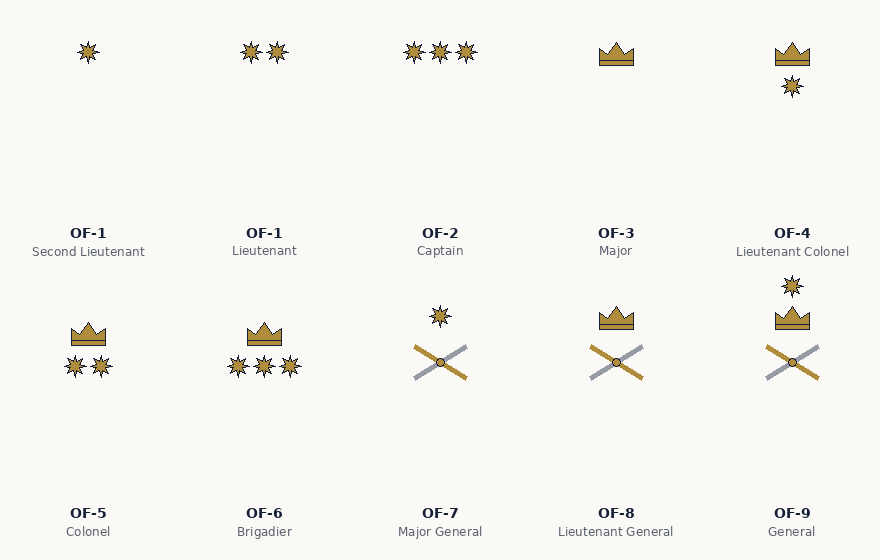
The officer ladder is simple: pips count up — one, two, three — for Second Lieutenant, Lieutenant and Captain. Then the crown takes over: a crown alone means Major, with pips added below it for Lieutenant Colonel, Colonel and Brigadier. At the top, the crossed baton and sword mark the generals, with a pip, a crown, or both above them. Above General sits Field Marshal, awarded only in exceptional circumstances. Note that a British Captain (OF-2) is a junior officer rank, equivalent to a Royal Navy Lieutenant or an RAF Flight Lieutenant — not the same as an American or Navy captain. The highest rank an SRR officer ordinarily meets is Major General, held by the Director Special Forces.
Beret, Cap Badge and Stable Belt
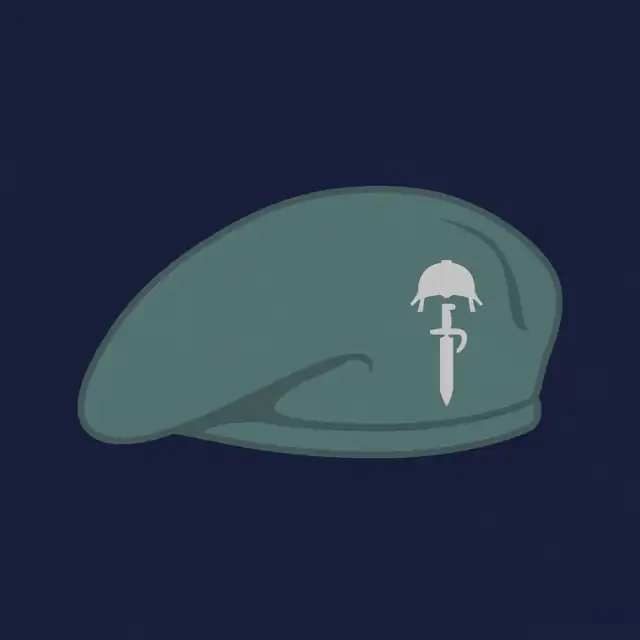
The most visible sign of an SRR operator is not a rank at all — it is the beret. SRR personnel wear an emerald-grey beret, a muted green-grey that sets them apart from the sand-coloured beret of the SAS and the green beret of the Royal Marines. Some sources call the colour Lovat green.
The beret carries the SRR cap badge: the mythical sword Excalibur behind a Corinthian helmet — described in some sources as an Argus helmet — with a scroll underneath inscribed “RECONNAISSANCE”. Like other UKSF units, the SRR uses Excalibur on its badge; the helmet and scroll make it the SRR’s own. Personnel otherwise keep their parent unit’s uniform, adding only the beret and the badge.
The regiment also has a stable belt in midnight blue, similar in style to the SAS stable belt but darker. In practice, SRR operators usually work in plain clothes and wear uniform mainly in barracks or on formal parades.
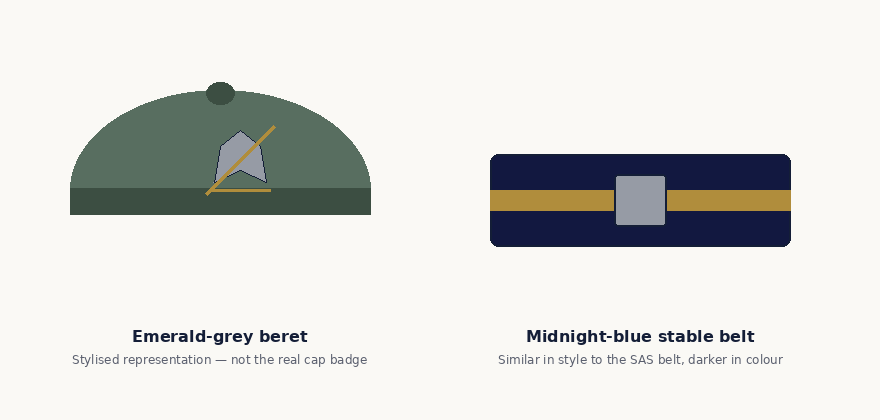
Did you know? The SRR’s cap badge shows Excalibur, the legendary sword — the same sword on the badges of the other UKSF units. The Corinthian helmet and the “RECONNAISSANCE” scroll make the SRR’s version distinct.
Selection and Training
The SRR does not recruit from the public: every volunteer must already be serving in the British Armed Forces, have completed trade training, served at least two years, and be under 32 — 30 for officers — with their commanding officer’s recommendation. Selection is held twice a year.
Volunteers begin with a Briefing Assessment Course, a five-day programme testing fitness, swimming, map reading and motivation. Those who pass move into the aptitude phase of UK Joint Special Forces Selection — the punishing hills phase in the Brecon Beacons that SAS and SBS candidates also face.
From there the SRR path diverges: where SAS and SBS candidates go on to jungle training, SRR candidates move into specialised surveillance and reconnaissance training — covert urban and rural surveillance, close target reconnaissance, photography, listening devices and hidden cameras, covert entry, signals work and advanced driving. The whole process lasts around six months (28 weeks for the SRR), and volunteers keep their existing rates of pay throughout.
It is a hard course: published accounts report a failure rate of around 90 per cent, and women take exactly the same tests as men. Those who finish are awarded the emerald-grey beret and the SRR cap badge. Two honest caveats: the exact content of the SRR’s selection course is not publicly disclosed in full, and published accounts differ on details such as the length of each phase. Operators keep building specialist skills for years, including languages such as Arabic, Farsi and Pashto.
Qualification Badges
Rank insignia shows an operator’s grade; qualification badges show what they are trained to do. The best-known is the parachutist badge — the “wings” worn by soldiers qualified in military parachuting. Some SRR personnel complete the Special Forces parachute course and wear the wings; it is the same badge worn across the British Army, not an SRR invention.
Beyond that, the public record is thin: the SRR’s own surveillance qualifications are not published, and there is no publicly confirmed list of SRR-specific qualification badges.
How Promotion Works in the SRR
Promotion in the SRR follows the parent service’s system, not a regimental one: an Army corporal is promoted by the Army’s rules, a Navy petty officer by the Navy’s, an RAF sergeant by the RAF’s. Service in the regiment does not speed promotion up or slow it down — the soldier’s record, courses and time served decide.
In practice, the SRR’s senior ranks are filled by people who were already senior before they arrived. A sergeant who volunteers and passes selection stays a sergeant, and the regiment’s warrant officers earned their crowns and Royal Arms in parent units first. The same is true of officers: the regiment is commanded by a lieutenant colonel, and its troop commanders are captains, just as in any Army regiment.
Read next
British Military Ranks · US Navy Ranks · US Military Branches
FAQs
Does the SRR have its own rank system?
No. The Special Reconnaissance Regiment uses British Army ranks, and its members keep the rank of their parent service. There are no SRR-specific ranks.
What is the highest rank in the SRR?
Lieutenant Colonel, the rank of its commanding officer. The regiment serves under the Director Special Forces, a Major General, and the highest Army rank is General (OF-9).
What colour beret does the SRR wear?
Emerald grey — a muted green-grey — worn with the SRR cap badge, which shows the sword Excalibur behind a Corinthian helmet with a scroll inscribed “RECONNAISSANCE”. Some sources describe the colour as Lovat green.
Can women join the SRR?
Yes. The regiment recruits volunteers from all three services, men and women, and women take exactly the same tests as men in selection.
How do you join the SRR?
You must already be serving in the British Armed Forces — the regiment does not recruit from the public. Candidates normally need at least two years’ service, to be under 32 (30 for officers), and to have their commanding officer’s recommendation. Selection runs twice a year and lasts around six months.
What is the difference between the SRR and the SAS?
The SRR specialises in covert surveillance and reconnaissance — watching targets and gathering intelligence. The SAS is a direct-action regiment built around raids, hostage rescue and counter-terrorism assaults. The SRR was formed in 2005 to take the surveillance role off the SAS and SBS: the SRR watches, and the SAS acts.
Where is the SRR based?
At Stirling Lines, Credenhill, in Herefordshire, alongside the SAS. Its exact organisation and strength are not publicly disclosed.
All insignia diagrams and images in this article are original graphics created for Forces Guide; the SRR cap badge and beret shown are stylised representations, not reproductions of the real badge.