
SFSG ranks work differently from the rank systems of most famous special forces units — because the Special Forces Support Group does not have a rank system of its own. Its soldiers, Royal Marines and RAF Regiment gunners wear the ranks of their parent service, and for most of the group that means British Army ranks, from Private (OR-1) to Field Marshal (OF-10). This guide explains the unit first — its history, role, selection, beret and badges — and then gives the full British Army rank tables with their insignia, so you can read any SFSG soldier’s rank at a glance.
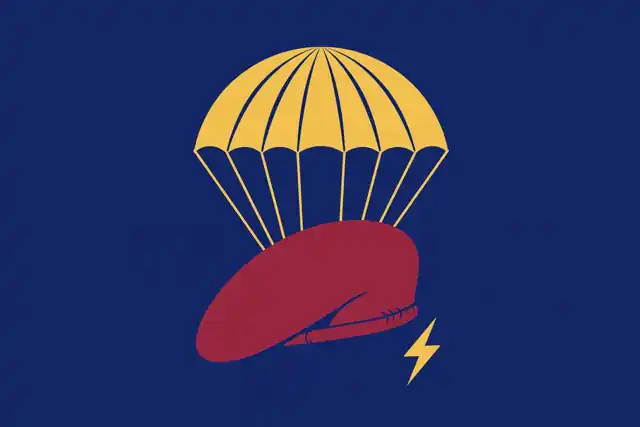
The short version is simple. If you see a member of the SFSG, their chevrons, pips, crowns and crossed sword-and-baton tell you their British Army rank, exactly as they would in any other Army unit. What marks them out as SFSG is not a rank badge at all, but a maroon beret (for the paratroopers), the cap badge of their parent regiment or corps, and a small DZ flash on the right sleeve — a lightning bolt over a downward-pointing sword. There is no separate SFSG rank and no shortcut into the group: every member has already passed one of the toughest selection courses in the British Armed Forces before they arrive.
Key facts
- Unit: Special Forces Support Group (SFSG), part of United Kingdom Special Forces (UKSF)
- Formed: 3 April 2006; inaugural parade 11 May 2006 at RAF St Athan
- Base: MOD St Athan, Vale of Glamorgan, Wales
- Rank system: None of its own — British Army ranks (parent-service ranks for Royal Marines and RAF Regiment members)
- Commissioned officers: OF-1 to OF-9 (Second Lieutenant to General), plus ceremonial Field Marshal (OF-10)
- Other ranks: OR-1 to OR-9 (Private to Warrant Officer Class 1)
- Highest rank in the group: The commanding officer of a battalion-sized unit is normally a Lieutenant Colonel (OF-4)
- Unit identifier: DZ flash — a lightning bolt over a downward-pointing Excalibur, worn on the right sleeve
What Is the Special Forces Support Group?
The Special Forces Support Group is the British Armed Forces’ specialist infantry support unit for its special forces. It was formed officially on 3 April 2006, announced in Parliament by the Defence Secretary John Reid on 20 April 2006, and paraded for the first time at RAF St Athan on 11 May 2006. It sits inside United Kingdom Special Forces (UKSF), the joint command that also holds the Special Air Service (SAS), the Special Boat Service (SBS) and the Special Reconnaissance Regiment (SRR), and it answers to the Director Special Forces.
The idea behind the unit came from hard experience. In Sierra Leone in 2000, during Operation Barras, paratroopers from 1st Battalion, The Parachute Regiment fought alongside the SAS and SBS to free captured soldiers — and the combination worked so well that the lesson stuck. Later, in Afghanistan, small SAS and SBS teams found themselves spending their time on jobs that needed solid infantry rather than specialist assault skills: holding ground and sealing off areas while a raid went in. The SFSG was created to do that work properly, so the small, specialist Tier 1 units could concentrate on the missions only they can do.
One naming point needs care. Some online sources report that in December 2025 the unit was redesignated the Special Forces Strike Group, keeping the same initials, SFSG. The British Army’s own website still calls it the Special Forces Support Group, and no official announcement of a new name has been published — so this article uses the long-established name.
What Does the SFSG Do?
The SFSG’s principal role is to give direct support to UKSF intervention operations around the world, and to add a domestic counter-terrorism capability at home. In practice that breaks down into a handful of jobs:
- Quick reaction force — a formed body of troops ready to move fast to back up an SAS or SBS team in trouble.
- Cordon and blocking force — sealing off an area, guarding roads and approaches, and stopping enemy reinforcements reaching a raid.
- Secondary assaults and diversionary raids — attacking a second target, or making noise in one place so the main assault succeeds elsewhere.
- Large-scale offensive operations — fighting alongside SAS and SBS forces in battles too big for small special forces teams alone.
- Counter-terrorism — a rotating company is held ready to support the on-call SAS or SBS squadron on counter-terrorism duties, including at home.
- Training and mentoring — teaching and advising foreign militaries, a job the SAS used to carry alone; in Afghanistan the SFSG mentored Afghan special forces troops.
- Hunter force on selection — the group acts as the pursuing “enemy” during the escape-and-evasion phase of UKSF Selection.
That mix makes the SFSG the closest British equivalent of the US Army’s 75th Ranger Regiment, which performs the same supporting role for Delta Force. Like the Rangers, the SFSG is often described as a Tier 2 unit — not because its soldiers are second-rate, but because its job is to support the Tier 1 assault units rather than to replace them. On operations a corporal leads a section of about eight soldiers, a sergeant runs a platoon of around thirty, a major commands a strike company, and the lieutenant colonel commands the group — with the Regimental Sergeant Major (WO1) as the commanding officer’s senior advisor.
Did you know? The SFSG’s first operations came almost immediately. Within months of forming, its troops were in Afghanistan supporting the SBS, and in Iraq they worked as “Task Force Maroon” alongside a rotating SAS squadron — cordoning targets, acting as a quick reaction force, and supporting the rescue of two detained SAS men during the Basra prison incident.
Who Serves in the SFSG?
The SFSG is a tri-service unit — soldiers, Royal Marines and RAF Regiment personnel serving together — built around one battalion of infantry. Its exact strength is not publicly disclosed, but it is a battalion-sized group, and open sources put it at roughly 800 personnel. Its three elements are:
- 1st Battalion, The Parachute Regiment (1 PARA) — the core of the group. 1 PARA is based at St Athan and is permanently under the command of the Director Special Forces. Paratroopers from 2 and 3 PARA can apply to join after two years’ service.
- Royal Marines — a company-strength element of commandos, originally formed as F Company. The Marines bring the group’s maritime and amphibious skills, and in later years they have been spread through the group’s companies rather than kept in a single company.
- RAF Regiment — a flight (the RAF equivalent of a platoon, around 30 personnel) of gunners, including Joint Terminal Attack Controllers (JTACs) who call in close air support, and a chemical, biological, radiological and nuclear (CBRN) element.
Around those fighting elements sits the usual battalion machinery: a headquarters, four strike companies (A, B, C and F), a support company with heavy weapons, mortars, snipers and joint fires, and — since a reorganisation in 2018 — R Company, the group’s intelligence, surveillance, target acquisition, reconnaissance (ISTAR) and communications specialists. The companies rotate through four six-month commitments: operations overseas, extreme high readiness for counter-terrorism at home, contingency standby, and training.
How Do You Join the SFSG?
There is no direct entry into the SFSG from civilian life. Every member arrives already qualified through one of the toughest courses in the British military, and then completes the group’s own training on top. The route depends on where you come from:
- Paratroopers pass P Company, the Parachute Regiment’s selection course at Catterick — a series of punishing physical tests — followed by parachute training, after which they are awarded the maroon beret and parachute wings.
- Royal Marines pass the All Arms Commando Course, earning the green beret and the right to wear the commando dagger.
- RAF Regiment gunners pass the RAF Regiment Pre-Parachute selection course.
Once posted in, new members complete the group’s own Unit Operator Cadre, run by its Operational Readiness Wing, which trains them to the SFSG Operator Qualification standard — the group’s own benchmark for the weapons, communications, medical and assault skills the job demands. The full detail of the cadre is not published, and the Ministry of Defence does not release pass rates or course content — so any article claiming to give a day-by-day breakdown of SFSG selection should be treated with suspicion.
Key point: SFSG selection is a second filter, not a first one. You must already be a trained paratrooper, commando or RAF Regiment gunner before the group will take you — and for Paras that means at least two years’ service in a parachute battalion first.
SFSG Beret, Cap Badge and DZ Flash
Here is the detail most people get wrong. The SFSG has no cap badge of its own, and its members do not all wear the same beret. Every member keeps the beret and cap badge of their parent unit:
- Paratroopers wear the maroon beret with the Parachute Regiment cap badge — the winged emblem with a parachute that the regiment has worn since 1943.
- Royal Marines keep the green beret with the globe and laurel cap badge of the Corps.
- RAF Regiment gunners wear their own RAF Regiment beret and cap badge.
So a maroon beret in the SFSG tells you the soldier is a paratrooper, not that he is in the SFSG — plenty of paratroopers outside the group wear exactly the same beret. The one item that is unique to the group is its DZ flash, worn on the right-hand sleeve: a lightning bolt laid over a downward-pointing Excalibur. That flash is the SFSG’s only unit-specific piece of insignia.
SFSG Qualification Badges
Rank shows a soldier’s grade. Qualification badges show what a soldier is trained to do, and SFSG members collect more of them than most soldiers:
- Parachute wings — the embroidered wings worn on the upper sleeve by soldiers qualified in military parachuting. Every paratrooper in the group has earned them, and RAF Regiment members attached to the group are parachute-trained too.
- Commando dagger — the badge of the All Arms Commando Course, worn by the Royal Marines and any Army or RAF personnel in the group who have passed the course.
- JTAC qualification — the RAF Regiment’s Joint Terminal Attack Controllers are qualified to direct close air support onto targets, a skill the group relies on when it fights with air support overhead.
- Sniper, heavy-weapons, medical and CBRN qualifications — the support company’s snipers and weapons teams, the group’s combat medical technicians and its chemical, biological, radiological and nuclear (CBRN) element each hold their own specialist qualifications.
Which of these any individual wears depends on their job in the group, and the full list of the group’s specialist qualifications is not published. What is certain is the principle: in the SFSG, badges are earned through courses, not granted with the posting.
The Key Fact: SFSG Ranks Are British Army Ranks
Because the SFSG is a British Army-led, tri-service group, its rank structure is the British Army rank structure. There are no SFSG-only grades, no special titles for group members, and no separate promotion ladder. A corporal in the SFSG is a corporal in the British Army, promoted by the same boards, paid on the same scale, and wearing the same insignia as a corporal in any other battalion.
That structure has two ladders. Commissioned officers hold the King’s commission and command units; they are identified by NATO codes OF-1 to OF-9, with Field Marshal (OF-10) above them as a ceremonial rank. Other ranks — soldiers, non-commissioned officers (NCOs) and warrant officers — are identified by NATO codes OR-1 to OR-9. British Army officers wear their rank as pips, crowns and crossed sword-and-baton on the shoulder; other ranks wear theirs as chevrons, crowns and the Royal Coat of Arms on the sleeve. Note that British chevrons point downwards, the opposite way from American chevrons.
One exception matters for readers. The Royal Marines and RAF Regiment members of the group keep their own service’s rank titles at equivalent grades — a Royal Marine private is called a Marine, and RAF Regiment ranks follow RAF titles. The tables below give the British Army ranks, which cover the great majority of the group.
SFSG Officer Ranks (OF-1 to OF-9)
Commissioned officers in the SFSG are mostly Parachute Regiment officers, trained at the Royal Military Academy Sandhurst. Junior officers lead platoons; field officers command companies and the battalion; generals command at brigade level and above.
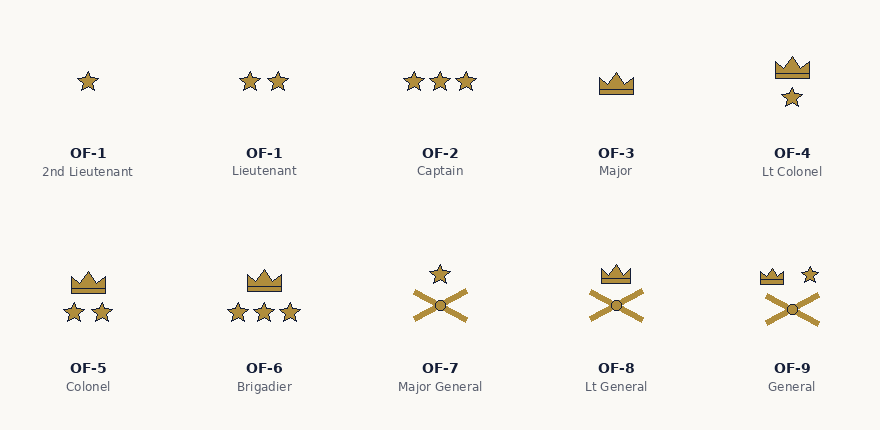
| Rank | NATO Code | Insignia | Typical Role |
|---|---|---|---|
| Second Lieutenant (2Lt) | OF-1 | One pip | Platoon commander; entry-level commissioned officer |
| Lieutenant (Lt) | OF-1 | Two pips | Platoon or troop commander |
| Captain (Capt) | OF-2 | Three pips | Second-in-command of a company; staff officer |
| Major (Maj) | OF-3 | One crown | Company commander; battalion second-in-command |
| Lieutenant Colonel (Lt Col) | OF-4 | Crown above one pip | Battalion commanding officer |
| Colonel (Col) | OF-5 | Crown above two pips | Senior staff officer; regimental or brigade staff |
| Brigadier (Brig) | OF-6 | Crown above three pips | Brigade commander |
| Major General (Maj Gen) | OF-7 | Pip above crossed sword and baton | Division commander; Director Special Forces |
| Lieutenant General (Lt Gen) | OF-8 | Crown above crossed sword and baton | Corps commander; senior command appointment |
| General (Gen) | OF-9 | Crown and pip above crossed sword and baton | Senior command appointment |
Above General sits Field Marshal (OF-10), whose insignia is crossed batons inside a wreath topped by a crown. Field Marshal is now a ceremonial rank, awarded only in exceptional circumstances. Officer cadets training at Sandhurst wear a single white stripe and are not yet commissioned officers.
How to Read British Army Officer Insignia
Officer insignia follow a simple ladder, and once you know the three building blocks you can read any shoulder board:
- Pips — the eight-pointed Bath stars. One pip is a Second Lieutenant, two is a Lieutenant, three is a Captain.
- Crowns — the St Edward’s Crown. A crown on its own is a Major. Add pips below it and you climb: crown and one pip is a Lieutenant Colonel, crown and two is a Colonel, crown and three is a Brigadier.
- Crossed sword and baton — the mark of a general. A pip above it is a Major General, a crown above it is a Lieutenant General, and a crown and a pip above it is a full General.
Two details catch out newcomers. First, a British Major commands a company, while a Captain is usually the company’s second-in-command — the opposite of the American arrangement, where a Captain commands the company. Second, there is no rank of “brigadier general” in the British Army: the one-star rank is simply Brigadier, and the generals begin at Major General.
SFSG Other Ranks (OR-1 to OR-9)
Other ranks are the soldiers of the group — the bulk of its strength. They do the fighting, the patrolling and the guarding, and their senior NCOs and warrant officers are the backbone of every company. The ladder runs from Private, who wears no insignia at all, to Warrant Officer Class 1, whose badge is the Royal Coat of Arms.
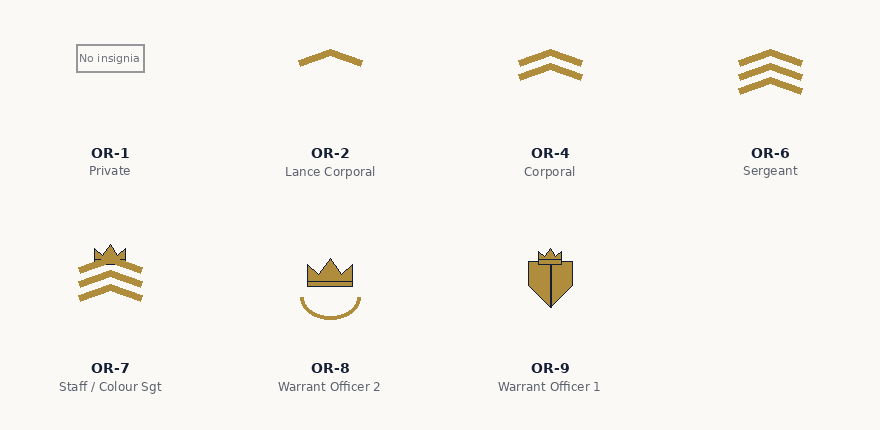
| Rank | NATO Code | Insignia | Typical Role |
|---|---|---|---|
| Private (Pte) | OR-1 | No insignia | Rifleman; entry-level soldier |
| Lance Corporal (LCpl) | OR-2 | One chevron | Second-in-command of a section; first step into leadership |
| Corporal (Cpl) | OR-4 | Two chevrons | Section commander (about eight soldiers) |
| Sergeant (Sgt) | OR-6 | Three chevrons | Platoon sergeant; second-in-command of a platoon |
| Staff Sergeant / Colour Sergeant (SSgt / CSgt) | OR-7 | Three chevrons beneath a crown | Senior NCO in a company; in infantry units the rank is called Colour Sergeant |
| Warrant Officer Class 2 (WO2) | OR-8 | Crown (in a wreath for quartermaster-sergeant appointments) | Company Sergeant Major; senior advisor at company level |
| Warrant Officer Class 1 (WO1) | OR-9 | Royal Coat of Arms | Regimental Sergeant Major; senior soldier of the battalion |
Private soldiers in the Parachute Regiment are usually just called “paratroopers”, and the same rank carries different names in other corps — trooper in the cavalry, gunner in the artillery, sapper in the engineers, guardsman in the Foot Guards. Note also that the British Army has no ranks at NATO grades OR-3 or OR-5, which is why the ladder jumps from OR-2 to OR-4 and from OR-4 to OR-6.
How to Read British Army Other-Ranks Insignia
Other-ranks insignia are read from the sleeve, and the code is even simpler than the officers’:
- Chevrons — the downward-pointing V-shaped stripes. One chevron is a Lance Corporal, two is a Corporal, three is a Sergeant. A Private wears no chevron at all.
- Crown above the chevrons — three chevrons with a crown above them is a Staff Sergeant, or a Colour Sergeant in an infantry battalion like 1 PARA.
- Crown on its own — a Warrant Officer Class 2 wears a crown without chevrons, usually as a Company Sergeant Major. In quartermaster-sergeant appointments the crown sits inside a wreath.
- Royal Coat of Arms — the lion and unicorn shield is a Warrant Officer Class 1, usually the Regimental Sergeant Major, the most senior soldier in the battalion. The most senior WO1 appointment in the whole Army is the Army Sergeant Major.
Did you know? In the Parachute Regiment, the rank of Colour Sergeant is more than a title. Colour Sergeants traditionally guarded the regimental colours — the flags carried into battle — and their dress badge still shows crossed swords and a flag. In the SFSG, where 1 PARA provides the core, Colour Sergeant is the rank you will see most often among the senior NCOs.
How Promotion Works in the SFSG
Promotion follows the British Army’s normal system — there is no separate SFSG promotion ladder. Soldiers are promoted on merit, time in rank and qualification, with selection boards for senior NCO and warrant officer ranks; officers are commissioned at Sandhurst and promoted by central boards.
What the SFSG Does Not Have
It is also worth stating plainly, because many online sources get it wrong: the SFSG has no separate rank system, no separate cap badge, no separate uniform and no published motto. Its members wear the uniform, beret and cap badge of their parent regiment or corps, with British Army ranks on the shoulder or sleeve, and the only item that identifies the group itself is the DZ flash on the right sleeve.
That is also why so little is publicly known about the group. The Ministry of Defence does not publish the SFSG’s order of battle, its exact strength, its current deployments or the details of its selection course. Much of what is written about the unit comes from a handful of books, official announcements from its formation in 2006, and reports of its operations in Iraq and Afghanistan.
Read next
British Military Ranks · Royal Navy Ranks · US Navy Ranks · US Military Branches
FAQs
Does the SFSG have its own ranks?
No. The Special Forces Support Group has no rank system of its own. Its members wear British Army ranks (or their own service’s equivalent ranks, for the Royal Marines and RAF Regiment personnel in the group), from Private (OR-1) to General (OF-9).
What beret do SFSG soldiers wear?
It depends on their parent unit. Paratroopers wear the maroon beret with the Parachute Regiment cap badge, Royal Marines keep the green beret with the globe and laurel, and RAF Regiment gunners wear their own beret and badge. The group’s only unit-specific insignia is its DZ flash on the right sleeve.
What is the SFSG DZ flash?
The DZ flash is a cloth patch worn on the right sleeve showing a lightning bolt over a downward-pointing Excalibur, the sword of legend. It is the one piece of insignia that identifies a soldier as a member of the SFSG.
How do you join the SFSG?
There is no direct civilian entry. You must first join the Parachute Regiment, the Royal Marines or the RAF Regiment and pass P Company, the All Arms Commando Course or the RAF Regiment Pre-Parachute selection course. After at least two years’ service (for Paras), you can apply, and if accepted you complete the group’s Unit Operator Cadre.
What is the highest rank in the SFSG?
The highest rank held in the group itself is normally Lieutenant Colonel (OF-4), who commands the battalion-sized group. The Director Special Forces, who commands all of UKSF including the SFSG, is a Major General (OF-7). The highest rank in the British Army system overall is Field Marshal (OF-10), which is now ceremonial.
Was the SFSG renamed the Special Forces Strike Group?
Some online sources report a redesignation to “Special Forces Strike Group” in December 2025, keeping the initials SFSG. The British Army’s own website still uses the name Special Forces Support Group, and no official announcement has been published, so the rename is not confirmed by an official source.
Where is the SFSG based?
At MOD St Athan in the Vale of Glamorgan, Wales, where the group was formed in 2006 and held its inaugural parade on 11 May 2006. 1st Battalion, The Parachute Regiment is based there with the group.
All insignia diagrams and images in this article are original graphics created for Forces Guide. Insignia devices are stylised schematic representations, not reproductions of official badges.