The Joint Special Forces Aviation Wing is the part of Britain’s special forces that flies. Its helicopters carry special forces teams in and out of places no ordinary aircraft can reach, often at night and often in secret. Yet if you ask what JSFAW ranks look like, there is a surprise: the wing has no rank system of its own. This guide explains the JSFAW ranks picture — the three rank systems it borrows — with the Army, Royal Air Force and Royal Navy tables, the wing’s history, its aircraft and its badges.
JSFAW is a tri-service organisation. Its people come from the Army Air Corps, the Royal Air Force (RAF) and, within the wider joint special forces structure, the Royal Navy. Each person keeps the rank of their own parent service. An Army pilot wears Army pips and a crown, an RAF pilot wears RAF sleeve braid, and a naval officer posted to a joint appointment wears Navy rings. There is no such thing as a “JSFAW rank” — only Army, RAF and Navy ranks worn inside one wing.
Key facts
- Unit: Joint Special Forces Aviation Wing (JSFAW), part of United Kingdom Special Forces (UKSF)
- Formed: 2 April 2001
- Headquarters: RAF Odiham, Hampshire
- Role: Aviation support to UK Special Forces — covert insertion and extraction, transport, resupply and counter-terrorism support
- Squadrons: No. 7 Squadron RAF (Chinook HC6) and No. 658 Squadron AAC (Dauphin II)
- Rank systems used: British Army (OF-1 to OF-9, OR-1 to OR-9), RAF (OF-1 to OF-9, OR-1 to OR-9) and Royal Navy (OF-1 to OF-9, OR-2 to OR-9)
- Own ranks: None — JSFAW has no separate rank system or insignia of its own

What Is the Joint Special Forces Aviation Wing?
JSFAW is the aviation wing of United Kingdom Special Forces (UKSF), the directorate that brings together Britain’s special forces units under the Director Special Forces. Its job is to provide aviation support to special forces wherever they operate: flying teams to their objective, picking them up again, carrying their vehicles and boats, dropping supplies deep behind enemy lines, and standing ready for counter-terrorism call-outs at home.
The wing is small — publicly listed as two squadrons — but it is one of the most important parts of UKSF, because special forces cannot do their work without aircraft that can reach them. It is often compared with the United States’ 160th Special Operations Aviation Regiment, the “Night Stalkers”, which does a similar job for American special operations forces.
History of JSFAW
JSFAW was formed on 2 April 2001, bringing two squadrons under a single command: No. 657 Squadron of the Army Air Corps (Westland Lynx AH9) and the RAF’s No. 7 Squadron (Boeing Chinook HC2). From the start the wing was based at RAF Odiham in Hampshire.
The wing grew in stages. In 2006, No. 651 Squadron AAC was reformed to fly the fixed-wing Britten-Norman Defender 4000 surveillance aircraft and joined the wing for a period; it is no longer publicly listed as one of its squadrons. In 2008, No. 8 Flight AAC joined, operating the Westland Gazelle AH1 and the AgustaWestland A109A, later replaced by Eurocopter AS365N3 Dauphin II helicopters in civilian-style colours. In September 2013 the flight was enlarged and re-designated as No. 658 Squadron AAC, which remains part of the wing today.
Change came again in 2018. The Lynx helicopter was retired on 31 January 2018, and with no replacement bought for the squadron, No. 657 Squadron AAC was disbanded in May 2018. That left the wing with the shape it still has today: one RAF Chinook squadron and one Army Air Corps Dauphin squadron.
The two founding squadrons both have long histories. No. 7 Squadron RAF was first formed at Farnborough on 1 May 1914, making it one of the oldest squadrons in the RAF. No. 658 Squadron traces its roots to 8 Flight AAC and an earlier 658 Squadron, and carries the motto Videmus Delemus — “We see and destroy”.
Role and Missions
JSFAW’s publicly described tasks are the classic work of special operations aviation: covert insertion and extraction of special forces personnel, transport of troops and cargo, resupply of teams far from support, reconnaissance support, and counter-terrorism operations. No. 7 Squadron’s role is often described in three parts: putting UKSF personnel and their vehicles or boats onto an objective, fast-roping them onto targets during counter-terrorism operations, and resupplying them deep behind enemy lines.
No. 658 Squadron AAC has a more specific public role: providing dedicated aviation support to 22 Special Air Service Regiment (22 SAS) for domestic counter-terrorism operations. It shares its home, Stirling Lines in Herefordshire, with 22 SAS itself. Much of what JSFAW does is not publicly disclosed — operational details, aircraft numbers and deployment histories are not published by the Ministry of Defence, and they are not guessed at here.
Structure: The Squadrons of JSFAW
The wing is commanded by a Wing Commander (OF-4), and in peacetime it sits under the Station Commander of RAF Odiham, a Group Captain (OF-5). The single services retain full command of their own personnel — the RAF commands its people, the Army its people, the Navy its people — even while they serve together in the wing. That is why the rank systems stay separate.
| Squadron | Parent Service | Base | Aircraft (publicly listed) |
|---|---|---|---|
| No. 7 Squadron | Royal Air Force | RAF Odiham, Hampshire | Boeing Chinook HC6 |
| No. 658 Squadron | Army Air Corps (British Army) | Stirling Lines, Herefordshire | Eurocopter AS365N3 Dauphin II |
| Wing Headquarters | Joint (RAF and Army) | RAF Odiham, Hampshire | — |
Two former squadrons are worth knowing about so they are not confused with the current wing. No. 657 Squadron AAC (Lynx AH9) was a founding squadron, disbanded in May 2018. No. 651 Squadron AAC (Defender fixed-wing aircraft) joined in 2006 and later left the wing. The Special Forces Flight of No. 47 Squadron RAF, which flies the C-130 Hercules from RAF Brize Norton, is not generally listed as part of JSFAW, although one source in 2015 claimed otherwise.
Aircraft Flown by JSFAW
Only two aircraft types are publicly listed as JSFAW aircraft today. The Boeing Chinook HC6 is the heavy-lift, twin-rotor helicopter flown by No. 7 Squadron from RAF Odiham — the RAF’s largest helicopter, able to carry troops, vehicles, boats and heavy loads. The Eurocopter AS365N3 Dauphin II is the smaller helicopter flown by No. 658 Squadron from Stirling Lines, a light, fast helicopter suited to discreet work, reported in civilian-style colours for low-profile tasks.
Earlier JSFAW aircraft included the Westland Lynx AH9 (657 Squadron, retired with the squadron in 2018), the Westland Gazelle AH1 (the last Gazelle retired in 2023) and the AgustaWestland A109A (replaced by the Dauphin in 2009). The fixed-wing Britten-Norman Defender 4000 served with 651 Squadron while that squadron was part of the wing. Aircraft numbers and the exact current fleet are not publicly confirmed, so no figures are given here.
Who Wears Which Rank? The Tri-Service System
Because the wing is tri-service, three different rank ladders operate side by side inside it, and the same level of seniority can have three different names.
| Personnel | Rank System Used | How Rank Is Shown |
|---|---|---|
| No. 7 Squadron aircrew and support staff | Royal Air Force | Blue-grey sleeve braid for officers; propellers and chevrons for other ranks |
| No. 658 Squadron aircrew and support staff | British Army (Army Air Corps) | Pips and crowns on shoulder straps for officers; chevrons and crowns for other ranks |
| Royal Navy personnel in joint UKSF appointments | Royal Navy | Gold sleeve rings for officers; anchors, crowns and chevrons for ratings |
JSFAW is listed in Army records as a tri-service wing. In practice, its two publicly listed flying squadrons are RAF and Army Air Corps, while Royal Navy personnel serve in the wider UKSF joint structure that JSFAW supports, keeping Royal Navy rank. No Royal Navy flying squadron is publicly listed as part of JSFAW, and this article does not invent one.
Did you know? A Wing Commander (RAF, OF-4) commands JSFAW, but the Army equivalent of that rank is a Lieutenant Colonel and the Navy equivalent is a Commander. All three are OF-4, all three are equals — and all three could be serving in the same wing at the same time.
Berets, Cap Badges and Headdress
Headdress is the quickest way to tell which service a JSFAW member belongs to. Army Air Corps soldiers wear the corps’ distinctive blue beret, worn with pride since the corps was formed in 1957. RAF personnel wear the RAF’s blue-grey beret or peaked cap with the RAF cap badge, while Royal Navy personnel wear the naval peaked cap or dark navy beret with the naval cap badge — a fouled anchor under a crown. None of these is a JSFAW badge: each person wears the headdress of their parent service. The diagrams in this article are stylised generic representations of berets, stripes, pips and chevrons — not copies of any real cap badge, and no actual unit cap badge is reproduced here.
Note that the famous sand-coloured beret belongs to the SAS, not to JSFAW. JSFAW aircrew do not wear it.
Qualification Badges: Wings and Brevets
Rank shows seniority. Qualification badges show what a person is trained to do, and in an aviation wing they matter almost as much as rank. The most important are the flying badges — the “wings”. An RAF pilot wears the RAF pilot’s flying badge, known as a brevet: embroidered wings with a crown and the RAF eagle, worn above the left breast pocket. An Army Air Corps pilot wears the Army Flying Badge, awarded on qualifying as an Army pilot. A Royal Navy pilot wears Fleet Air Arm wings, with a crown and a fouled anchor at the centre.
Other aircrew wear their own brevets. RAF aircrew in roles such as weapons systems operator or air loadmaster wear specialist aircrew badges, and Army rear crew wear the Army’s aircrew badges. Parachutist wings are worn by personnel qualified in military parachuting. None of these badges changes a person’s rank: a corporal with wings is still a corporal. But in JSFAW, where almost everyone flies or supports flying, wings are the badge that marks the aircrew from the ground crew.
British Army Officer Ranks (OF-1 to OF-9)
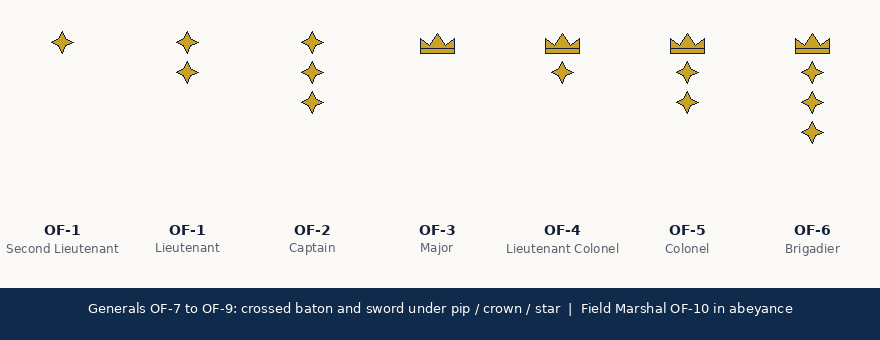
Army officers in JSFAW wear pips and crowns on their shoulder straps. A pip is a small eight-pointed star, often called a Bath star. Junior officers wear pips alone; field officers add a crown; generals wear crossed baton and sword devices. The most senior Army rank, Field Marshal (OF-10), is in abeyance.
| Rank | NATO Code | Insignia | Typical Role |
|---|---|---|---|
| Second Lieutenant (2Lt) | OF-1 | One pip | Troop or platoon commander |
| Lieutenant (Lt) | OF-1 | Two pips | Troop commander; junior pilot |
| Captain (Capt) | OF-2 | Three pips | Flight commander; experienced pilot |
| Major (Maj) | OF-3 | One crown | Squadron second-in-command |
| Lieutenant Colonel (Lt Col) | OF-4 | Crown above one pip | Squadron commanding officer |
| Colonel (Col) | OF-5 | Crown above two pips | Senior staff officer |
| Brigadier (Brig) | OF-6 | Crown above three pips | Brigade commander |
| Major General (Maj Gen) | OF-7 | Pip above crossed baton and sword | Division commander |
| Lieutenant General (Lt Gen) | OF-8 | Crown above crossed baton and sword | Corps commander |
| General (Gen) | OF-9 | Crown and star above crossed baton and sword | Most senior serving Army rank |
British Army Other Ranks (OR-1 to OR-9)
Army other ranks — everyone below commissioned officer — wear their rank as chevrons and crowns on the sleeve. A private wears no insignia at all. In the Army Air Corps, ground crew, technicians and support soldiers in JSFAW follow this ladder.
| Rank | NATO Code | Insignia | Typical Role |
|---|---|---|---|
| Private (Pte, or equivalent) | OR-1 | No insignia | Trained soldier |
| Lance Corporal (LCpl) | OR-2 | One chevron | Leads a small team |
| Corporal (Cpl) | OR-4 | Two chevrons | Section commander |
| Sergeant (Sgt) | OR-6 | Three chevrons | Platoon sergeant |
| Staff Sergeant / Colour Sergeant (SSgt / CSgt) | OR-7 | Crown above three chevrons | Company quartermaster roles |
| Warrant Officer Class 2 (WO2) | OR-8 | Crown in a wreath | Squadron or company sergeant major |
| Warrant Officer Class 1 (WO1) | OR-9 | Royal Arms | Regimental sergeant major |
Two NATO grades have no separate Army rank — there is no distinct rank at OR-3 or OR-5 — which is why the ladder jumps from Lance Corporal (OR-2) to Corporal (OR-4), and from Corporal (OR-4) to Sergeant (OR-6).
RAF Officer Ranks (OF-1 to OF-9)
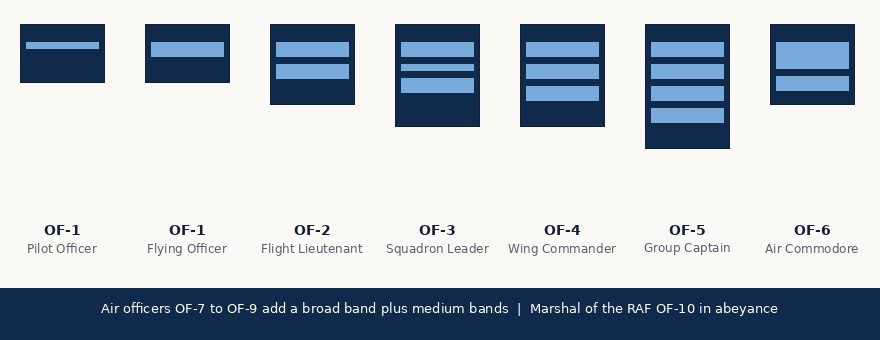
RAF officers in JSFAW wear their rank as rings of light-blue braid on a dark blue sleeve: a thin stripe, a medium stripe and a broad stripe, combined in different numbers. Junior officers wear one or two stripes; senior officers add a broad stripe. The most senior RAF rank, Marshal of the Royal Air Force (OF-10), is in abeyance.
| Rank | NATO Code | Insignia | Typical Role |
|---|---|---|---|
| Pilot Officer (Plt Off) | OF-1 | One thin stripe | Newly qualified pilot |
| Flying Officer (Fg Off) | OF-1 | One medium stripe | Co-pilot or pilot |
| Flight Lieutenant (Flt Lt) | OF-2 | Two medium stripes | Aircraft captain |
| Squadron Leader (Sqn Ldr) | OF-3 | Two medium stripes with a thin stripe between | Flight commander |
| Wing Commander (Wg Cdr) | OF-4 | Three medium stripes | Squadron commander; commands JSFAW |
| Group Captain (Gp Capt) | OF-5 | Four medium stripes | Station commander, e.g. RAF Odiham |
| Air Commodore (Air Cdre) | OF-6 | One broad stripe with medium stripes | One-star air officer |
| Air Vice-Marshal (AVM) | OF-7 | Broad stripe with one medium stripe | Two-star air officer |
| Air Marshal (Air Mshl) | OF-8 | Broad stripe with two medium stripes | Three-star air officer |
| Air Chief Marshal (Air Chf Mshl) | OF-9 | Broad stripe with three medium stripes | Four-star air officer; most senior serving RAF rank |
RAF Other Ranks (OR-1 to OR-9)
RAF other ranks in JSFAW — the technicians, loadmasters, engineers and support staff of No. 7 Squadron — wear a mix of propellers and chevrons. A two-bladed propeller marks a junior airman, and chevrons take over from Corporal upward, with a crown or the Royal Arms for the most senior airmen.
| Rank | NATO Code | Insignia | Typical Role |
|---|---|---|---|
| Air Recruit (AR) | OR-1 | No insignia | Recruit in training |
| Air Specialist (Class 2) (AS2) | OR-1 | No insignia | Trained airman |
| Air Specialist (Class 1) (AS1) | OR-2 | Two-bladed propeller | Technician or operator |
| Corporal (Cpl) | OR-4 | Two chevrons | Team leader |
| Sergeant (Sgt) | OR-6 | Three chevrons | Section leader |
| Chief Technician (Chf Tech) | OR-7 | Four-bladed propeller | Senior technical specialist |
| Flight Sergeant (FS) | OR-7 | Crown above three chevrons | Senior NCO |
| Warrant Officer (WO) | OR-9 | Royal Arms | Station warrant officer |
RAF aircrew have their own parallel titles at the senior end: Sergeant Aircrew, Flight Sergeant Aircrew and Master Aircrew (OR-9), who wear a wreath with the RAF eagle. The RAF has no Warrant Officer Class 2 — unlike the Army and Navy, it jumps straight from Flight Sergeant to Warrant Officer.
Royal Navy Officer Ranks (OF-1 to OF-9)
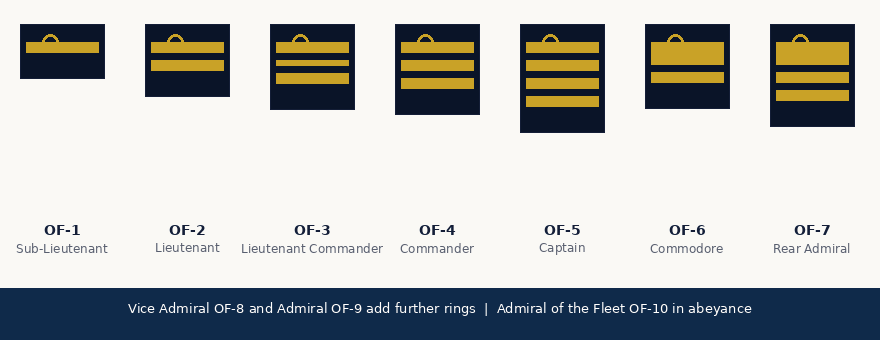
Royal Navy officers wear their rank as gold rings on the sleeve, with a distinctive loop — the executive curl — in the top ring. The rings grow more numerous with seniority, and a broad ring marks the flag ranks. The most senior Navy rank, Admiral of the Fleet (OF-10), is in abeyance.
| Rank | NATO Code | Insignia | Typical Role |
|---|---|---|---|
| Midshipman (Mid) | OF-1 | One small ring (no curl) | Officer under training |
| Sub-Lieutenant (Sub Lt) | OF-1 | One ring with executive curl | Junior officer |
| Lieutenant (Lt) | OF-2 | Two rings, curl on top | Watchkeeper |
| Lieutenant Commander (Lt Cdr) | OF-3 | Two rings with a thin ring between | Department head |
| Commander (Cdr) | OF-4 | Three rings, curl on top | Commands a small ship |
| Captain (Capt) | OF-5 | Four rings, curl on top | Commands a major ship |
| Commodore (Cdre) | OF-6 | One broad ring with executive curl | Flotilla commander |
| Rear Admiral (RAdm) | OF-7 | Broad ring with one ring below | Flag officer |
| Vice Admiral (VAdm) | OF-8 | Broad ring with two rings below | Flag officer |
| Admiral (Adm) | OF-9 | Broad ring with three rings below | Most senior serving Navy rank |
Royal Navy Ratings (OR-2 to OR-9)
Sailors in the Royal Navy do not technically hold “rank” — they hold a rate, and are called ratings. Their sleeve insignia is built from anchors, crowns, chevrons and the Royal Arms.
| Rate | NATO Code | Insignia | Typical Role |
|---|---|---|---|
| Able Rating (AB) | OR-2 | Branch badge, with stars as qualified | Trained sailor |
| Leading Rating (LH) | OR-4 | Anchor above one chevron | Leading hand |
| Petty Officer (PO) | OR-6 | Crown above crossed anchors | Departmental leader |
| Chief Petty Officer (CPO) | OR-7 | Crown above crossed anchors with laurel | Chief of a department |
| Warrant Officer 2 (WO2) | OR-8 | Crown in a wreath | Senior warrant officer |
| Warrant Officer 1 (WO1) | OR-9 | Royal Arms | Warrant officer of a ship |
Ratings also wear branch badges on the right sleeve showing their trade, with stars and crowns showing qualification level. Rate insignia goes on the left sleeve, branch badge on the right.
How the Three Systems Line Up
The NATO codes are the key to comparing the three services, because the names differ while the seniority matches. A Flight Lieutenant (RAF), Captain (Army) and Lieutenant (Navy) are all OF-2 — equals, despite three different titles.
| NATO Code | British Army | Royal Air Force | Royal Navy |
|---|---|---|---|
| OF-4 | Lieutenant Colonel | Wing Commander | Commander |
| OF-3 | Major | Squadron Leader | Lieutenant Commander |
| OF-2 | Captain | Flight Lieutenant | Lieutenant |
| OF-1 | Second Lieutenant / Lieutenant | Pilot Officer / Flying Officer | Midshipman / Sub-Lieutenant |
| OR-9 | Warrant Officer Class 1 | Warrant Officer / Master Aircrew | Warrant Officer 1 |
| OR-7 | Staff / Colour Sergeant | Flight Sergeant / Chief Technician | Chief Petty Officer |
| OR-6 | Sergeant | Sergeant | Petty Officer |
| OR-4 | Corporal | Corporal | Leading Rating |
Key point: never translate a rank word for word. An Army Captain is OF-2, but a Navy Captain is OF-5 — three grades higher. Inside JSFAW, the NATO code is the only safe way to compare a soldier, an airman and a sailor.
Selection and Training
There is no publicly published JSFAW selection course, and this article does not pretend otherwise. Unlike the SAS, SBS and Special Reconnaissance Regiment, whose candidates go through the joint UK Special Forces Selection course, JSFAW’s aircrew are already qualified pilots and aircrew from their parent service before they join the wing. A pilot arrives with wings, flying hours and a service record, and is then screened and trained for the special forces support role — night flying, low-level flying, fast-roping and the demanding standards of flying with special forces teams.
What that further training involves, how long it takes, and how candidates are chosen is not publicly disclosed by the Ministry of Defence. The same is true of the wing’s operational history: JSFAW is known to have supported UK operations overseas, but the Ministry of Defence does not publish a list of its missions. Treat any website claiming a detailed JSFAW selection syllabus or a full operations list with caution — the public record does not contain one.
What is public is the pipeline that feeds the wing. Army pilots train at the Army Aviation Centre at Middle Wallop, RAF pilots through the RAF flying training system, and naval aircrew through the Fleet Air Arm. In every case, the person’s rank comes from their parent service and travels with them into JSFAW — earned before they arrive, not awarded by the wing.
How to Read JSFAW Insignia at a Glance
Reading rank in JSFAW means first asking which service the person belongs to, then reading that service’s code. For the Army, count the pips, then look for a crown: pips alone mean a junior officer, a crown alone means a Major, a crown with pips means a Lieutenant Colonel or above. For the RAF, count the braid: thin stripes are junior, medium stripes are the working ranks, a broad stripe marks an air officer. For the Navy, count the gold rings and look for the curl in the top ring.
For other ranks, chevrons are the common language of the Army and RAF: one chevron is a Lance Corporal, two a Corporal, three a Sergeant. A crown above the chevrons marks a senior NCO, and the Royal Arms marks a Warrant Officer Class 1 or equivalent. In the Navy, look for the anchor: a chevron under an anchor is a Leading Rating, crossed anchors under a crown are a Petty Officer or Chief Petty Officer. Remember the golden rule — the NATO code, not the title, tells you who outranks whom.
Read next
British Military Ranks · British Air Force Ranks · Royal Navy Ranks · US Navy Ranks · US Military Branches
FAQs
Does JSFAW have its own ranks?
No. JSFAW has no rank system of its own. Its personnel keep the ranks of their parent service — the Army Air Corps uses British Army ranks, No. 7 Squadron uses RAF ranks, and Royal Navy personnel in joint appointments use Royal Navy ranks.
Which squadrons make up JSFAW?
Two squadrons are publicly listed: No. 7 Squadron RAF, flying the Chinook HC6 from RAF Odiham, and No. 658 Squadron AAC, flying the Dauphin II from Stirling Lines in Herefordshire. The wing headquarters is at RAF Odiham.
What aircraft does JSFAW fly?
Publicly listed aircraft are the Boeing Chinook HC6 and the Eurocopter AS365N3 Dauphin II. Earlier aircraft included the Lynx AH9, Gazelle AH1 and A109A, and the Defender fixed-wing aircraft while 651 Squadron was part of the wing.
What is the highest rank in JSFAW?
There is no JSFAW rank, so there is no single highest rank. The wing is commanded by a Wing Commander (RAF, OF-4), and the station commander at RAF Odiham is a Group Captain (OF-5). Officers of higher rank in all three services hold senior appointments above the wing.
Do JSFAW personnel wear the SAS sand beret?
No. The sand beret belongs to the SAS. JSFAW personnel wear the headdress of their parent service — the AAC blue beret, the RAF blue-grey beret or cap, or naval headdress.
Is JSFAW part of the SAS?
No. JSFAW is a separate unit within United Kingdom Special Forces (UKSF). It provides aviation support to the SAS, the SBS and the other UKSF units, but it is not part of any of them.
How do I join JSFAW?
There is no direct public entry route. Personnel join JSFAW after qualifying in their parent service — as an Army, RAF or Navy pilot, aircrew member or technician — and are then selected and trained for the special forces support role. The details of that selection are not publicly disclosed.
All insignia diagrams and images in this article are original graphics created for Forces Guide. Rank tables are based on the publicly listed rank structures of the British Army, Royal Air Force and Royal Navy. Where JSFAW details are not publicly confirmed, this article says so rather than speculating.