If you have ever spotted a young Swiss man in uniform on a Friday-afternoon train, kit bag at his feet and rifle case over his shoulder, you have seen the Swiss militia system in action. He is probably heading home after three weeks of refresher training — and on Monday he will be back at his ordinary job, as a teacher, an engineer or an apprentice. That is the first thing to understand about Swiss military ranks: most of the people who hold them are soldiers only part of the time. This guide walks through every rank in the Swiss Armed Forces, from the newest recruit, a Rekrut, to the most senior peacetime officer, a Korpskommandant — plus the one rank above them all, General, which only exists when Switzerland goes to war.
Here is the whole system in plain English: what each German rank name means, what the person holding it actually does all day, what their shoulder board looks like, and the NATO code (OR-1 to OR-9, OF-1 to OF-9) so you can compare it with the US Army or the German Army. The Army and the Air Force share a single rank ladder, there is no navy to learn, and every rank has a name in four languages — German, French, Italian and Romansh. This guide uses the German forms, the ones you will see most often, and gives the French and Italian where they help.
Key facts
- Country: Switzerland — Swiss Armed Forces (Schweizer Armee)
- Branches: Land Forces and Air Force share one rank system; there is no navy
- Enlisted and NCO ranks: OR-1 to OR-9, from Soldat to Chefadjutant — plus Rekrut, who holds no NATO code
- Commissioned officers: OF-1 to OF-9, from Leutnant to General
- Highest rank in peacetime: Korpskommandant (Lieutenant General, OF-8), held by the Chief of the Armed Forces
- The wartime-only rank: General (OF-9) — parliament elects one only in wartime; the last was Henri Guisan in the Second World War
- Notable fact: Switzerland runs a militia army. Of roughly 145,000 personnel, only about 20,000 are full-time professionals — the rest are citizens who train for a few weeks a year
One Ladder, Two Services — and No Navy at All
Switzerland is landlocked, so the first thing to cross off your list is the navy: there isn’t one. The Swiss Armed Forces have two services, the Land Forces and the Swiss Air Force, and both use exactly the same ranks, the same German titles and the same insignia. A Wachtmeister is a Wachtmeister whether he serves in an infantry battalion or on an air base — only the colour of his shoulder board changes. (There are small patrol boats on the Swiss lakes, but they are a police-style border task, not a navy, and they use no naval ranks.)
That single ladder keeps things simple, but it hides a lot of variety. The colour behind the rank tells you the wearer’s branch: dark green for infantry, dark blue for the Air Force, yellow for armour, red for artillery, black for staff and engineers, royal blue for medical troops, plum for logistics, khaki for special forces and orange for the territorial corps. So when you meet a Swiss soldier, the shoulder board answers two questions at once — how senior they are, and what kind of unit they belong to.
Soldiers and Sergeants: the Other Ranks, OR-1 to OR-9
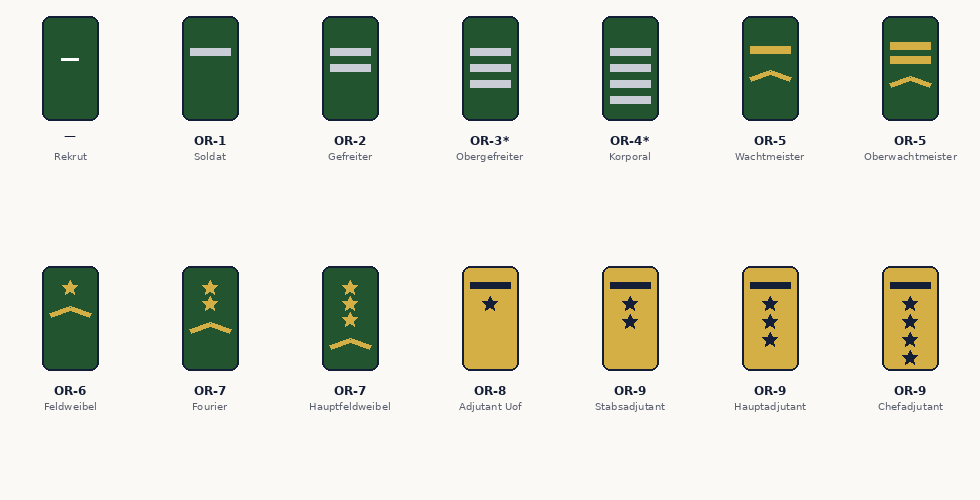
Almost every Swiss man starts on this ladder. He turns up for recruit school, spends 18 to 21 weeks learning to be a soldier, and at the end of it he is promoted from Rekrut to Soldat — and for the first time, something appears on his shoulder boards. From there the ladder climbs through the junior soldiers, the sergeants who run platoons, the senior NCOs who keep companies and battalions working, and finally the warrant officers, the technical experts at the top of the enlisted world. Here is the full list, lowest first.
| NATO Code | Rank (German) | English Equivalent | What They Actually Do |
|---|---|---|---|
| — | Rekrut | Recruit | In recruit school for about four months; wears no rank insignia at all |
| OR-1 | Soldat | Private E-1 | The ordinary soldier: patrols, guard duty, driving, digging, carrying — one silver bar |
| OR-2 | Gefreiter | Private E-2 | A reliable soldier trusted with small jobs and two or three others to look after — two silver bars |
| OR-3* | Obergefreiter | Private First Class | An experienced private for specialist kit and harder tasks — three silver bars; abolished in 2019, earlier holders keep it |
| OR-4* | Korporal | Corporal | A specialist NCO — weapons, signals, medical or postal work — four silver bars; no new promotions since 2019 |
| OR-5 | Wachtmeister | Sergeant | The platoon sergeant: runs daily life, training and welfare for the platoon — one gold bar with a chevron |
| OR-5 | Oberwachtmeister | Sergeant First Class | The platoon leader’s deputy, picked for very good assessments; serves ten extra days — two gold bars with a chevron |
| OR-6 | Feldweibel | Sergeant Major | A senior NCO, often in military police or specialist units, keeping service and operations on track |
| OR-7 | Fourier | Quartermaster Sergeant | The company’s quartermaster: the money, the food and the beds — every soldier knows the Fourier |
| OR-7 | Hauptfeldweibel | Chief Sergeant Major | The senior NCO who oversees service and operations across a whole unit |
| OR-8 | Adjutant Unteroffizier | Warrant Officer | A technical specialist — logistics, maintenance and other expert work — rather than a troop commander |
| OR-9 | Stabsadjutant | Staff Warrant Officer | The battalion’s warrant officer, advising the commander and guiding the senior NCOs |
| OR-9 | Hauptadjutant | Master Warrant Officer | The brigade’s warrant officer, the expert adviser at brigade level |
| OR-9 | Chefadjutant | Chief Warrant Officer | The most senior warrant officer, advising commanders at division level |
* Obergefreiter was removed on 1 January 2019 under the army’s WEA reform, and no new promotions to Korporal have been made since 2019 either. Soldiers who already held these ranks were allowed to keep them, so you can still meet both on a Swiss uniform today.
Did you know? Swiss soldiers are paid by the day, and promotion shows up in the pay packet. A Soldat earns 6 Swiss francs a day; a Gefreiter earns 7.50. It is not much money — nobody joins the Swiss Army to get rich — but the extra 1.50 francs is a small, very Swiss way of saying that good work in a refresher course has been noticed.
Reading an Enlisted Shoulder Board
Swiss enlisted insignia are worn on the shoulder boards, and once you know the code you can read them in seconds. Start by counting the silver bars: one bar is a Soldat, two is a Gefreiter, three is an Obergefreiter and four is a Korporal. Silver means junior soldier; when the bars turn gold and a chevron — the little V-shape — appears, you are looking at a sergeant. A Wachtmeister wears one gold bar with a chevron, and an Oberwachtmeister adds a second gold bar.
From there the boards get busier: the senior NCOs — Feldweibel, Fourier and Hauptfeldweibel — combine gold chevrons with stars, more stars as the rank rises. The warrant officers sit on a gold base board, with a gold bar and stars marking their seniority. And if the shoulder board is completely blank, that is not a mistake: a Rekrut in recruit school wears no insignia at all, because he has not earned his first bar yet. The board’s background colour, meanwhile, tells you the branch — dark green for infantry, dark blue for the Air Force, yellow for armour, red for artillery, and so on — so rank and branch are read together, at a glance.
The Officers: OF-1 to OF-9
Swiss officers do not arrive from a separate world. Almost all of them climb the same ladder you have just read: recruit school, then NCO school, then officer school, with refresher courses in between. A new Leutnant has typically already served as a sergeant, and he will go on leading a platoon of twenty to forty soldiers while holding down a civilian job the rest of the year. Only the generals at the very top are full-time professionals. Here is the officer ladder, lowest first.
| NATO Code | Rank (German) | English Equivalent | What They Actually Do |
|---|---|---|---|
| OF-1 | Leutnant | Second Lieutenant | Leads a platoon of 20–40 soldiers; the first officer rank, after officer school |
| OF-1 | Oberleutnant | First Lieutenant | Senior platoon leader, deputy company commander, or a new officer on battalion staff |
| OF-2 | Hauptmann | Captain | Commands a company of 100–150 soldiers, or serves on battalion staff |
| OF-3 | Major | Major | Battalion staff officer — often chief of staff — or a staff officer in a large unit |
| OF-4 | Oberstleutnant | Lieutenant Colonel | Commands a battalion, or deputises for a brigade commander |
| OF-5 | Oberst | Colonel | Senior staff officer, deputy brigade commander, or battalion commander in special cases |
| OF-1 to OF-5 | Fachoffizier | Specialist Officer | An expert — doctor, engineer, cyber specialist — whose grade follows the job, not a command ladder |
| OF-6 | Brigadier | Brigadier General | Commands a brigade; also serves as a military attaché — one gold star |
| OF-7 | Divisionär | Major General | Commands a territorial division, or serves at Army headquarters — two gold stars |
| OF-8 | Korpskommandant | Lieutenant General | The Chief of the Armed Forces; the highest rank in peacetime — three gold stars |
| OF-9* | General | General | Commander-in-chief of the whole armed forces — but only in wartime; four gold stars |
* General is not a rank you can be promoted to. Switzerland’s parliament, the Federal Assembly, elects a General only when the country mobilises for war — and the rank disappears again when the crisis ends.
Key point: In peacetime, the word “general” is not used at all in the Swiss military — not even for the top officers. A Brigadier, a Divisionär and a Korpskommandant are all generals in the NATO sense, but none of them is called one. The only General Switzerland has ever had in living memory was Henri Guisan, elected by parliament in August 1939, who led the army through the Second World War and was discharged in 1945. Before him, the rank had been used just three times: in the Neuchâtel Crisis, the Franco-Prussian War and the First World War.
Reading an Officer’s Shoulder Board
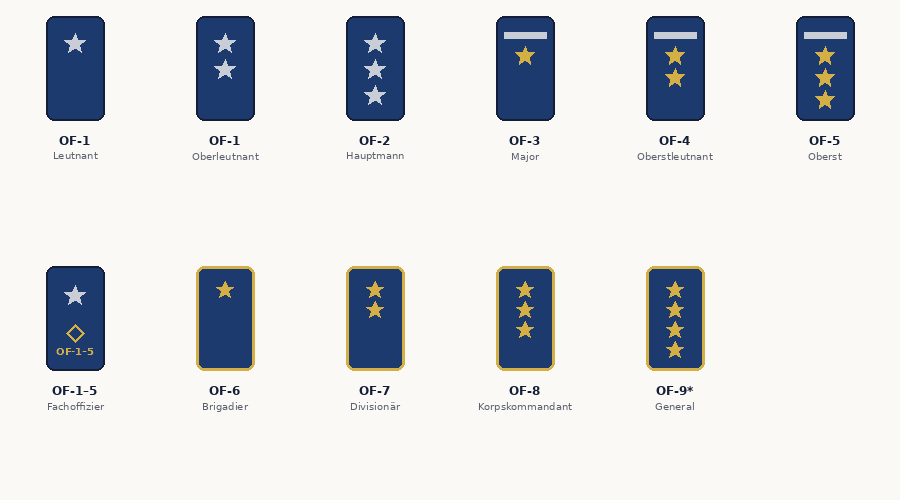
Officer boards follow a simple rule: silver stars for junior officers, gold stars for everyone senior. A Leutnant wears one silver star, an Oberleutnant two and a Hauptmann three — count the silver stars and you have the junior officer. Step up to the field officers and the pattern changes: a Major, an Oberstleutnant and an Oberst wear one, two and three gold stars above a silver bar. That silver bar is the giveaway that you are looking at a staff officer rather than a junior one.
The generals are the simplest of all: plain gold stars, one for a Brigadier, two for a Divisionär, three for a Korpskommandant and four for a wartime General. Two more details mark the senior officers out on parade: the higher staff officers wear black lampasses — stripes down the outside seam of their dress trousers — and the four most senior ranks wear a kepi (a peaked dress cap) with extra rank insignia. The Fachoffizier, the specialist officer, is the exception to every rule: his or her board mirrors the ordinary officer pattern but adds a specialist badge — a doctor’s caduceus, for example — because the grade follows the civilian expertise, not a command ladder.
Citizen-Soldiers: What the Militia System Does to Rank
Here is the thing that makes Swiss ranks different from almost every other army in Europe — and very different from the US Army or the British Army, where soldiering is a full-time career. In Switzerland, soldiering is something most citizens do alongside their real lives. Every Swiss man is liable for service from the age of 18, women may volunteer, and the total obligation is about 245 days: 18 to 21 weeks of recruit school, then six three-week refresher courses spread over the next nine years. After that, he returns to civilian life — and stays in the reserve, ready to be called up, for years afterwards.
That shapes everything about promotion. You do not get promoted in Switzerland just for serving your time. You get promoted by passing the next course and doing well in your refresher training — NCO school to become a Wachtmeister, officer school to become a Leutnant, staff courses to climb higher. A soldier can also step forward for promotion during his refresher courses, which means a keen Gefreiter in his late twenties can still decide to become a sergeant. And because everyone goes home again, rank and daily life sit side by side in a way that surprises outsiders: the platoon sergeant shouting orders on a Tuesday morning might be a schoolteacher on Wednesday.
The Swiss are also careful to separate rank, function and command. Your rank is your place on the ladder; your function is the job you have been given; and command — who can actually order whom around — follows the appointment, not just the badge. Two soldiers with the same rank can hold very different jobs, and if two people hold the same rank, the one who has held it longer (and then the older one) takes precedence. It is a system built for a country that wants an army ready to mobilise at short notice, but does not want a permanent military class — which is also why the top rank, General, does not exist until parliament votes it into being. Switzerland would rather keep its highest military office empty in peacetime than hand it to someone permanently.
One last detail that catches visitors out: the same rank has different names depending on where in Switzerland you are. A German-speaking sergeant is a Wachtmeister; his French-speaking counterpart is a Sergent; in Italian-speaking Ticino he is a Sergente. The shoulder board is the same, the job is the same — only the word changes. That is Switzerland in miniature: four languages, one army, and a rank system that has barely changed in centuries.
Read next
German Army Ranks · French Military Ranks · Italian Army Ranks · Canadian Armed Forces Ranks · Military Ranks and Insignia: The Complete Overview
Frequently Asked Questions
What is the highest rank in the Swiss army?
In peacetime, the highest rank is Korpskommandant — Lieutenant General, NATO code OF-8. That is the rank held by the Chief of the Armed Forces. Above it sits General (OF-9), but that rank only exists in wartime, when parliament elects a commander-in-chief.
How many ranks are there in the Swiss army?
There are 24 rank levels from Rekrut to General, but only 23 of them are in everyday peacetime use — General is the exception. Counting the peacetime ladder, that is 14 other ranks (OR-1 to OR-9, plus Rekrut) and 9 officer ranks (OF-1 to OF-8), with the specialist Fachoffizier sitting alongside the officer grades.
Does Switzerland have generals?
Not in the way most countries do. Switzerland has no serving general in peacetime, and the word “general” is not even used for its senior officers — they are called Brigadier, Divisionär and Korpskommandant. A General is elected by the Federal Assembly only when the country mobilises for war. The last one was Henri Guisan in the Second World War.
Does Switzerland have a navy?
No. Switzerland is landlocked, so it has no navy and no naval ranks. Its armed forces are the Land Forces and the Air Force. There are small patrol boats on Swiss lakes for border and security work, but they are not a navy and their crews hold ordinary Army ranks.
Is military service mandatory in Switzerland?
Yes — for men. Every able-bodied Swiss man is liable for military service (or civilian service as an alternative) from the age of 18, and women may volunteer for any role. The standard obligation is about 245 days in total: 18 to 21 weeks of recruit school, followed by six three-week refresher courses over nine years. People who do neither military nor civilian service pay an exemption tax instead.
Do the Swiss Army and Air Force use the same ranks?
Yes, exactly the same. The Land Forces and the Air Force share one rank ladder, the same German titles and the same insignia. The only difference is the colour of the shoulder board — dark blue for the Air Force, dark green for infantry, and so on — which tells you the branch, not the rank.
Sources: Wikipedia, “Military ranks of Switzerland” and “General (Switzerland)”; Swiss Armed Forces, “Insignia of the Swiss Armed Forces” (Regulation 51.009, 2008); CIA World Factbook, Switzerland (military service and personnel). Rank names, NATO codes and insignia descriptions were checked against these sources; the charts in this article are original simplified diagrams.