
If you have ever looked at an Austrian soldier’s uniform and wondered what all those little stars mean, you are in the right place. Austria’s rank system looks simple at first glance — just twenty-one ranks, all in German, all read from stars on a collar patch or a shoulder strap. But spend five minutes with it and the quirks start showing: the stars have six points instead of five, the top rank is tied to one specific job, and two of the most senior NCOs share the same NATO code. This guide walks through every Austrian military rank, from the newest recruit to the four-star General, in plain language — what each rank is called, what the insignia looks like, and what the person wearing it actually does all day.
The force itself is called the Bundesheer, which just means “federal army”. It covers the Land Forces and the Air Force together, and because Austria is landlocked there is no navy to learn about at all — one ladder, two branches, same titles everywhere. In total there are 21 ranks: one recruit, three corporal grades, six NCO grades and eleven officer grades. Once you know the pattern — count the stars, check the braid — you can read any Austrian uniform without speaking a word of German.
Key facts
- Country: Austria
- Force: Austrian Armed Forces (Bundesheer) — Land Forces and Air Force share one rank system
- Enlisted and NCO ranks: OR-1 to OR-9 (Rekrut to Vizeleutnant)
- Commissioned officers: OF-1 to OF-9, plus the officer cadet Fähnrich (Leutnant to General)
- Highest rank: General (OF-9), held by the Chief of the General Staff
- No navy: Austria is landlocked — there are no naval ranks at all
- Notable fact: Austrian rank stars have six points, shaped like the edelweiss, and Austria is not in NATO, so every OF/OR code is approximate
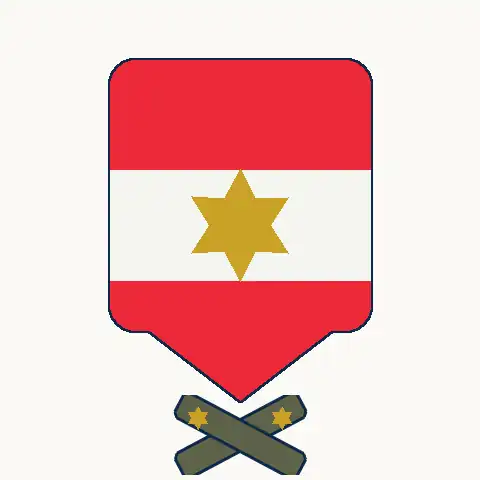
From Recruit to Warrant Officer: The Enlisted Ladder (OR-1 to OR-9)
Most Austrian soldiers start at the very bottom, and the bottom is refreshingly honest: a Rekrut wears no insignia at all. That is the rank every young man holds during his six months of compulsory service. From there the ladder climbs: first the three Chargen — the corporal grades — then the proper NCOs, then the staff NCOs, and finally the two warrant officers at the top. Only a Wachtmeister (OR-5) or above counts as an NCO in Austria, which surprises people used to the British or American systems, where a corporal is already an NCO.
The names take a little getting used to, but they are descriptive once you break them down. A Gefreiter is roughly a lance corporal, a Korporal is a corporal, and a Zugsführer is literally a “platoon leader” — although in practice it is still a corporal grade, not an officer. The NCO ranks all end in -wachtmeister, which comes from the old cavalry word for a sergeant, and the two warrant officers at the top — Offiziersstellvertreter and Vizeleutnant — are the people who really keep a unit running. A Vizeleutnant is the highest rank a non-commissioned soldier can reach, and the Vize is often the person a young lieutenant turns to when they need to know how things actually work.
| Rank (German) | English Equivalent | NATO Code | Insignia | Typical Role |
|---|---|---|---|---|
| Rekrut (Rekr) | Private | OR-1 | Plain olive shoulder strap, no star | New soldier in basic training |
| Gefreiter (Gfr) | Lance Corporal | OR-2 | One white six-pointed star | Trained soldier |
| Korporal (Kpl) | Corporal | OR-3 | Two white six-pointed stars | Assistant squad leader |
| Zugsführer (Zgf) | Master Corporal | OR-4 | Three white six-pointed stars | Senior corporal grade |
| Wachtmeister (Wm) | Sergeant | OR-5 | One silver star above a narrow silver braid stripe | Squad leader, usually 8 to 13 soldiers |
| Oberwachtmeister (OWm) | Master Sergeant | OR-6 | Two silver stars above a narrow silver braid stripe | Squad leader; senior NCO duties |
| Stabswachtmeister (StWm) | Staff Sergeant | OR-7 | One gold star above wide and narrow gold braid stripes | Squad leader (technical) or platoon leader |
| Oberstabswachtmeister (OStWm) | Warrant Officer III | OR-8 | Two gold stars above wide and narrow gold braid stripes | Senior staff NCO; platoon-level leadership |
| Offiziersstellvertreter (OStv) | Warrant Officer II | OR-9 | One brass-gold star above a wide gold braid stripe | Platoon leader; stands in for an officer |
| Vizeleutnant (Vzlt) | Warrant Officer I | OR-9 | One large gold star above a wide gold braid stripe | Most senior NCO; unit’s senior enlisted adviser |
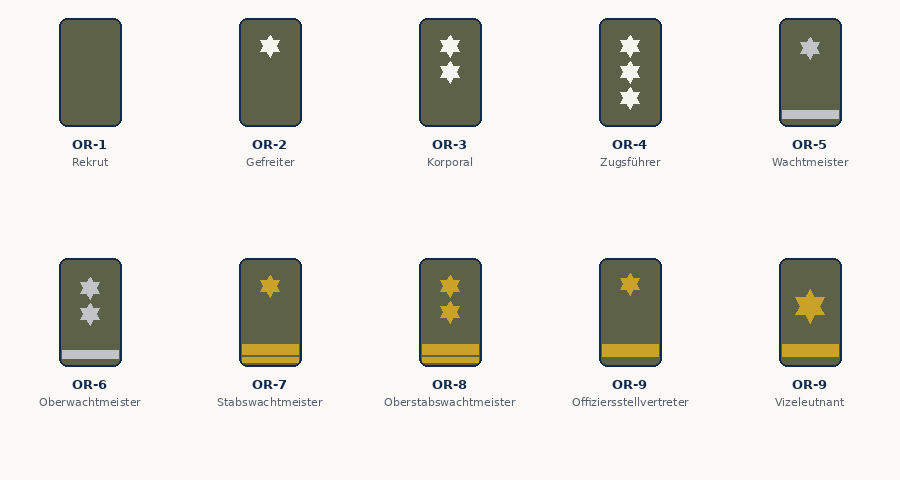
Did you know? The word Charge is a little piece of military history. The three corporal grades — Gefreiter, Korporal and Zugsführer — are called the Chargen (OR-2 to OR-4), and they are not NCOs at all. In Austria you can be a corporal, wear stars on your shoulder, and still officially be an enlisted soldier. The first real NCO rank is Wachtmeister, and that is the first promotion that genuinely changes your job: from that day on, other soldiers are yours to look after.
How to Read an Austrian Uniform
Here is the good news: Austrian insignia run on a system, not on memorisation. Learn the system once and every rank falls into place. On the field uniform, rank is worn on the shoulder straps — olive drab straps with white, silver or gold stars. On the dress uniform, the same rank moves to the collar, on a coloured patch called a Paroli (or Kragenspiegel), where the stars are silver on a green or gold background. Same stars, different place.
Within each group, the rule is simply to count the stars. The three corporals carry one, two and three white stars: Gefreiter one, Korporal two, Zugsführer three. The junior officers work the same way with gold stars — one for a Leutnant, two for an Oberleutnant, three for a Hauptmann — and the generals run one to four. What tells you the group is the braid. A stripe of braid at the base of the strap means you are looking at an NCO; a wide band of gold braid across the strap means a field officer (Major, Oberstleutnant or Oberst); and a strap that is gold all over means a general. At the very top of the enlisted ladder the counting stops: the two warrant officers are marked by a single metal star and a wide gold braid instead of a row of stars.
The other thing to look at is the colour, which tells you the soldier’s job, not their rank. The coloured collar patch — the Waffenfarbe, or branch colour — shows the arm of service: green for infantry, black for armour, yellow for reconnaissance, sky blue for the medical service, violet for the Air Force, and scarlet with a white edge for the Guards. Berets work the same way: scarlet for the Guard, green for infantry, black for armour, cherry for airborne troops and dark blue for quartermaster troops. And if you look at the little federal eagle on the beret, silver means an NCO and gold means an officer.
The Officers: Cadets, Company Commanders and Generals (OF(D) to OF-9)
Officers are where the Austrian system starts to feel familiar to anyone who knows the German or British armies — and then, just as quickly, unfamiliar again. The junior officers are exactly what you would expect: a Leutnant fresh out of the academy leads a platoon, an Oberleutnant is usually the company second-in-command, and a Hauptmann commands a company of around a hundred soldiers. Then come the field officers — Major, Oberstleutnant and Oberst — who command battalions and regiments and fill the staff jobs that keep a brigade moving.
Then there is the Fähnrich. A Fähnrich is an officer cadet, still training at the military academy, and their rank is officially graded OF-Student — not OF-1, because they are not a commissioned officer yet. They wear a single silver star, and when they finish their roughly three-year course they are commissioned as Leutnant. And at the very top sits the General, a four-star rank that belongs to exactly one person at a time: the Chief of the General Staff. There is no five-star rank in Austria — General is the ceiling.
| Rank (German) | English Equivalent | NATO Code | Insignia | Typical Role |
|---|---|---|---|---|
| Fähnrich (Fhr) | Officer Cadet | OF(D) | One silver six-pointed star above a narrow silver braid stripe | Officer cadet, Theresian Military Academy |
| Leutnant (Lt) | Second Lieutenant | OF-1 | One gold six-pointed star | Platoon leader |
| Oberleutnant (Olt) | First Lieutenant | OF-1 | Two gold six-pointed stars | Company second-in-command |
| Hauptmann (Hptm) | Captain | OF-2 | Three gold six-pointed stars | Company commander |
| Major (Mjr) | Major | OF-3 | One gold star with a wide gold braid band | Battalion commander or headquarters company commander |
| Oberstleutnant (Obstlt) | Lieutenant Colonel | OF-4 | Two gold stars with a wide gold braid band | Battalion commander |
| Oberst (Obst) | Colonel | OF-5 | Three gold stars with a wide gold braid band | Regiment or brigade commander |
| Brigadier (Bgdr) | Brigadier General | OF-6 | One star on a gold-backed strap | Brigade commander; first general officer rank |
| Generalmajor (GenMjr) | Major General | OF-7 | Two stars on a gold-backed strap | Ministry of Defence Chief of Staff; commanding general of the Air Force |
| Generalleutnant (GenLt) | Lieutenant General | OF-8 | Three stars on a gold-backed strap | Commanding general of the operational forces |
| General (Gen) | General | OF-9 | Four stars on a gold-backed strap | Chief of the General Staff; highest rank in Austria |
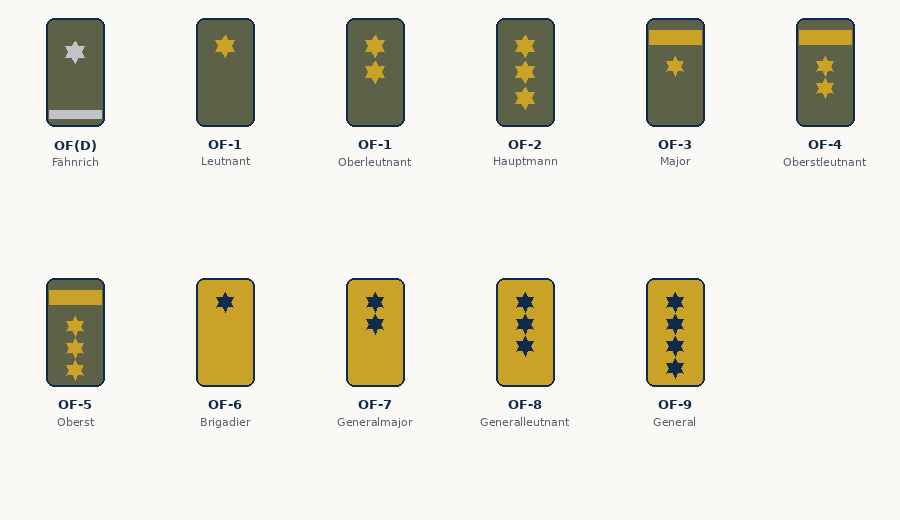
Key point: Austria is not a member of NATO, so the OF and OR codes in these tables are not official NATO grades — they are approximate comparisons published by the Austrian Armed Forces themselves, purely to make Austrian ranks easier to compare with other armies. Two ranks sharing one code is normal here: Leutnant and Oberleutnant are both OF-1, and Offiziersstellvertreter and Vizeleutnant are both OR-9. The code tells you roughly where a rank sits, not exactly what it is.
The Six-Pointed Star, Neutrality and the General Who Isn’t Always a General
Look closely at an Austrian rank star and you will notice something odd: it has six points, not five. Most of the world’s armies use the familiar five-pointed star, but Austria’s stars are six-pointed, and the shape is deliberate — the six points echo the petals of the edelweiss, the white mountain flower that has become Austria’s unofficial emblem. The two stars on an Oberstabswachtmeister’s collar patch are officially described as six-pointed stars symbolising the edelweiss, and the flower itself is worn as a badge by Austria’s mountain troops, the Gebirgsjäger, who train and fight in the Alps.
The six-pointed star is old, too — it comes down from the Austro-Hungarian Empire, where rank was shown with six-pointed stars and gold lace on the collar, and the modern Bundesheer has kept the tradition almost unchanged since the empire fell. Austria’s army in its current form dates to 1955, when the Austrian State Treaty ended ten years of occupation and Austria declared its permanent neutrality — no military alliances, no foreign bases on Austrian soil. The Bundesheer’s job since then has been to protect that neutrality, and it does so as a small professional core backed by a large militia: every fit young man serves six months, then spends years in the reserve, training in his local battalion alongside a civilian job. It is a citizen army in the old sense, and it is why so many Austrian families have a personal connection to these ranks.
Neutrality also explains the strangest quirk in the whole system: Austria technically has only two ranks of general in its personnel system. Because the military is part of the civil service, the system only provides for a Brigadier (one star) and a Generalleutnant (three stars). The other two general ranks, Generalmajor (two stars) and General (four stars), are not grades you are promoted into; they are granted to officers who hold particular commands. In other words, in Austria you do not simply become a General — you become the Chief of the General Staff, and the four stars come with the job.
Beyond the Rank: Berets, Wings and the Edelweiss
Rank insignia tells you a soldier’s grade. Everything else on the uniform tells you what they do — and in Austria, there is a lot to look at. The most prized badge in the Air Force is the pilot’s wings, worn on the right breast: gold for officers, silver for enlisted personnel. The Air Force itself is small and wears the same ranks as the Army, with violet as its branch colour instead of infantry green.
Then there are the berets. Most Austrian soldiers wear one, and the colour is a quick guide to their unit: scarlet for the ceremonial Guard, green for infantry, black for armour, cherry for airborne troops and dark blue for quartermaster troops. The mountain infantry are the exception — the Gebirgsjäger wear their own peaked mountain cap with the edelweiss badge, the same flower that gives the rank stars their six points.
How Promotion Actually Works
Promotion in Austria is not a matter of simply waiting your turn. The law requires two things for every step up: the required period of service in your current rank, and the right examinations passed. That holds from Gefreiter all the way to General, and it makes the Austrian ladder slower and more deliberate than the American one. A soldier who wants to become a Wachtmeister — the first NCO rank, and the first promotion that really matters — has to go through NCO training and prove they can lead a squad of eight to thirteen soldiers. It is the first real career gate, and it is where a soldier stops being someone else’s responsibility and becomes responsible for others.
Officers take the long road. Career officers study for about three years at the Theresian Military Academy in Wiener Neustadt, a school founded in 1752. Cadets there hold the rank of Fähnrich and graduate with a bachelor’s degree in military leadership before being commissioned as Leutnant. The NCO school sits at Enns, near Linz. There is also a second path that many Austrians take: the militia. A volunteer can do a one-year programme, take courses and exercises over several years, and eventually be promoted to Leutnant in the reserve — a slower route, fitted around a civilian career, but a real one, and it is how much of Austria’s reserve officer corps is built.
One thing that surprises outsiders is how top-heavy the Austrian system can look. Because the military is part of the civil service, senior officers tend to stay until retirement, and because the general ranks are tied to specific commands, there are never many of them. It is a small army that takes its time.
For comparison, see our guides to German military ranks, Italian military ranks, French military ranks, British military ranks, Canadian military ranks and US Army ranks, and our overview of military ranks and insignia.
Read next
German Army Ranks · Italian Army Ranks · French Military Ranks · British Military Ranks · US Army Ranks · Military Ranks and Insignia Overview
FAQs
What is the highest rank in the Austrian army?
General, graded OF-9. It is the highest rank in the Austrian Armed Forces, and it is held by one person at a time — the Chief of the General Staff. Austria has no five-star rank and no field marshal, so four stars is the ceiling.
How many ranks are there in the Austrian army?
There are 21 ranks in total: one recruit rank (Rekrut), three corporal grades (Gefreiter, Korporal, Zugsführer), six NCO grades (Wachtmeister up to Vizeleutnant) and eleven officer grades (Fähnrich up to General). The Army and the Air Force share the same 21 ranks.
What rank is Vizeleutnant?
Vizeleutnant is the highest non-commissioned rank in Austria, graded OR-9 — roughly the equivalent of a US Sergeant Major or a British Warrant Officer Class 1. Despite the name, which sounds like “vice lieutenant”, it is not an officer rank at all. A Vizeleutnant is usually the most experienced soldier in a unit, often its senior enlisted adviser, addressed as Herr or Frau Vizeleutnant — or just Vize.
What is a Fähnrich in the Austrian army?
A Fähnrich is an officer cadet. Cadets at the Theresian Military Academy in Wiener Neustadt hold this rank during their roughly three-year course, and reserve officers in training for Leutnant hold it too. It is graded OF-Student rather than OF-1, because a Fähnrich is not a commissioned officer yet — they wear a single silver star, and they become a Leutnant when they graduate.
Does Austria have a navy?
No. Austria is a landlocked country and has no navy, no naval ranks and no coast guard. The Bundesheer is the army and the air force only, and both services use the same rank system. Austria-Hungary once had a navy, but that went with the empire in 1918.
Do Austrian ranks use NATO codes if Austria is not in NATO?
Yes, but only as an approximate comparison. Austria is not a NATO member, and the Austrian Armed Forces say so plainly: there is no policy on NATO rank equivalents, and the OR and OF classes shown are approximations to make comparison easier. That is why two Austrian ranks can share one code — Leutnant and Oberleutnant are both OF-1, and Offiziersstellvertreter and Vizeleutnant are both OR-9.
All insignia diagrams and images in this article are original graphics created for Forces Guide. The charts are simplified stylised diagrams of field-uniform shoulder straps, not photographs of real insignia.