Croatia’s armed forces are small, professional and fully integrated into NATO — and their rank system is one of the most distinctive in Europe. A Croatian soldier’s rank is read from gold or silver stars and braid bars on shoulder boards in the Army and Air Force, and from gold sleeve stripes in the Navy. The rank names themselves are Croatian, not borrowed English titles: a colonel is a Brigadir, a captain is a Satnik, and the most senior soldier is a Stožerni general. This guide covers every Croatian military rank — officers and enlisted, Army, Navy and Air Force — with NATO codes, insignia and what each rank actually does.
Key facts
- Country: Croatia
- Branches: Croatian Army, Croatian Navy and Croatian Air Force
- Officer ranks: OF-1 to OF-10 (Poručnik to Stožerni general)
- Enlisted and NCO ranks: OR-1 to OR-9 (Vojnik / Mornar to Časnički namjesnik)
- Highest rank: Stožerni general (OF-10), held by the Chief of the General Staff
- NATO: member since 2009 — every rank carries a NATO code
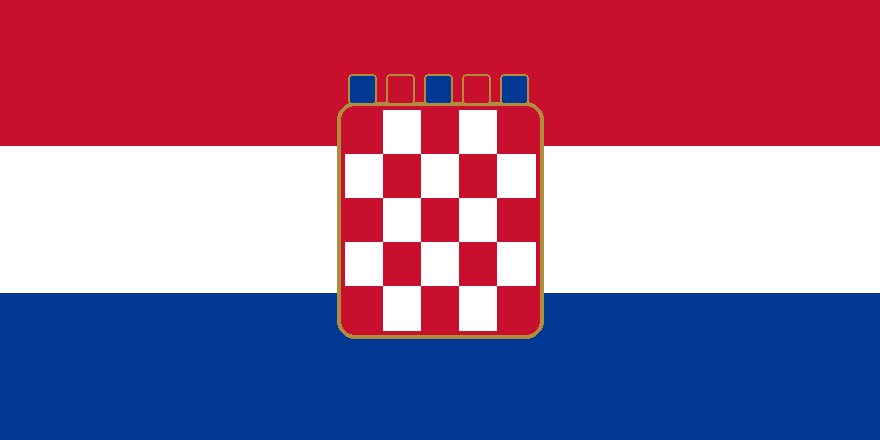
- Notable fact: the red-and-white checkerboard, the šahovnica, appears on uniforms and insignia across all three services
The Armed Forces of the Republic of Croatia (Oružane snage Republike Hrvatske) have three branches: the Croatian Army (Hrvatska kopnena vojska), the Croatian Navy (Hrvatska ratna mornarica), which guards the Adriatic coast, and the Croatian Air Force (Hrvatsko ratno zrakoplovstvo). Croatia joined NATO in 2009, so every Croatian rank carries a NATO code — OF-1 to OF-10 for officers and OR-1 to OR-9 for other ranks — which makes Croatian ranks directly comparable with those of every other NATO ally. Each branch has 20 ranks: 11 officers and 9 enlisted and non-commissioned officers.
Croatian Army Officer Ranks (OF-1 to OF-10)
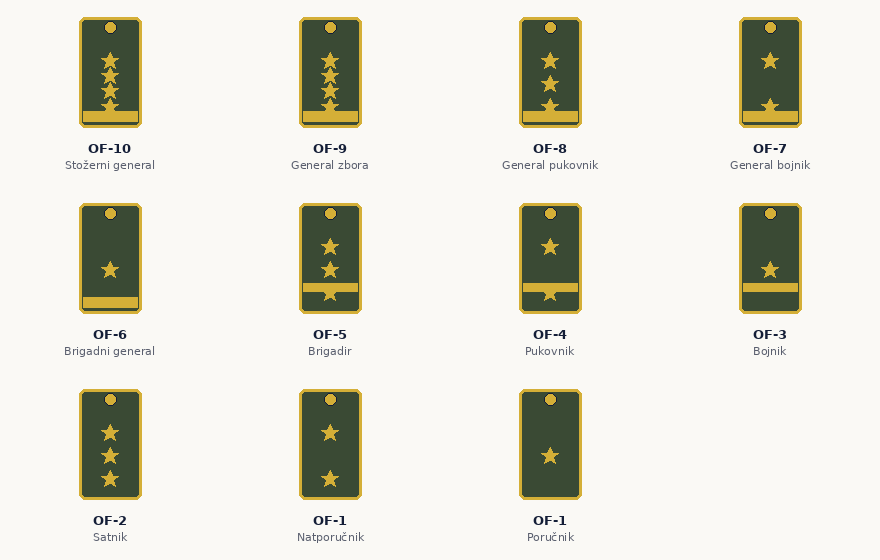
Croatian Army officers wear their rank on shoulder boards (epaulettes) on the service uniform. The system is built from stars and braid: junior officers wear one to three stars, senior officers add a horizontal braid bar, and generals wear a wide braid band at the base of the board with one to four stars. Army insignia is gold. The Army has five general ranks — more than most NATO armies of its size — a legacy of the rank structure built during the Homeland War of the 1990s.
| Rank | NATO Code | English Equivalent | Typical Role |
|---|---|---|---|
| Stožerni general | OF-10 | General of the Army | Chief of the General Staff; the most senior officer in the Armed Forces |
| General zbora | OF-9 | General | Deputy Chief of the General Staff or commander of a major command |
| General pukovnik | OF-8 | Lieutenant General | Corps or major formation commander; senior staff appointment |
| General bojnik | OF-7 | Major General | Division or brigade-group commander |
| Brigadni general | OF-6 | Brigadier General | Brigade commander; the most junior general rank |
| Brigadir | OF-5 | Colonel | Brigade commander or senior staff officer |
| Pukovnik | OF-4 | Lieutenant Colonel | Battalion commander or senior staff officer |
| Bojnik | OF-3 | Major | Battalion executive officer or company commander of a specialist unit |
| Satnik | OF-2 | Captain | Company commander |
| Natporučnik | OF-1 | First Lieutenant | Platoon commander or company executive officer |
| Poručnik | OF-1 | Second Lieutenant | Platoon commander; entry-level commissioned officer |
Did you know? The Croatian Army has five general ranks — more than most NATO armies of its size — a legacy of the rank structure built during the Homeland War of the 1990s.
How to Read Croatian Army and Air Force Officer Insignia
Once you know the code, a Croatian shoulder board can be read at a glance:
- Stars — the basic counting unit. Junior officers wear one star (Poručnik), two (Natporučnik) or three (Satnik). The same one-two-three pattern repeats for senior officers and generals.
- The braid bar — senior officers (Bojnik, Pukovnik, Brigadir) wear a horizontal gold braid bar across the board, with one, two or three stars above it. The bar is what separates a major from a captain: both may wear one star, but only the major has the bar.
- The wide braid band — generals wear a broad gold braid band at the base of the shoulder board, with one star for a Brigadni general rising to four stars for a General zbora and a Stožerni general.
- Gold or silver — Army insignia is gold; Air Force insignia is silver. The rank names are identical in both services, so the metal colour is the quickest way to tell an airman from a soldier. A silver board with three stars is an Air Force Satnik, not an Army one.
- The button — every shoulder board carries a small button at the top, a detail shared across the Croatian services.
Two traps catch newcomers. First, Brigadir is not a general: despite the name, it is the OF-5 rank, the equivalent of a colonel, and it sits below the one-star Brigadni general. Second, the two OF-1 ranks — Poručnik and Natporučnik — share a single NATO code, just as second and first lieutenants do in most NATO armies. The Croatian word natporučnik literally means “above-lieutenant”, which is a useful memory aid.
Croatian Navy Officer Ranks (OF-1 to OF-10)
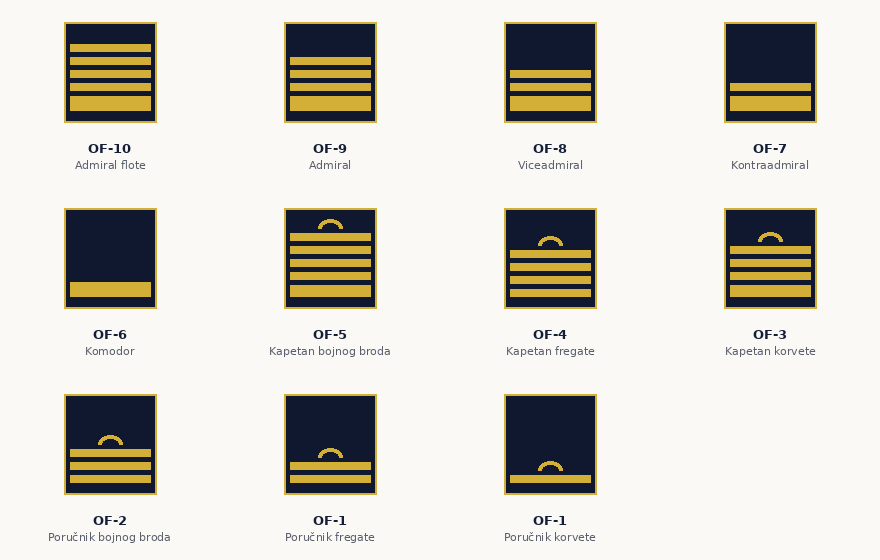
The Croatian Navy is the smallest of the three branches, built around coastal patrol, mine countermeasures and support vessels in the Adriatic. Its officers use naval rank titles built from the names of warships: a Kapetan korvete is literally a “corvette captain” and a Kapetan bojnog broda is a “battleship captain”. Where the Army reads rank from shoulder boards, the Navy reads it from gold sleeve stripes on the dark navy uniform, with a loop — the executive curl — on the uppermost stripe for officers up to captain. Flag officers wear a broad stripe with narrower stripes beneath it.
| Rank | NATO Code | English Equivalent | Typical Role |
|---|---|---|---|
| Admiral flote | OF-10 | Fleet Admiral | The most senior naval rank; held only in exceptional circumstances |
| Admiral | OF-9 | Admiral | Commander of the Navy or a senior joint appointment |
| Viceadmiral | OF-8 | Vice Admiral | Deputy Navy commander or fleet commander |
| Kontraadmiral | OF-7 | Rear Admiral | Flotilla or naval base commander |
| Komodor | OF-6 | Commodore | Flotilla commander; the most junior flag rank |
| Kapetan bojnog broda | OF-5 | Captain | Commanding officer of a major vessel or shore establishment |
| Kapetan fregate | OF-4 | Commander | Commanding officer of a frigate-sized vessel or squadron |
| Kapetan korvete | OF-3 | Lieutenant Commander | Commanding officer of a corvette or patrol vessel; department head |
| Poručnik bojnog broda | OF-2 | Lieutenant | Watch officer or department head aboard ship |
| Poručnik fregate | OF-1 | Lieutenant (Junior Grade) | Junior watch officer; division officer |
| Poručnik korvete | OF-1 | Ensign | Junior officer aboard ship; entry-level commissioned officer |
How to Read Croatian Navy Insignia
- Count the stripes — lieutenants wear one to three narrow gold stripes on the sleeve; captains add a broader stripe; admirals wear one broad stripe with one to four narrow stripes beneath it.
- The loop (curl) — the uppermost stripe of officers up to Kapetan bojnog broda carries a small loop, the traditional executive curl of naval uniforms. Flag officers do not wear the loop.
- The broad stripe — a single wide gold band marks a flag officer. One broad stripe alone is a Komodor; each narrow stripe added beneath it raises the rank by one step, up to Admiral flote.
- Shoulder boards too — on some uniforms naval officers also wear shoulder boards carrying the same stripe pattern, so the sleeve and the shoulder always agree.
Croatian Air Force Officer Ranks (OF-1 to OF-10)
The Croatian Air Force uses exactly the same officer rank names as the Army, from Poručnik to Stožerni general. The only difference is the metal: Air Force insignia is silver where the Army’s is gold, worn on dark blue shoulder boards. The Air Force operates fighter, transport and helicopter squadrons from bases at Zagreb and Zadar, and its officers follow the same NATO OF-1 to OF-10 ladder as their Army counterparts — a Bojnik in the Air Force is the same OF-3 major as a Bojnik in the Army, and a squadron commander is typically a Bojnik or Pukovnik.
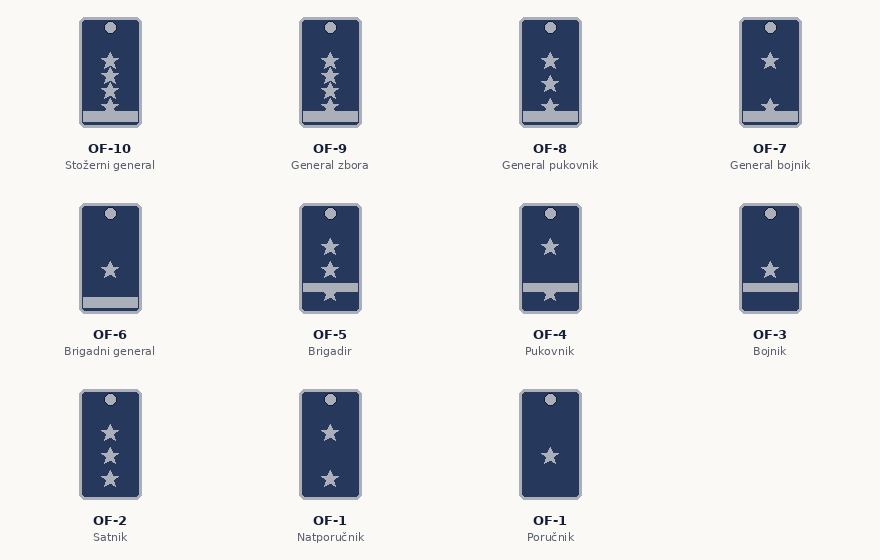
Because the two services share rank names, Croatians usually name the service when the rank alone would be ambiguous — “satnik Hrvatske kopnene vojske” for an Army captain, for example. For anyone reading a uniform, the rule is simple: gold means Army, silver means Air Force, and the stars and braid bars count the same in both.
Croatian Enlisted and Non-Commissioned Officer Ranks (OR-1 to OR-9)
The other ranks — the non-commissioned officers (NCOs) and enlisted personnel — use the same nine ranks in all three services. The only difference is the lowest rank: a soldier or airman is a Vojnik, while a sailor is a Mornar. The senior NCO, Časnički namjesnik, takes its name from časnik (officer) and namjesnik (deputy or governor) — literally, “one who stands in for an officer”.
| Rank | NATO Code | English Equivalent | Typical Role |
|---|---|---|---|
| Časnički namjesnik | OR-9 | Command Sergeant Major | The most senior NCO in a unit or branch; advisor to the commanding officer |
| Stožerni narednik | OR-8 | Sergeant Major | Senior NCO of a battalion or equivalent formation |
| Nadnarednik | OR-7 | Master Sergeant | Senior NCO of a company or specialist section |
| Narednik | OR-6 | Staff Sergeant | Platoon sergeant; leads and trains a platoon |
| Desetnik | OR-5 | Sergeant | Section or squad leader; the name means “leader of ten” |
| Skupnik | OR-4 | Corporal | Team leader; first junior NCO rank |
| Razvodnik | OR-3 | Lance Corporal | Experienced soldier with limited leadership duties |
| Pozornik | OR-2 | Private First Class | Soldier who has completed basic training and gained experience |
| Vojnik (Army / Air Force) / Mornar (Navy) | OR-1 | Private / Seaman | New recruit in training; wears no rank insignia |
Key point: The senior NCO, Časnički namjesnik, literally means “one who stands in for an officer” — and in many units the commanding officer’s most trusted advisor is the senior NCO, not another officer.
How to Read Croatian Enlisted Insignia
Enlisted and NCO insignia are worn as chevrons and bars on the sleeve and shoulder, in the same gold (Army), silver (Air Force) or gold-on-navy (Navy) scheme as the officers. The pattern is simple: the more chevrons and bars, the more senior the soldier. Senior NCOs — Nadnarednik and above — wear broader, more elaborate insignia that mark them out as the unit’s experienced backbone, while junior ranks wear a small number of chevrons. One rule is absolute: a Vojnik or Mornar (OR-1) wears no insignia at all. It is the only Croatian rank with nothing to show, and it marks a recruit who has not yet earned a rank.
The NCO corps is the part of the Croatian system most shaped by NATO practice. Since Croatia joined NATO, its NCOs have taken on the same role they hold in other allied armies: the sergeants run the daily life of a unit — training, discipline and standards — while the officers plan and command. The Časnički namjesnik at OR-9 is the enlisted counterpart of a senior officer, and in many units the commanding officer’s most trusted advisor is not another officer but the senior NCO.
Croatian Military Badges
Rank insignia shows a Croatian service member’s grade. Badges show what they are qualified to do — and Croatian badges carry the most recognisable symbol in the country, the red-and-white checkerboard known as the šahovnica.
- The šahovnica (checkerboard) — the red-and-white chequered shield from the Croatian coat of arms appears on uniforms, shoulder patches and insignia across all three services. It is the single most recognisable mark of a Croatian soldier.
- The Armed Forces emblem — the emblem of the Armed Forces of the Republic of Croatia, worn on the uniform, combines the checkerboard with the symbols of the three services.
- Branch badges — each service has its own cap badge and breast insignia: crossed rifles and a sword for the Army, an anchor for the Navy, and wings for the Air Force.
- Pilot wings — Croatian Air Force pilots wear gold wings on the chest, awarded after completing flight training. Naval aviators and helicopter pilots wear their own variants.
- Parachutist badge — worn by soldiers qualified in military parachuting, including special forces personnel.
- Marksmanship and specialist badges — qualification badges for weapons, driving, communications and other military skills are worn on the chest of the service uniform.
How Promotion Works in the Croatian Armed Forces
Promotion in the Croatian Armed Forces follows the NATO-standard pattern of time in grade, professional education, performance and vacancies. Officers are commissioned after graduating from the Croatian Military Academy in Zagreb, entering service as a Poručnik (OF-1). From there, promotion to each higher rank requires a minimum time in the current rank, successful completion of the next level of professional military education, and a vacancy in the higher rank. A captain cannot simply wait out the clock: without the staff course and a strong record, promotion stops.
Enlisted soldiers advance from Vojnik through the junior ranks on time in service and performance, then enter the NCO path, which requires NCO schooling and leadership courses. Promotion to the senior NCO ranks — Nadnarednik and above — is competitive and selective, with far fewer posts than candidates. The most senior appointments of all, the general and admiral ranks, are made by the President of the Republic, who is Commander-in-Chief of the Armed Forces, on the recommendation of the Minister of Defence and the Chief of the General Staff.
Because the Croatian Armed Forces are small — around 15,000 active personnel — promotion is slower than in larger NATO armies. There are fewer posts at each higher rank, and officers and NCOs often spend longer in grade. The trade-off is experience: a Croatian Pukovnik or Stožerni narednik has usually held the rank for years and knows the job thoroughly.
A Note on Croatian Military Tradition
Croatian ranks carry the history of the country’s fight for independence. The modern rank system was built during the Homeland War (Domovinski rat) of 1991–1995, when the Croatian Army was created almost from nothing and its ranks were set down in law in 1995. That is why the structure looks the way it does: five general ranks for a small army, naval ranks named after warships, and NCO titles drawn from Croatian words rather than imported ones.
One rank from that era is gone. Vrhovnik — roughly equivalent to a marshal or generalissimo — was created on 22 March 1995 and held only by the first President, Franjo Tuđman, as supreme commander. It was abolished on 19 March 2002 and has never been awarded since. The 1990s structure also included two ranks that no longer exist: Stožerni brigadir and Zastavnik, both removed in the reforms that followed the war. Since joining NATO in 2009, Croatia has kept its Croatian rank names while aligning every grade to the NATO OF and OR codes — national tradition on the surface, alliance standard underneath.
For comparison with other NATO allies, see our guides to German military ranks and Italian military ranks, and for the wider picture, the US Navy ranks, the US military uniform and the US military branches.
Read next
German Army Ranks · Italian Army Ranks · US Navy Ranks · US Military Uniform · US Military Branches
FAQs
What is the highest rank in the Croatian military?
Stožerni general (OF-10), the equivalent of a General of the Army, held by the Chief of the General Staff. The naval equivalent is Admiral flote (Fleet Admiral). The highest enlisted rank is Časnički namjesnik (OR-9).
Are Croatian Army and Air Force ranks the same?
Yes — the rank names are identical in both services, from Poručnik to Stožerni general. The difference is the insignia colour: gold for the Army, silver for the Air Force. Only the Navy has different rank names.
What does “Brigadir” mean in the Croatian Army?
Brigadir is the OF-5 rank, the equivalent of a colonel — not a general. The one-star general rank is Brigadni general (OF-6), which sits above it. The similar names are the most common source of confusion in Croatian ranks.
What is the lowest rank in the Croatian military?
Vojnik in the Army and Air Force and Mornar in the Navy, both OR-1. It is the only rank with no insignia at all.
How many ranks are there in the Croatian Armed Forces?
Twenty per branch: 11 commissioned officer ranks (OF-1 to OF-10) and 9 enlisted and NCO ranks (OR-1 to OR-9), making 60 ranks across the Army, Navy and Air Force.
What was the rank of Vrhovnik?
Vrhovnik was a supreme rank, roughly equivalent to a marshal, created in 1995 and held only by President Franjo Tuđman. It was abolished in 2002 and no longer exists.
All insignia diagrams and images in this article are original graphics created for Forces Guide.