
Hungary’s soldiers wear their rank on their shoulders — literally. A Hungarian soldier’s grade is read from the gold stars and chevrons on the shoulder strap, backed by the colour of the wearer’s branch. There are no naval ranks to learn, no separate Air Force ladder, and no five-star rank at the top. This guide covers every Hungarian military rank, from the newest private, a Közkatona, to the most senior general, a Vezérezredes, with insignia, NATO grades, roles and promotion explained.
The Hungarian Defence Forces (Magyar Honvédség) are an integrated service: the Land Forces and the Air Force use exactly the same ranks, the same titles and the same insignia. Only the branch colour on the uniform changes. Hungary is a landlocked country, so it has no navy — the only waterborne element is a small brown-water River Guard on the Danube, which uses the same rank titles too. In total there are twenty ranks: ten enlisted and non-commissioned officer ranks (OR-1 to OR-9) and ten commissioned officer ranks (OF-1 to OF-9). There is no OF-10 rank in Hungarian service.
Key facts
- Country: Hungary
- Branch: Hungarian Defence Forces (Magyar Honvédség) — Land Forces and Air Force share one rank system
- Enlisted and NCO ranks: OR-1 to OR-9 (Közkatona to Főtörzszászlós)
- Commissioned officers: OF-1 to OF-9 (Hadnagy to Vezérezredes)
- Highest rank: Vezérezredes (General, OF-9), held by the Chief of the Defence Staff
- No navy: Hungary is landlocked — its only waterborne force is the small River Guard on the Danube
- Notable fact: Honvéd means “defender of the homeland”, a name dating back to the Hungarian revolution of 1848
Hungarian Enlisted and NCO Ranks (OR-1 to OR-9)
The ten “other ranks” cover everyone from a new recruit to the most senior warrant officer. They fall into three groups. The junior ranks (OR-1 to OR-3) are the ordinary soldiers. The non-commissioned officers (OR-4 to OR-6) lead squads and platoons. And the senior ranks (OR-7 to OR-9) are the zászlós family — warrant officers who are the technical experts and senior advisers of their units. The word honvéd, which gives the armed forces their name, means “defender of the homeland”, and it dates back to the Hungarian revolution of 1848.
| Rank (Hungarian) | English Equivalent | NATO Code | Insignia | Typical Role |
|---|---|---|---|---|
| Közkatona | Private (PV1) | OR-1 | Plain shoulder strap, no insignia | New soldier in basic training; entry-level rank |
| Őrvezető | Private (PV2) | OR-2 | One gold chevron on the shoulder strap | Trained soldier; guard and patrol duties |
| Tizedes | Private First Class | OR-3 | Two gold chevrons on the shoulder strap | Experienced soldier; fire-team member |
| Szakaszvezető | Corporal | OR-4 | Three gold chevrons on the shoulder strap | First NCO rank; leads a squad |
| Őrmester | Sergeant | OR-5 | Gold chevron with a star on the shoulder strap | Squad or section leader; trains junior soldiers |
| Törzsőrmester | Staff Sergeant | OR-6 | Gold braid with stars on the shoulder strap | Platoon sergeant; senior tactical leader |
| Főtörzsőrmester | Sergeant First Class | OR-7 | Gold braid with stars on the shoulder strap | Senior platoon or company sergeant |
| Zászlós | Warrant Officer | OR-8 | Gold-braided shoulder board with one star | Warrant officer; technical or administrative specialist |
| Törzszászlós | Senior Warrant Officer | OR-8 | Gold-braided shoulder board with two stars | Senior warrant officer and adviser |
| Főtörzszászlós | Chief Warrant Officer | OR-9 | Gold-braided shoulder board with three stars | Most senior enlisted rank; senior enlisted adviser |
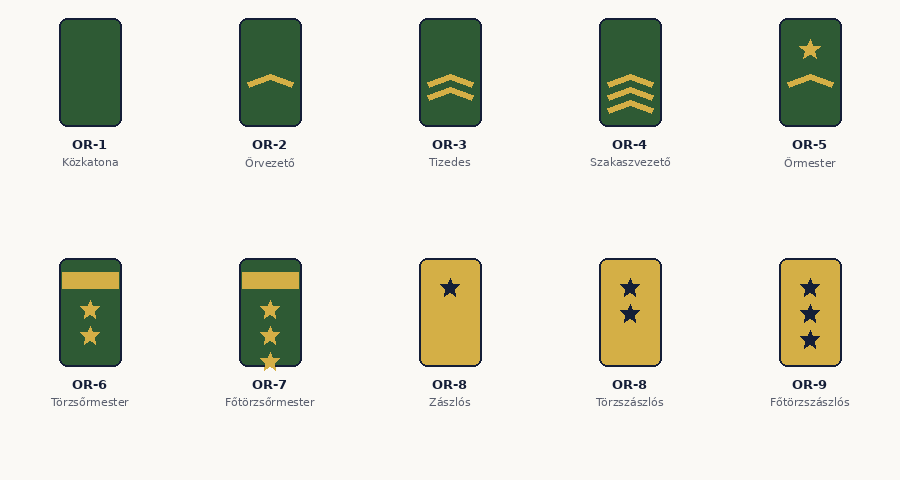
Did you know? The word zászlós literally means “flag-bearer”. The three warrant officer ranks — Zászlós, Törzszászlós and Főtörzszászlós — sit at the top of the enlisted ladder (OR-8 and OR-9), not among the officers, even though their gold-braided shoulder boards can look officer-like at a distance.
How to Read Hungarian Enlisted Insignia
Every Hungarian enlisted insignia is built from the same few pieces on the shoulder strap, so once you know the code you can read any rank at a glance:
- Chevrons — the gold V-shaped stripes. One chevron means Őrvezető (OR-2), two means Tizedes (OR-3), three means Szakaszvezető (OR-4). Count the chevrons and you have the junior rank.
- Stars — the gold five-pointed star is the mark of seniority. From Őrmester (OR-5) upward, stars join the braid, and the number of stars climbs with the grade.
- Gold braid — the wide gold band on the shoulder strap marks the senior NCOs and warrant officers. A plain cloth strap with chevrons is a junior soldier; a gold-braided strap is a senior leader.
- The plain strap — a Közkatona (OR-1) wears a shoulder strap with no insignia at all. Like a US Marine Private, the newest soldier has nothing to show yet.
- The branch colour — the backing of the strap tells you the soldier’s branch, not their rank. Rifle green is infantry, light blue is the Air Force, black is armour, scarlet is artillery and the military police, and sand is reconnaissance and special operations.
One useful warning: the Hungarian word zászlós literally means “flag-bearer”, and the three warrant officer ranks — Zászlós, Törzszászlós and Főtörzszászlós — sit at the top of the enlisted ladder. In NATO terms they are OR-8 and OR-9, not officers, even though their gold-braided shoulder boards can look officer-like at a distance.
Hungarian Commissioned Officer Ranks (OF-1 to OF-9)
Hungarian officers lead at every level, from a platoon of thirty soldiers to the entire Defence Forces. Junior officers (OF-1 to OF-2) lead platoons; a Százados (OF-2) commands a company; field officers (OF-3 to OF-5) serve on battalion and brigade staffs and command battalions; and general officers (OF-6 to OF-9) command brigades and higher formations. The highest rank in Hungarian service is Vezérezredes (OF-9) — there is no five-star or OF-10 rank.
| Rank (Hungarian) | English Equivalent | NATO Code | Insignia | Typical Role |
|---|---|---|---|---|
| Hadnagy | Second Lieutenant | OF-1 | One gold star on the shoulder board | Platoon leader; entry-level commissioned officer |
| Főhadnagy | First Lieutenant | OF-1 | Two gold stars on the shoulder board | Platoon leader or deputy company commander |
| Százados | Captain | OF-2 | Three gold stars on the shoulder board | Company commander (around 100 soldiers) |
| Őrnagy | Major | OF-3 | One gold star with a gold braid band | Battalion staff officer or deputy battalion commander |
| Alezredes | Lieutenant Colonel | OF-4 | Two gold stars with a gold braid band | Battalion commander |
| Ezredes | Colonel | OF-5 | Three gold stars with a gold braid band | Brigade staff officer or regimental commander |
| Dandártábornok | Brigadier General | OF-6 | One star on a gold-braided shoulder board | Brigade commander; first general officer rank |
| Vezérőrnagy | Major General | OF-7 | Two stars on a gold-braided shoulder board | Division or senior formation commander |
| Altábornagy | Lieutenant General | OF-8 | Three stars on a gold-braided shoulder board | Senior commander; deputy chief of the Defence Forces |
| Vezérezredes | General (Colonel General) | OF-9 | Four stars on a gold-braided shoulder board | Highest rank; held by the Chief of the Defence Staff |
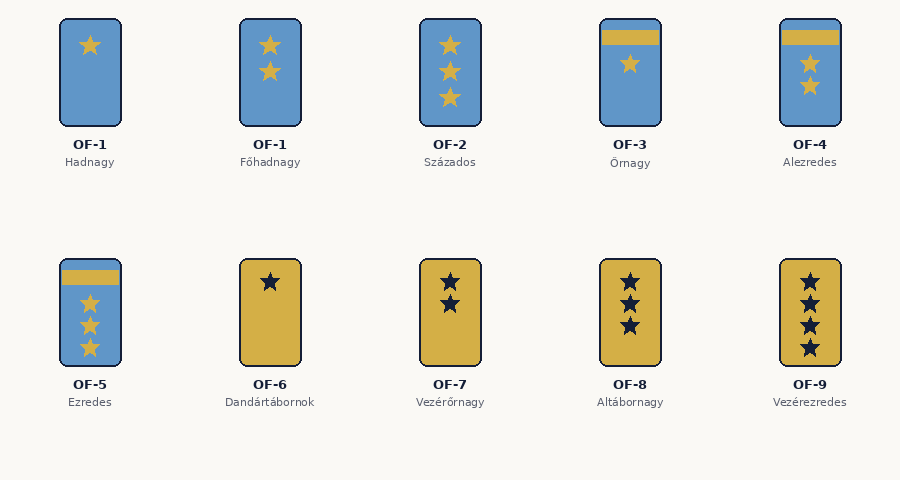
Key point: unlike the US system, where silver outranks gold, Hungarian insignia are gold throughout. Seniority comes from the number of stars and the amount of braid, never from the colour of the metal.
How to Read Hungarian Officer Insignia
Officer insignia follow a simple ladder of stars and braid, inherited from the Austro-Hungarian tradition:
- Stars — the gold five-pointed star is the basic counting unit. Junior officers carry one, two or three stars: Hadnagy one, Főhadnagy two, Százados three.
- The braid band — field officers (Őrnagy, Alezredes, Ezredes) add a wide gold braid band across the shoulder board, with one, two or three stars above it. The band, not the star count alone, tells you the officer is a field officer.
- The gold-braided board — generals wear a shoulder board covered in gold braid, with one to four stars: one for a Brigadier General (Dandártábornok), two for a Major General (Vezérőrnagy), three for a Lieutenant General (Altábornagy) and four for a General (Vezérezredes).
- Gold, not silver — unlike the US system, where silver outranks gold, Hungarian insignia are gold throughout. Seniority comes from the number of stars and the amount of braid, never from the colour of the metal.
The Hungarian name for a general officer tells its own story. Vezér means “leader” and ezredes means “colonel”, so Vezérezredes is literally a “leading colonel” — the officer who leads all the colonels. Altábornagy and Vezérőrnagy carry the older word tábornagy, “camp master”, the historic Hungarian word for a general.
One Rank System, Two Branches
The most important thing to understand about Hungarian ranks is that there is only one ladder. A Százados in the Land Forces and a Százados in the Air Force hold the same rank, wear the same insignia, and are addressed the same way. What changes is the branch colour — the coloured backing and piping of the uniform. The Air Force wears light blue; the Land Forces wear a range of colours by arm: rifle green for infantry, black for armour, scarlet for artillery, air defence and the military police, sand for reconnaissance and special operations, steel green for technical troops, cornflower blue for signals and IT, and carmine for logistics, engineers and medical troops. Generals wear scarlet whatever their branch.
The Air Force itself is small and focused: its best-known aircraft are the JAS 39 Gripen fighters based at Kecskemét, supported by transport aircraft and helicopters. Because the ranks are shared, an Air Force pilot and an Army infantry officer of the same grade are exact equals, and both answer to the same Chief of the Defence Staff.
Hungary’s lack of a navy surprises some readers, but it follows from geography: the country has been landlocked since the First World War. The only exception is the River Guard, the Danube flotilla, a small brown-water force that patrols the river. Its officers use the same rank titles as the Army and Air Force, but its officer ladder tops out at Ezredes (Colonel, OF-5) — the flotilla has no generals of its own.
Hungarian Military Badges
Rank insignia shows a Hungarian soldier’s grade. Badges show what they are qualified to do. The most important are:
- Pilot wings — worn by Hungarian Air Force pilots above the breast pocket. The Gripen pilots of Kecskemét wear the same style of wings as the transport and helicopter pilots, and the badge is one of the most respected qualifications in the service.
- Parachutist badge — worn by soldiers qualified in military parachuting, including special operations troops.
- Branch badges — worn on the collar, these show the soldier’s arm or service: crossed rifles for infantry, crossed cannons for artillery, wings and propellers for the Air Force, and so on. The branch badge and the branch colour together identify a soldier’s job at a glance.
- The cap badge — the Hungarian coat of arms, worn on the peaked cap and on the distinctive stiff Bocskai hat of the Land Forces’ dress uniform, which takes its name from the seventeenth-century prince Stephen Bocskai.
- Marksmanship and specialist badges — awarded for shooting, driving, medical and other qualifications, and worn on the chest of the service uniform.
How Promotion Works in Hungary
Hungary has had a fully professional armed force since peacetime conscription was suspended in 2004, so every rank is earned by a volunteer. Promotion rests on three things: time in grade, professional courses, and vacancies. A soldier cannot simply wait out the clock — each step up the ladder needs the right course passed and a post waiting at the higher rank.
Officers are educated at the Ludovika University of Public Service in Budapest, Hungary’s officer academy, where cadets study for a degree alongside their military training and are commissioned as Hadnagy on graduation. Non-commissioned officers train at the NCO academy and on branch courses, and the step from Szakaszvezető (Corporal) to Őrmester (Sergeant) is the first real career gate — it is the point where a soldier stops being a supervised team member and becomes a leader responsible for other soldiers. Warrant officers are appointed from the senior NCO ranks, and promotion to general officer is decided at the top of the Defence Forces and confirmed by the President of Hungary, who is the commander-in-chief.
A Note on Hungarian Tradition
Two traditions explain almost everything about Hungarian ranks. The first is the hussar heritage: Hungary gave the world the hussar, the light cavalryman in the braided jacket and fur-trimmed cap, and the braided shoulder boards and gold lace of today’s generals descend directly from hussar dress. The second is the Honvéd tradition of 1848, when Hungary raised its own national army — the Honvédség — against the Habsburg empire. The name has survived every change of regime since, and it is why the armed forces are still the Magyar Honvédség today.
The five-pointed star is the thread running through the whole system. A Hungarian defence magazine once summed the insignia up as “the collar and the five-pointed star”, and it is an apt description: count the stars, check the braid, and you can read any Hungarian soldier’s rank without knowing a word of Hungarian.
For comparison with other countries, see our guides to German military ranks, French military ranks, US Navy ranks, the US military uniform and the US military branches.
Read next
German Army Ranks · French Military Ranks · US Navy Ranks · US Military Uniform · US Military Branches
FAQs
What is the highest rank in the Hungarian military?
Vezérezredes (General, OF-9), with four stars on a gold-braided shoulder board. It is held by the Chief of the Defence Staff. Hungary has no OF-10 or five-star rank. The highest enlisted rank is Főtörzszászlós (Chief Warrant Officer, OR-9).
Does Hungary have a navy?
No. Hungary is landlocked and has no navy. Its only waterborne force is the small River Guard, a brown-water flotilla on the Danube, which uses the same Army and Air Force rank titles.
Are Hungarian Army and Air Force ranks the same?
Yes. The Hungarian Defence Forces are an integrated service, so the Land Forces and the Air Force share exactly the same twenty ranks and insignia. Only the branch colour differs — light blue for the Air Force, rifle green for infantry, black for armour, and so on.
What does “Honvéd” mean?
It means “defender of the homeland”. It dates to the Hungarian revolution of 1848, when the national army was called the Honvédség, and it is still the name of the Hungarian Defence Forces (Magyar Honvédség) today.
What is the difference between a Zászlós and a Hadnagy?
A Zászlós (OR-8) is a warrant officer — the most senior enlisted rank group, reached after years as an NCO. A Hadnagy (OF-1) is a commissioned second lieutenant, the most junior officer rank, usually reached by graduating from the Ludovika officer academy. A Hadnagy outranks a Zászlós, but a new lieutenant is wise to listen to an experienced warrant officer.
How do you read Hungarian rank insignia?
Look at the shoulder strap. Count the gold stars and check the braid: junior officers have one to three stars, field officers add a gold braid band, and generals wear a fully gold-braided board with one to four stars. Junior soldiers wear gold chevrons — one, two or three — while senior NCOs and warrant officers wear gold braid with stars. The branch colour on the strap tells you the soldier’s branch, not their rank.
All insignia diagrams and images in this article are original graphics created for Forces Guide.