
23 SAS ranks are British Army ranks — the reserve regiment has no rank system of its own. A soldier of 23 Special Air Service Regiment (Reserve), known as 23 SAS(R), wears the same grades, chevrons, pips and crowns as any other British Army soldier, from Trooper up to senior officer. What makes the regiment different is not the rank ladder, but who climbs it: part-time soldiers with civilian jobs who train as special forces reservists in their spare time.
This guide explains every 23 SAS rank with its insignia, the regiment’s history and squadrons, its beret and badges, and the selection course every member must pass.
Key facts
- Unit: 23 Special Air Service Regiment (Reserve) — 23 SAS(R)
- Country and branch: United Kingdom, British Army Reserve, part of United Kingdom Special Forces
- Other ranks: OR-2 to OR-9 (Trooper to Warrant Officer Class 1); no separate British Army rank at OR-1 or OR-5
- Officers: OF-1 to OF-9 (Second Lieutenant to General); Field Marshal (OF-10) is a ceremonial appointment
- Headquarters: MOD Kingstanding, Birmingham, West Midlands
- Motto: “Who Dares Wins”
- Beret: Sand-coloured (beige) beret, worn with the SAS cap badge
What Is 23 SAS?
23 SAS(R) is one of two reserve regiments of the Special Air Service, alongside 21 SAS(R), based in London. Together they form the Special Air Service (Reserve), or SAS(R). The third SAS regiment, 22 SAS, is the regular, full-time regiment based at Hereford. All three sit under the operational command of the Director Special Forces as part of United Kingdom Special Forces.
The reserve regiments are the part-time half of the SAS. Their soldiers are Army Reservists — teachers, engineers, police officers, students and tradespeople in civilian life — who train in the evenings, at weekends and on annual camps. Unlike the regular SAS, the reserve regiments have historically been open to people without previous military service, although the current published entry rules are more specific, as explained below.
A Short History of 23 SAS
The story of 23 SAS begins with Military Intelligence 9, or MI9, the wartime organisation that helped Allied prisoners of war escape and evade capture. After the war, MI9’s work passed through small reserve organisations and became the Reserve Reconnaissance Unit, a Territorial Army unit studying battlefield surveillance.
In 1959, that unit became 23 SAS. During its annual exercise in 1957, it had impressed 1 (BR) Corps, the British corps in West Germany, which asked for it to be placed on its order of battle, so it could be mobilised and deployed to Germany within 48 hours of an alert. Its Cold War task was secret — operating behind enemy lines in West Germany — and by the 1960s, Soviet and East German intelligence had tried, without success, to penetrate it. The regiment’s first headquarters was in London; later in 1959 it moved to Thorpe Street in Birmingham, and in 1966 to Kingstanding, Birmingham, where its headquarters remains. Its first commanding officer was Lieutenant Colonel H. S. Gillies, and its first deployment came in 1963, in Borneo during the Indonesia–Malaysia confrontation.
Reservists later served in the Balkans, in the Gulf War as casualty replacements for 22 SAS, and in Afghanistan and Iraq after 2001. In early 2003, a composite squadron of about 60 soldiers from 23 SAS and 21 SAS deployed to Afghanistan; published accounts disagree about what it did, and this guide does not present one version as settled fact. On 1 September 2014, both reserve regiments were moved out of United Kingdom Special Forces and placed under the 1st Intelligence, Surveillance and Reconnaissance Brigade; they left before the end of 2019 and are now back under the Director Special Forces.
What Does 23 SAS Do Today?
The publicly stated role of 23 SAS is special operations as part of United Kingdom Special Forces. Beyond that, details are deliberately limited: the Ministry of Defence does not comment on the SAS’s current operations, and much of what the regiment does is not publicly disclosed. Its traditional role was long-range reconnaissance patrols — small teams operating deep in hostile territory, watching, reporting and surviving undetected. After the 2014 move, the reserve regiments were given a newer described role, Human Environment Reconnaissance and Analysis (HERA) — understanding the people, networks and terrain of an area. Whether that still defines its work is not publicly confirmed.
Where Is 23 SAS Based?
Its headquarters and headquarters squadron are in Birmingham, but its fighting squadrons are spread across England and Scotland, setting it apart from the London-based 21 SAS and the Hereford-based 22 SAS.
| Sub-unit | Location | Note |
|---|---|---|
| Regimental Headquarters (RHQ) | Birmingham | MOD Kingstanding, Birmingham, West Midlands |
| HQ Squadron | Birmingham | Headquarters squadron, alongside RHQ |
| B Squadron | Leeds | Based at Carlton Barracks, Leeds |
| D Squadron | Scotland | The regiment’s Scottish squadron |
| G Squadron | Manchester | Based in Manchester |
The squadron letters reflect history rather than alphabetical order. What matters is the geography: 23 SAS is a dispersed reserve regiment, training at weekends at local centres and at annual camps that bring the whole regiment together.
23 SAS Ranks at a Glance
23 SAS is a reserve regiment, but its ranks are exactly the same as the regular Army’s — a reservist wears the same grades, chevrons and pips as a regular soldier, and the lowest grade is called Trooper, not Private. Most of the regiment are other ranks: a Trooper who has passed selection, corporals and sergeants leading sections and patrols, and warrant officers as squadron and regimental sergeant majors. Officers are fewer — a Captain commands a troop, a Major a squadron, and a Lieutenant Colonel the regiment.
| Rank | NATO Code | Insignia | Typical Role in 23 SAS |
|---|---|---|---|
| Trooper (Tpr) | OR-2 | No insignia | New soldier who has passed selection |
| Lance Corporal (LCpl) | OR-3 | One chevron | Junior NCO; second-in-command of a team |
| Corporal (Cpl) | OR-4 | Two chevrons | Commands a section or patrol |
| Sergeant (Sgt) | OR-6 | Three chevrons | Senior NCO; patrol commander |
| Staff Sergeant (SSgt) | OR-7 | Three chevrons with a crown above | Troop or squadron staff work |
| Warrant Officer Class 2 (WO2) | OR-8 | Crown in a wreath | Squadron Sergeant Major |
| Warrant Officer Class 1 (WO1) | OR-9 | Royal Arms | Regimental Sergeant Major |
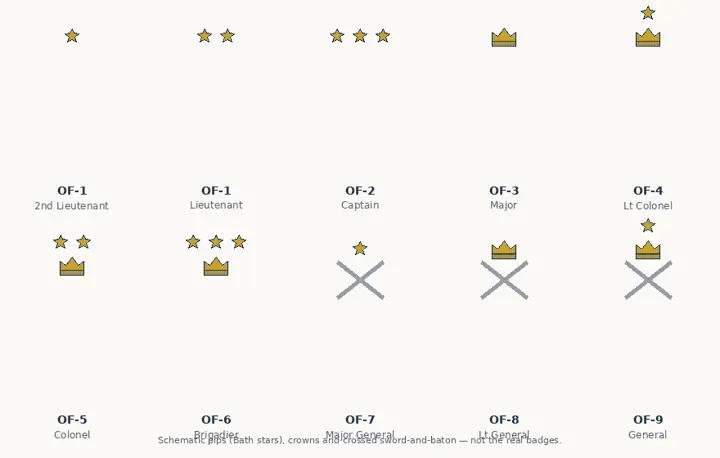
| Second Lieutenant / Lieutenant (2Lt / Lt) | OF-1 | One / two pips | Junior officer; troop commander |
| Captain (Capt) | OF-2 | Three pips | Commands a troop |
| Major (Maj) | OF-3 | One crown | Second-in-command or squadron commander |
| Lieutenant Colonel (Lt Col) | OF-4 | Crown and one pip | Commanding Officer of 23 SAS |
| Colonel to General (Col–Gen) | OF-5–OF-9 | Crowns, pips, crossed sword and baton | Senior staff appointments above the regiment |
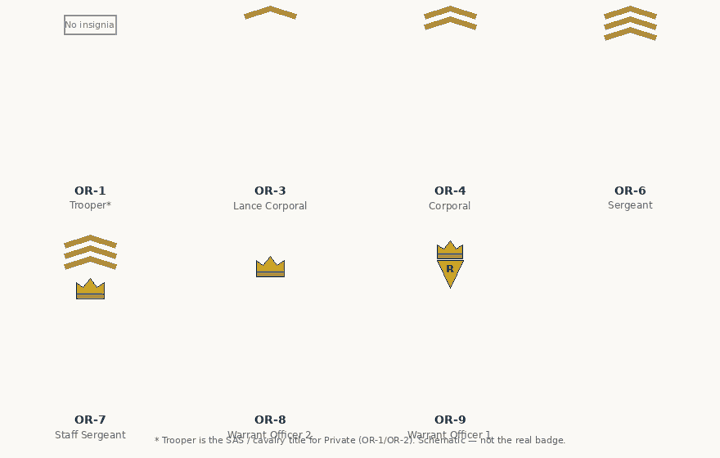
On the sleeve, British chevrons point downward — one, two or three for Lance Corporal, Corporal and Sergeant — and there is no grade at OR-1 or OR-5, so the ladder jumps from Lance Corporal to Corporal and from Corporal to Sergeant. Squadron Sergeant Major and Regimental Sergeant Major are appointments, not ranks: a soldier holds the rank of WO2 or WO1 while doing the job.
Key point: call a 23 SAS private soldier a Trooper, not a Private. The title is shared with cavalry regiments, and in the SAS it marks a soldier who has passed selection — a regimental title for the OR-2 grade, not a separate rank.
Full rank table: the full table of British Army ranks, grade by grade from Trooper to General, is in our guide to SAS ranks.
Selection: How a Reservist Earns the Beret
Selection is where the reserve regiment differs most sharply from a regular unit. A soldier cannot simply be posted to 23 SAS. They must volunteer, pass a briefing course, and then pass a selection course designed to test endurance, navigation, self-reliance and clear thinking while exhausted.
According to the published recruitment information, applicants must be aged 17 years 9 months to 47 years 6 months and must already be phase-two trained in another reserve or regular unit — that is, they must have finished basic and trade training elsewhere first. They must pass a United Kingdom Special Forces briefing course, then are mobilised for a six-month, full-time selection course, which runs twice a year. Applications are accepted from men and women, across all three services.
That six-month, full-time course differs from the older picture of reserve selection spread out in blocks to fit around civilian careers; published sources describe both models at different times, and this guide follows the current published route. The course follows the regular SAS pattern: long marches over the Brecon Beacons carrying heavy loads, map-reading and navigation alone, and tests that get harder as candidates get more tired. The exact distances, weights and timings are not officially published, and this guide does not invent them. Only a small minority finish, and an inquest into the deaths of three reservists during a test march in the Brecon Beacons in July 2013 heard that six months of preparation is needed before attempting it.
The Beret, the Cap Badge and Qualification Badges
The most recognisable thing about any SAS soldier is the sand-coloured beret. It dates back to the desert origins of the SAS in North Africa in the Second World War, and it is the first thing a new soldier earns the right to wear after passing selection. On the beret sits the SAS cap badge: a downward-pointing sword, often described as a winged dagger, with the motto “Who Dares Wins” beneath it. The sword is properly described as Excalibur, wreathed in flames.
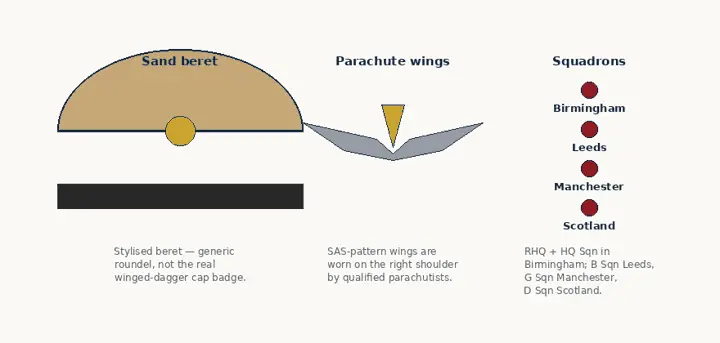
Rank shows a soldier’s grade; a badge shows what they are qualified to do. The best-known SAS qualification badge is the SAS-pattern parachute wings, worn on the right shoulder by soldiers qualified in military parachuting. Other badges depend on a soldier’s qualifications, but the Army does not publish a list of which badges 23 SAS soldiers hold, and this guide does not invent one.
Did you know? The reserve SAS once took civilians with no military experience at all — a door the regular SAS has never opened. The current published route asks for phase-two training first, so the open door of the past and the rules of today are not the same thing.
Reserve Life and 21 SAS
Life in 23 SAS is a double life: a reservist might spend the week as a teacher, builder, nurse or software engineer, and the weekend on a training area in Wales with soldiers from Leeds, Manchester, Scotland and Birmingham.
How does 23 SAS differ from 21 SAS, the other reserve regiment? Less than readers expect. Both use the same British Army ranks, beret, cap badge and motto, and both returned to United Kingdom Special Forces after the same period under the intelligence brigade. The differences are geography and history: 21 SAS is based in London and traces its lineage to the Artists Rifles, raised in 1860, while 23 SAS is based in Birmingham and traces its lineage to MI9 and the Reserve Reconnaissance Unit. For the rank system both share, see our British military ranks guide, and for how other countries organise their forces, see our US military branches guide. One limit must be stated plainly: the regiment’s current strength, selection details, equipment and operations are not published, and the Ministry of Defence does not comment on them.
Read next
British Military Ranks · US Navy Ranks · US Military Branches
FAQs
Does 23 SAS have its own ranks?
No. It uses British Army ranks, from Trooper (OR-2) to Warrant Officer Class 1 (OR-9), and from Second Lieutenant (OF-1) to General (OF-9). The only regimental difference is the title Trooper, used instead of Private.
What rank is a Trooper in 23 SAS?
Trooper is the SAS title for the OR-2 grade, the equivalent of Private in most of the Army. A Trooper wears no rank insignia.
Can a civilian join 23 SAS?
Historically, yes — the reserve SAS accepted people with no previous military service. The current published route requires phase-two training in another reserve or regular unit first, plus a UKSF briefing course and a six-month, full-time selection course. Applicants must be aged 17 years 9 months to 47 years 6 months.
Where is 23 SAS based?
Its headquarters is at MOD Kingstanding, Birmingham. Its squadrons are HQ Squadron in Birmingham, B Squadron in Leeds, D Squadron in Scotland, and G Squadron in Manchester.
What beret does 23 SAS wear?
The sand-coloured (beige) beret, with the SAS cap badge and the motto “Who Dares Wins”. It dates back to the SAS’s desert origins in North Africa in the Second World War.
How long is 23 SAS selection?
Successful applicants are mobilised for a six-month, full-time selection course, which runs twice a year. Its exact distances, weights and timings are not officially published.
Is 23 SAS part of UK Special Forces?
Yes, today. Both reserve regiments left United Kingdom Special Forces in September 2014, but returned before the end of 2019 and are now back under the Director Special Forces.
All insignia diagrams and images in this article are original graphics created for Forces Guide. The beret and badge diagrams are stylised representations, not copies of the real SAS cap badge.