21 SAS ranks are British Army ranks — but the regiment that holds them is unlike any other in the Army. 21 Special Air Service Regiment (Artists) (Reserve) is a London reserve regiment of part-time soldiers, heir to the Artists Rifles of 1859, whose members hold civilian jobs and train in their spare time to the same standard as the regular SAS. This guide is about that regiment: its history, its squadrons, its selection course and its reserve way of life, with a short summary of the ranks its soldiers wear, from Trooper to General.
21 SAS is the London-based reserve regiment of the SAS, heir to the Artists Rifles, a volunteer unit raised in 1859. With 23 SAS (Reserve) it is the reserve half of the Special Air Service under United Kingdom Special Forces (UKSF), training in spare time and deploying to the same standards as the regular SAS.
Key facts
- Country: United Kingdom
- Branch: British Army Reserve (part of United Kingdom Special Forces)
- Full title: 21 Special Air Service Regiment (Artists) (Reserve) — 21 SAS(R)
- Other ranks: OR-1 to OR-9 (Trooper to Warrant Officer Class 1)
- Officers: OF-1 to OF-9 (Second Lieutenant to General); Field Marshal (OF-10) is honorary
- Headquarters: Regent’s Park Barracks, London
- Founded: 1859 as the Artists Rifles; became 21 SAS in 1947
- Squadrons: Capability, A, C and E — London, Basingstoke, Cambridge, Hitchin, Newport and Exeter
- Motto: Who Dares Wins
What Is 21 SAS?
21 SAS is a reserve special forces regiment of the British Army. Its soldiers are reservists — men and women with civilian jobs who train in the evenings, at weekends and on annual courses — yet the regiment sits inside UKSF alongside the regular 22 SAS, the Special Boat Service and the other special forces units.
From Artists Rifles to 21 SAS: A Short History
In 1859, art student Edward Sterling organised a corps of painters, musicians, actors and architects in London amid fears of a French invasion. On 28 February 1860 it became the 38th Middlesex (Artists’) Rifle Volunteer Corps, based at Burlington House, first commanded by the painters Henry Wyndham Phillips and Frederic Leighton. Its badge, by J. W. Wyon, showed the Roman gods Mars and Minerva in profile — a design still honoured today.
The Artists Rifles fought in the Second Boer War, and in the First World War became famous as an officer-producing unit: over 15,000 men passed through it, more than 10,000 becoming officers elsewhere — the poet Wilfred Owen trained with its Officers Training Corps. The battalion fought in France in 1917 and 1918, and 2,003 of its men were killed.
In the Second World War it again served as an officer training unit and was disbanded in 1945. Two years later it was reborn as the 21st Special Air Service Regiment (Artists Rifles), resurrecting the SAS name; the “21” honours two wartime regiments, 1 SAS and 2 SAS, the digits reversed.
The new regiment served in the Malayan Emergency, and in 1952 its men formed 22 SAS, the regular special forces regiment — the only time a Territorial Army unit has formed a Regular Army unit. Through the Cold War, 21 SAS prepared stay-behind parties to operate behind Warsaw Pact lines. In 2003 a composite squadron of about 60 soldiers from 21 and 23 SAS deployed to Afghanistan, and in 2008 three 21 SAS soldiers won Military Crosses in Nad-e Ali, Helmand Province.
Did you know? SAS founder David Stirling said in 1985 that the reserve regiments mattered because their part-time soldiers, “drawn as they are from every walk of civilian life”, kept bringing fresh ideas to the special forces.
In September 2014, 21 and 23 SAS were moved out of UKSF to 1st Intelligence, Surveillance and Reconnaissance Brigade, tasked with Human Environment Reconnaissance and Analysis patrols. They left before the end of 2019 and are now back under the Director Special Forces in UKSF. The detail of their present-day role is not published.
Where 21 SAS Is Based
Regimental headquarters and two squadrons sit at Regent’s Park Barracks in London; the squadrons are spread across southern England and Wales:
- Capability Squadron — Regent’s Park, London
- A Squadron — Regent’s Park, London
- C Squadron — Basingstoke, Cambridge and Hitchin
- E Squadron — Newport and Exeter
Reservists train at the nearest squadron, travelling to London and the Brecon Beacons for longer courses.
The Reserve Soldier: Part-Time Service, Full-Time Standards
A 21 SAS soldier is a part-time soldier held to a full-time standard. Most members have civilian careers and fit training — weekday evenings, weekends and longer courses — around them, and are paid for the days they serve.
Promotion comes more slowly than in the Regular Army, because a reservist serves fewer days a year, and every step depends on the same courses and assessments. In return, a reservist serves in special forces without giving up a civilian career, bringing civilian skills — languages, medicine, engineering, technology — into a unit that values them.
21 SAS Ranks at a Glance
There is no separate rank ladder for 21 SAS: its soldiers wear British Army ranks, the same ones used across the Army. The short lists below give the main grades and the badge each one wears. For the full role-by-role breakdown of every grade, see our main guide to SAS ranks, insignia and badges.
Full SAS rank tables
For every grade with its role in the regiment, read the main guide: SAS Ranks: Complete Guide to Ranks, Insignia and Badges (2026)
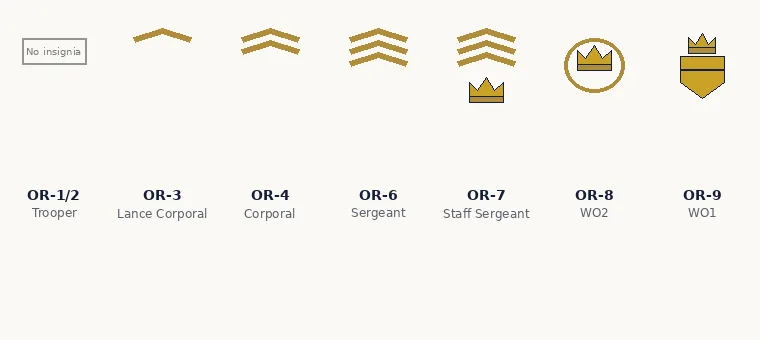
Other ranks (OR-1 to OR-9) — the soldiers, from Trooper to Warrant Officer Class 1:
| Rank | NATO | Insignia |
|---|---|---|
| Trooper (Tpr) | OR-1/OR-2 | No insignia |
| Lance Corporal (LCpl) | OR-3 | One chevron |
| Corporal (Cpl) | OR-4 | Two chevrons |
| Sergeant (Sgt) | OR-6 | Three chevrons |
| Staff Sergeant (SSgt) | OR-7 | Three chevrons beneath a crown |
| Warrant Officer Class 2 (WO2) | OR-8 | Crown within a wreath |
| Warrant Officer Class 1 (WO1) | OR-9 | Royal coat of arms |
Key point: the lowest rank in 21 SAS is not called Private. Like regiments with a cavalry tradition, the SAS calls its private soldiers Troopers — members of a four-man patrol rather than an infantry section. A new soldier who has passed selection is a Trooper, and wears no rank insignia at all.
Officers (OF-1 to OF-9) — from Second Lieutenant to General:
| Rank | NATO | Insignia |
|---|---|---|
| Second Lieutenant (2Lt) | OF-1 | One pip |
| Lieutenant (Lt) | OF-1 | Two pips |
| Captain (Capt) | OF-2 | Three pips |
| Major (Maj) | OF-3 | Crown |
| Lieutenant Colonel (Lt Col) | OF-4 | Crown and one pip |
| Colonel (Col) | OF-5 | Crown and two pips |
| Brigadier (Brig) | OF-6 | Crown and three pips |
| Major General (Maj Gen) | OF-7 | Pip over crossed sword and baton |
| Lieutenant General (Lt Gen) | OF-8 | Crown over crossed sword and baton |
| General (Gen) | OF-9 | Crown and pip over crossed sword and baton |
Reading the badges takes a moment to learn. Other ranks are read from chevrons on the sleeve — one, two or three, with a crown added for Staff Sergeant and the Royal coat of arms for the most senior warrant officer — while officers are read from pips and crowns on the shoulder, with a crossed sword and baton marking the generals. Field Marshal (OF-10) is an honorary rank above them all. Note that there is no OR-5 grade in the standard Army structure, and that on operations SAS soldiers wear no badges of rank at all.
Beret, Badges and Wings: What a 21 SAS Reservist Wears
Rank insignia shows a soldier’s grade. The beret and badges show what regiment they belong to and what they are qualified to do.
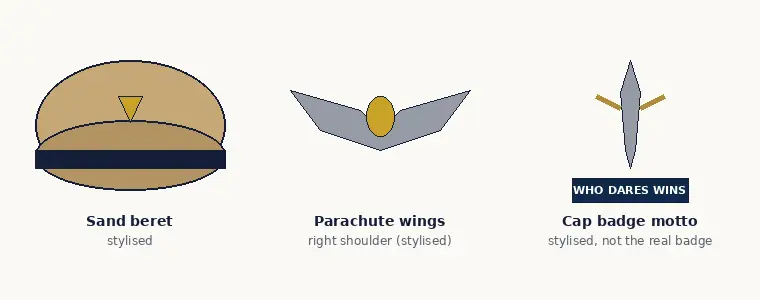
The sand-coloured beret is the everyday headdress of the SAS, and earning it is the visible mark of passing selection — its colour recalling the North African desert, where the wartime SAS was born in 1941.
The cap badge is one of the most famous emblems in the world — and one of the most misunderstood. It is not, strictly speaking, a winged dagger: it shows a downward-pointing Excalibur, wreathed in flames, worked into a Crusader shield, with the motto Who Dares Wins beneath it.
The SAS parachute wings are worn on the right shoulder and kept for life — even by officers who return to their parent regiments after an SAS tour. They were drawn up in 1941 by Jock Lewes, a founding officer, who took the ibis-wing motif from Egyptian decoration he had seen in Cairo.
Did you know? The Artists Rifles’ own badge — the heads of Mars and Minerva — survives in ceremonial dress, worn by the Commanding Officer on the pouch belt of No 1 dress.
Ceremonial No 1 dress carries a light-blue stripe down the trouser leg, and the stable belt is matching pompadour blue — the regiment’s colour.
Joining 21 SAS: Selection for Reservists
Selection is the heart of the regiment. To apply, a soldier must already be phase-two trained in another reserve or regular unit — basic and trade training complete. Applicants with no military experience are first sponsored to a local Army Reserve unit for basic training. Applications are open to men and women, from all three services.
The first step is the UKSF briefing course. Those who pass are mobilised to take selection itself — a six-month, full-time course that runs twice a year — followed by mission-specific training.
That full-time course is the current model, replacing an older part-time route spread over weekends and training weeks in the Brecon Beacons — the same standard, spread differently for reservists.
Those who pass are badged as SAS (Reserve) and enter probation, completing a Basic Parachute Course and a Communications Course. Only then do they earn the sand beret, cap badge and parachute wings. The regiment does not publish pass rates.
How Promotion Works for a Reservist
Promotion follows the British Army system, but at a reservist’s pace: a Trooper becomes a Lance Corporal through courses and field leadership, Corporal and Sergeant follow with experience and time in rank, and warrant officer appointments go to the most experienced soldiers.
A reservist serves far fewer days a year than a regular soldier, so each promotion takes longer in calendar terms, though the standard never bends. For officers, the usual path is a three-year tour as a troop commander, most often as a Captain, after which they return to their parent regiment — keeping their SAS parachute wings.
The Army publishes no fixed timetable for 21 SAS promotion: it is earned through courses, assessed performance and time in rank, and moves more slowly than in the Regular Army because the service is part-time.
What 21 SAS Does Today
21 SAS is a special operations regiment, and the limit of the public record must be stated plainly: the Ministry of Defence does not comment on SAS operations, and its current tasking is not published.
The regiment sits inside United Kingdom Special Forces, under the Director Special Forces, alongside 22 SAS and 23 SAS, organised for reconnaissance and special operations. In 2014 it was tasked with Human Environment Reconnaissance and Analysis patrols under 1st Intelligence, Surveillance and Reconnaissance Brigade; it has since returned to UKSF command. Its ranks, from Trooper to Commanding Officer, are held by reservists who passed the same selection as the regular SAS and who deploy when called upon.
Read next
SAS Ranks · British Military Ranks · US Navy Ranks · US Military Branches
FAQs
Where is 21 SAS based?
Regimental headquarters is at Regent’s Park Barracks in London, along with Capability Squadron and A Squadron. C Squadron is in Basingstoke, Cambridge and Hitchin, and E Squadron is in Newport and Exeter.
Can someone with no military experience join 21 SAS?
Yes, but not directly. Applicants with no military experience are sponsored to a local Army Reserve unit to complete basic training first, and must be phase-two trained and pass the UKSF briefing course before attempting selection.
How is 21 SAS selection different from regular SAS selection?
The standard is the same; the shape is different. The current 21 SAS course is six months long, full-time, running twice a year, and successful applicants are mobilised to take it. An older route spread the same standard over weekends and training weeks. Those who pass are badged as SAS (Reserve) and complete parachute and communications courses in probation.
What did the Artists Rifles do in the First World War?
They became famous as an officer-producing unit: over 15,000 men passed through the regiment, and more than 10,000 of them went on to become officers in other regiments — the poet Wilfred Owen trained with its Officers Training Corps. The battalion itself fought in France in 1917 and 1918, and 2,003 of its men were killed.
Do 21 SAS soldiers keep their civilian jobs?
Yes. 21 SAS soldiers are part-time: they train on weekday evenings and weekends, are paid for the days they serve, and keep their civilian careers. They are mobilised — called up for full-time service — for operations and for long courses such as selection.
Why are 21 SAS soldiers called Troopers?
Trooper is the title the SAS gives its private soldiers, following regiments with a cavalry tradition. A Trooper is a member of a four-man patrol, holds the lowest rank in the regiment, and wears no rank insignia at all.
All insignia diagrams and images in this article are original graphics created for Forces Guide. Rank insignia drawings are stylised representations of the standard British Army patterns, not reproductions of official badges.