
The 22 SAS ranks system is simple to state and easy to misunderstand. The men of 22 Special Air Service wear British Army ranks — there is no separate SAS rank ladder and no hidden set of grades. What makes the regiment different is not the names on the ladder, but who climbs it: every Trooper has passed one of the hardest selection courses in the world, and every officer and sergeant in its Sabre squadrons leads soldiers who have done the same. This guide explains every 22 SAS rank, from Trooper to General, with its insignia, its job inside the regiment, and the badges that mark a soldier as SAS.
22 SAS is the regular regiment of the Special Air Service, based at Stirling Lines, Credenhill, near Hereford. It is the full-time core of the SAS, distinct from the two Army Reserve regiments, 21 SAS and 23 SAS. It sits inside United Kingdom Special Forces (UKSF), alongside the Special Boat Service, and its work covers special reconnaissance, direct action, hostage rescue and counter-terrorism. Much of what the regiment does is not publicly discussed by the British government, so where a detail is not publicly confirmed this article says so plainly.
Key facts
- Country: United Kingdom
- Branch: British Army — part of United Kingdom Special Forces (UKSF)
- Unit: 22 Special Air Service Regiment, the regular SAS regiment, based at Stirling Lines, Credenhill, Herefordshire
- Other ranks: OR-1 to OR-9 (Trooper to Warrant Officer Class 1)
- Officers: OF-1 to OF-9 (Second Lieutenant to General); the regiment itself is commanded by a Lieutenant Colonel
- Highest rank in the regiment: Lieutenant Colonel (Commanding Officer)
- Motto: “Who Dares Wins” — Nickname: “The Regiment”
What Is 22 SAS?
The Special Air Service was founded in 1941 by David Stirling as a small raiding force behind enemy lines in North Africa. Disbanded after the war, it was rebuilt — first as a Territorial Army regiment in 1947, then as a regular regiment. 22 SAS was formally added to the Army List in 1952 and has been based at Hereford since 1960, moving to the former RAF station at Credenhill in 1999, where its barracks are called Stirling Lines after the founder.
The regiment became world famous in 1980, when its counter-terrorist team stormed the Iranian Embassy in London live on television and freed the hostages inside. That operation — Operation Nimrod — turned a little-known regiment into the model special forces units around the world copied. Since then 22 SAS has served in Oman, Borneo, the Falklands, the Gulf War, Sierra Leone, Iraq and Afghanistan. Its exact strength is not officially published; public estimates put it at around 400 to 600 soldiers.
Within the SAS, 22 SAS is the only regular regiment. The other two regiments, 21 SAS (Artists) and 23 SAS, are Army Reserve units whose soldiers train part-time. This article covers the regular regiment only — not the reserve regiments, which have their own organisation and selection path.
The Four Sabre Squadrons
The fighting heart of 22 SAS is its four Sabre squadrons: A, B, D and G. “Sabre” marks them out from headquarters and support squadrons — these are the operational squadrons that deploy. Each has roughly 65 soldiers, is commanded by a Major, and is divided into four troops of about 16 men, each commanded by a Captain. Inside a troop, soldiers work in four-man patrols, each member carrying a specialist skill — signals, demolition, medicine or languages — on top of the basic skills every SAS soldier learns.
Each troop specialises in one environment, so a squadron can work almost anywhere:
- Boat Troop — maritime skills: diving, kayaks and rigid inflatable boats, often training with the Special Boat Service.
- Air Troop — freefall parachuting, including high-altitude HALO and HAHO jumps.
- Mobility Troop — vehicle-mounted operations and desert warfare, including field repair of vehicles.
- Mountain Troop — Arctic and mountain warfare, using skis, snowshoes and climbing skills.
The troops are numbered differently in each squadron: A Squadron has 1 (Boat), 2 (Air), 3 (Mobility) and 4 (Mountain); B Squadron has 6 to 9; D Squadron 16 to 19; and G Squadron 21 to 24, with the specialisms in a different order. The squadrons rotate through duties: one is held on counter-terrorism duty in the UK, a second is deployed, a third is preparing for deployment, and the fourth is on long-term overseas training such as jungle or desert exercises. In wartime two squadrons may deploy at once. Internal organisation beyond this outline is not publicly confirmed, and this article does not speculate about it.
Did you know? There is no C Squadron in 22 SAS. The Sabre squadrons are A, B, D and G — the letter C was left out as a matter of regimental tradition.
22 SAS Ranks at a Glance
Almost everyone at Stirling Lines is an other rank, and the ladder is the ordinary British Army one — the only regimental twist is that the lowest grade is called Trooper instead of Private. A soldier arrives as a Trooper after selection, whatever rank he held before, and climbs from there. Officers are few: a Captain commands each troop, a Major each Sabre squadron, and a Lieutenant Colonel the regiment itself.
| Rank | NATO Code | Insignia | Role in 22 SAS |
|---|---|---|---|
| Trooper (Tpr) | OR-1 / OR-2 | No insignia | Operator in a four-man patrol; the rank every soldier holds after passing selection |
| Lance Corporal (LCpl) | OR-3 | One downward chevron | Experienced operator; junior leader within a patrol or troop |
| Corporal (Cpl) | OR-4 | Two downward chevrons | Usually commands a four-man patrol on operations |
| Sergeant (Sgt) | OR-6 | Three downward chevrons | Senior patrol leader or troop sergeant |
| Staff Sergeant (SSgt) | OR-7 | Three chevrons below a crown | Senior NCO; squadron-level specialist or senior troop sergeant |
| Warrant Officer Class 2 (WO2) | OR-8 | Crown in a wreath | Squadron sergeant major or senior specialist appointment |
| Warrant Officer Class 1 (WO1) | OR-9 | Royal Arms | Regimental sergeant major — the most senior soldier in the regiment |
| Second Lieutenant / Lieutenant (2Lt / Lt) | OF-1 | One / two pips | Junior officer; troop second-in-command or staff role |
| Captain (Capt) | OF-2 | Three pips | Troop commander — commands one of the four troops in a Sabre squadron |
| Major (Maj) | OF-3 | One crown | Squadron commander — commands a Sabre squadron of about 65 soldiers |
| Lieutenant Colonel (Lt Col) | OF-4 | Crown above one pip | Commanding Officer of 22 SAS — the most senior rank inside the regiment |
| Colonel to General (Col–Gen) | OF-5–OF-9 | Crowns, pips, crossed sword and baton | Senior staff and UKSF command; no post inside the regiment itself |
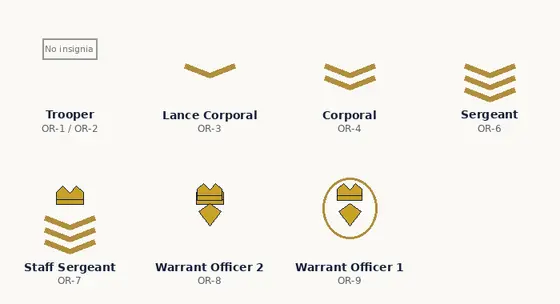
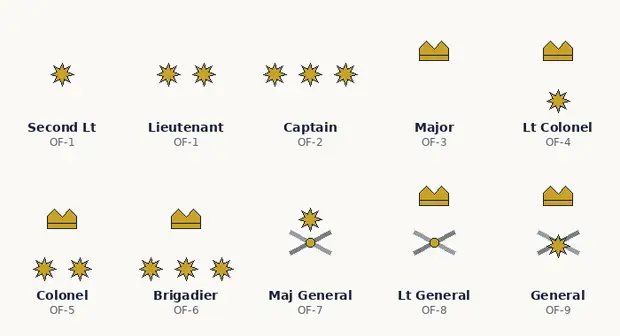
Two details catch newcomers out. There is no OR-5 in the British Army — the ladder jumps from Corporal straight to Sergeant. And British chevrons point downwards, the opposite of American ones, so a Trooper’s bare sleeve and a Sergeant’s three downward chevrons are read at a glance once you know the direction. In the field, rank is often deliberately hard to read — which suits a regiment that values what a soldier can do over what he wears.
Full rank table: for the complete grade-by-grade table — every British Army rank from Trooper to General, with its insignia and role — see our guide to SAS ranks.
Key point: the rank on the shoulder does not tell you who is in charge of a patrol. In 22 SAS a patrol of four is usually led by a Corporal or Sergeant, and a troop by a Captain — so the officer ranks above Major are almost never seen leading soldiers in the field. Command in the regiment is deliberately kept close to the ground.
The Trooper Rank and the Trooper-to-Officer Path
The rank of Trooper is the most distinctive feature of the 22 SAS rank system. A soldier who passes selection is badged as a Trooper whatever rank he previously held — a corporal from the Parachute Regiment and a private from the infantry both start again as Troopers. Inside the regiment, selection matters more than the rank you arrived with.
From Trooper, the path upward follows the normal British Army ladder — Lance Corporal, Corporal, Sergeant, Staff Sergeant, Warrant Officer — but the jobs are SAS jobs. A Corporal may command a four-man patrol deep behind enemy lines; a Sergeant may be a troop sergeant running 16 operators; a WO1 is the regimental sergeant major, the commanding officer’s closest adviser on the soldiers. Senior NCOs in 22 SAS carry unusual authority, because they have usually spent far longer in the regiment than the officers above them.
Officers reach the regiment by a different route. They are already commissioned, and they must pass the same selection course as the soldiers, plus an extra week assessing their ability to plan operations while exhausted and under stress. An officer’s time in the regiment is typically a tour of a few years, after which many return to their parent regiment — which is why the regiment’s long memory lives mostly in its warrant officers and senior NCOs. A Trooper can in principle rise through the ranks and later take a commission, but that path is the exception, not the rule.
Selection: Earning the Beige Beret
No rank in 22 SAS means anything without selection. The course was created by John Woodhouse in 1952. The UK Special Forces do not recruit directly from the public: candidates must already be serving members of the UK Armed Forces, most historically from the Parachute Regiment or the Royal Marines. Selection is held twice a year, and typically only about 10 per cent of candidates get through the first phase. From around 200 starters, fewer than 30 usually remain at the end.
The first phase, aptitude, lasts four weeks in the Brecon Beacons in Wales. It opens with fitness tests, then builds into long marches over the hills carrying heavy loads. It ends with the Endurance: a 40-mile march with full equipment, finishing with a climb up and down Pen y Fan (886 metres), all inside 20 hours. Survivors go on to jungle training in Belize, Brunei or Malaysia, then return for battle training, foreign weapons and escape and evasion exercises. The final test is resistance to interrogation, lasting 36 hours.
Only then does a soldier receive the sand-coloured beret and join an operational squadron — still on probation, completing parachute training and further courses before he is fully deployable. Since October 2018, women have been eligible to apply on the same terms as men. Between 2014 and 2022 more deaths occurred in training and exercises than in combat — a stark measure of how seriously the regiment takes its own standards.
Beret, Cap Badge and Qualification Badges
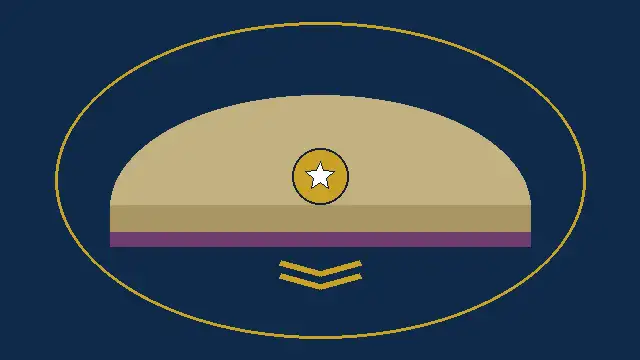
Rank insignia shows a soldier’s grade. The badges of the SAS show what he has earned. The most visible is the sand-coloured beret, often called the beige beret, dating from the regiment’s desert origins in North Africa. It replaced the maroon beret of the airborne forces after the war. Our guide to military beret colours explains how it compares with other units’ berets.
The cap badge is usually described as a winged dagger, but that is not quite what it shows. It is meant to depict a downward-pointing Excalibur, wreathed in flames, on a Crusader shield with the motto “Who Dares Wins”. The winged-dagger reading is so widespread that it is now universally accepted, but the flaming sword is the original design. This article’s images are stylised graphics only — they do not reproduce the real cap badge.
The other great badge is the SAS parachute wings, worn on the right shoulder. They were designed by Lieutenant Jock Lewes, one of the regiment’s founders, and are based on the stylised wings of the sacred ibis of the Egyptian goddess Isis, as seen in the decor of Shepheard’s Hotel in Cairo. They differ from the parachute wings worn by the rest of the Army, and are awarded only after SAS parachute training. On ceremonial No 1 dress, the regiment also wears a light-blue stripe down the trousers and a stable belt in pompadour blue, the regimental colour.
Did you know? The motto “Who Dares Wins” sums up David Stirling’s original idea: a small force that dares to strike where the enemy does not expect it can achieve what a much larger force cannot. The phrase has been copied by special forces units around the world.
Ranks Inside a Sabre Squadron
Put the tables together and a Sabre squadron looks like this. A Major commands it, with a WO2 as squadron sergeant major. Under them sit four troops, each led by a Captain with a Sergeant as troop sergeant, dividing into patrols of four men usually led by a Corporal or Sergeant. Above the four squadrons sits regimental headquarters, commanded by the Lieutenant Colonel with the WO1 as regimental sergeant major.
This shape explains why so few officers are needed: a squadron of about 65 soldiers is run by one Major and four Captains, with day-to-day leadership in the hands of sergeants and corporals. It also explains why promotion is so competitive — there are very few senior posts, and each is filled by a soldier who has already proved himself on selection and on operations.
One squadron at a time also takes on the counter-terrorism role, through the regiment’s Counter Terrorist Wing — previously the Counter Revolutionary Warfare (CRW) Wing. The squadron on this duty trains constantly in close-quarter battle, hostage rescue and sniper work at the Killing House at Pontrilas, a specialist building that includes part of a Boeing 747 which can be rearranged to match the inside of almost any commercial aircraft. Two troops stay at immediate notice near Hereford, ready to move. Squadrons refresh this training roughly every 16 months.
What 22 SAS Does Not Have
It is worth ending with what this guide deliberately leaves out. 22 SAS has no separate rank system, no unit-specific officer grades and no published table of its own appointments — no publicly confirmed strength figure, no order of battle beyond the four Sabre squadrons, and no official account of its current operations. The British government does not comment on special forces matters. That secrecy is part of the point: the ranks are ordinary British Army ranks, worn by extraordinary soldiers, and the badges that matter most — the beige beret, the flaming sword and the parachute wings — are earned in selection and on operations, not granted with a grade. If another source offers a 22 SAS rank chart with ranks you cannot find in the British Army, treat it with suspicion.
Read next
British Military Ranks · US Navy Ranks · US Military Branches
FAQs
Does 22 SAS have its own rank system?
No. 22 SAS uses standard British Army ranks — Trooper to Warrant Officer Class 1 (OR-1 to OR-9) and Second Lieutenant to General (OF-1 to OF-9). The only regimental difference is the title Trooper, used instead of Private.
What rank is a Trooper in 22 SAS?
Trooper is the lowest rank in the regiment, at NATO codes OR-1 / OR-2, and it wears no insignia. Every soldier who passes SAS selection is badged as a Trooper, whatever rank he held before, and promotion then follows the normal Army ladder.
Who commands 22 SAS?
A Lieutenant Colonel, its Commanding Officer, supported by a Warrant Officer Class 1 as regimental sergeant major. Above the regiment, the Director Special Forces — a Major General — commands all of United Kingdom Special Forces.
What are the four Sabre squadrons of 22 SAS?
A, B, D and G Squadrons. Each has about 65 soldiers, is commanded by a Major, and contains four troops — Boat, Air, Mobility and Mountain — each commanded by a Captain. They rotate through counter-terrorism duty, deployment, preparation and long-term training.
What colour beret does 22 SAS wear?
A sand-coloured beret, often called the beige beret, dating from the regiment’s desert origins in North Africa. Its cap badge shows a downward-pointing Excalibur wreathed in flames — usually described as a winged dagger — with the motto “Who Dares Wins”.
What is the pass rate for 22 SAS selection?
Around 10 per cent of candidates pass the first phase. Selection is held twice a year, starting with about 200 candidates. It includes four weeks in the Brecon Beacons, a 40-mile Endurance march over Pen y Fan, jungle training, escape and evasion, and 36 hours of resistance to interrogation.
All insignia diagrams and images in this article are original graphics created for Forces Guide. Squadron organisation and strength figures are as publicly reported; details of current operations are not publicly disclosed.