
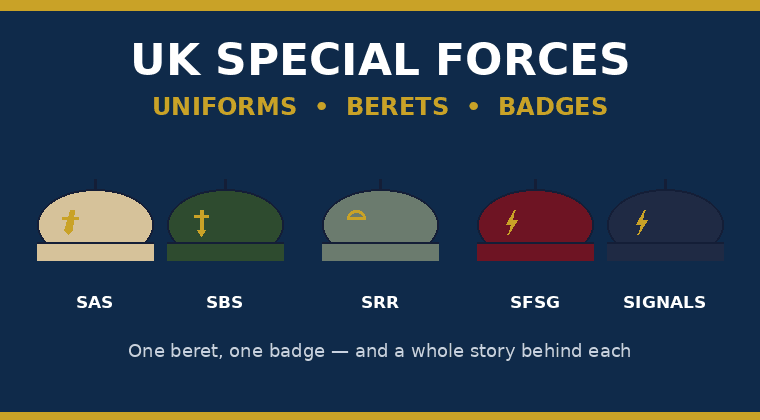
Ask a soldier to describe a British special forces operator and the answer will usually start with a beret. The sand-coloured beret of the SAS, the green beret of the Special Boat Service, the emerald grey beret of the Special Reconnaissance Regiment — each one is a uniform in miniature, a whole history worn on the head. Yet the beret is only the beginning. Underneath it, every United Kingdom Special Forces (UKSF) unit wears the uniform of its parent service, and the small badges and flashes that sit on it tell you exactly which unit the wearer belongs to.
This guide explains the uniforms of every UKSF unit — 22 SAS, 21 and 23 SAS, the SBS and SBS Reserve, the SRR, the SFSG, 18 (UKSF) Signal Regiment and the Joint Special Forces Aviation Wing — and every uniform type they wear, from the MTP combat smock to mess dress. The pictures in this article are original stylised drawings, not photographs and not copies of real cap badges, which are protected regimental emblems.
Key facts
- Units covered: 22 SAS, 21 SAS, 23 SAS, SBS, SBS Reserve, SRR, SFSG, 18 (UKSF) Signal Regiment and JSFAW.
- The one rule: most UKSF personnel keep their parent unit’s uniform and add only a beret, a cap badge and a unit flash.
- Combat dress: the same Multi-Terrain Pattern (MTP) Personal Clothing System for almost everyone.
- Most famous beret: the sand-coloured beret of the SAS, worn since the desert campaign of 1942.
- Newest beret: the emerald grey beret of the SRR, formed in 2005.
- Most mixed unit: the SFSG, where maroon, green and RAF blue-grey berets serve side by side.
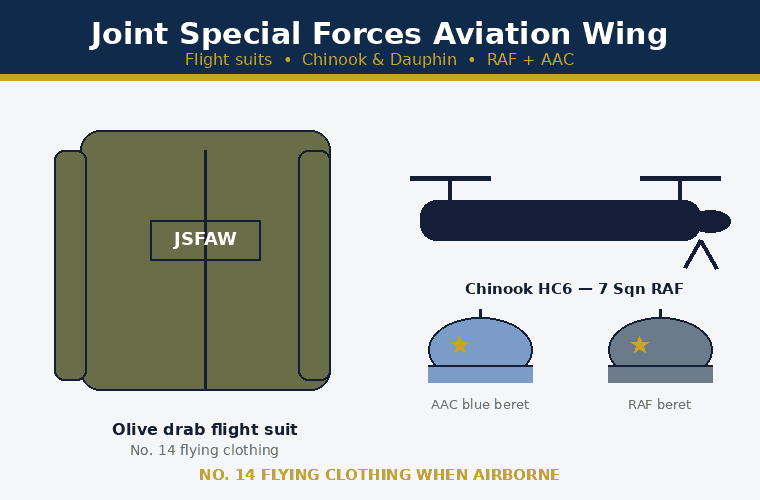
- Flying kit: JSFAW aircrew wear No. 14 flying clothing — an olive drab flight suit in temperate regions.
The one rule behind every UKSF uniform
There is no single “UKSF uniform”. The United Kingdom Special Forces is not a regiment of its own — it is a group of units drawn from the Army, the Royal Navy and the Royal Air Force, all under the Director Special Forces. Each unit keeps the dress of its parent service, and the special forces identity is added on top in a handful of places: the beret, the cap badge, a shoulder flash and a stable belt.
That is why two soldiers standing side by side in the same MTP combat dress can belong to completely different units. In the field, the difference is almost invisible — deliberately so. In barracks and on parade, the beret and the badge give it away at once. This guide works through the units one by one, and then through the uniform types themselves, so you can read any UKSF uniform from the head down.
Did you know? The SAS cap badge is not really a winged dagger. It was designed as Excalibur, the sword of legend, wreathed in flames on a Crusader shield — but the “winged dagger” reading is now so universal that it has effectively become the badge’s real name.
22 SAS — the sand beret and the windproof smock
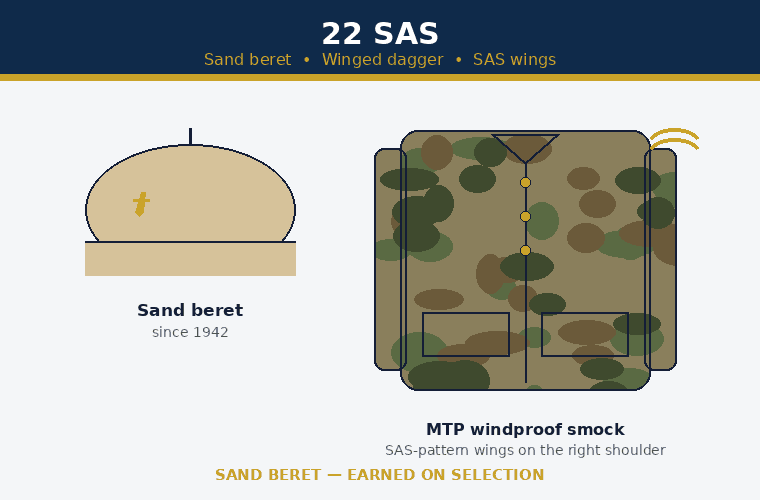
The uniform of 22 SAS is the most recognisable in the British Army, and it starts with the sand-coloured beret. It dates to the regiment’s desert origins in North Africa in the Second World War, when the first SAS patrols operated behind enemy lines in the sand. The regiment wore a maroon beret for a short period in the mid-1940s, when it served under airborne command, but the sand beret returned and has been the regiment’s mark ever since. On the beret sits the cap badge: the flaming sword Excalibur with the motto “Who Dares Wins”.
On the shoulder, SAS soldiers wear the SAS-pattern parachute wings — and on the right shoulder, not the left, where most British Army parachute wings are worn. The wings were designed by Lieutenant Jock Lewes in 1941, based on the stylised ibis wings of the Egyptian goddess Isis. In combat dress, the SAS wears the same MTP Personal Clothing System as the rest of the Army, but the regiment has its own history with the smock: the SAS was the first unit to adopt its own windproof smock in DPM camouflage, wearing it in preference to the standard combat jacket. The current windproof smock is in MTP, and the windproof remains the most famous single item of SAS field kit.
On formal occasions the SAS wears Army No. 1 dress — the dark blue ceremonial “blues” — with one regimental touch: a light blue stripe down the trouser leg. The commanding officer and the officer of the day wear a black leather pouch belt with a silver whistle chain and the Mars and Minerva badge of the Artists Rifles, a nod to the regiment’s reserve roots.
21 and 23 SAS (Reserve) — the same beret, part-time soldiers
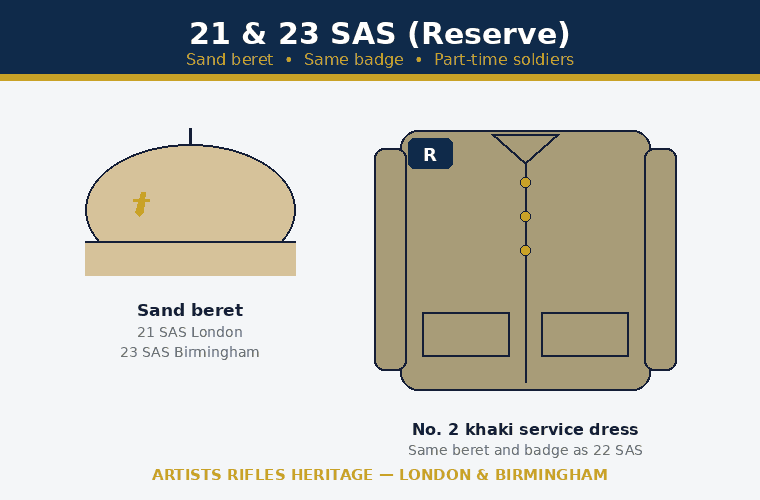
The two reserve regiments of the SAS wear exactly the same beret and cap badge as 22 SAS. There is no separate reserve beret. A soldier of 21 SAS, based in London, or 23 SAS, headquartered in Birmingham with squadrons in Leeds, Scotland and Manchester, earns the sand beret the same way a regular does — by passing selection — and wears it with the same Excalibur badge and the same SAS-pattern wings.
The difference is in heritage and in how the uniform is worn day to day. 21 SAS carries the lineage of the Artists Rifles, a volunteer regiment founded in 1859, and the Mars and Minerva badge of the Artists still appears on regimental dress — including the pouch belt worn by the commanding officer of 22 SAS. 23 SAS was formed in 1959 from the Reserve Reconnaissance Unit. Both regiments are part-time: their soldiers hold civilian jobs and train in their spare time, then wear the same combat dress, the same khaki No. 2 service dress and the same mess dress as their regular counterparts when they parade.
Special Boat Service — the green beret and Lovat dress
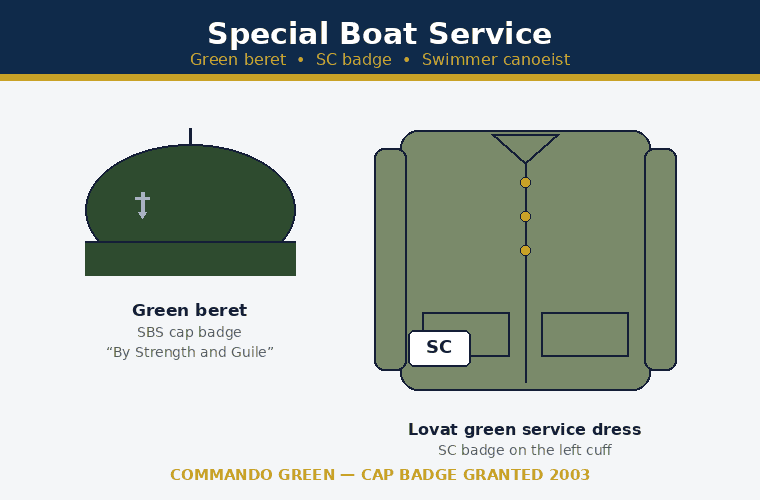
The SBS wears the commando green beret, the same beret worn by the Royal Marines Commandos, because most SBS operators come through the Commandos. What makes the beret SBS is the badge on it. The SBS cap badge was granted on 18 November 2003 — before that date, operators wore the cap badge of their parent unit. The badge shows a sword with two blue waved lines and the motto “By Strength and Guile”.
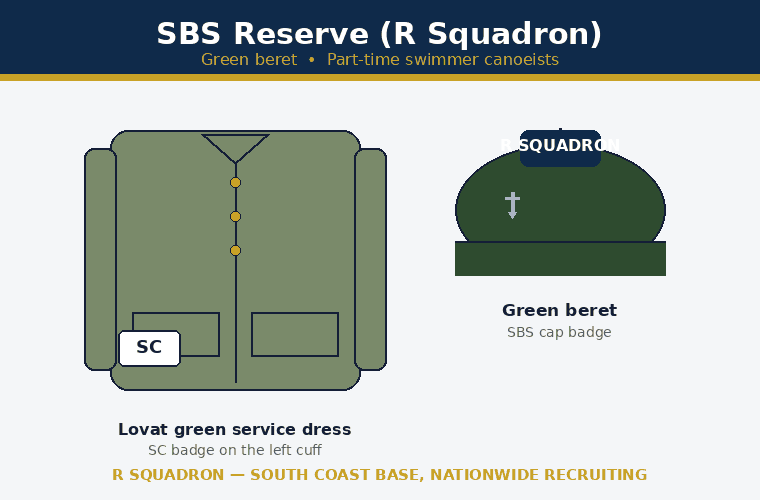
A qualified SBS operator is a swimmer canoeist, and that is marked by the “SC” badge — the letters SC over a wreath — worn on the left cuff of the dress uniform. The badge comes in three classes: SC3 on first qualifying, then the more advanced SC2 and SC1 as the operator gains experience. Officers do not wear the SC branch badge, but they do wear the SBS variant of the special forces parachute wings on the right sleeve after completing military parachuting training.
Off duty and on parade, SBS personnel wear Royal Marines dress. The most distinctive item is the Lovat green service dress — a sage-green tunic and trousers introduced in 1964, worn with the green beret and with medals. For the most formal occasions there is the dark blue No. 1A “Blues” parade dress, worn with the white Wolseley pith helmet or the red and white peaked cap, and the scarlet and blue mess dress: a scarlet jacket with a royal blue shawl collar and royal blue trousers with a scarlet stripe. In the field, like everyone else in UKSF, they wear MTP.
SBS Reserve — R Squadron
The SBS Reserve, known as R Squadron, wears the same uniform as the regular SBS: the green beret with the SBS cap badge, Lovat service dress and the SC badge for qualified swimmer canoeists. The reserve is based on the south coast and recruits nationwide, and every member must have previous military service — it is not open to civilians with no service behind them. Applicants must also be under 42 years and 6 months old at the Aptitude phase.
Because reservists train part-time and deploy to augment the regular squadrons, their uniform is deliberately identical to the regulars’. On an operation or an exercise, there is nothing in the dress to tell a reservist from a regular operator — and that is the point. The only formal difference is administrative: R Squadron is a reserve unit, and its members balance special forces training with civilian careers.
Special Reconnaissance Regiment — the emerald grey beret
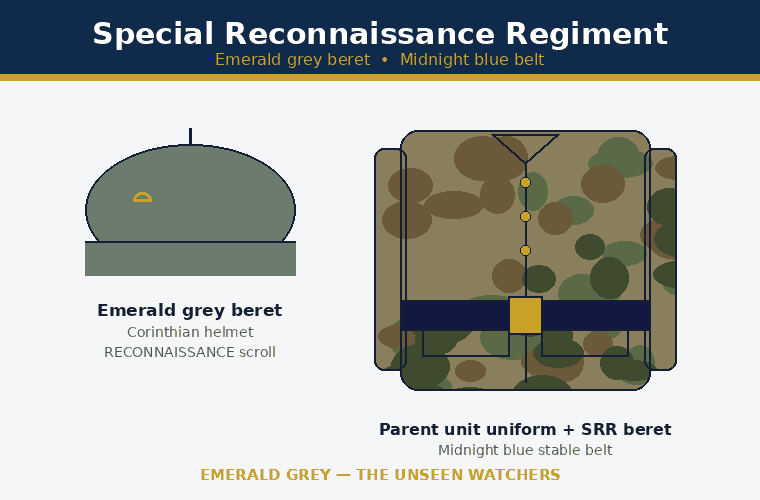
The SRR has the most quietly distinctive uniform in UKSF. Its personnel wear an emerald grey beret — a muted green-grey that sets them apart from the sand beret of the SAS and the green beret of the Royal Marines. The beret carries the SRR cap badge: the sword Excalibur behind a Corinthian helmet, with a scroll underneath inscribed “RECONNAISSANCE”. Like the SAS and SBS, the SRR carries Excalibur on its badge; the helmet and the scroll make the SRR’s version its own.
The regiment also has a stable belt in midnight blue, similar in style to the SAS stable belt but darker. Beyond the beret, the badge and the belt, SRR personnel simply keep the uniforms of their parent organisations. That fits the regiment’s work: formed on 6 April 2005 for covert surveillance and special reconnaissance, its operators usually work in plain clothes and wear uniform mainly in barracks or on formal parades. The uniform is a statement of identity, not a working outfit.
Key point: The SRR beret is sometimes described as Lovat green, but the official colour is emerald grey. One older published account says a beige beret was worn when the regiment formed — the emerald grey beret is the documented current dress.
Special Forces Support Group — three berets, one flash
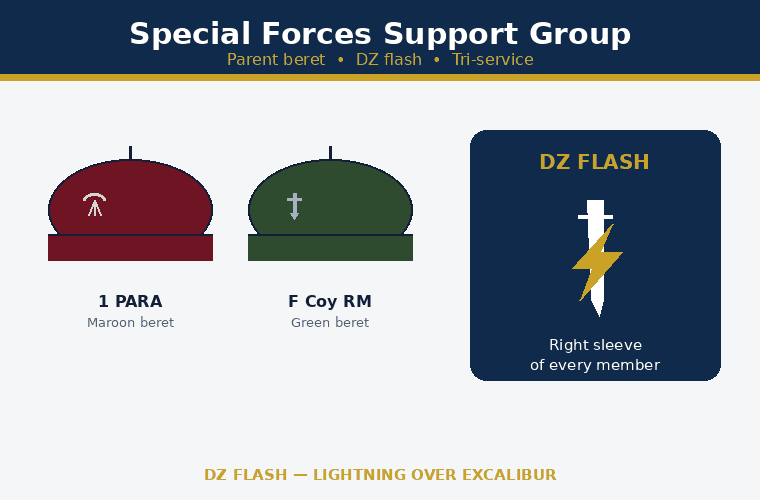
The SFSG is the most mixed unit in UKSF, and its uniform shows it. Formed on 3 April 2006 and based at MOD St Athan, it is a tri-service unit: the 1st Battalion, The Parachute Regiment (1 PARA), a company of Royal Marine Commandos (F Company), and a flight from the RAF Regiment. Each part keeps its own beret and cap badge — maroon for the Paras, green for the Marines, blue-grey for the RAF Regiment — so an SFSG parade shows three beret colours in a single formation.
What unites them is the DZ flash, worn on the right sleeve: a lightning bolt laid over a downward-pointing Excalibur. Every member of the SFSG wears it, whatever their parent unit. It is the single most recognisable SFSG uniform item, and the one thing a Para, a Marine and an RAF Regiment gunner in the group all have in common. In the field the group wears standard MTP combat dress, and its soldiers have sometimes worn American-pattern uniforms when operating alongside United States special operations units.
Note on the name: some online sources report that the unit was redesignated the “Special Forces Strike Group” in December 2025, keeping the initials SFSG. The British Army’s own website still calls it the Special Forces Support Group and no official announcement has been published, so this article uses the long-established name.
18 (UKSF) Signal Regiment — the Xiphos badge
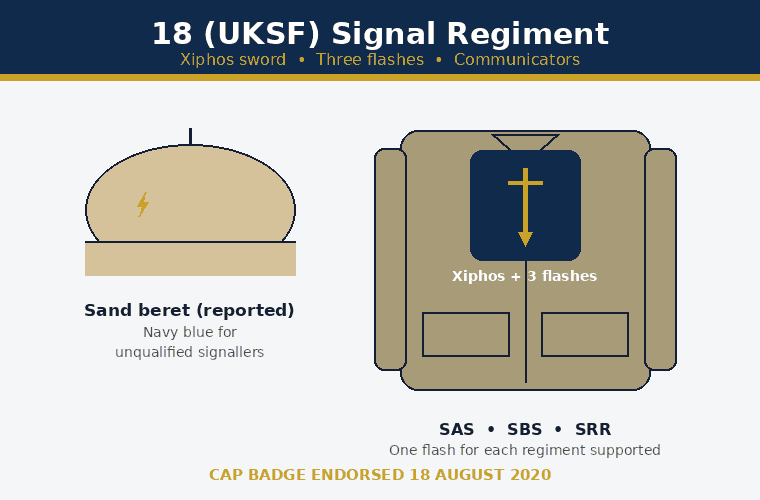
18 (UKSF) Signal Regiment is the communications arm of UKSF, formed on 5 April 2005, and its uniform marks out a qualified Special Forces Communicator from any other signaller. The regimental cap badge was endorsed on 18 August 2020: a Xiphos sword with three signal flashes, one for each of the three regiments the unit supports — the SAS, the SBS and the SRR. Signallers who have not qualified as communicators wear the Royal Corps of Signals’ own cap badge, the figure of Mercury known as “Jimmy”.
The beret is less certain than the badge. Older published accounts say that Army personnel who complete the Special Forces Communicator course are awarded the sand-coloured beret of the SAS, worn with their parent unit’s cap badge, while Royal Marine communicators in the SBS Signal Squadron keep the green commando beret. That matches the wider UKSF pattern, but the Ministry of Defence has not published a current statement confirming it, so treat the sand beret as reported rather than officially confirmed. Ordinary Royal Signals soldiers wear the navy blue beret.
Otherwise the regiment wears standard Army dress: MTP combat dress in the field, khaki No. 2 service dress on parade, and the usual qualification badges — most visibly the parachute wings earned on the UKSF parachuting course, plus Corps trade badges such as the Yeoman of Signals qualification for senior communications planners.
Joint Special Forces Aviation Wing — flight suits and two berets
JSFAW is the odd one out in UKSF: it is the only unit whose working uniform is a flight suit. Formed on 2 April 2001 and headquartered at RAF Odiham, the wing flies the helicopters that carry UKSF operators to and from their targets — No. 7 Squadron RAF with the Chinook HC6, and No. 658 Squadron of the Army Air Corps with the Dauphin II, based with 22 SAS at Stirling Lines. A third squadron, 657 Squadron AAC, flew the Lynx until it was disbanded in May 2018.
Because the wing is tri-service, its people wear three different uniforms. RAF aircrew wear RAF No. 1 service dress in blue-grey on the ground and No. 14 flying clothing in the air — an olive drab flight suit in temperate regions, or a khaki flight suit in the desert. Army Air Corps aircrew wear Army dress with the Cambridge blue beret the AAC has worn since 1957, and their own flying suits. The Special Forces Flight of No. 47 Squadron RAF, which flies the C-130 Hercules in support of UKSF, is listed as part of the wing by some sources and not by others — most published sources do not include it, so this article follows the majority.
The uniform types: combat, service dress, mess dress and ceremonial
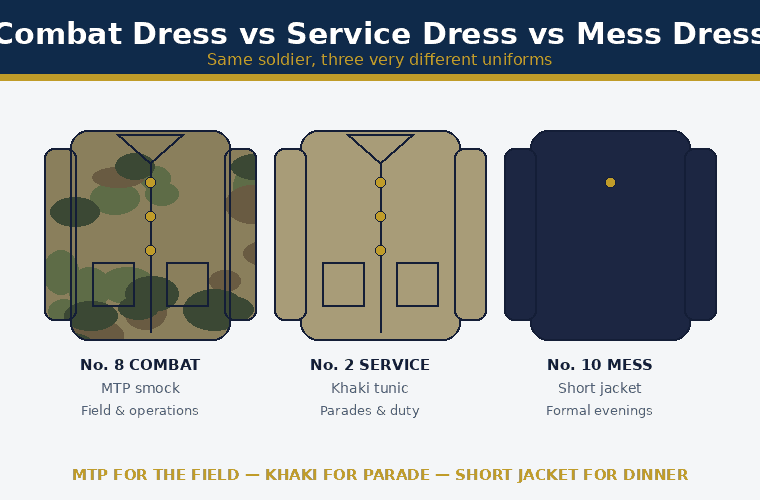
Whatever the unit, the uniforms themselves come from the same small set of orders of dress. The one every UKSF soldier wears most is No. 8 combat dress — the Personal Clothing System, Combat Uniform (PCS-CU), introduced in 2011. It is built around an MTP windproof smock, a lightweight jacket and trousers, with thermals and waterproofs as layers. Before 2011 the Army issued separate desert, temperate and tropical combat uniforms; the single MTP system replaced them all. The SAS windproof smock is the famous ancestor of the current issue smock.
For parades and formal duty, Army personnel wear No. 2 service dress — the khaki tunic and trousers that are the Army’s main parade uniform — while Royal Marines wear the Lovat green equivalent and RAF personnel wear blue-grey No. 1 service dress. For the most formal occasions there is No. 1 dress, the dark blue ceremonial “blues”, and for formal evenings there is No. 10 mess dress: a waist-length short jacket, normally worn by sergeants and above. Royal Marines have their own mess dress in scarlet and blue. Day-to-day barrack wear is No. 13 barrack dress, and in warm weather the shirt-sleeve order, No. 14.
Did you know? The SAS was the first unit in the British Army to adopt its own windproof smock, in DPM camouflage, wearing it in preference to the standard combat jacket. The idea spread until the windproof smock became the basis of the whole Army’s current combat uniform.
Every UKSF uniform at a glance
| Unit | Beret | Cap badge | Combat uniform | Dress uniform | Distinguishing feature |
|---|---|---|---|---|---|
| 22 SAS | Sand | Excalibur (“winged dagger”), “Who Dares Wins” | MTP windproof smock | No. 1 blues, light blue trouser stripe | SAS wings on the right shoulder |
| 21 & 23 SAS | Sand | Same as 22 SAS | MTP (PCS-CU) | No. 2 khaki service dress | Artists Rifles heritage (21 SAS) |
| SBS | Commando green | Sword and two blue waves, “By Strength and Guile” (2003) | MTP (PCS-CU) | Lovat green service dress | SC swimmer canoeist badge on the cuff |
| SBS Reserve | Commando green | Same as SBS | MTP (PCS-CU) | Lovat green service dress | R Squadron — identical to the regulars |
| SRR | Emerald grey | Excalibur behind a Corinthian helmet, “RECONNAISSANCE” | MTP (PCS-CU) | Parent unit dress | Midnight blue stable belt |
| SFSG | Maroon, green, RAF blue-grey | Parent unit badge | MTP (PCS-CU) | Parent unit dress | DZ flash — lightning over Excalibur |
| 18 (UKSF) Signals | Sand (reported) / navy blue | Xiphos sword and three flashes (2020) | MTP (PCS-CU) | No. 2 khaki service dress | Three flashes for SAS, SBS and SRR |
| JSFAW | Cambridge blue (AAC) / RAF blue-grey | Parent service badge | No. 14 flying clothing | RAF No. 1 / Army No. 2 | Olive drab flight suit |
How to spot each unit at a glance
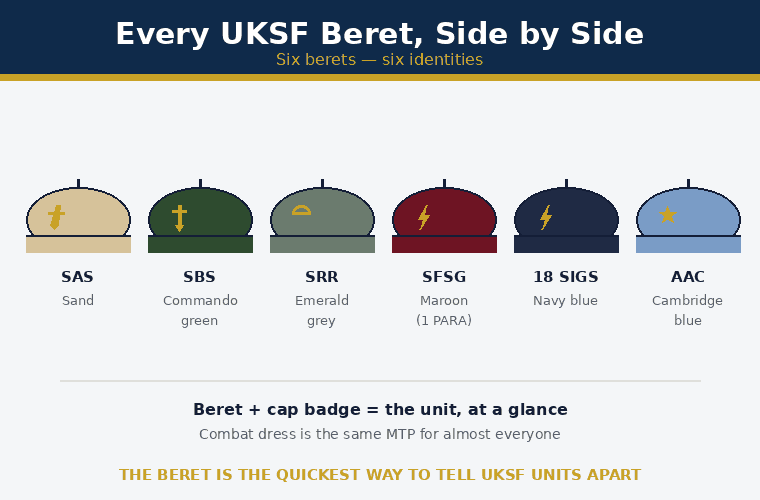
If you can see the beret, you can usually name the unit. Sand means SAS — regular or reserve. Commando green with a sword-and-waves badge means SBS. Emerald grey means SRR. Maroon in a UKSF context usually means 1 PARA in the SFSG, and the lightning-bolt DZ flash on the right sleeve confirms it. Navy blue means an unqualified signaller; Cambridge blue means Army Air Corps.
If the beret is covered — by a helmet, for instance — look at the shoulder. The SAS wings sit on the right shoulder. The SBS “SC” badge sits on the left cuff of the dress jacket. The SFSG DZ flash sits on the right sleeve. The 18 Signals cap badge, with its Xiphos sword and three flashes, is the only UKSF badge that names three regiments at once. And if the person is wearing a flight suit, they are almost certainly JSFAW: no other UKSF unit flies for a living.
Read next
Special Air Service Ranks & Insignia • Special Boat Service Ranks & Insignia • Special Reconnaissance Regiment Ranks • Special Forces Support Group Ranks • 18 UKSF Signals Ranks • Joint Special Forces Aviation Wing Ranks • Military Beret Colours Explained • Types of Military Uniforms Explained
Frequently asked questions
What colour beret does the SAS wear?
Sand-coloured, often called beige. It dates to the regiment’s desert origins in the Second World War and is worn with the Excalibur cap badge and the motto “Who Dares Wins”.
Do all UKSF units wear the same combat uniform?
Almost. Nearly every UKSF soldier wears the same MTP Personal Clothing System combat uniform in the field. The exception is JSFAW aircrew, who wear No. 14 flying clothing — a flight suit — when they fly.
Why does the SFSG wear three different berets?
Because it is a tri-service unit: 1 PARA wears the maroon beret, F Company Royal Marines wears the green beret, and the RAF Regiment flight wears the RAF blue-grey beret. The DZ flash on the right sleeve is what unites them.
What colour is the SRR beret?
Emerald grey — a muted green-grey. It is worn with the SRR cap badge, Excalibur behind a Corinthian helmet with a scroll reading “RECONNAISSANCE”, and a midnight blue stable belt.
What does the SBS “SC” badge mean?
It marks a qualified swimmer canoeist. Operators earn SC3 on first qualifying, then SC2 and SC1 as they gain experience. The badge is worn on the left cuff of the dress uniform; officers do not wear it.
Do UKSF soldiers wear their berets on operations?
Berets are barrack and parade headdress. On operations, helmets and caps are worn instead — the beret is the uniform of the barracks, the parade square and the mess, and earning it is what marks a soldier as a member of the unit.
All images in this article are original stylised illustrations drawn for Forces Guide. They are not photographs and not reproductions of real cap badges, which are protected regimental emblems. Beret colours, badges and uniform details were checked against Wikipedia and the regiments’ published histories; where the Ministry of Defence has not published a detail, the article says so.